


Most evidence systems don't fail in September. They fall apart in late October, right when report cards and conferences collide with the first round of "can you send me proof the intervention block is working?" emails. By then the weekly data walls are half-empty, the shared drive has four folders named some version of "Evidence FINAL," and the coach is personally screenshotting student work at 9pm because nobody uploaded anything.
The problem almost never comes down to teachers not caring. It comes down to a system that demands the same intensity every single week — no built-in pacing, no clear owner, no realistic plan for when things get busy. Evidence collection that depends on heroics collapses the moment people get tired. And people always get tired.
This is about the opposite approach: a tiered plan that spreads the load across the year, assigns the boring parts to whoever is best positioned to carry them, and automates the stuff that shouldn't require a human at all. The goal is evidence that survives flu season, testing windows, and the February slump.
Why most evidence systems quietly break
The usual failure isn't dramatic. It's slow erosion nobody flags until it's too late to fix cleanly.
A school decides to "collect evidence" for an initiative — a new curriculum, an MTSS rollout, a literacy push. Everyone agrees it matters. So the leader asks every teacher for a weekly artifact: a photo of student work, an exit ticket sample, a short reflection. For about three weeks it works. The folder fills up. People feel good.
Then the asks pile on. The same teachers are logging behavior, reconciling grades, writing IEP notes, and prepping for a walkthrough. The weekly artifact becomes the thing that slides, because it has the softest deadline and the least immediate consequence. Nobody's calling home because a teacher didn't upload a writing sample.
The deeper issue is that these systems treat all evidence as equally urgent and equally frequent. In reality, different kinds of evidence belong on different timelines. A quick classroom artifact can be weekly. A deliberate work sample pulled across classrooms makes sense monthly. A real KPI — something you'd put in front of a board — only belongs at the quarterly level, because a quarter is roughly the shortest window where a trend actually means something.
When everything gets flattened into "everyone, every week," you get three predictable breakdowns:
-
Volume without signal. Hundreds of artifacts, no sampling logic, and nobody can actually answer whether the initiative is working.
-
Owner confusion. Teachers assume coaches are organizing it, coaches assume admin is, admin assumes the data clerk is. The result is a drive full of files nobody has opened.
-
Burst-and-crash effort. Collection spikes before reporting deadlines and flatlines the rest of the time, which makes the data useless for catching problems early.
The result is a drive full of files nobody has opened.
What actually changes as you scale
A single teacher collecting evidence for personal reflection is a workflow problem. A school collecting across 40 classrooms is a coordination problem. A district doing it across a dozen buildings is a sampling and standardization problem. These are genuinely different animals, and running all three the same way is where things go sideways.
Keep every student on track with ease.
Skolyly helps you create, assign, and monitor classroom activities efficiently.
- Integrated lesson and assignment management
- Real-time student progress tracking
- Automated class scheduling & notifications
No credit card required
At the classroom level, tooling barely matters. A teacher can keep a shoebox folder of exit tickets and get real value — especially if the items are built well, which is a separate skill worth getting right (the standards-aligned exit-ticket checklist covers how to write items that actually tell you something).
At the school level, the bottleneck shifts to who collects from whom and how it rolls up. One teacher forgetting to upload isn't a crisis. Fifteen teachers each forgetting once a month means your monthly sample is garbage. This is where you need role handoffs, not more reminder emails.
At the district level, the whole thing lives or dies on sampling discipline. You cannot read every artifact from every classroom, and you shouldn't try. You need a defensible sample — enough classrooms, enough students, pulled consistently — so that when someone challenges the data, you can explain exactly how it was gathered without flinching.
| Layer | Primary evidence | Cadence | Who owns collection | Main failure mode |
|---|---|---|---|---|
| Classroom | Artifacts (exit tickets, work photos, short logs) | Weekly | Teacher | Slides when busy |
| School | Work samples across classrooms | Monthly | Coach / grade-level lead | Inconsistent sampling |
| District | KPI pulls, trend summaries | Quarterly | Admin + data clerk | No standardization across buildings |
The key point: people at each layer should mostly be handling their cadence, not everyone else's. When you ask classroom teachers to also think about district KPIs, you get worse classroom artifacts and worse KPIs.
The tiered plan, laid out by clock
Each tier has a different frequency, a different owner, and a different purpose — so the load never stacks on one person.
Weekly: lightweight artifacts (teacher owns)
The weekly tier should be nearly frictionless. If it takes a teacher more than two minutes, it won't survive past November. One artifact per class — one exit ticket photo, one work sample, one quick behavior note tied to whatever initiative you're tracking.
The trick is piggybacking on things teachers already produce. If they're running exit tickets anyway, the "evidence" is a photo of three sorted stacks (got it / almost / not yet). If they're logging behavior already, that log is the artifact — no separate form needed. The same low-friction logic that makes five-minute behavior logs actually stick applies here: anything that requires re-entering data somewhere else quietly dies.
Keep it to capture-and-drop.
What breaks this tier: asking for reflection paragraphs, custom tagging, or uploads to a system with a slow login. Keep it to capture-and-drop.
Monthly: deliberate samples (coach owns)
Once a month, someone other than the teacher pulls a sample. This is the tier most schools skip, and skipping it is exactly why weekly folders turn into noise.
A monthly sample means a coach or grade-level lead selects — say, 6–8 student work pieces across a few classrooms using a fixed rule — not "whatever's easy to grab," but something like "two students from each of three classrooms, one on-track and one struggling per class." The sample is small on purpose. You're not trying to see everything; you're trying to see enough to catch a trend or a problem.
This is also where quality control happens. The coach can spot that one classroom's artifacts are all top performers (a sampling bias worth a quiet conversation) or that nobody's capturing the struggling-reader group the initiative was supposed to help.
Quarterly: KPI pulls (admin owns)
Four times a year, someone synthesizes. Weekly artifacts and monthly samples get rolled into something a principal or board can read in five minutes: are we moving, flat, or sliding on the two or three metrics that actually matter.
Quarterly is the right clock because anything shorter is mostly noise, and anything longer means you find out about a failing initiative in May. The quarterly pull should be boring to produce if the lower tiers did their job. If generating the quarterly summary requires a frantic scramble to find evidence, that's a sign the weekly and monthly tiers broke months ago.
Here's a simple visual of that flow.
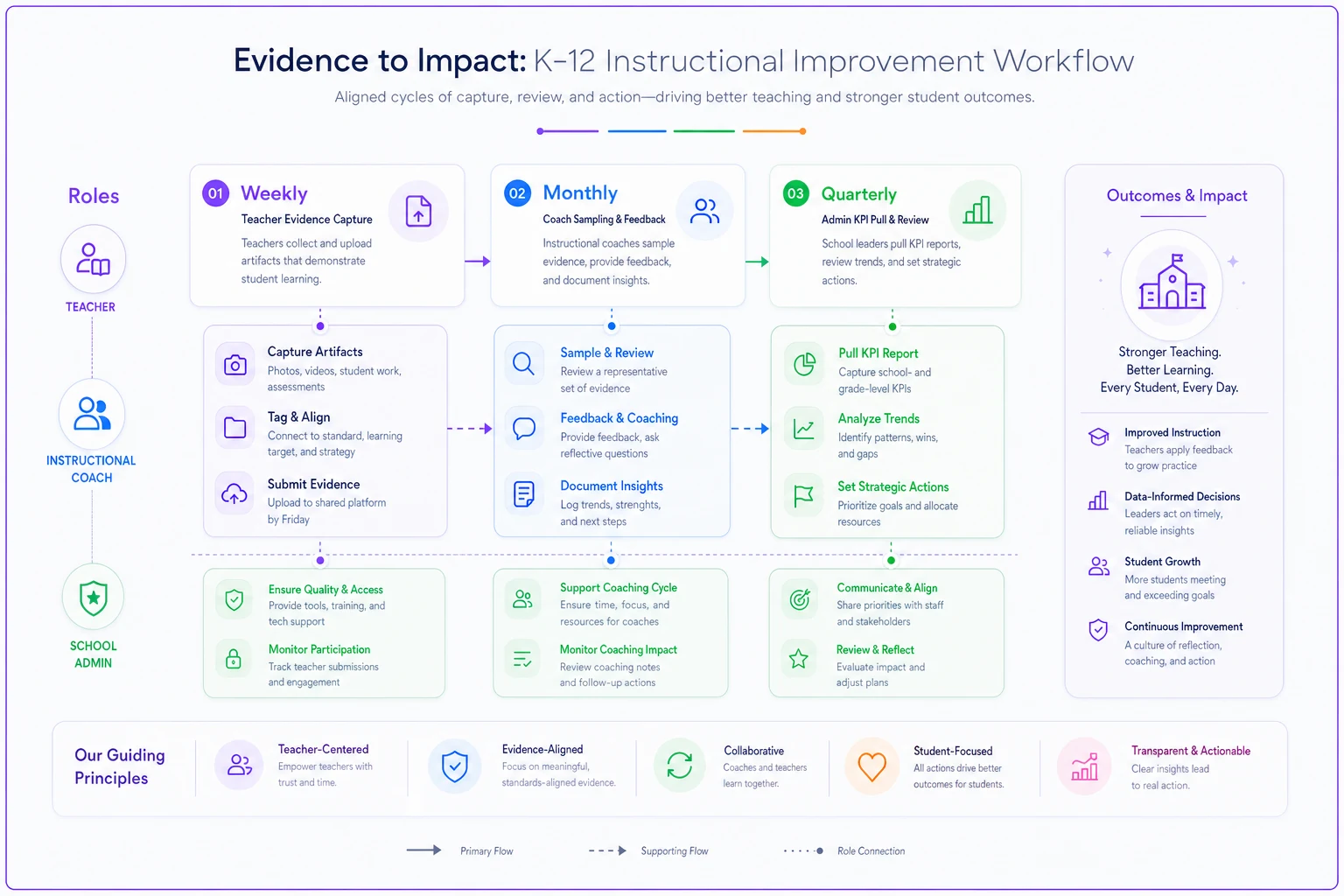
The quarterly summary should be boring to produce if the lower tiers did their job; if it's a scramble, the tiers broke months earlier.
A sampling template that keeps things honest
The most common reason evidence gets challenged is that the sampling was sloppy or invisible. Someone asks "how'd you pick these students?" and the honest answer is "I grabbed what was handy." That answer sinks the whole case.
A defensible monthly sampling template needs only a few fields, filled in before you collect:
-
Target group — which students the initiative is supposed to help (e.g., below-benchmark readers in grades 3–4).
-
Sampling rule — the fixed selection logic (e.g., two students per participating classroom, one at/above and one below target).
-
Classrooms in scope — which rooms are in the sample this month, rotated so the same three aren't always showcased.
-
Artifact type — what you're pulling (writing sample, math task, running record), kept consistent month to month.
-
Collector and date — who pulled it and when, so gaps are visible.
The rotation in point three matters more than people expect. If the same high-functioning classrooms always end up in the sample because they're organized and responsive, your evidence will look great and mean nothing. Deliberate rotation is what separates evidence from marketing.
Role handoffs that actually reduce teacher burden
The whole premise here is that teachers do the least, not the most. Burden reduction isn't about being nice — it's about reliability. The tiers only survive if the heavy, boring coordination work lands on people who aren't also teaching six periods a day.
A clean handoff model looks roughly like this:
-
Teachers capture weekly artifacts in the moment and drop them in one place. No organizing, no tagging, no rollups.
-
Coaches / grade leads own the monthly sample, the sampling template, and the quality-control conversations. They're the ones noticing patterns and nudging.
-
Admin / data clerk owns the quarterly synthesis and the KPI narrative. They're the ones facing the board and the district.
The failure point most schools hit: they assign collection but never assign chasing. When a teacher misses an upload, whose job is it to notice and follow up? If the answer is "nobody" or "the principal, eventually," you've built a system that silently degrades. The chasing has to belong to the layer above — coaches chase teachers, admin chases coaches — and it has to be lightweight enough to feel like a nudge, not a confrontation.
Where automation genuinely helps (and where it doesn't)
A fair amount of this coordination overhead is exactly the kind of thing worth automating so humans don't burn energy on it. The mistake is trying to automate the judgment — deciding what evidence actually means. Automate the logistics, keep the humans on interpretation.
The parts that automate cleanly:
-
Reminders and gap detection. Instead of a coach manually checking who uploaded, the system flags the classrooms that didn't drop a weekly artifact. The coach gets a short list, not a spreadsheet to audit.
-
Sample selection. Given a sampling rule, software can randomly pull the right students from the right classrooms and rotate automatically — which eliminates the "always the easy classrooms" bias.
-
Rollup scaffolding. Weekly artifacts can be auto-tagged by classroom and date so the monthly and quarterly views assemble themselves, rather than someone rebuilding them by hand each time.
-
Routing. When an artifact lands, it goes to the right folder tied to the right initiative automatically, instead of relying on everyone naming files correctly (they won't).
An AI-assisted operational platform earns its keep here mostly by removing the chasing and manual rollups — the invisible labor that usually falls on one overextended coach. The goal isn't a dashboard nobody opens; it's that the quarterly summary is already 80% assembled because the weekly and monthly pieces flowed into place on their own.
What should stay human: judging whether a work sample shows real growth, deciding what a flat trend means, and having the quiet conversation when one classroom's evidence looks off. Those are instructional calls. And if your weekly artifacts are tied to assessment data teachers are already interpreting, the teacher data-literacy micro-modules approach pairs well here — teachers who can read their own class data produce artifacts that already carry meaning.
A realistic scenario
A mid-sized elementary school — around 30 classroom teachers, one instructional coach, one part-time data clerk — rolled out a new early-literacy block and wanted year-long evidence it was working.
Their first attempt was the usual: every teacher, every week, upload a reading sample. By late October, participation had dropped to roughly half. The coach was spending close to a full day each month hunting down missing files, and the first quarterly report was guesswork stitched together from whatever happened to be in the drive.
They reset to the tiered model. Weekly dropped to a single photo of sorted exit work — under two minutes, piggybacked on a routine teachers already ran. Monthly became the coach's job: a fixed sample of 8 students across rotating classrooms using a written sampling rule. Quarterly became a short KPI narrative the clerk assembled from tagged artifacts.
The difference by spring wasn't a miracle. Weekly participation settled somewhere around 85–90% once the ask shrank and gap-chasing became automatic. The coach's monthly collection time dropped from roughly a full day to a couple of hours. The quarterly report stopped being a scramble because the pieces were already there. A couple of classrooms still needed regular nudging — that's just reality — but the evidence was reliable enough to actually trust, which is the whole point.
When this makes sense — and when it doesn't
This tiered approach makes sense when you're tracking something over a full year, across multiple classrooms, where you'll eventually need to defend the evidence to someone outside the room — a board, a grant funder, a district office. The structure is overkill for a single teacher's personal reflection loop.
This is a bad idea when you haven't decided what you're actually measuring. Building an evidence machine before naming your two or three real KPIs just generates organized noise. Figure out the questions first, then build the collection around them.
Who should NOT run this: schools without a clear owner for the monthly and quarterly tiers. If the only person available to coordinate is a teacher already at capacity, the system will default back to heroics and collapse. Either free up a coach's time or shrink the ambition — don't pretend the coordination is free.
The real test
A good evidence system is one you forget about until you need it. If the weekly tier is frictionless, the monthly sampling is honest, and the quarterly pull assembles mostly on its own, then standing in front of people who want proof becomes a non-event. You just open the folder.
Schools that get burned treat evidence as a year-end project instead of a quiet background process. The whole trick is pacing: ask a little every week, sample deliberately every month, synthesize calmly every quarter, and put the coordination load on people who can actually carry it. Do that, and the evidence is still there in May — collected, defensible, and nobody had to pull an all-nighter to produce it.
A good evidence system is one you forget about until you need it. If the weekly tier is frictionless, the monthly sampling is honest, and the quarterly pull assembles mostly on its own, then standing in front of people who want proof becomes a non-event. You just open the folder.
Schools that get burned treat evidence as a year-end project instead of a quiet background process. The whole trick is pacing: ask a little every week, sample deliberately every month, synthesize calmly every quarter, and put the coordination load on people who can actually carry it. Do that, and the evidence is still there in May — collected, defensible, and nobody had to pull an all-nighter to produce it.
Ready to elevate your classroom management?
Join 5,000+ educators using Skolyly to save time, engage students, and improve learning outcomes.