

Most teachers don't lack data. They're drowning in it. A quiz, an exit ticket, a warm-up, a unit check—there's more evidence sitting in your gradebook and on your desk than you could ever realistically act on. The problem isn't collection. It's that twenty-minute gap between "I have the data" and "I know what to teach tomorrow."
That gap is where good intentions die. You tell yourself you'll look through the quiz over lunch, then a kid needs a pass, a parent emails, and suddenly it's 3:15 and you're just going to reteach the whole thing tomorrow because you didn't have time to figure out what specifically broke.
The three routines below are built for a single prep slot—about 45 minutes total, 15 minutes each. Each one produces something concrete: a next-day mini-lesson, a reteach grouping, or a clear read on whether the class actually got it. They're deliberately narrow. You're not analyzing trends across a quarter. You're answering one question: what do I do tomorrow morning?
Why 15 minutes is the right constraint (and why longer analysis usually fails)
There's a pattern worth naming. Teachers who do the most thorough data analysis are often the ones who do it least consistently. They build the beautiful spreadsheet, color-code everything, then abandon it by October because a 40-minute analysis ritual can't survive a normal week.
Short, repeatable routines beat deep occasional ones. A 15-minute scan you run three times a week produces more instructional change than a 90-minute deep-dive you run twice a semester. This isn't about being lazy with data—it's about matching the analysis to the decision. The decision "what's tomorrow's warm-up" doesn't need a regression. It needs you to spot the two or three things most students got wrong and design ten minutes of reteaching.
These routines also assume you already have decent formative items. If your exit tickets don't isolate specific skills, no amount of scanning will help—garbage in, garbage out. If that's your situation, fixing the items comes first. The standards-aligned exit-ticket checklist covers how to write items that actually produce a clean reteach signal.
—
Routine 1: The Sampling Check (15 minutes)
What it answers: Did the class as a whole get this, or do I need to reteach?
Keep every student on track with ease.
Skolyly helps you create, assign, and monitor classroom activities efficiently.
- Integrated lesson and assignment management
- Real-time student progress tracking
- Automated class scheduling & notifications
No credit card required
This routine is for when you have a full-class set and no time to grade every paper carefully before tomorrow. Instead of reading 28 responses, you read a smart sample and make a go/no-go call.
The mistake most people make is grabbing the first ten papers off the top of the stack. That's not a sample—it's whoever turned it in fastest, which skews toward your stronger students and makes the class look better than it is.
The minute-by-minute
| Time | Action |
|---|---|
| 0:00–2:00 | Shuffle the stack. Pull every 3rd or 4th paper until you have 8–10. Don't cherry-pick. |
| 2:00–4:00 | Pick the ONE item on the assessment that matters most for tomorrow's lesson. Ignore the rest for now. |
| 4:00–10:00 | Score just that item across your sample. Tally: correct / partial / wrong. |
| 10:00–13:00 | Calculate the rough hit rate. Under ~60% correct = whole-class reteach. 60–80% = small-group. Over 80% = move on, spiral later. |
| 13:00–15:00 | Write the decision on a sticky note and attach it to the stack: "Reteach [skill] whole class" or "Small group: [names]." |
A realistic example: you pull nine papers from a 27-student algebra class. On the item about isolating a variable with a coefficient, five are correct, two are partial, two are wrong. That's roughly 55% clean—below your threshold. So tomorrow opens with a five-minute whole-class reteach, not a full-period redo.
The sampling check protects you from two expensive mistakes: reteaching something the class already knows (wasting a day) and moving on from something half the class missed (creating a gap that compounds for weeks). You're trading precision for speed, and for a next-day decision, that trade is almost always worth it.
When this makes sense: big classes, tight turnaround, formative stakes.
When it's a bad idea: anything going in the gradebook as a real grade needs full scoring. Sampling is for instructional decisions, not grades.
Routine 2: The Error-Pattern Scan (15 minutes)
What it answers: WHY did they get it wrong—and is it the same wrong for everyone?
A hit rate tells you how many missed it. It doesn't tell you what to teach. Two students can both get an answer wrong for completely different reasons, and if you reteach the wrong misconception, you'll watch them fail the same item twice.
This is the routine that separates "I reviewed the quiz" from "I know exactly what my mini-lesson needs to fix." The core move is sorting wrong answers into types of wrong rather than just marking them incorrect.
The minute-by-minute
-
0
00–2:00 — Pick one or two items. Usually the lowest-scoring items from Routine 1, or the ones most central to the standard.
-
2
00–4:00 — Set up three buckets on scratch paper: procedural slip (knew it, small execution error), conceptual gap (fundamentally misunderstood), and didn't attempt (blank, ran out of time, or gave up).
-
4
00–11:00 — Go through the papers and drop each wrong answer into a bucket. Don't overthink it—first instinct is usually right. Jot the actual wrong answer next to the tally if you see one repeating.
-
11
00–13:00 — Look for the dominant bucket. This is the whole point. If most errors are procedural, your mini-lesson is a quick "watch the sign" fix. If they're conceptual, you need to reteach the underlying idea, not just re-show the steps.
-
13
00–15:00 — Name the misconception in one sentence. Write it the way a student would think it. That sentence becomes the target of tomorrow's mini-lesson.
Here's why the buckets matter. Say twelve students missed a fraction-division problem. If eleven of them inverted the wrong fraction, that's one specific procedural slip—a four-minute fix. But if you'd just seen "twelve wrong" and retaught fraction division from scratch, you'd have bored the class and never named the actual error. Math formatives are especially good at surfacing these distinct patterns when the items are built for it; the breakdown in how quick math formatives reveal instructional gaps pairs well with this scan.
The most common mistake in this routine is treating a "didn't attempt" as a conceptual gap. A blank often means the student ran out of time or hit a wall two steps earlier—not that they don't understand the target skill. Lumping those in inflates your conceptual count and sends you reteaching things some of those blank-answer kids actually understood.
Worth keeping an eye on: if wrong answers scatter across all three buckets with no dominant pattern, the item itself was probably the problem—ambiguous wording, double-barreled question, something like that. That's not a reteach signal. That's a rewrite-the-question signal.
Routine 3: The Reteach-Group Assignment (15 minutes)
What it answers: Who works on what tomorrow, and how do I run it without chaos?
The first two routines tell you what broke and why. This one turns that into a physical plan for the room—which is where most data analysis quietly falls apart. Teachers finish the scan feeling informed, then default to whole-class instruction anyway because grouping felt like too much to organize in the moment.
This routine builds the grouping now, during prep, so tomorrow you're executing instead of improvising.
The minute-by-minute
| Time | Action |
|---|---|
| 0:00–3:00 | Using your Routine 2 buckets, list which students fall into each misconception. Keep it to 2–3 groups max. |
| 3:00–6:00 | Decide what each group does. The "got it" group gets an extension or a peer-teaching role. Reteach groups get the targeted mini-lesson. |
| 6:00–11:00 | Draft the mini-lesson for the biggest reteach group. One worked example, one guided problem, one independent check. That's it. |
| 11:00–13:00 | Plan the logistics: where each group sits, what the "got it" group does independently, how long you'll rotate. |
| 13:00–15:00 | Write it on a single index card you'll carry tomorrow. Groups, task per group, timer. |
Keep the group count low. Three groups is manageable; five is a substitute-teacher nightmare that guarantees at least one group goes off-task while you're across the room. If your buckets suggest more than three groups, collapse the smallest ones. Perfect grouping isn't worth losing control of the room.
A quick reteach-card example for a science class after a photosynthesis check:
-
Group A (got it, ~14 students) design a quick diagram showing where the reaction happens; act as helpers if time allows.
-
Group B (confused inputs/outputs, ~8 students) teacher-led mini-lesson, 8 minutes, one worked model, then a labeled-diagram check.
-
Group C (didn't attempt / absent, ~4 students) work the original item with a partner from Group A before joining the check.
The card is the deliverable. It's the difference between a plan that lives in your head and evaporates by first period, and one you can actually run while managing 28 kids and a fire drill you didn't know about.
Keep the index card folded and clipped to your lesson planner so it's easy to grab between classes.
—
Running all three in one prep slot: the connected workflow
The three routines aren't independent—they hand off to each other. Run in sequence, they form a clean pipeline from raw papers to a next-day plan.
Here's a quick visual of that workflow.
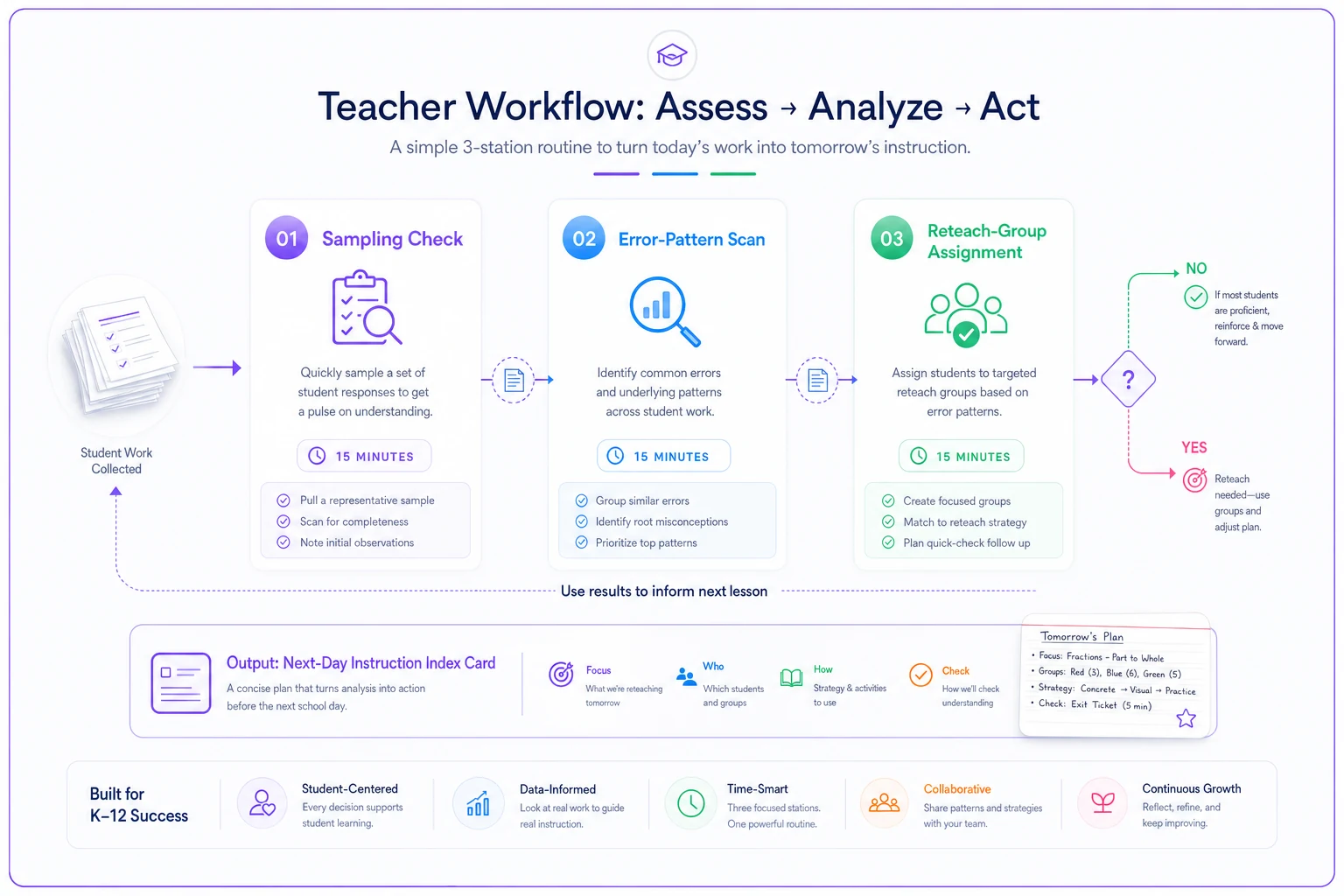
Run in sequence, they form a clean pipeline from raw papers to a next-day plan.
-
Sampling Check decides whether to reteach.
-
Error-Pattern Scan decides what to reteach.
-
Reteach-Group Assignment decides who and how.
If the Sampling Check comes back above 80%, you stop. No scan, no grouping—you spiral the skill into a warm-up next week and reclaim your prep period. That off-ramp is the whole reason the sampling check goes first. You don't want to run a 30-minute error scan on something the class already mastered.
A realistic full-cycle example: a 6th-grade ELA teacher has 26 short-response papers on citing text evidence. The sampling check on nine papers shows roughly 50% strong responses—clear reteach signal, about 12 minutes in. The error-pattern scan reveals most weak responses quote the text but never explain the connection—a conceptual gap, not a mechanics problem. The reteach card sets up two groups: one refining explanations, one still learning to locate evidence. Total time: maybe 40 minutes of one prep period. The next day starts with a targeted 10-minute mini-lesson instead of a vague "let's review."
One prep slot. Three concrete decisions. One index card you actually use.
Where the routines break down (and how to keep them alive)
The failure mode isn't the routines—it's consistency. Two things tend to kill them.
The stack backlog. You skip a day, then two, and now three assessments are piled up and the scan feels overwhelming. Fix: only run the routines on the most recent assessment. Old stacks get sampled or tossed, not deep-scanned. Yesterday's data drives tomorrow's lesson; a two-week-old quiz drives nothing.
The tool tax. If your grade data lives in one system, your groupings in a notebook, and your mini-lesson plans in a doc, the friction of stitching them together every prep period is what actually stops you. Some teachers eventually move this onto a lightweight platform—assessment tools with AI-assisted grouping can pre-sort students by response pattern, so the "who goes in which group" step drops from three minutes of listing names to a quick review of a suggested split. That's a real time-saver on the logistics side, but it only helps after you've identified the misconception. The thinking in Routine 2 is still yours to do. Software can sort wrong answers faster, but deciding why they're wrong is a teacher's judgment call, and no tool replaces that.
Keep the analysis fast, recent, and pointed at one decision. The moment these routines start feeling like a research project, they've drifted from their purpose.
The bigger point
Data literacy for teachers isn't about becoming a statistician. It's about building a repeatable habit that reliably converts a stack of student work into a specific instructional move by tomorrow morning. Fifteen minutes, one clear question, one concrete output.
Run the sampling check to decide whether to act. Run the error-pattern scan to decide what to fix. Run the reteach-group assignment to decide who does what. Do that consistently and your instruction stops reacting to grades and starts responding to actual student thinking—which is the entire point of collecting the data in the first place.
Data literacy for teachers isn't about becoming a statistician. It's about building a repeatable habit that reliably converts a stack of student work into a specific instructional move by tomorrow morning. Fifteen minutes, one clear question, one concrete output.
Ready to elevate your classroom management?
Join 5,000+ educators using Skolyly to save time, engage students, and improve learning outcomes.