

Most schools don't fail their initiatives. They just never find out whether the initiatives failed them. A new writing program, a fresh SEL curriculum, a revised intervention block—it rolls out in September, gets a lukewarm mid-year check, and by May everyone's too exhausted to ask the honest question: did this thing move anything, or did we just add work?
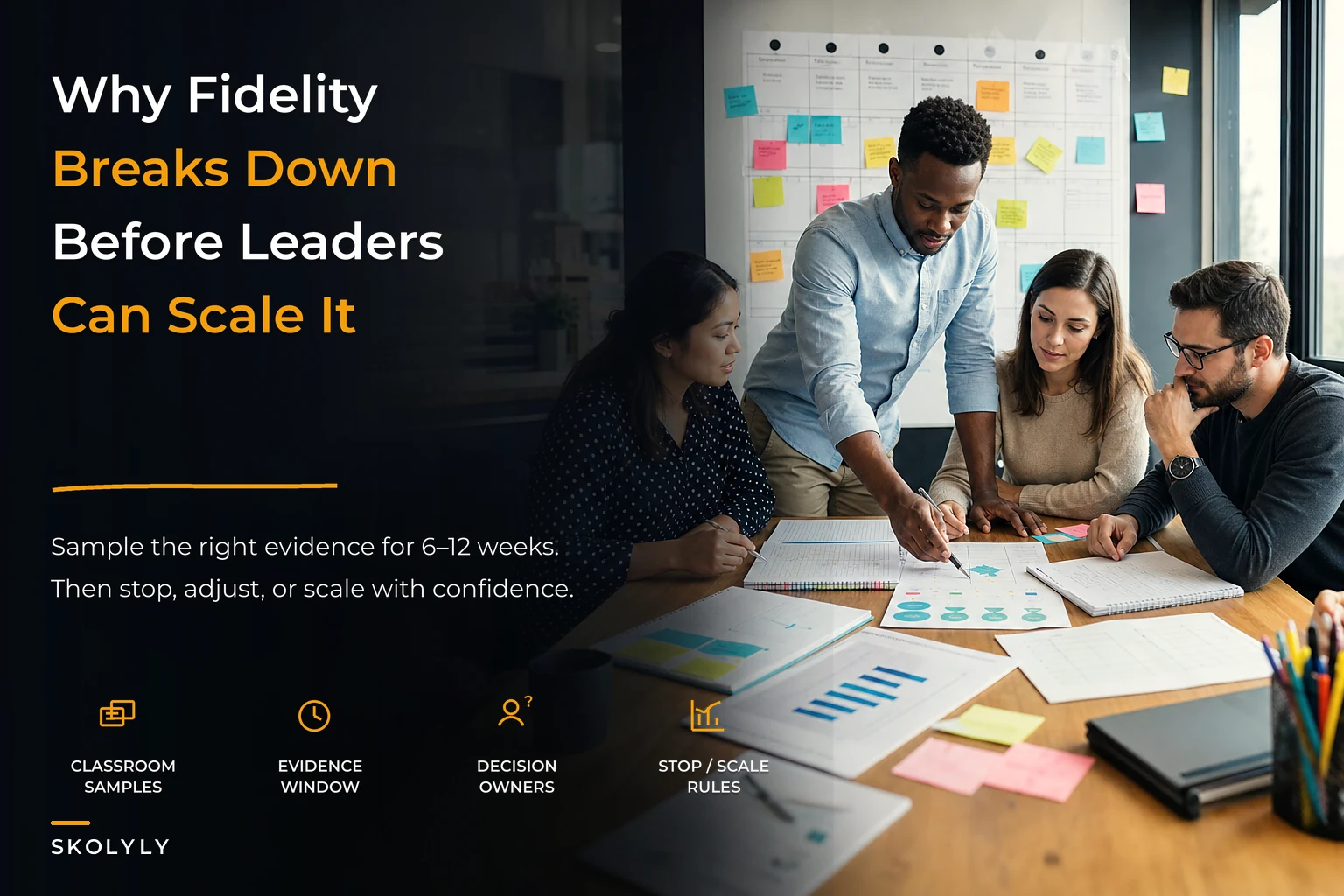
The reason this keeps happening isn't laziness. It's that fidelity and impact get measured on two completely different clocks. Fidelity ("are people doing it?") gets checked constantly and casually. Impact ("did it matter?") gets checked once, late, with high-stakes state data that arrives too late to change course. A real schoolwide fidelity framework collapses that gap—short, repeatable sampling, a fixed evidence window, and pre-agreed rules for stopping or scaling before emotions and sunk costs take over.
Why "we're implementing it" tells you almost nothing
Walk into ten classrooms during a new initiative and you'll usually find four versions of it running. Two teachers are doing it exactly as designed. Three are running a modified version they've convinced themselves is better. Three are doing something vaguely inspired by a PD session they half-remember. Two aren't doing it at all but will nod if you ask.
That spread is the actual operating reality—and it's why "adoption rate" numbers pulled from a sign-in sheet are basically fiction. The initiative isn't one thing being implemented with varying enthusiasm. It's four or five different things wearing the same name. When year-end data comes back flat, leadership concludes "the program doesn't work," when the more accurate read is "40% fidelity produced 40% of nothing."
This pattern shows up across nearly every district size. Small schools assume they'll notice drift because everyone's close together—so they don't sample, and drift hides in plain sight. Large schools assume the coaching structure catches it—but coaches see the classrooms that invite them in, which tend to be the high-fidelity ones. Both ends of the spectrum end up measuring the wrong rooms.
The two-clock problem, and why it breaks at scale
The coordination failure at the center of all this: fidelity signals are cheap and fast; impact signals are expensive and slow. When you only pair fast-fidelity with slow-impact, you get a lag so long that decisions become political instead of operational.
Keep every student on track with ease.
Skolyly helps you create, assign, and monitor classroom activities efficiently.
- Integrated lesson and assignment management
- Real-time student progress tracking
- Automated class scheduling & notifications
No credit card required
A single grade team can hold this together informally. One teacher notices exit tickets aren't improving, mentions it in a PLC, the team adjusts. The loop is short, the group is small, it works.
Scale that to a K–8 building with 40 teachers, three initiatives running simultaneously, and a leadership team meeting every other week. The informal loop dies. Nobody owns the question "is this specific thing working?" Fidelity data lives in a coach's notebook. Impact data lives in a benchmark platform nobody opens between windows. The two never sit on the same table at the same time, so the stop/scale decision defaults to whoever championed the program hardest. That's not governance—that's advocacy.
-
Sampling stops being representative. Early on you look at everything. Later you look at whatever's convenient.
-
Definitions drift. "Fidelity" quietly shifts from "core practice present" to "teacher tried something."
-
Windows stretch. A 6-week look becomes a "let's give it more time" look, forever.
-
No one has authority to kill it. Ending an initiative feels like an accusation, so zombie programs pile up and eat calendar space.
That last one deserves its own moment. Most schools have more dead initiatives consuming staff attention than live ones, because nothing was ever formally stopped. Every zombie program is a tax on the next real idea.
What actually goes on the table: three sampling templates
You don't need a research design. You need three short instruments a busy AP or instructional coach can run without turning it into a second job. The goal is representative and fast, not comprehensive.
Template 1 — The 8-minute fidelity look (structural). A single-page checklist of 4–6 observable, binary core practices. Not quality ratings—presence/absence. "Was the daily objective posted and referenced? Yes/No." "Did students complete the independent practice component? Yes/No." Binary items keep two observers from arguing about a 3 versus a 4. You're sampling whether the machine is running, not judging the artistry.
Template 2 — The student-work pull (impact proxy). Instead of waiting for a benchmark, pull five student work samples per classroom on a fixed schedule tied to the initiative's actual mechanism. If it's a writing program, you pull writing. Score against a shared rubric your team already uses—if you haven't built one, the 30-minute rubric protocol approach that keeps common assessments reliable is a prerequisite, because inconsistent scoring just turns your impact data into noise.
Template 3 — The teacher friction note (leading indicator). Two questions, asked verbally, logged in one line: "What part of this is taking longer than it should?" and "What would make you stop doing it?" Friction predicts fidelity collapse weeks before it shows up in observations. Teachers abandon things because of workflow pain long before they abandon them philosophically.
| Template | What it measures | How often | Time cost per classroom | Who runs it |
|---|---|---|---|---|
| 8-minute fidelity look | Core practice presence | Weekly, rotating sample | ~8 min | Coach/AP |
| Student-work pull | Early impact signal | Every 2–3 weeks | ~15 min for 5 samples | Grade team |
| Teacher friction note | Adoption risk | Bi-weekly | ~3 min | Coach |
The rotating sample matters more than sample size. In a 40-teacher building, eight classrooms a week means you cover everyone roughly every five weeks—enough to catch drift, light enough to actually sustain. The mistake schools make is front-loading: 30 observations in week two, then almost nothing by week seven.
Fix the evidence window before you start
The single most useful governance move is deciding the window before the initiative launches and writing it somewhere people can see it. Six to twelve weeks is the practical range for most K–12 instructional initiatives—long enough for a practice to stabilize past the awkward learning curve, short enough to still change course within the same semester.
Under six weeks, you're mostly measuring novelty and confusion. Past twelve, you've lost the ability to act on what you learn this year, and you've burned through staff patience you can't get back.
Pick the window based on the mechanism, not the calendar:
-
Define the change you expect to see in student work, specifically. "More multi-step reasoning shown in math journals," not "better outcomes."
-
Estimate the stabilization lag—how many weeks before teachers move past the fumbling stage. Usually 2–3 weeks for a routine, longer for a full curriculum shift.
-
Add your reading window on top of stabilization—the weeks you'll actually sample cleanly. Typically 4–6.
-
Set the decision date as stabilization plus reading window, and put it on the master calendar as a hard checkpoint, not a "sometime this quarter" intention.
-
Name the decider—one person or one small team with actual authority to stop or scale. Not "the leadership team will discuss."
Anchoring checkpoints to your real scheduling structure is what makes them stick. Loose dates get swallowed by everything else. If you've built anything resembling a master-calendar governance system that aligns staffing and assessment windows, the fidelity checkpoints belong right on it, sitting next to benchmark windows so they compete for attention on equal footing.
Cost-to-impact heuristics: is this worth the room it takes?
Every initiative occupies more than money. It occupies calendar minutes, teacher cognitive load, and coaching hours—all finite, all contested. Before scaling anything, run a rough cost-to-impact read. You're not looking for precision; you're looking for obviously-yes, obviously-no, and the murky middle.
A simple way to frame it:
-
High impact, low cost → scale immediately, and figure out why it's cheap so you can protect that.
-
High impact, high cost → scale, but plan the cost down. High-cost programs that never get streamlined collapse the moment their champion leaves.
-
Low impact, low cost → the dangerous zone. Cheap enough to survive, useless enough to waste everyone's time indefinitely. These are your future zombies. Kill them.
-
Low impact, high cost → stop now, publicly, so the resources visibly return to the pool.
A concrete example: a middle school piloted a daily 20-minute vocabulary routine across two grade levels. Fidelity looked solid—around 80% of sampled classrooms had it running by week five. But the student-work pull showed almost no movement in the target reasoning items, and friction notes were loud: teachers reported the routine ate the front of every period, somewhere around 90–100 minutes of instructional time per teacher per week. Low-ish impact, genuinely high cost. They stopped it at the eight-week checkpoint and reinvested the time in small-group reteach. Nobody had to argue, because the numbers and the rule were agreed on in August.
Contrast that with a quieter win: a fifth-grade team's exit-ticket-driven reteach habit cost maybe 10 minutes of planning and showed steady gains in work samples by week six. Cheap, effective, easy to spread. That's the profile you scale without hesitation.
The stop/scale decision rules
This is the part that gives the whole framework teeth. Vague rules ("we'll review the data and decide") produce vague decisions. Pre-committed rules produce action. Write them out like a rubric.
Stop if:
-
Fidelity is below roughly 50% at the checkpoint and friction notes point to structural workflow problems, not just unfamiliarity. Low fidelity plus loud friction means the design is fighting the workday.
-
Fidelity is high but the student-work pull shows no directional movement toward the defined change. You proved people can do it and it still doesn't matter.
Scale if:
-
Fidelity is at or above roughly 70% and work samples show clear directional movement, even modest. Consistency plus a real signal is your green light.
-
The cost profile is low or clearly worth it.
Hold and adjust (one cycle only) if:
-
Fidelity is climbing and impact is early-positive but thin. Give it one more short window—not an open-ended extension. "One more cycle" has to have its own end date, or it becomes forever.
The "one cycle only" guardrail is what prevents the most common failure: the endless hold. Every hold gets exactly one renewal. After that, it's a stop or a scale. No third window.
When this framework is a bad fit
Don't run this machinery on everything. It's overkill for small, low-stakes classroom experiments a single teacher wants to try—let those breathe informally. It's also a poor fit mid-crisis, when you're triaging rather than improving; fidelity sampling assumes enough stability to actually observe a routine. And if your team doesn't have shared scoring standards, fix that first—an impact signal built on inconsistent rubrics will send you confidently in the wrong direction.
How the pieces coordinate as you grow
The framework is really a coordination layer sitting on top of things you probably already run. Sampling feeds the fidelity picture. Student-work pulls feed the impact picture. Friction notes feed the early-warning picture. The evidence window forces those three onto the same table on the same date. The stop/scale rules turn that table into a decision instead of a debate.
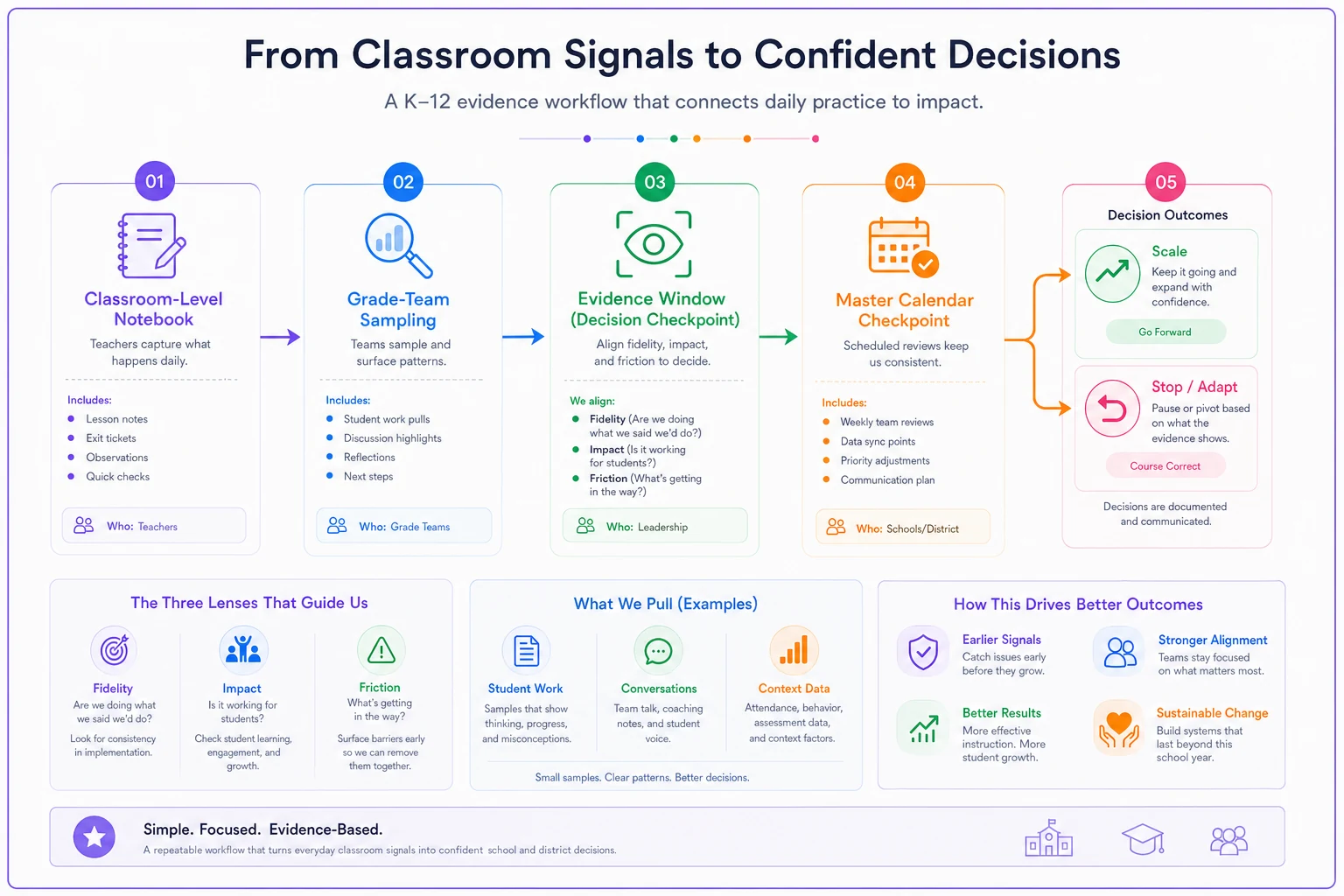
At small scale, one coach can hold the whole thing in a notebook. As you add teachers, initiatives, and grade levels, the bottleneck stops being data collection and becomes keeping definitions stable and windows honest across people who don't talk daily. This is where most schools quietly lose the thread—the sampling drifts, the checkpoint slips, the fidelity definition softens, and six months later you're back to gut-feel governance.
The durable fix is treating fidelity data with the same discipline you'd apply to a coaching cycle. When a school connects its sampling to a real accountability rhythm—the way a well-run PD-to-coaching-to-accountability cycle links effort to follow-through—the fidelity framework stops being a binder and becomes the actual operating system for deciding what stays and what goes.
The takeaway for leaders
Schools rarely suffer from a shortage of good ideas. They suffer from too many undecided ones running at once, none of them formally alive and none formally dead. A working schoolwide fidelity framework doesn't ask you to measure more—it asks you to measure shorter, decide sooner, and commit to the stop/scale rule before anyone's ego is attached to the outcome.
Start with one initiative. Pick the three templates, set a real window with a named decider, write the stop/scale rule in plain language, and hold yourself to it at the checkpoint. The first time you stop a low-impact program on schedule and hand that time back to teachers, the whole staff learns something more valuable than any single initiative: that around here, we actually find out whether things work.
Ready to elevate your classroom management?
Join 5,000+ educators using Skolyly to save time, engage students, and improve learning outcomes.