
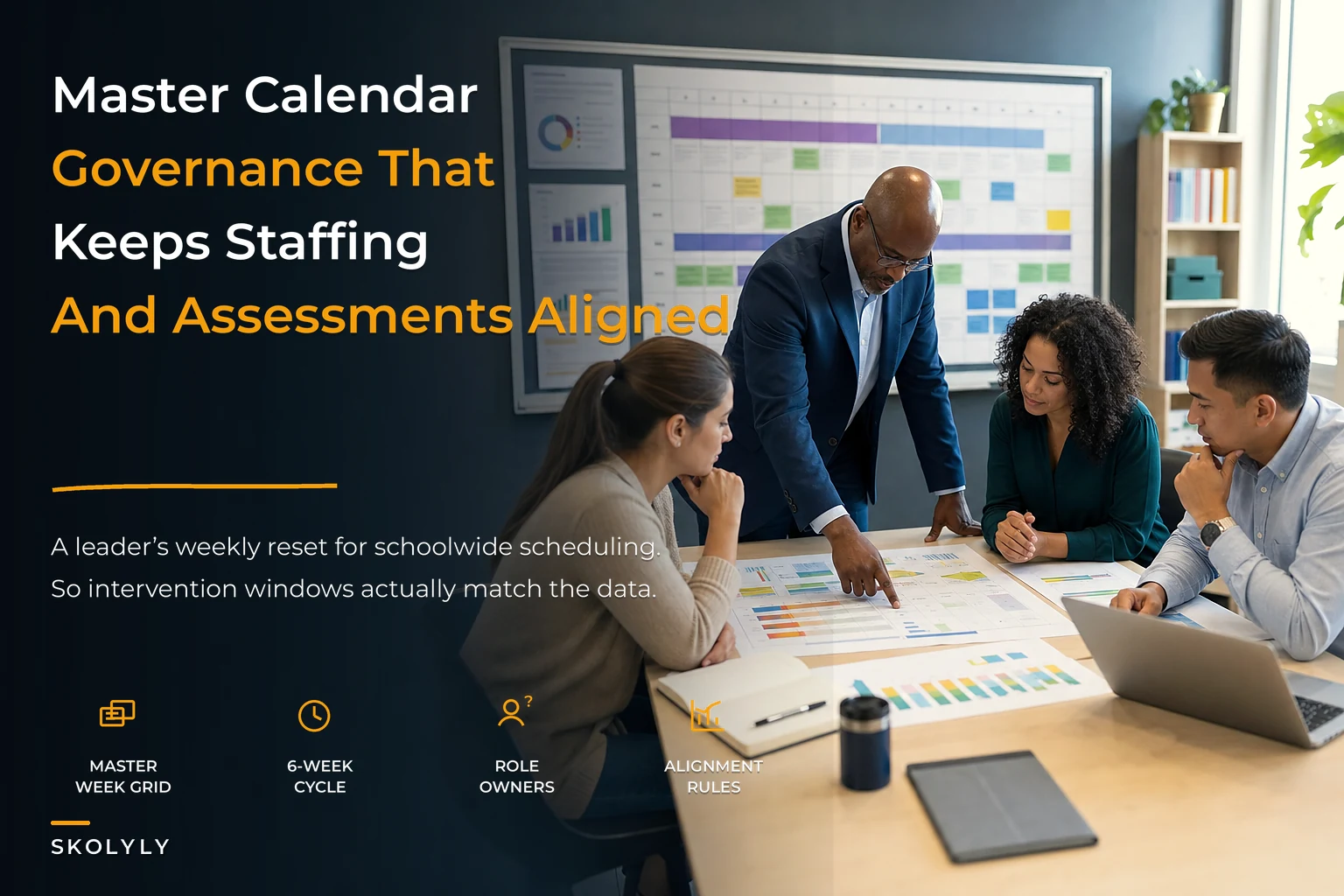

Most schools don't have a calendar problem. They have a coordination problem that happens to show up on the calendar. The master schedule looks fine in August. Then reality hits: the fall benchmark lands the same week as a three-day sub shortage, intervention blocks get eaten by assemblies, and the data you paid to collect sits in a spreadsheet nobody opens until January. By then it's diagnostic history, not something you can act on.
The core failure isn't planning. It's that the three systems that should move together—staffing, intervention time, and assessment windows—are owned by different people, planned on different timelines, and only collide when something breaks. This piece is about wiring those three together with explicit ownership and a planning cadence tight enough that data windows reliably turn into instructional moves.
Why the three systems drift apart
Walk into almost any building and you'll find these three calendars living in separate heads.
The assessment calendar usually belongs to an assistant principal or a data coordinator. It's built around district testing windows and reporting deadlines. The staffing calendar belongs to whoever handles master scheduling and sub coverage—often the same AP, often not. And intervention blocks? Those tend to be owned by nobody in particular. They exist on paper, but the actual protection of that time gets negotiated week to week, and it almost always loses to whatever feels more urgent.
The drift is predictable because each system optimizes for its own constraint. Assessment optimizes for compliance windows. Staffing optimizes for coverage. Intervention optimizes for whatever's left over. When you let three systems each protect their own local priority, the seams between them are where students fall through.
A common pattern: the winter benchmark closes on a Friday. Reports generate over the weekend. The following Monday there's no PLC time scheduled because it's a professional development day the calendar committee locked in six months earlier. So the freshest data your teachers will ever have sits idle for a week, and by the time they can look at it, they've already taught four more days of content on top of the gaps the data revealed. The window closed before it opened.
What breaks as the building scales
At a small elementary with one grade-level team per grade, informal coordination sometimes works. The reading specialist and the third-grade team eat lunch together and just talk. Coordination lives in relationships.
Keep every student on track with ease.
Skolyly helps you create, assign, and monitor classroom activities efficiently.
- Integrated lesson and assignment management
- Real-time student progress tracking
- Automated class scheduling & notifications
No credit card required
That stops working the moment you add complexity. A K-5 with two or three sections per grade, a couple of interventionists, an EL teacher, and a special education caseload can't run on hallway conversations. Middle and high schools are worse—now you've got departments, bell schedules, shared-staff scheduling, and intervention carved out of a fixed period structure.
Here's what specifically breaks at scale:
-
Shared staff become single points of failure. One interventionist serving four grades means every schedule conflict cascades. If she's pulled to cover a class, four intervention groups vanish that day and nobody tracks it.
-
Assessment windows widen to accommodate logistics, which destroys comparability. When a benchmark "window" stretches across two weeks because you couldn't get devices and proctors aligned, your data isn't measuring the same thing across classrooms.
-
Intervention groups go stale. Kids get placed in a Tier 2 group in October based on fall data, and nobody re-sorts them until spring because there's no scheduled decision point to do it.
-
Nobody owns the handoff. Data exists. Time exists. But the moment where someone says "this data means we regroup these seven kids and change what happens in this block" has no owner, so it doesn't happen.
The failure isn't that people are lazy or the calendar is wrong. As the building grows, the number of coordination points grows faster than the informal capacity to manage them. Governance is what replaces the hallway conversation once the hallway conversation can't scale.
The master-week: what "aligned" actually looks like
Before roles or cadence, you need a shared picture of a normal week where these systems fit together instead of fighting each other. This isn't the annual calendar—it's the repeatable weekly rhythm that every other calendar has to respect.
Here's a sample master-week for a middle school running a 6-day intervention cycle. Adjust the block names to your context; the point is the structure, not the labels.
| Day | Protected intervention block | Data / decision activity | Staffing note |
|---|---|---|---|
| Mon | Tier 2 math groups (30 min) | Teachers pull last week's exit-ticket trend | Interventionist floats to math |
| Tue | Tier 2 reading groups (30 min) | — | EL teacher co-plans during prep |
| Wed | Enrichment / flex (30 min) | Grade-team 20-min data check | Coverage priority day for subs |
| Thu | Tier 2 math groups (30 min) | — | Interventionist floats to reading |
| Fri | Tier 3 pullout (30 min) | Interventionist logs progress notes | No assemblies scheduled—protected |
Two things make this work that most schedules miss.
First, the intervention block is the same time every day, which means when you have to sub-cover, the coverage priority is unambiguous. Everyone knows Friday's Tier 3 pullout is the last thing you sacrifice.
Second, the data-check moment is scheduled inside the week, not appended to a PD day months later. That Wednesday 20-minute grade-team check is where fresh formative data becomes a regrouping decision. It's small, it's frequent, and it's protected. If you're struggling to get teachers to actually use formative data in the first place, that adoption problem has to be solved before governance can help—we've written separately about building a school-wide formative assessment cycle teachers will actually use, and it's a prerequisite for everything here.
Explicit owner roles
The single biggest governance improvement in most buildings costs nothing: writing down who owns what, so decisions have a name attached.
Vague ownership sounds like "the team decides." Explicit ownership sounds like "the grade-level lead makes the regrouping call by Thursday and the interventionist executes it Friday." Here's a role set that covers the seams.
-
Calendar owner (usually an AP). Owns the master-week and the annual overlay. Has veto power over anything that would eat a protected intervention block. This is the person who says no to the 9:30 assembly that lands on Tier 3 Friday.
-
Assessment window owner. Owns the open/close dates for every common and benchmark assessment, and—critically—owns the rule that a scoring and decision window is scheduled before the assessment opens, not after.
-
Intervention placement owner. Owns the roster of who's in which group and the re-sort decisions. This role is what stops groups from going stale.
-
Staffing/coverage owner. Owns the sub coverage priority list and the shared-staff schedule. Knows exactly what gets protected when coverage runs short.
-
Data-to-action facilitator. Owns the Wednesday check—makes sure the 20 minutes produces a written decision, not just a discussion. This is the role most schools skip, and it's the one that determines whether any of the rest matters.
Name the decision deadline when assigning an owner so responsibilities aren't ambiguous.
One person can hold two roles in a small building. What you cannot do is leave a role unassigned, because the unassigned role is exactly where the system fails silently.
Conflict-resolution rules
Governance is mostly about what happens when two systems collide, because they will. The point of writing the rules in advance is that you make the hard call once, in a calm moment, instead of re-litigating it every time under pressure.
A workable conflict hierarchy looks like this:
-
Tier 3 intervention time is protected above almost everything. Assemblies, non-emergency meetings, and photo days move—not the pullout.
-
A scheduled assessment window cannot open without a scheduled decision window. If you can't schedule the "what do we do about this" meeting, you don't open the test. This one rule prevents the most common failure in the whole system.
-
Shared-staff conflicts resolve toward the highest-need students. When the interventionist is double-booked, the Tier 3 group wins over the enrichment group. Written down, this stops being a daily negotiation.
-
Coverage shortfalls sacrifice enrichment/flex first, then Tier 2, and Tier 3 last. Everyone knows the order before the shortage hits.
-
Assessment windows do not widen for logistics. If you can't proctor everyone in the window, you fix logistics or shrink scope—you don't stretch the window and quietly break comparability.
When the rule is written, the person enforcing it isn't being difficult. They're just following governance. That depersonalizes the conflict, which is what lets a protected block actually stay protected over a full year instead of eroding by November.
The 6-week planning cadence
Here's the engine that keeps assessment and intervention aligned instead of drifting apart. A rolling six-week cycle, repeated all year, where each week has one job.
-
Week 1 — Assess. The common assessment or benchmark opens and closes inside a tight window. No widening. Scoring begins immediately because the decision window is already on the calendar.
-
Week 2 — Read the data. The data-to-action facilitator prepares a focused view—not a data dump—of which standards and which students need a move. Keep the visuals disciplined; leaders who over-produce data slides tend to get less action, not more, which is why we've argued for tight sampling rules and one-page narrative briefs that actually prompt decisions.
-
Week 3 — Decide. Grade or department teams make written regrouping and reteach decisions. Intervention placement owner updates rosters. This is the hinge week—the whole cadence exists to reach a decision here.
-
Week 4 — Intervene. New groups run. Reteach mini-lessons hit the standards the data flagged. The interventionist schedule reflects the new rosters.
-
Week 5 — Monitor. Quick formatives check whether the intervention is working. Small adjustments, not new placements.
-
Week 6 — Reset and stage. Confirm progress, close out groups that met exit criteria, and stage the next assessment window. Then Week 1 begins again.
A simple diagram of this rolling cycle helps keep everyone synced.
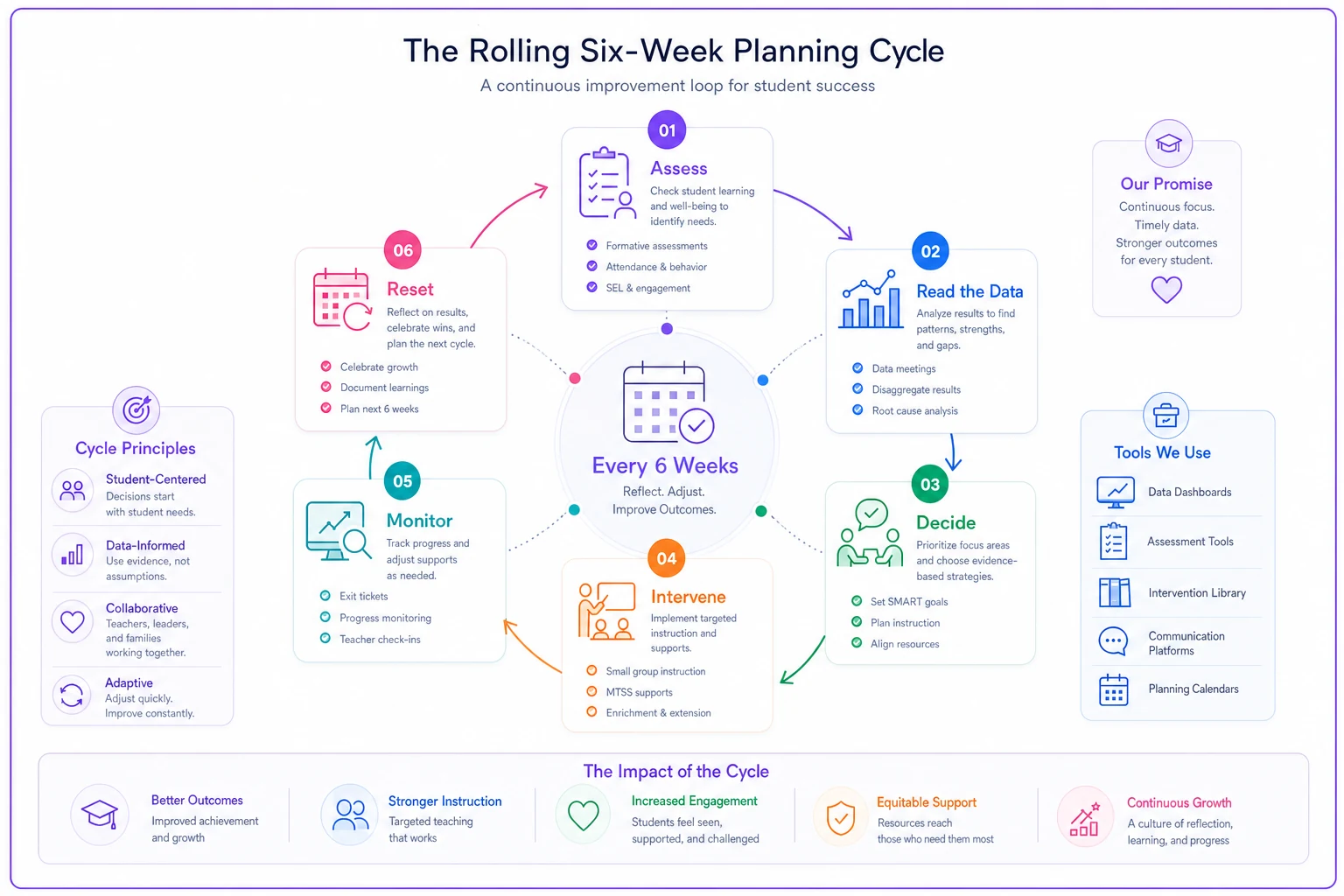
The value isn't any single week—it's that assessment can never run more than a couple of weeks ahead of the intervention it's supposed to inform. You've structurally guaranteed that data windows produce instructional action because the action week is baked into the same cycle as the assessment week. There's no way for the data to sit idle for a month, because the cadence physically doesn't allow it.
A real scenario
A K-8 with roughly 620 students had all the right pieces and none of the connection. Three benchmark administrations a year, a formative platform, two interventionists, and daily 30-minute intervention blocks. On paper, a strong system.
In practice, the fall benchmark closed in mid-October and regrouping decisions didn't happen until the first week of December—about seven weeks of lag. Intervention groups formed in September were still running in November on stale data. When they finally looked at placement, roughly a quarter of kids in Tier 2 groups no longer needed to be there, and a similar number who did need support had never been placed.
They didn't buy anything or add staff. They did three things: named a data-to-action facilitator, moved the decision window to sit two weeks after each assessment window, and wrote the conflict rules so the Friday Tier 3 block stopped getting raided for assemblies. The intervention blocks were already there—they just weren't governed.
By the spring benchmark, decision-to-placement lag had dropped from around seven weeks to under two. The number of misplaced Tier 2 students fell by more than half. No new tools, no new time in the day—just the three systems finally moving on the same clock.
When this makes sense—and when it doesn't
This governance model is worth the overhead once your building has crossed the point where informal coordination fails. Multiple sections per grade, shared interventionists, more than one common assessment cycle a year—those are the signals you've outgrown hallway coordination.
It's a bad fit for a very small school where two teachers and one specialist can genuinely coordinate in real time. You'll add ceremony without adding value, and staff will correctly resent it. Start with just the conflict rules and one owned decision window; add cadence only when the coordination load demands it.
And it's the wrong move entirely if your formative data isn't trusted yet. Governance can force a decision meeting, but it can't make a bad assessment good. If teachers don't believe the data, they'll comply with the cadence and ignore the results. Fix data quality and adoption first; govern the calendar second.
Where tools fit—quietly
None of this requires software. The K-8 above fixed most of it with a named role and a rewritten calendar. But at scale, the manual version gets heavy fast: someone hand-tracking which intervention groups are stale, which decision windows are scheduled, whether the Friday block got raided again this week.
That's where a workflow platform earns its keep—not by making decisions, but by keeping the seams visible. Automatically flagging when an assessment window opens without a decision window attached. Surfacing which intervention rosters haven't been re-sorted in over six weeks. Alerting the coverage owner when a shared-staff conflict is about to eat a protected block. The governance logic stays with your leaders; the software just makes sure nothing falls through a seam because a human forgot to check. Used that way, it removes the clerical tracking that makes governance exhausting, without pretending to replace the judgment that makes it work.
The takeaway
Your master calendar isn't a scheduling document—it's the place where staffing, intervention, and assessment either connect or quietly disconnect. When they drift, you don't lose the data or the time; you lose the link between them, which is worse, because you keep paying for both while getting the payoff from neither. Name the owners. Write the conflict rules before you need them. Run a cadence tight enough that no assessment can outrun the intervention it's supposed to feed. Do that, and the calendar stops being the thing that breaks under pressure and starts being the thing that holds the whole instructional system together.
Ready to elevate your classroom management?
Join 5,000+ educators using Skolyly to save time, engage students, and improve learning outcomes.