
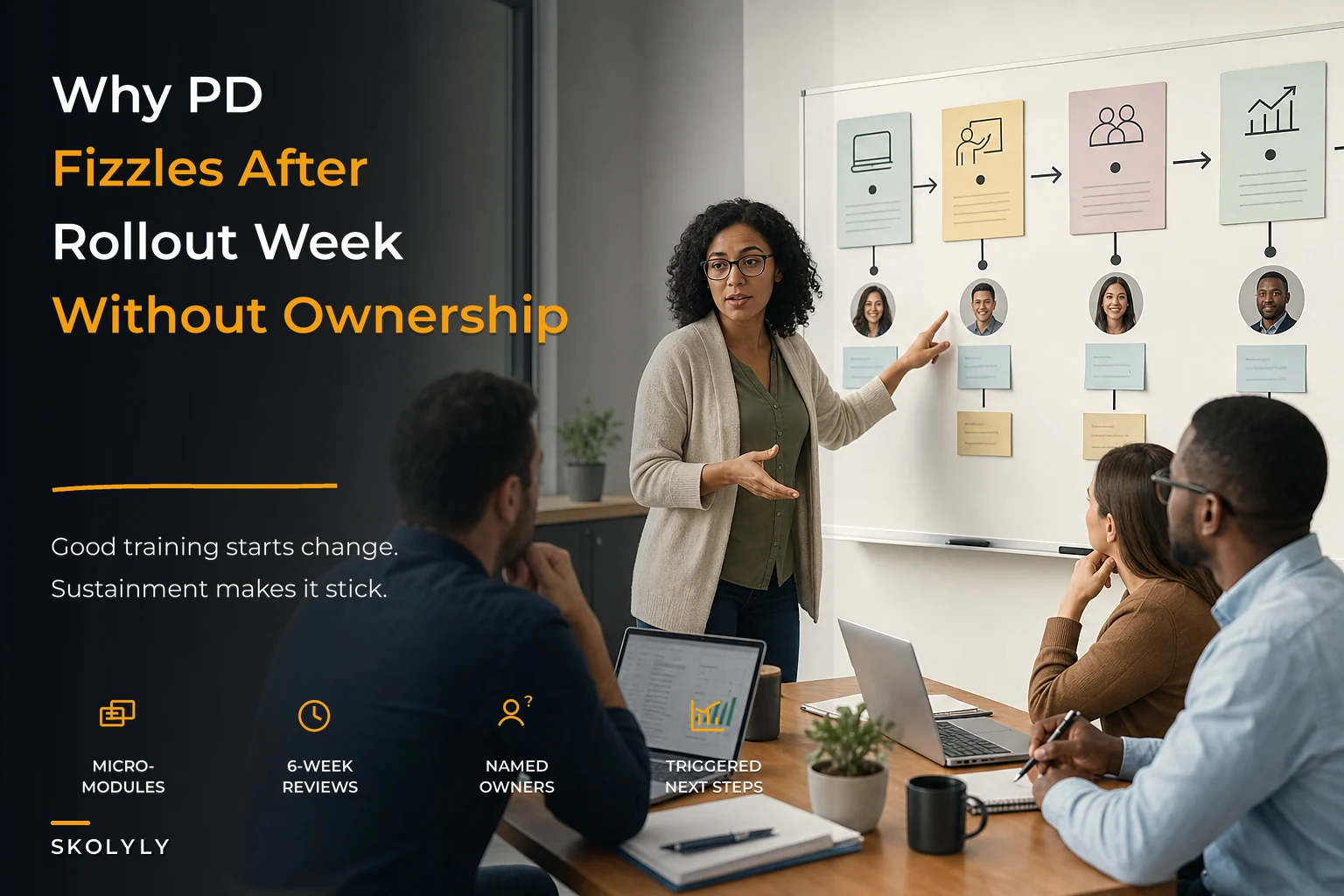

Most schools don't have a PD quality problem. They have a PD decay problem. The February inservice was genuinely good. Teachers walked out with a new questioning strategy, some sample stems, maybe a shared doc. By April, if you walked into ten classrooms, you'd struggle to find two where the strategy was still alive. Not because teachers didn't care — because nothing in the operational system between "training day" and "Tuesday's third-period lesson" was designed to carry the change forward.
That gap is the whole ballgame. Sustaining instructional change K-12 isn't about picking better PD content. It's about building a chain where each link hands the work to the next one, with named people responsible at each handoff and a scheduled point where you check whether the thing actually stuck. When you compare PD that fizzles to PD that sticks, the difference almost always shows up in the connective tissue, not the training itself.
Where the chain usually snaps
Think about the typical flow: a full-day PD, followed by "go try it," followed by an evaluation observation two months later that has nothing to do with the PD, followed by a new initiative in the spring. There's no chain there. There are four disconnected events that happen to occur in the same building.
-
PD-to-practice. The training ends and there's no structured first attempt. Teachers are asked to "implement" something they've done once, in a workshop, with adult peers.
-
Practice-to-coaching. A teacher tries it, it goes sideways in period two, and no one sees it. The struggle is invisible, so it never gets corrected. The teacher quietly concludes the strategy "doesn't work for my kids."
-
Coaching-to-team. A coach helps one teacher, but the learning stays locked in that one relationship. Nothing feeds back into the grade-level or department team.
-
Team-to-accountability. The PLC talks about the strategy warmly, everyone nods, and there's no metric or owner tied to whether it's changing anything.
Each snap point looks small in isolation. Stacked together, they're why a district can spend a real chunk of budget — easily $40k–$70k a year on outside PD for a mid-sized school — and see almost no durable movement in instruction.
The micromodule shift: stop dumping, start metering
The first structural fix is to stop treating PD as a delivery event and start treating it as a metered supply. Instead of one six-hour session on formative assessment, you break it into micromodules — 20 to 40 minute chunks, each targeting one concrete, observable teacher move.
Keep every student on track with ease.
Skolyly helps you create, assign, and monitor classroom activities efficiently.
- Integrated lesson and assignment management
- Real-time student progress tracking
- Automated class scheduling & notifications
No credit card required
The reason this matters operationally isn't attention span. It's traceability. When a PD block covers eleven ideas, you can't observe whether any single one landed. When a micromodule covers exactly one move — say, "cold-call after a 10-second wait time" — you can walk into a room next week and see, in about ninety seconds, whether it's happening. That observability is what makes every downstream step possible.
-
The move (one sentence, describes exactly what the teacher does)
-
The look-fors (2–3 observable indicators someone else could spot)
-
The failure modes (how it goes wrong the first time — genuinely useful, because teachers hit these on day one)
-
One rehearsal (teachers practice the move on each other before leaving)
Make each micromodule focus on one observable move so observations and coaching can be sharply targeted.
That last piece — rehearsal — is the part schools skip most and pay for most. If the first time a teacher performs a new move is in front of 28 students, you've guaranteed a rough first attempt, and rough first attempts are where good strategies get abandoned.
Coached classroom tasks: the handoff most schools skip entirely
Between the micromodule and any real accountability sits the piece that actually determines whether change survives: a coached classroom task. Not a vague "go implement it." A specific, small, assigned task the teacher does in their own room within about a week, with a coach's eyes on it.
The scale problem here is obvious and worth being honest about. You cannot coach every teacher on every move every week. A single instructional coach might realistically support 12–18 teachers with any depth. So the coaching has to be targeted, not universal — which means the micromodule's look-fors double as a triage tool. The coach doesn't observe everything; they observe the specific move, score the look-fors, and spend their limited time where the move isn't landing.
This is where an observation-to-coaching workflow earns its keep. The observation isn't an evaluation and isn't about the whole lesson — it's a tight loop tied to one move from one recent micromodule. Fifteen minutes in the room, five minutes of feedback, one adjustment for next time. Short, frequent, and directly connected to what the teacher was just trained on.
The mistake to avoid: letting coaching drift into general instructional feedback. The moment a coach walks in to look at "cold-call wait time" and walks out having discussed classroom management, seating, and pacing, the chain breaks. The feedback is now unconnected to the PD, and the teacher has no clear next action. Staying disciplined about scope is what keeps the link intact.
Feeding it back into the PLC — without turning it into a book club
This is the link that separates individual improvement from school-wide change. One coached teacher getting better is nice. It doesn't move a building. The coaching insights have to flow back into the team.
The follow-up PLC isn't a place to re-teach the micromodule. It's a place to surface what happened when real teachers tried the move with real kids. The coach — or a teacher-leader — brings back the patterns: "Three of us found the wait time collapses when the question is too open. Here's the fix." That's collective problem-solving grounded in this school's classrooms, not a generic strategy discussion.
-
Who tried the move, and what did the look-fors show?
-
Where is it breaking, specifically?
-
What's the one adjustment everyone commits to before the next meeting?
The failure mode at team scale is diffusion of responsibility. When "the team" owns the follow-up, no one does. Which brings us to the piece that makes the whole chain hold.
Named owners and triggers: accountability that isn't personal
Sustained change requires that at every handoff, a named human — not a role, not a committee — owns the next step, and a trigger defines when action happens. Vague ownership produces vague outcomes.
| Stage | Named owner | Trigger | What they actually do |
|---|---|---|---|
| Micromodule delivery | PD lead / dept chair | Scheduled inservice or PLC slot | Delivers one move, runs the rehearsal |
| Coached classroom task | Instructional coach | Within ~7 days of the module | Observes the look-fors, gives one adjustment |
| PLC follow-up | Teacher-leader | Next scheduled team meeting | Surfaces patterns, sets one shared commitment |
| 6-week metric review | AP or principal | Calendar date, set in advance | Reviews the metric, decides continue/adjust/stop |
The "trigger" column is the part people consistently underestimate. If coaching happens "when the coach gets to it," it slides. If it happens "within seven days of the module," it's on the calendar the moment the module ends. Change survives on scheduling, not intentions.
The 6-week metric review: the checkpoint that decides everything
Every chain needs a point where you stop and ask: is this working, and what do we do about it? Six weeks is roughly the right window — long enough for the move to show up in student work or observation data, short enough that you haven't wasted a semester on something that isn't landing.
The review needs one metric tied to the actual move, not a vibe. If the micromodule was about formative checks, the metric might be the percentage of exit tickets that trigger a next-day adjustment. If it was cold-call wait time, it might be look-for presence across a sample of observations. The metric doesn't have to be fancy — it has to be specific to the move and cheap to collect, because an expensive metric won't get collected at week six when everyone's underwater.
-
Continue — the move is landing; fold it into normal practice and stop actively coaching it.
-
Adjust — the move is partially landing; the review identifies the specific breakdown and assigns a follow-up micromodule or targeted coaching.
-
Stop — the move isn't working here, for real reasons; kill it cleanly rather than letting it zombie-walk through the year.
That third option is the one schools almost never allow themselves, and it's why PD graveyards fill up. If you can't stop something, you can't credibly start anything new, because teachers have learned that every initiative just piles onto the last.
A real scenario: a middle school that stopped the fizzle
A mid-sized middle school — around 640 students, roughly 40 teachers — had run three years of PD on formative assessment with basically nothing to show for it. Walkthroughs showed maybe a quarter of classrooms using any consistent check-for-understanding routine, despite the topic appearing in PD every single year.
They rebuilt the chain instead of the content. Same formative-assessment focus, broken into four micromodules across a semester, one move each. Each module ended with rehearsal. Within a week of each module, the two coaches ran targeted 15-minute observations — not on everyone, but on teachers whose look-fors were weakest from the previous cycle. PLCs spent one meeting per cycle on "where's this breaking," and an AP owned a fixed six-week review with one metric: share of observed classes showing the target move.
By the second review, that share had moved from around 25% to somewhere north of 60%. Not because the PD was better — the content was arguably thinner. It moved because nothing fell into a gap. Every module had a coaching follow-up on the calendar, every coaching insight fed a PLC, and every six weeks someone with authority looked at one number and made a call. One of the four modules got stopped at review — the move didn't fit their master schedule — and teachers noticed that too. It signaled the whole thing was real.
Why this connects to adoption — and where it can still fail
None of this survives if teachers experience it as surveillance. The coaching link only works when it's genuinely developmental and scoped tightly, and when the six-week review is about the system's effectiveness, not individual teacher ratings. The moment the metric review becomes a way to identify "underperformers," teachers stop giving you honest data at the coaching stage, and the whole chain fills with performance theater.
This is the same reason a school-wide formative assessment cycle lives or dies on whether teachers see it as help or as compliance. Adoption and sustainability are the same problem viewed from two angles.
When this full chain makes sense: when you have at least a part-time coaching capacity, PLC time already on the calendar, and a leader willing to own the six-week review. Without those three, start smaller.
When it's a bad idea: if you try to run it across six initiatives at once. The chain works precisely because it's narrow — one move, tracked all the way through. Layer four simultaneous focuses on top and you've recreated the diffusion problem you were trying to solve.
Who should not do this: a school with no coaching capacity and no protected collaboration time shouldn't fake the middle links. A broken chain with named owners is still a broken chain. Build the coaching and PLC capacity first, then connect it.
Where the operational load actually is
The honest constraint in all of this is tracking. Someone has to remember which teacher got which module, when their coaching follow-up is due, what the look-fors showed, what the PLC committed to, and what the six-week metric said. Across 40 teachers and four cycles, that's a real coordination burden — and when it lives in someone's head or a scattered set of spreadsheets, the triggers slip and the chain quietly reverts to disconnected events.
This is the piece where a shared workflow platform earns its place — not as a magic fix, but as the connective memory. When the micromodule, coaching notes, PLC commitments, and six-week metric all live in one linked record per focus area, the handoffs stop depending on anyone's memory. Trigger dates surface automatically, the coach sees which look-fors were weak last cycle without digging through old notes, and the person running the six-week review isn't reconstructing history the night before.
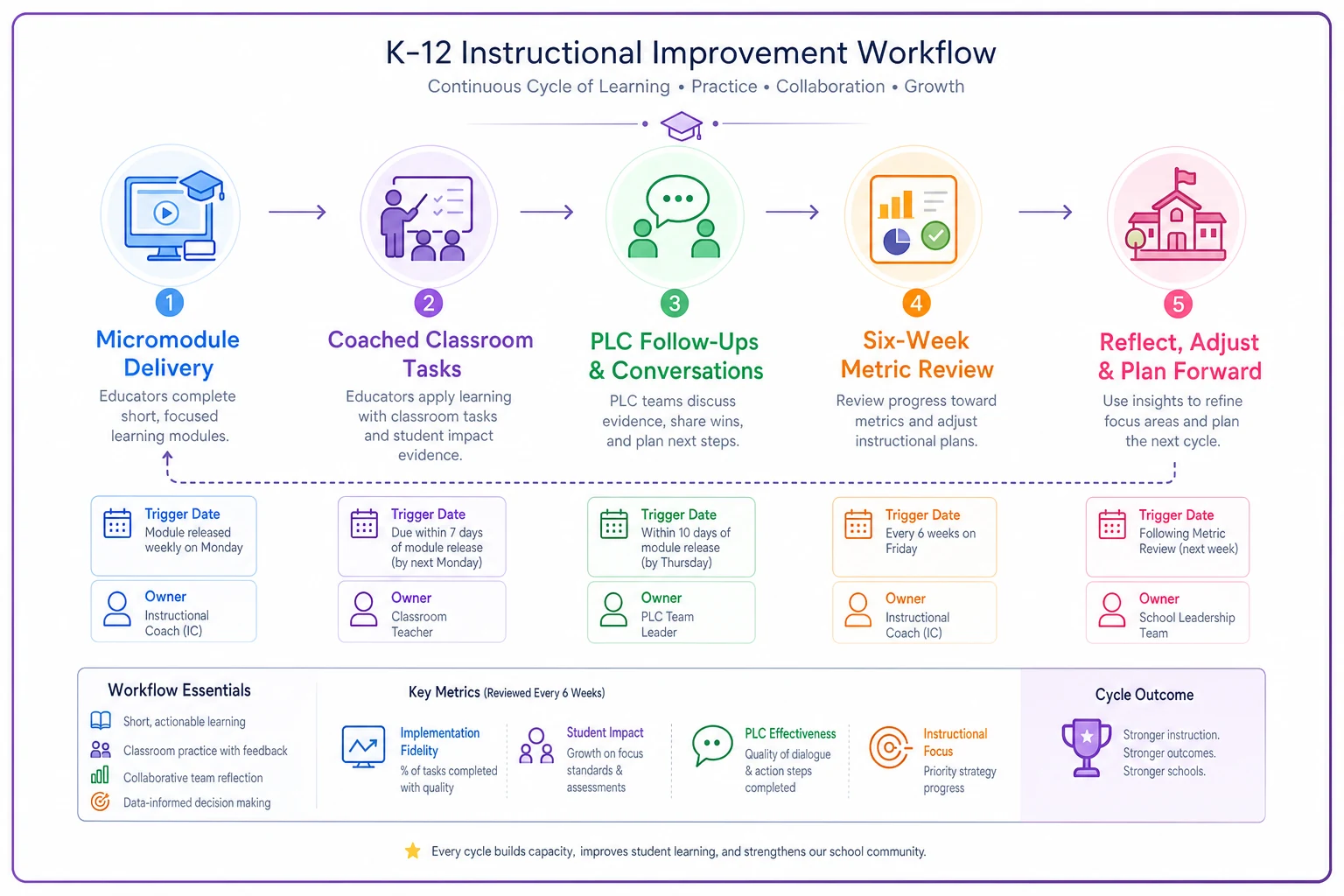
This diagram maps the handoffs, triggers, and named owners across the chain.
AI-assisted tools can help by pulling scattered observation notes and exit-ticket patterns into a single view so the review is about deciding, not data-hunting. But the platform only matters because the chain exists first. Software organizes a good system; it doesn't rescue a system that was never connected.
The takeaway for leaders
PD doesn't fail because the content is weak. It fails because the building treats it as an event instead of a chain — and every unowned gap between training, practice, coaching, teams, and review is a place where good instruction leaks out. Fix the connective tissue: one move at a time, a coaching follow-up on the calendar, a team debrief that actually surfaces breakdowns, and a six-week checkpoint with a named owner and the willingness to stop what isn't working. That's what turns a good February inservice into something you can still see in April.
Ready to elevate your classroom management?
Join 5,000+ educators using Skolyly to save time, engage students, and improve learning outcomes.