


What happens when common assessments quietly fall apart
Most schools launch common assessments with genuine alignment work—grade teams agreeing on standards, shared rubrics, quarterly benchmarks. Six months later, you've got wildly different scoring expectations across classrooms, item banks nobody trusts, and teachers quietly building their own versions because the shared one stopped making sense.
The breakdown is gradual. A teacher scores extended responses more leniently than their colleague. Someone revises test items without mentioning it. New staff join mid-year without any calibration. Before long, your common assessments aren't really common—they're shared documents with entirely different interpretations living inside each classroom.
What's missing isn't better assessments. It's assessment literacy governance K-12 schools can actually keep running without bolting another committee onto everyone's already full plate.
The reliability problem hiding in plain sight
Walk into any middle school running common unit assessments and ask three teachers to score the same constructed response. You'll likely get three different scores—sometimes varying by full proficiency levels. Not because teachers don't know the content, but because nobody's actively maintaining scoring consistency.
Keep every student on track with ease.
Skolyly helps you create, assign, and monitor classroom activities efficiently.
- Integrated lesson and assignment management
- Real-time student progress tracking
- Automated class scheduling & notifications
No credit card required
This isn't a competence issue. It's a system design problem. When governance exists only as a PDF in a shared drive or a single August training, reliability degrades in completely predictable ways.
Here's what tends to break down first:
Item quality decay: Assessment items get modified independently by different teachers. A math problem that started clear becomes convoluted after three people "improved" it without coordinating. Science labs drift from measuring the same skills as materials get adapted to whatever's available.
Scoring drift: Without regular calibration, "proficient" in Room 203 looks nothing like "proficient" in Room 208. Teachers develop internal rubric interpretations based on their own students. Grade inflation creeps into some rooms while others maintain stricter standards.
Version control chaos: Multiple versions of the "same" assessment float around the building. Nobody knows which is current. Teachers pull whatever's in their files from last year. The assessment coordinator assumes everyone's on Version 3.2 when half the grade team never stopped using Version 2.1.
Knowledge gaps that compound: New teachers inherit assessments without understanding the design logic behind them. Veterans who helped build them retire or transfer. The institutional knowledge about why certain items exist, what they actually measure, and how to score them consistently just disappears.
The downstream consequence is that your data stops meaning anything. PLCs spend time analyzing numbers that don't represent the same thing across classrooms. Intervention decisions get made on inconsistent evidence. Students get different opportunities depending on which teacher's version they happened to take.
Why lightweight governance actually holds up
Schools typically respond to assessment problems by building elaborate governance structures—assessment committees, monthly meetings, detailed protocols that nobody touches after October. Heavy approaches fail because they treat governance as an add-on rather than something woven into existing work.
-
Item authors (2 per grade)
Teachers responsible for maintaining actual test items and making authorized changes
-
Moderators (1 per grade)
Facilitate monthly 15-minute calibration during existing PLC time
-
Scorers (all teachers)
Follow calibration agreements and flag scoring questions as they come up
The governance runs through existing rhythms—monthly PLCs include a brief scoring calibration, quarterly data reviews include item analysis, grade-level planning incorporates assessment updates. No new meetings. No extra time. Just clear roles inside structures schools already protect.
No new meetings. No extra time. Just clear roles inside structures schools already protect.
Monthly calibration that takes 15 minutes
Most calibration happens once—August—and then never again. By November, scoring consistency has quietly evaporated. The fix isn't more intensive training. It's short, regular touchpoints that maintain alignment without eating up instructional time.
A calibration protocol that teams will actually stick with looks like this:
Week 1 of each month (15 minutes during PLC):
-
Moderator brings one anonymous student work sample
-
Teachers independently score using the rubric (3 minutes)
-
Reveal scores and discuss discrepancies (7 minutes)
-
Agree on anchor points for the current unit (5 minutes)
Keep it short and focused on one specific scoring challenge. Don't try to recalibrate the entire rubric—just maintain alignment on whatever's actively being assessed that month.
Between calibrations, teachers drop scoring questions into a shared document. The moderator pulls the most common confusion for next month's session. This creates a feedback loop where real scoring challenges drive the governance process rather than hypothetical ones cooked up at a planning meeting.
Try asynchronous scoring when departments are split across campuses to keep PLC time focused and efficient.
Some schools run calibrations asynchronously: teachers score a sample independently by Tuesday, post scores in a shared spreadsheet, then spend five PLC minutes discussing outliers. Works especially well for departments split across multiple campuses.
The three quality checks that actually catch problems
Quality assurance sounds bureaucratic, but it doesn't have to be. The most sustainable QA runs through three checks embedded in work teachers already do.
The version check (quarterly, 5 minutes): Before each assessment window, item authors confirm everyone has the current version. One email: "Unit 3 launches Monday. Current version is dated 10/15 in the filename. Delete older versions." Simple. Catches drift before it affects scores.
The item performance check (after each assessment, 10 minutes): Item authors review basic patterns—which questions did most students miss? Any items where high performers struggled? This isn't complex psychometric work. It's spotting obvious problems like confusing wording or misaligned difficulty.
The scoring variance check (monthly, built into calibration): Moderators track whether score spreads are narrowing or widening. If teachers scoring the same sample are consistently more than one level apart, that's either a rubric problem or a signal for more focused calibration work.
These checks hold up because they're specific, brief, and tied to immediate action. Not "analyze assessment quality" in the abstract—but "flag items where 80% of students got it wrong." The data from these checks feeds directly back into the system. Problem items get revised, confusing rubric language gets clarified, training gaps surface in the next calibration session.
Creating anchor papers without the endless debates
Anchor papers—exemplar student work at each proficiency level—make scoring consistent. Creating them usually means lengthy meetings where teachers argue whether a sample is "approaching" or "meets" until everyone's exhausted.
There's a faster method that actually produces stronger anchors.
The blind selection process:
-
After an assessment, each teacher submits one "clear example" at each proficiency level—no discussion yet
-
Moderator removes names and identifiers
-
Teachers independently classify all samples into proficiency levels
-
Samples with 80% or more agreement become anchors automatically
One PLC meeting instead of three. Teachers spend roughly 20 minutes selecting and submitting, then 15 minutes classifying during the next session. The moderator needs maybe 30 minutes of organizing between meetings.
Anchors that emerge through consensus are stronger than negotiated compromises. When four out of five teachers independently agree a paper is "proficient," that's your anchor. No debate required.
Update anchors each semester—student writing evolves, standards shift, and old anchors lose relevance. But don't rebuild from scratch. Keep the strongest ones and only generate new anchors for levels that have drifted.
Store anchors where teachers actually look: linked directly in the assessment materials, not buried in a binder or a nested drive folder. When someone opens the scoring rubric, anchor papers should be one click away.
Who does what: a role matrix that prevents dropped balls
Unclear ownership is what kills assessment governance. When everybody's responsible, nobody actually is. The table below clarifies who does what across the core tasks.
| Task | Item Authors | Moderators | Scorers | Admin |
|---|---|---|---|---|
| Maintain test items | Responsible | Consulted | Informed | Approve major changes |
| Run calibration sessions | Consulted | Responsible | Participate | Informed of issues |
| Score assessments | Guidelines | Support | Responsible | Review data |
| Flag problem items | Accountable | Consulted | Responsible | Informed |
| Version control | Responsible | Informed | Follow | Support |
| Create anchor papers | Compile | Responsible | Contribute | Approve |
| Track scoring variance | Analyze | Responsible | Provide data | Review trends |
Notice what's not in this structure: no single "assessment coordinator" who owns everything and becomes the one point of failure when they go on leave or switch schools.
Item authors aren't building assessments from scratch—they're maintaining existing ones. Moderators aren't running trainings—they're facilitating brief calibrations. Scorers aren't developing rubrics—they're following them and flagging problems. The work is distributed enough that the system survives normal staff turnover.
Rotate roles annually. This year's scorer becomes next year's moderator. Moderators move into item author work. It builds redundancy and slowly grows assessment literacy across the entire team rather than concentrating it in two people.
Building assessment literacy through micro-PD
Two-day summer institutes on assessment design rarely change daily classroom practice. Teachers sit through presentations about reliability and validity evidence, then return to rooms where those concepts feel completely abstract.
Assessment literacy grows through micro-PD embedded in regular work.
During PLCs: Spend five minutes examining why students struggled with specific items. This builds understanding of item-objective alignment naturally, without anyone needing to "teach" it formally.
In calibration: Discussing score discrepancies teaches rubric application better than most standalone trainings. The disagreement itself becomes the learning.
Through item authoring: Revising even one assessment item teaches more about assessment design than a semester of theory.
Via error analysis: Looking at common wrong answers reveals quality issues in the assessment itself while building diagnostic skills at the same time.
The PD happens through the work, not separate from it. This approach also surfaces real professional development needs organically. When calibration reveals consistent scoring disagreements around writing conventions, that's your next micro-PD focus. When item analysis shows a poorly performing question, that's a chance to learn about item writing together in context.
Track growth through practical indicators: Can teachers identify problematic items? Do calibration spreads narrow over time? Are fewer old versions floating around? These operational signals matter more than whether someone can define "construct validity" on a survey.
The documentation sweet spot
Documentation swings between two bad extremes—either nothing written down at all, or a 47-page assessment manual nobody reads after orientation week. The sustainable middle is minimal but essential documentation that people actually reference.
The one-page assessment calendar: Lists assessment windows, calibration dates, and version release dates. Not philosophies or procedures—just when things happen.
The living FAQ document: Starts empty and grows only from actual teacher questions. "How do I score if a student does X?" becomes one entry. After a year, you have a practical guide built entirely from real needs rather than anticipated ones.
-
The version log
Simple spreadsheet showing assessment name, current version date, and what changed. Takes two minutes to update and saves hours of confusion.
-
The calibration tracker
Records monthly sample scores and spread across teachers. Shows whether consistency is improving. Fits on half a page.
What's deliberately not in this list: lengthy rubric explanations, theoretical frameworks, detailed protocols. That material can live somewhere for reference, but the working documents stay brief. And they need to live where people actually work—if teachers plan in Google Drive, assessment materials live there. If Canvas is the hub, build it there. Don't make people hunt across platforms for basic information.
Warning signs your governance is drifting
Even lightweight governance can slide off track. A few early warning signals worth watching for:
-
Silent modifications
Teachers stop mentioning when they change items. Either the process is unclear or too cumbersome. Simplify the change process to one form, one approval.
-
Calibration attendance drops
If fewer teachers show up, calibration is probably too long or too theoretical. Cut it to ten minutes and focus on one real scoring problem.
-
Multiple versions resurface
Old assessments reappear because teachers can't find current ones. Delete old versions from shared drives and clearly label what's current.
-
Scoring variance widens
Despite calibration, scores drift apart over time. Increase frequency or narrow focus to specific rubric rows causing confusion.
-
New teacher confusion
Recently hired staff don't understand the system. A 15-minute onboarding video showing where materials live and who to ask solves most of this.
These problems are predictable and fixable. The key is catching them through regular quality checks rather than discovering them during state testing season when it's already too late to course correct.
Making it sustainable without burning people out
Assessment governance usually fails not from bad intentions but from unsustainable design. Systems that require significant extra work always decay once the initial energy fades.
Sustainable governance attaches to existing structures:
-
Calibration during PLCs, not additional meetings
-
Item review while analyzing assessment data teachers are already looking at
-
Anchor papers emerging from regular scoring, not special sessions
-
Documentation growing from actual questions, not anticipated ones
The time investment stays manageable. Around 15 minutes monthly for calibration, 5 minutes quarterly for version checks, 10 minutes per assessment for item analysis, 30 minutes per semester for anchor updates. That's genuinely less time than teachers typically waste hunting for the right assessment version or arguing over scoring inconsistencies. The governance pays for itself by preventing those problems from compounding.
Distribute the work so no single person burns out. Rotate roles. Keep documentation lean. Use existing meeting structures. Make the right path the easy path.
Technology's role: support, not takeover
AI-powered assessment platforms can strengthen governance without replacing the human judgment at the center of it. The right tools help with version control, scoring consistency tracking, and pattern detection across classrooms.
Automated version management ensures everyone accesses current assessments—no more emailing files or wondering which version is active. Scoring calibration tools let teachers practice on sample responses asynchronously, then surface variance patterns so you can see scoring consistency data instead of guessing at it. Pattern detection helps item authors spot problematic questions faster: when an item shows unusual response distributions, the system flags it for review rather than waiting for someone to notice.
But technology supports human governance, it doesn't replace it. Teachers still calibrate through conversation. Item authors still revise based on pedagogical judgment. Moderators still facilitate the discussions that build shared understanding of what quality work actually looks like.
The most effective approach combines lightweight human governance with practical data collection systems that reduce manual tracking while keeping educator ownership of assessment quality intact.
A 60-day implementation roadmap
Don't try to launch everything simultaneously. A phased approach builds momentum without overwhelming anyone.
Days 1–14: Assign roles and clean house
-
Identify item authors and moderators for each grade or subject
-
Delete old assessment versions from shared drives
-
Create a simple version log
Days 15–30: Launch calibration
-
Run the first 15-minute calibration during an existing PLC
-
Start a FAQ document with questions that surface in that session
-
Distribute a one-page assessment calendar
Days 31–45: Add quality checks
-
Implement the version check before the next assessment window
-
Run an item performance review after that assessment
-
Track score spreads from the first calibration
Days 46–60: Generate anchors and adjust
-
Use the blind selection method for anchor papers
-
Link anchors directly in assessment materials
-
Adjust calibration approach based on what the first month revealed
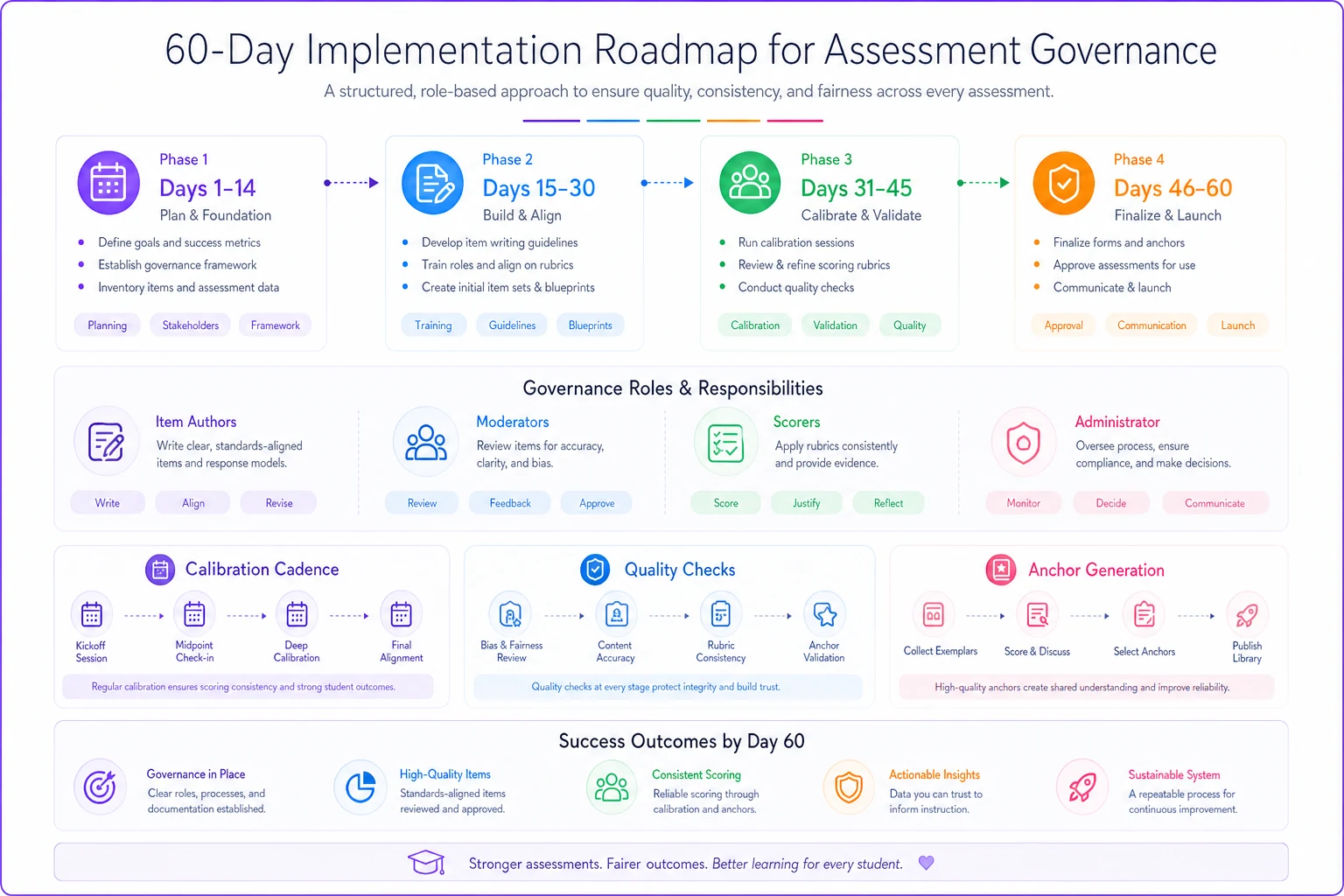
This visual maps the phased workflow so teams can follow it step by step.
After 60 days, you have a functioning governance system. Not perfect, but sustainable. It'll continue to evolve based on your school's context—but the foundation is in place.
What the payoff actually looks like
One middle school put a version of this lightweight governance in place after discovering their common math assessments had completely diverged across the building. Different teachers were assessing different standards with different scoring criteria, which made their data essentially useless for making intervention decisions.
Six months in, the results were clear. Scoring disagreement dropped from roughly 35% to under 10%. Version confusion disappeared. New teachers who joined mid-year onboarded successfully without disrupting consistency. Most importantly, PLC conversations shifted away from arguing about scores and toward actually analyzing what students understood.
The improvement didn't come from heavy oversight or top-down mandates. It came from clear role distribution and embedded quality checks that caught problems early, before they became systemic.
Building something that actually lasts
Assessment literacy governance K-12 schools can sustain isn't about complex frameworks or adding meetings to an already crowded calendar. It's about simple practices that maintain consistency without burning people out.
Assign clear roles. Calibrate monthly. Run three short quality checks. Keep documentation lean but useful. Attach all of it to existing work. Make the right way the easy way.
Start with one grade level or department. Run the 60-day implementation. Demonstrate that lightweight governance actually improves scoring consistency without adding burden. Then expand gradually from a foundation that's proven to work in your building.
The goal isn't perfect assessments—those don't exist. The goal is assessments that mean the same thing across classrooms, scored consistently enough that the data you're analyzing actually reflects what students know. That requires governance, but not the heavy kind that collapses under its own weight within a semester. Build something simple enough to maintain and specific enough to matter. Your PLCs will work better for it, your teachers will have clearer guidance, and your students will at least get a consistent shot at showing what they've learned.
The goal isn't perfect assessments—those don't exist. The goal is assessments that mean the same thing across classrooms, scored consistently enough that the data you're analyzing actually reflects what students know. That requires governance, but not the heavy kind that collapses under its own weight within a semester. Build something simple enough to maintain and specific enough to matter. Your PLCs will work better for it, your teachers will have clearer guidance, and your students will at least get a consistent shot at showing what they've learned.
Ready to elevate your classroom management?
Join 5,000+ educators using Skolyly to save time, engage students, and improve learning outcomes.