


Most induction programs fall apart not because the content is bad, but because the pieces never talk to each other. Onboarding lives in HR's world. Mentoring lives with the assigned buddy teacher. Professional learning lives on the PD calendar. And actual classroom performance lives inside a principal's head until the spring evaluation, when everyone scrambles to reconstruct a story from memory.
By then, the new teacher has already formed their habits — good or bad. The induction "program" turns into paperwork that certifies attendance, not competence.
What follows is a way to run teacher induction with micro-credentials over a 90-day window so that onboarding tasks, skill validation, and real classroom evidence feed one continuous loop. The goal isn't more meetings. It's making the induction period actually produce something HR, principals, and the teacher can all trust.
Why induction breaks into silos in the first place
Walk through the first 90 days of almost any new hire and you'll find three separate tracks running on three separate clocks.
The HR track front-loads everything into week one: benefits, policies, mandated trainings, fingerprinting, the emergency binder. It's compliance-driven, measured by completion, not application. Once the checkboxes are done, HR mostly disappears.
The mentor track is relationship-driven and wildly inconsistent. One mentor meets weekly with real feedback. Another signs a log in April for meetings that technically happened in the hallway. There's rarely a shared definition of what "on track" actually looks like, so mentors improvise — and the results vary just as much as you'd expect.
The evaluation track is episodic. A formal observation in October, maybe another in February, and a summative in spring. Three data points across an entire year of someone learning the hardest version of the job.
None of these tracks share a common unit of evidence. HR has attendance. Mentors have anecdotes. Evaluators have observation forms. When someone asks whether this teacher is developing the competencies they were hired for, you get three different answers depending on who you ask — and none of them are exactly wrong, which is the whole problem.
The disconnect gets more expensive as you scale. A building with two new hires can survive on relationships. A district onboarding 40–60 teachers a year cannot. The variability between mentors becomes the single biggest predictor of whether a new teacher stays, and you have almost no shared data to manage it.
The shift: make evidence the connective tissue
The fix isn't a better binder. It's picking one currency — classroom evidence tied to specific competencies — and making all three tracks use it.
Keep every student on track with ease.
Skolyly helps you create, assign, and monitor classroom activities efficiently.
- Integrated lesson and assignment management
- Real-time student progress tracking
- Automated class scheduling & notifications
No credit card required
Micro-credentials are useful here, but not the way vendors usually pitch them. A micro-credential only means something if earning it requires demonstrating a skill with real artifacts, not sitting through a module. So the design principle is pretty simple:
> Every micro-credential in the induction path must be earned with evidence a principal could recognize as good teaching, and stored where HR can see the milestone was hit.
That one rule reorganizes the whole system. Onboarding tasks become prerequisites. Mentoring becomes coaching toward specific credentials. Observations become evidence-collection events instead of one-off judgments. And HR gets defensible competence milestones instead of attendance logs.
Here's how the two approaches compare in practice:
| Dimension | Traditional induction | Evidence-loop induction |
|---|---|---|
| Unit of progress | Hours attended / tasks checked | Competencies demonstrated with artifacts |
| Mentor role | Support person, informal | Coach toward defined credentials |
| Observation purpose | Rating event | Evidence collection point |
| HR record | Completion certificate | Competence milestones with dates |
| Feedback cadence | 2–3 formal touchpoints | Continuous 30/60/90 checkpoints |
| Visibility across roles | Fragmented | Shared evidence trail |
The table looks tidy, but the real work is defining a small set of competencies. Don't build 30. Pick six to eight that genuinely predict early success — things like formative checks that inform next-day instruction, routines and transitions, accommodation implementation, and family communication. If you already run a school-wide formative cycle, the induction credentials should mirror it rather than invent a parallel language. That alignment matters more than people expect, and it's worth reading how to build a formative assessment cycle teachers will actually use before you lock in your credential list.
The 90-day spine: 30/60/90 checkpoints
The reason 30/60/90 works is that it matches how new teachers actually struggle. The problems shift in predictable ways, so the evidence you collect should shift with them.
Days 0–30: survival and setup. Nobody is demonstrating instructional mastery in week two. This phase validates the foundations — classroom routines, the gradebook, seating and transitions, and whether the teacher can run a basic formative check and read the result. The onboarding tasks HR owns should be fully closed here, because dragging compliance items into month two is one of the most common failure points in the whole cycle.
Days 31–60: instruction and adjustment. Now you're looking for the teacher to use evidence, not just collect it. Can they pull an exit ticket and change tomorrow's opening? Can they implement a written accommodation without a reminder? This is where the first real micro-credentials get earned, because there's finally enough classroom artifact to judge.
Days 61–90: consistency and independence. The question shifts from "can they do it once?" to "do they do it reliably without a mentor prompting?" The credentials earned here should carry more weight because they represent habits, not attempts.
A workable checkpoint structure looks like this:
-
30-day checkpoint all HR onboarding tasks closed; two foundational credentials attempted (routines, basic formative check); mentor and teacher agree on one focus area.
-
60-day checkpoint three instructional credentials in progress with artifacts attached; one observation completed and coded to a competency, not a rating; accommodation implementation verified against actual lesson plans.
-
90-day checkpoint at least four competencies earned with evidence; a short self-reflection tied to the same competency language; an HR-ready milestone recorded that says, plainly, whether the teacher is on track, needs support, or needs intervention.
The 90-day mark should produce a decision, not just a status update. That's what traditional induction almost always skips, and it's what protects both the teacher and the district later.
Wiring the checkpoints to coaching, not judgment
A checkpoint that only produces a score creates defensiveness. One that produces a next coaching move creates growth. The difference is entirely in how you route the evidence after you collect it.
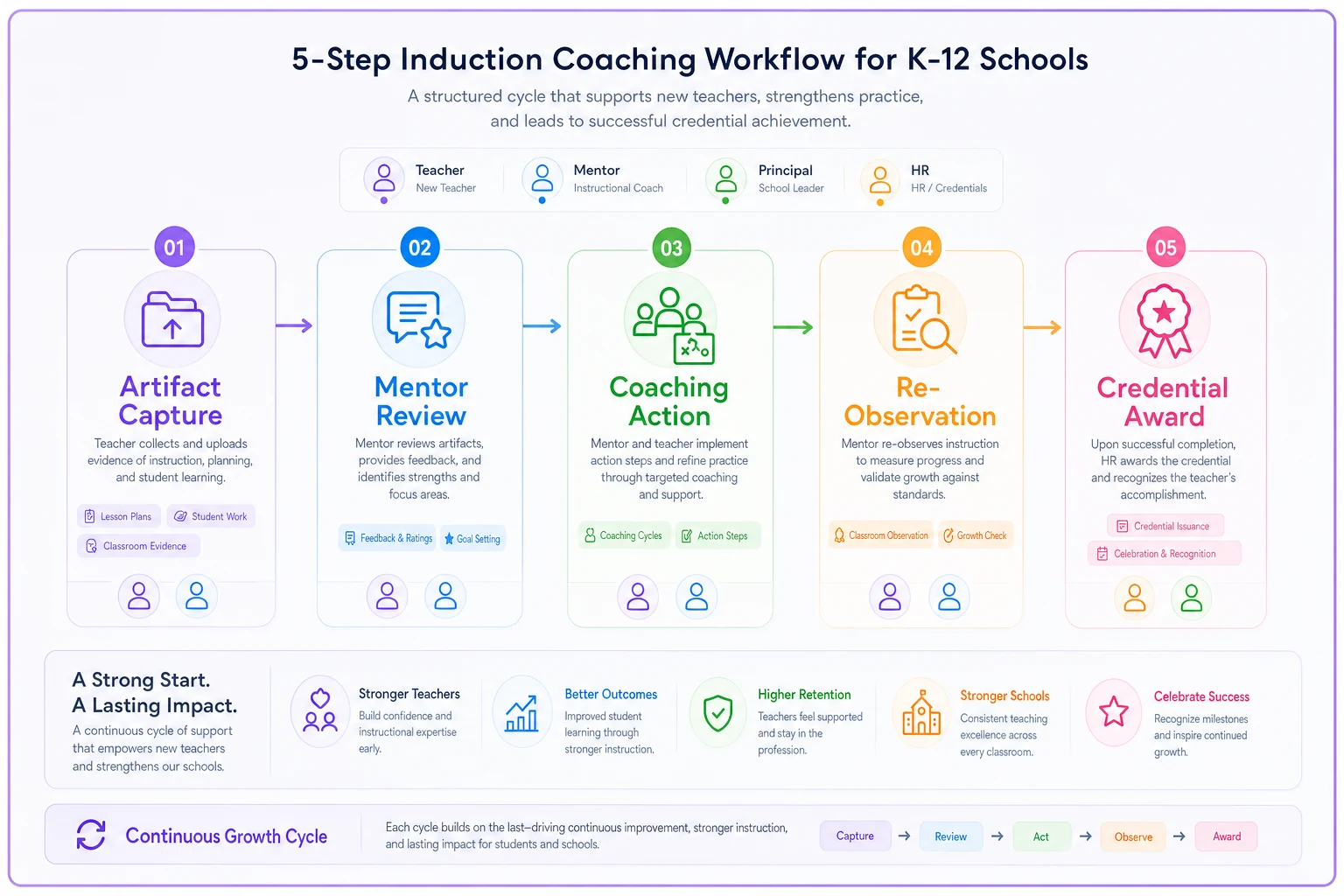
The workflow that holds up under load looks like this:
-
Observation or artifact captured and tagged to a specific competency (not the whole rubric).
-
Mentor reviews the evidence within 48 hours and identifies one gap — just one.
-
A coaching action is assigned that directly targets that gap, with a date to re-observe.
-
Re-observation confirms the skill or restarts the cycle.
-
Credential is awarded only after the skill shows up consistently, and the milestone flips in the HR record.
A quick visual helps teams see the handoffs that must be fast and visible.
Don't. Sample. Two or three competencies per checkpoint, rotated, gives you a truer picture than a rushed sweep of all eight.
The tight turnaround matters. When feedback lands more than a few days after the lesson, the teacher has already moved on and the coaching feels abstract. Districts that already run a fast observation-to-coaching handoff have a real head start; if that pipeline is shaky, fix it first, because the induction loop runs on top of it. The mechanics of turning observations into same-week improvement cycles are essentially the engine that makes 30/60/90 checkpoints actually move.
One recurring mistake: schools try to collect evidence on every competency at every checkpoint. Don't. Sample. Two or three competencies per checkpoint, rotated, gives you a truer picture than a rushed sweep of all eight. Over-collection burns out mentors faster than anything else — and burned-out mentors are the reason most induction programs quietly die by November.
A real scenario: a mid-size district cleaning up its induction
A district onboarding around 45 new teachers a year had the classic three-silo setup. HR reported 100% "induction completion." First-year retention was hovering around 78%, and principals privately admitted they couldn't tell which struggling teachers had actually gotten support versus a signature.
The core issue surfaced quickly: mentor logs showed meetings, but there was no shared evidence anyone else could see. When a teacher was let go mid-year, HR had a folder of completed trainings and nothing that documented whether coaching had actually happened. That's a legal and ethical exposure, not just an operational one.
They rebuilt around a 90-day evidence loop with six competencies and 30/60/90 checkpoints. Nothing exotic — they reused their existing observation form and just recoded it to competencies instead of a single rating.
Results after the first full year weren't dramatic on paper, but they were the right kind of change. First-year retention moved into the mid-80s. More telling: at the 60-day checkpoint, principals identified four teachers who needed intervention early enough to actually help two of them. Under the old system, those four wouldn't have surfaced until spring. HR also reported that the milestone records cut their end-of-year documentation scramble by what they described as days, not hours — because the competence trail was already built as the year happened.
The mentors' feedback was the quiet win. Because they were coaching toward defined credentials instead of improvising, newer mentors performed almost as consistently as the veterans. The variability that usually decides a new teacher's fate shrank noticeably.
Where the tools actually help — and where they don't
Most of this is a design and discipline problem, not a software problem. You can run a 30/60/90 evidence loop on shared spreadsheets and a folder structure, and plenty of small schools should start exactly there.
Where a workflow platform earns its keep is at scale and coordination. Once you're past roughly 25–30 new hires, the manual version starts leaking. Artifacts don't get tagged. Milestones don't sync to HR. A mentor forgets a re-observation date and nobody notices until the next checkpoint. The failure is never one big thing — it's a hundred small handoffs that quietly drop.
A platform that lets you attach evidence to a competency, auto-flip an HR milestone when a credential is earned, and surface overdue coaching actions removes the coordination tax. That's the honest use case: it doesn't make induction better, it keeps a well-designed induction from silently falling apart under volume. If your design is bad, software just helps you fail faster.
The related trap is confusing tracking with development. A dashboard full of green checkmarks can mask a program where no real coaching is happening. Keep a human accountable for reading the evidence, not just watching the status bars.
When this system makes sense — and when it doesn't
When it's clearly worth it:
-
You're onboarding more than a handful of teachers a year and mentor quality varies.
-
You've had a termination or retention issue where documentation was thin.
-
Your PD and induction feel disconnected from actual classroom practice.
When to keep it lighter:
-
A small school with one or two hires and a strong, present mentor. A shared doc and weekly check-in may genuinely be enough.
-
A year where leadership itself is in transition — don't launch a new evidence system when the people who'd run it are unstable.
Who should hold off entirely: any building where observations currently function as "gotcha" events. If teachers experience evidence collection as a threat, the whole loop poisons trust before it produces growth. Fix the coaching culture first. The same logic applies to PD generally — induction credentials sit on top of your professional learning system, and if that system fizzles, the credentials become hollow. It's worth aligning this work with the broader approach to linking PD, coaching, and accountability cycles so induction isn't a separate initiative competing for the same attention.
Making it HR-ready without turning it into paperwork
Principals think in competencies and coaching. HR thinks in milestones, dates, and defensibility. The evidence loop only works long-term if it serves both without making anyone do double entry.
The trick is designing competence milestones so they're generated as a byproduct of the coaching work, not as a separate report. When a credential is earned, the milestone should record itself — date, evidence reference, status. When a teacher is flagged at a checkpoint, that flag and the support that followed should live in the same record. Done right, the spring summative practically writes itself, and if a personnel decision ever needs to be defended, the documentation is already coherent because it was built in real time.
That's the whole point of integrating induction, micro-credentials, and a 90-day evidence loop: you stop running three programs that each produce a partial truth, and start running one system where onboarding, skill-building, and classroom reality reinforce each other. New teachers get earlier, clearer support. Principals get a real read months before the old timeline allowed. And HR gets records that reflect actual competence instead of attendance — which, in the end, is the only thing induction was ever supposed to certify.
Ready to elevate your classroom management?
Join 5,000+ educators using Skolyly to save time, engage students, and improve learning outcomes.