


Instructional coaches observe somewhere between 3 and 5 teachers per day during walkthroughs. That's 15–25 observations a week, 60–100 a month. Yet most coaching cycles still take 8–12 weeks before you see any measurable shift in teaching practice.
The breakdown happens in that window between the observation and the next coaching conversation. A teacher gets feedback on Tuesday, but by Friday's follow-up, neither the coach nor the teacher can clearly remember the specific moment that triggered it. The coaching gets generic. Improvement stalls.
The Missing Link Between Classroom Visits and Actual Teacher Growth
What makes this worse is how most observation-to-coaching workflows actually operate. Coaches fill out detailed forms, schedule debrief meetings days later, then wonder why teachers can't connect the feedback to what actually happened in their classroom. The observation data exists — it's the bridge between what was seen and what needs to change that's missing.
The observation data exists — it's the bridge between what was seen and what needs to change that's missing.
Why Traditional Coaching Cycles Break Down
Most instructional coaching follows a pretty predictable arc: pre-observation conference, formal observation, post-observation debrief, repeat in 2–3 weeks. Between those touchpoints, teachers are implementing changes on their own while coaches move on to other classrooms.
Keep every student on track with ease.
Skolyly helps you create, assign, and monitor classroom activities efficiently.
- Integrated lesson and assignment management
- Real-time student progress tracking
- Automated class scheduling & notifications
No credit card required
That gap creates three real problems.
First, specificity evaporates. When a teacher is struggling with student engagement during independent work time, waiting three days to discuss it means both parties are reconstructing the moment from memory. Second, momentum dies. Teachers leave debriefs motivated, but without structured check-ins, that energy is usually gone by week two. Third, evidence becomes anecdotal. Without systematic tracking between observations, coaches end up relying on general impressions rather than documented patterns.
The traditional model assumes teachers can take broad feedback and translate it into daily practice on their own. But classroom teaching involves hundreds of micro-decisions per hour. A teacher who hears "improve your questioning techniques" might interpret that a dozen different ways, and most won't match what the coach actually saw.
Building a Focused Observation Rubric That Actually Works
Forget comprehensive rubrics with 40-something indicators across eight domains. Those belong in formal evaluations, not coaching cycles. A focused observation rubric for coaching contains exactly four elements tied to one specific skill.
Pick one instructional move you're targeting. Maybe it's wait time after questions. Your rubric tracks four observable behaviors:
-
Teacher asks a question and pauses 3+ seconds
-
Teacher resists calling on the first hand raised
-
Teacher uses non-verbal cues during wait time
-
Teacher acknowledges multiple perspectives before responding
That's it. Four checkboxes, one skill. The coach can mark these during a 15-minute observation without looking away from instruction.
Use the four-checkbox rubric during short observations so coaches can track frequency without taking their eyes off instruction.
Compare that to standard district rubrics asking coaches to simultaneously evaluate classroom environment, instructional delivery, assessment practices, differentiation, and student engagement. Those tools serve their purpose for formal evaluations, but they dilute coaching conversations. When everything is a priority, nothing actually changes.
The focused rubric also shifts how teachers receive feedback. Instead of hearing "your questioning could be stronger," they hear "you gave wait time 3 out of 11 times when asking higher-order questions." Specific, countable, improvable.
The Two-Point Feedback Script That Teachers Remember
After observing with a focused rubric, resist the urge to share everything you noticed. Cognitive load research is pretty clear that people can only process and retain about two pieces of instructional feedback at once — especially when they're managing daily teaching responsibilities on top of it.
Affirmation point: "When you had students turn-and-talk before sharing whole-group answers, six more students participated than yesterday. That strategy directly increased engagement." Growth point: "You provided wait time after 3 of your 11 higher-order questions. Let's target increasing that to 7 out of 11 by focusing on second period first."
Notice the difference: specific observed behavior, quantifiable data, targeted improvement goal. Not "try to give more wait time" — but "increase from 3 to 7 instances in second period."
This constraint forces coaches to prioritize. You might notice ten things in a single observation. But flooding teachers with feedback creates paralysis, not progress. The two-point script keeps focus without stripping away teacher agency or confidence.
Some coaches worry this approach ignores important issues. But concentrated improvement in one area tends to have spillover effects. A teacher who gets good at wait time naturally improves student discourse, which improves engagement, which reduces behavior issues. Single-point focus doesn't mean single-point impact.
Creating 3-Week Micro-Goals Instead of Semester Plans
Traditional coaching cycles set goals like "improve student engagement by the end of the semester." Those distant targets lack urgency and specificity. Micro-goals flip the timeline entirely.
-
Week 1 Practice the skill in one class period daily
-
Week 2 Extend to two class periods, refine based on Week 1 data
-
Week 3 Implement across all classes, document evidence of impact
For wait time specifically, it might look like:
-
Week 1
Use 3-second wait time in second-period math only, track instances
-
Week 2
Add fourth period, aim for 70% consistency
-
Week 3
All math classes, document change in student participation rates
These compressed cycles create momentum. Teachers see results quickly, which builds enough confidence to tackle the next cycle. Coaches can support 4–5 teachers at once because each cycle has clear parameters and a defined endpoint.
The 3-week structure also fits naturally with teaching rhythms. Most units run 2–4 weeks, so teachers can practice new skills inside familiar content rather than juggling instructional changes alongside brand-new curriculum. That matters for implementation fidelity.
Evidence Checklists and Tracking Cards for Follow-Through
The gap between feedback and follow-up is where most coaching breaks down. Teachers intend to change their practice but have no system to track their own progress between visits.
An evidence checklist turns intentions into actual data. For wait time:
Daily Tracking Card — Week 1
-
[ ] Used wait time in target class period
-
[ ] Counted instances (tally
____)
-
[ ] Noted one student response that surprised me
-
[ ] Identified one moment where wait time felt uncomfortable
Thirty seconds to fill out. But it creates accountability and reflection. Teachers aren't just practicing the skill — they're documenting it.
Coaches collect these cards weekly, not daily. That respects teacher autonomy while still maintaining touchpoints. During a 5-minute weekly check-in, coach and teacher review the cards together, note what's working, and adjust where needed.
Here is a simple workflow to visualize how observation, tracking cards, and brief check-ins create a tight improvement loop.
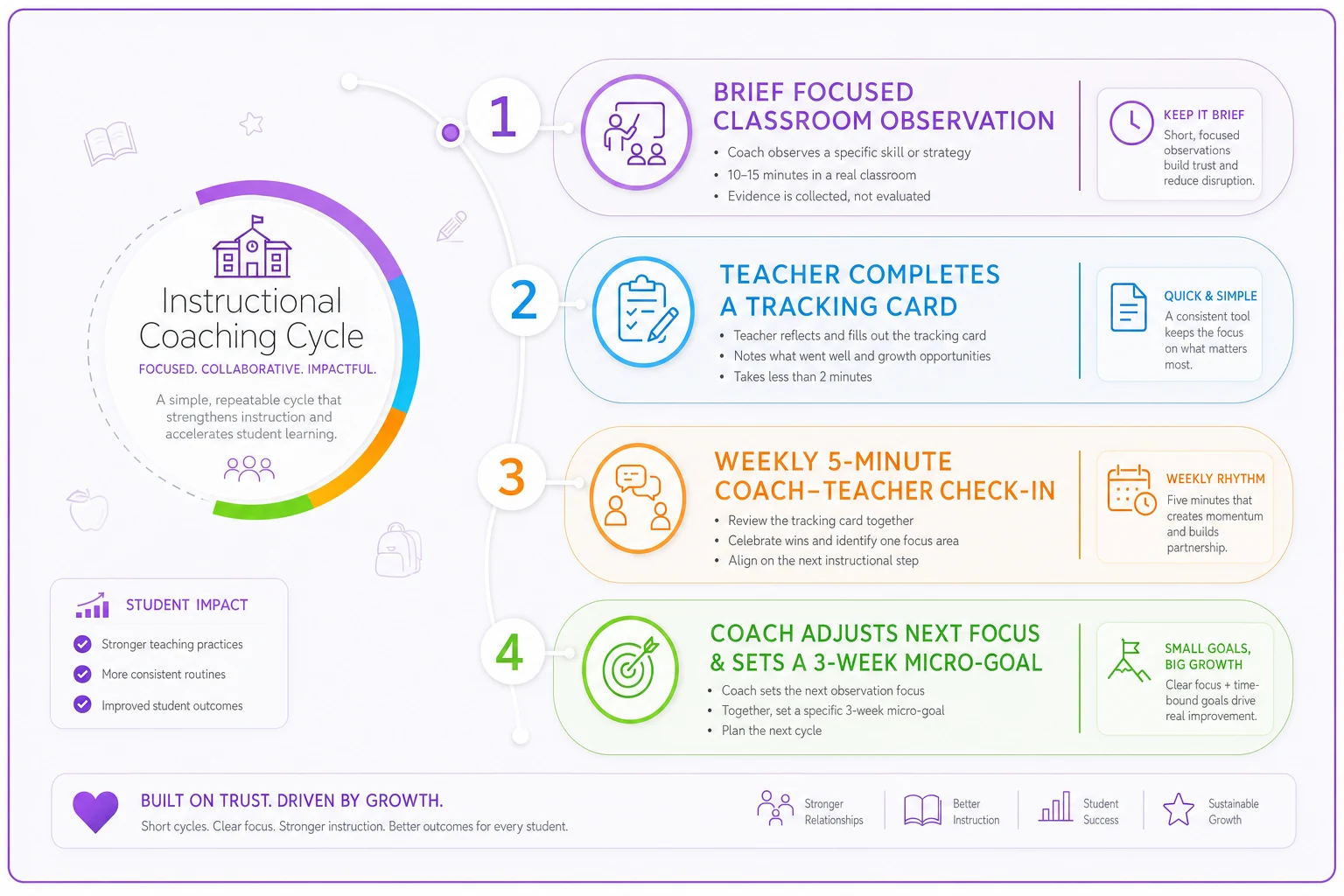
The tracking card does three things: it creates evidence of implementation, helps teachers notice patterns in their own practice, and gives coaches data to guide the next observation focus.
Some teachers initially push back on tracking cards as "one more thing." But unlike lesson plan requirements or standardized assessment cycles, these cards exist to serve the teacher's own growth. They're not compliance documents — they're progress markers.
When This Coaching Workflow Makes Sense (And When It Doesn't)
This approach works best for teachers who have classroom management reasonably under control and are ready to refine specific instructional practices — typically second-year teachers through veterans who've plateaued and want to push past it.
It works particularly well for:
-
Schools with part-time instructional coaches juggling multiple responsibilities
-
Districts trying to shift from evaluative to growth-focused coaching
-
Teams working on school-wide instructional initiatives needing consistent implementation
-
Coaches supporting 8–12 teachers who need regular but not intensive contact
It breaks down for:
-
First-year teachers who need support across multiple domains simultaneously
-
Crisis intervention situations requiring daily coaching presence
-
Teachers on formal improvement plans with legal documentation requirements
-
Schools without protected coaching time built into the schedule
The model assumes baseline competence. A teacher struggling with classroom management can't meaningfully focus on wait time techniques at the same time. They need fundamental support first, then can move into focused improvement cycles.
Avoiding Common Implementation Mistakes
The first mistake is choosing goals that are too abstract. "Increase rigor" isn't observable in a 15-minute walkthrough. "Ask three analysis-level questions per lesson" is. The focused rubric must contain behaviors you can literally see and count.
The second mistake is expanding the rubric after initial success. A teacher masters wait time, so the coach adds checking for understanding, differentiation, and student discourse. Suddenly the focused tool becomes another comprehensive checklist. Resist the scope creep — complete one cycle, acknowledge the progress, then start fresh with a new single focus.
The third mistake is skipping evidence collection between observations. Coaches get busy, teachers forget the tracking cards, and three weeks pass with no data except memory. The tracking card isn't optional. It's what keeps momentum alive between conversations.
The fourth mistake is treating all teachers identically. A veteran comfortable with experimentation might thrive with ambitious micro-goals. A struggling third-year teacher might need smaller targets and more frequent check-ins. The framework stays consistent; the implementation has to flex.
Integrating With Existing School Systems
This workflow doesn't replace formal evaluation systems — it supplements them by creating rapid improvement cycles between official observations. Think of formal evaluations as annual physicals and coaching cycles as weekly training sessions.
Most schools already have coaches doing observations. This framework just structures those observations for better impact. Instead of general walkthroughs, coaches observe with specific rubrics. Instead of broad feedback, they deliver focused two-point scripts. Instead of hoping for follow-through, they track evidence.
The model connects to existing professional development work too. If your school is focused on differentiation strategies this year, coaching cycles can target specific differentiation techniques one at a time. The PD provides the why and what; coaching cycles provide the how and when.
For schools using digital coaching platforms, tracking cards can become simple digital forms. Teachers input data directly or photograph their paper cards. The medium matters less than the consistency of collection.
Making It Sustainable With Limited Resources
An instructional coach supporting 10 teachers needs roughly 3 hours weekly to maintain this system:
| Task | Time per Teacher | Total (10 Teachers) |
|---|---|---|
| Focused classroom observation | ~15 minutes | ~2.5 hours |
| Evidence card review | ~3 minutes | ~30 minutes |
| Total weekly | ~3 hours |
Compare that to traditional coaching with hour-long pre-conferences, full-period observations, and extended debriefs. The focused model delivers more frequent touchpoints with significantly less time investment.
Schools without full-time coaches can adapt this using department heads or teacher leaders. The observation rubric is simple enough that you don't need extensive coaching training to use it. A math department head can observe for wait time just as effectively as a certified instructional coach.
Tracking cards require no special resources — index cards, sticky notes, half-sheets of paper, a small notebook, whatever fits how a teacher already organizes their work. Format flexibility increases adoption.
For schools looking to get more out of their coaching data, AI-powered operational software can help aggregate tracking card patterns across multiple cycles and flag when someone might need additional support. But the core framework functions fine without any digital tools at all.
Building Momentum Through Visible Wins
Teachers need to see impact quickly. The 3-week cycle delivers visible wins that longer coaching models simply can't match.
After three weeks on wait time, a teacher might notice two or three typically quiet students now participating regularly, more depth in student responses, less repetition needed for directions, and higher engagement during discussions. These aren't dramatic transformations. But they're noticeable, and they're evidence that intentional practice leads to something real. That's what keeps teachers invested in the next cycle.
Coaches should track these wins consistently — a simple spreadsheet with each teacher's micro-goals and outcomes works fine. After a few cycles, patterns surface. Some teachers are strong at implementation but need help with goal-setting. Others aim high but need more support with daily consistency. Those patterns shape how coaches differentiate their support going forward.
The Compound Effect of Focused Cycles
Six 3-week cycles is one semester. A teacher who completes six focused cycles has systematically improved six specific instructional techniques and, more importantly, built the habit of intentional practice with evidence to show for it.
These cycles compound. Wait time leads to better questioning. Better questioning produces richer discourse. Richer discourse increases engagement. Each cycle builds on what came before.
It compounds at the school level too. When multiple teachers are simultaneously working on the same skill, they start talking about strategies, sharing what works, comparing what they're noticing in their own classrooms. The coaching cycle becomes a catalyst for professional learning communities rather than an isolated one-on-one process.
Observations become data points rather than judgment moments. Feedback becomes specific and actionable rather than overwhelming. Follow-through becomes systematic rather than hopeful. Most importantly, both teachers and coaches can point to concrete evidence of growth — not vague improvements in "teaching quality," but specific, documented changes in classroom practice that connect directly to student learning. That specificity is what separates coaching that feels supportive from coaching that actually moves instruction forward.
Observations become data points rather than judgment moments. Feedback becomes specific and actionable rather than overwhelming. Follow-through becomes systematic rather than hopeful. Most importantly, both teachers and coaches can point to concrete evidence of growth — not vague improvements in "teaching quality," but specific, documented changes in classroom practice that connect directly to student learning. That specificity is what separates coaching that feels supportive from coaching that actually moves instruction forward.
Ready to elevate your classroom management?
Join 5,000+ educators using Skolyly to save time, engage students, and improve learning outcomes.