


Every August, schools roll out ambitious formative assessment plans. By November, maybe three teachers still use them consistently. The rest? Back to whatever they were doing before.
This pattern destroys more than just data collection. When teachers abandon assessment systems, schools lose visibility into student progress, instructional coaches waste time chasing down missing data, and administrators make decisions based on incomplete information. Meanwhile, the teachers who actually need coaching support the most become invisible in the data.
The fundamental problem isn't teacher resistance or lack of training. Most school-wide formative assessment cycles are built backwards—starting with what administrators want to measure instead of what teachers can realistically sustain during an actual teaching day.
Why assessment systems fail at the classroom level
Traditional assessment rollouts follow a predictable death spiral. Leadership picks a platform, schedules professional development, creates elaborate rubrics, then expects teachers to completely restructure their workflow around data entry.
What actually happens in classrooms is a different story. Teachers face an enormous number of decisions every class period. They're managing behavior, differentiating instruction, responding to IEP requirements, and trying to actually teach content. When your assessment system requires teachers to log into three different platforms, cross-reference standards, and spend 20 minutes entering data after each lesson, it becomes the first thing they drop when things get hectic.
The breaking point usually hits around week six. That's when the reality of grading, parent conferences, and everyday classroom chaos collides with the theoretical assessment schedule created in July. Teachers start skipping entry days. Data gets backlogged. Coaches stop getting the information they need for observations. Within two months, your carefully designed system becomes another abandoned initiative.
Schools typically respond by adding more accountability measures—mandatory data meetings, submission deadlines, compliance tracking. This creates a vicious cycle where assessment becomes punitive rather than instructive. Teachers learn to game the system, entering minimum viable data to avoid scrutiny rather than using assessments to actually improve instruction.
The hidden operational costs of fragmented assessment
When formative assessment systems fragment, the damage spreads across your entire instructional operation. Consider what happens in a typical middle school with 42 teachers across six grade levels.
Keep every student on track with ease.
Skolyly helps you create, assign, and monitor classroom activities efficiently.
- Integrated lesson and assignment management
- Real-time student progress tracking
- Automated class scheduling & notifications
No credit card required
Without consistent assessment data, instructional coaches spend a huge chunk of their time just figuring out which teachers need support. They're walking classrooms, sitting through lessons, trying to identify patterns that should already be visible in assessment data. That's hours per week of highly paid coaching time spent on basic reconnaissance instead of actual instructional improvement.
Grade-level teams lose their primary feedback loop for curriculum adjustments. When only half the team submits assessment data, you can't identify whether students are struggling with the content or the instruction. Teams end up making curriculum decisions based on whoever speaks loudest in meetings rather than actual student performance data.
The administrative burden multiplies from there. Department heads spend hours chasing down missing assessments, reconciling different data formats, and creating reports from incomplete information. A process that should take 90 minutes weekly becomes a two-day scramble every time the district requests performance data.
Most damaging, teachers who genuinely want to use assessment data for instruction can't trust the system. When they know their colleagues aren't participating consistently, they stop investing effort in their own data quality. Why spend time on detailed assessment notes when the grade-level data will be meaningless anyway?
Building assessment routines that survive contact with reality
Successful school-wide formative assessment cycles share one critical characteristic: they integrate into existing teacher workflows rather than creating new ones. This means designing around the natural rhythm of classroom instruction, not imposing an artificial schedule from above.
Start with the absolute minimum viable assessment. Not minimum for administrators—minimum for teachers to get actionable feedback about their instruction. For most subjects, this means one common formative assessment every two weeks, taking no more than 10 minutes of class time and 5 minutes of data entry.
Here's what that looks like operationally:
Week A (Assessment Week):
-
Monday
Teachers receive the assessment template (pre-built, standards-aligned, no customization needed)
-
Tuesday-Thursday
Teachers administer during natural transition points in their lessons
-
Friday
Data entry window (must be completable in under 5 minutes)
Week B (Application Week):
-
Monday
Coaches receive aggregated data reports
-
Tuesday
Grade teams review patterns (15-minute standing meeting)
-
Wednesday-Thursday
Coaches conduct targeted observations based on data
-
Friday
Individual teacher coaching as needed
The key difference from typical systems: teachers don't create assessments, choose standards, or customize rubrics. They receive a ready-to-use tool that requires zero prep time. The cognitive load shifts from teachers to the instructional support team, who handle the technical aspects of assessment design and data aggregation.
Administer assessments during natural transition points to minimize instructional disruption.
The cognitive load shifts from teachers to the instructional support team, who handle the technical aspects of assessment design and data aggregation.
The technical infrastructure that makes adoption inevitable
Most assessment systems fail because they require teachers to become data analysts. Successful systems do the opposite—they make data entry so frictionless that compliance becomes easier than non-compliance.
Your assessment platform needs three non-negotiable features:
-
Single-point entry Teachers enter data once, in one place, without switching between systems. This sounds obvious but most schools require teachers to enter grades in one system, formative data in another, and attendance in a third. Every additional login reduces compliance noticeably.
-
Automatic aggregation Individual assessment data should flow automatically to grade-level dashboards, coaching reports, and administrative summaries. Teachers should never manually compile or submit reports.
-
Mobile-responsive design Teachers need to enter data from wherever they are—classroom, hallway, cafeteria duty. If your system requires desktop access, you've already lost.
The technical setup should eliminate excuse pathways. When teachers can enter assessment data from their phone in 30 seconds while students transition between activities, "I didn't have time" stops being valid. When data automatically populates coaching dashboards, "I forgot to submit" becomes irrelevant.
Defining roles that create mutual accountability
Clear role definition prevents assessment systems from becoming another task dumped entirely on teachers. Each role needs specific responsibilities tied to the assessment cycle:
Teachers:
-
Administer provided assessments during specified windows
-
Enter raw scores (not analysis or interpretation)
-
Implement one specific instructional adjustment based on coaching feedback
Instructional Coaches:
-
Design and distribute assessment templates
-
Analyze aggregated data for patterns
-
Provide three targeted teachers with specific instructional modifications each cycle
-
Track implementation of recommended changes
Grade Level Leads:
-
Facilitate 15-minute data review meetings
-
Identify curriculum adjustments needed based on assessment trends
-
Communicate changes to teaching teams
Department Heads:
-
Monitor system-wide compliance without chasing individual teachers
-
Adjust assessment schedules based on school calendar realities
-
Report trends to administration with actionable recommendations
Each role has concrete, measurable deliverables. This creates positive peer pressure—when coaches don't analyze data, teachers notice they're not getting feedback. When teachers don't enter scores, coaches can't do their job. The system becomes self-reinforcing rather than requiring constant administrative enforcement.
The coach-teacher handoff that determines success
Data Window Closes (Friday, 3 PM): The system automatically locks assessment entry and generates coach dashboards. No late submissions, no exceptions. This sounds harsh but creates predictability teachers can plan around.
Initial Analysis (Monday, before 8 AM): Coaches receive three automated reports: students below proficiency by standard, teachers with unusual score distributions, and comparison to previous assessment cycles. This pre-analysis eliminates hours of manual data review.
Coaching Triage (Monday, by noon): Coaches identify their three focus teachers for the cycle. Not the three lowest performing—the three where targeted intervention will create the most improvement. This might be a second-year teacher struggling with checking for understanding, not the veteran who's been phoning it in for five years.
Observation Schedule (Monday, end of day): Coaches schedule 15-minute observations with focus teachers. Not full lessons—targeted observations looking for specific instructional elements identified in the assessment data.
Feedback Delivery (Wednesday): Coaches provide written feedback with one specific, implementable change. Not three suggestions or a comprehensive instructional overhaul—one concrete adjustment the teacher can make immediately.
Implementation Check (Following Monday): Coaches verify implementation through a five-minute walkthrough. Did the teacher make the recommended change? Binary yes or no, recorded in the system.
A visual of this handoff clarifies roles and timing.
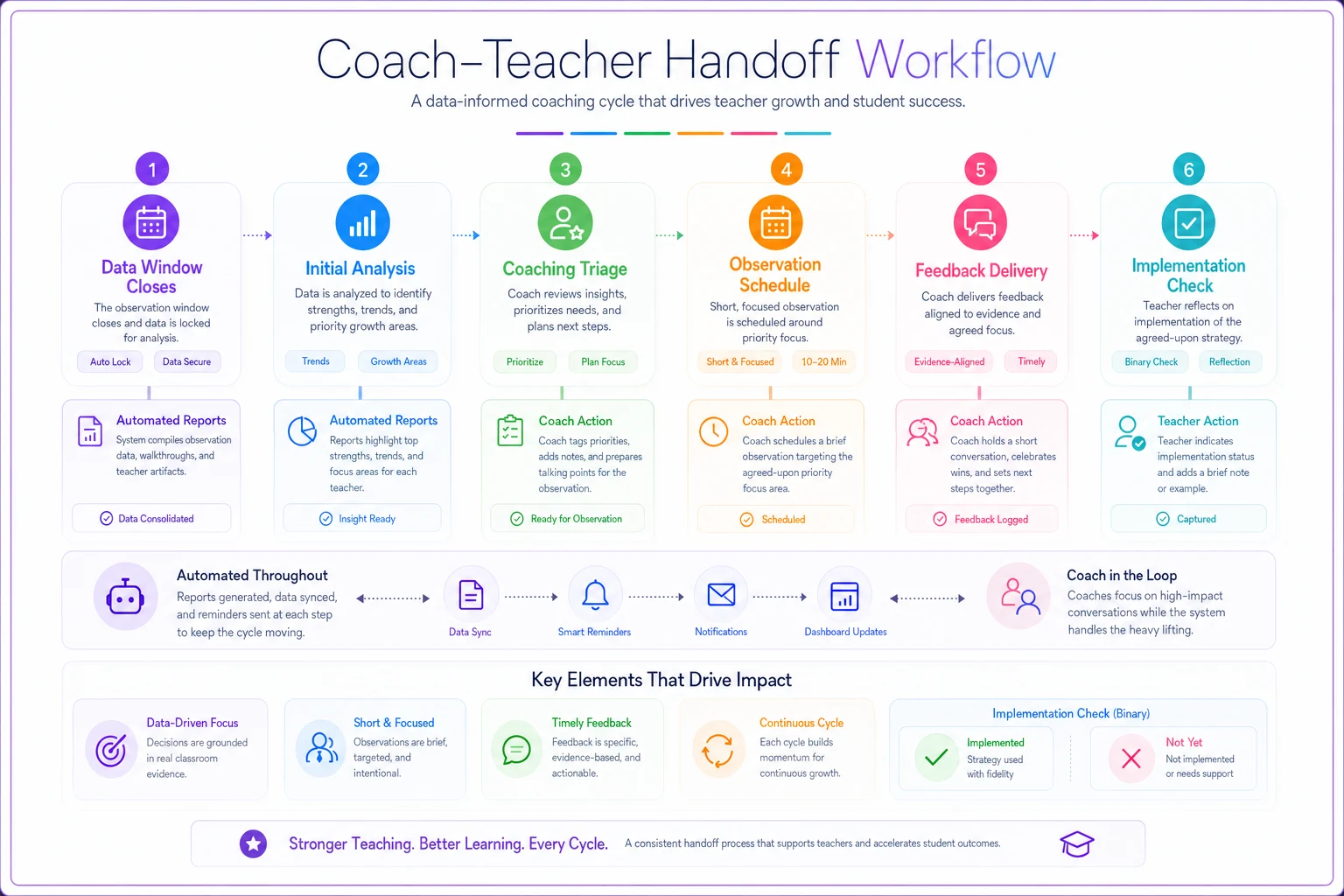
This handoff structure removes ambiguity. Teachers know exactly when they'll receive feedback and what they're expected to do with it. Coaches know exactly how many teachers they need to support and how to prioritize their time.
Creating low-friction assessment templates teachers actually use
The assessment template determines whether teachers engage with your system or abandon it. Most districts create elaborate assessment structures that require teachers to understand backward design, standards alignment, and data analysis. These templates die in September.
Pre-built structure: Everything except student responses is predetermined. Question types, point values, standards alignment, and proficiency calculations are locked. Teachers can't modify the assessment even if they want to.
Natural integration points: Assessments fit into existing lesson structures without requiring special scheduling. Exit tickets, warm-ups, or checkpoint problems that teachers already use—just standardized and trackable.
Instant scoring capability: Teachers can score the entire class in under five minutes. This means selected response, numerical answers, or simple rubrics only. No open-ended responses requiring interpretation.
Here's what a sustainable template structure looks like for different subjects:
| Subject | Format | Admin Time | Scoring Time | Data Points |
|---|---|---|---|---|
| Math | 5 problems (3 skill, 2 application) | 7 minutes | 3 minutes | Skill proficiency, problem-solving approach |
| ELA | 1 passage, 4 questions, 1 writing prompt | 12 minutes | 5 minutes | Comprehension, text evidence, writing structure |
| Science | 1 phenomenon, 3 explanation items | 10 minutes | 4 minutes | Concept understanding, scientific reasoning |
| Social Studies | 1 source, 3 analysis questions | 8 minutes | 3 minutes | Source analysis, historical thinking |
These templates work because they respect the reality of classroom time. A seven-minute math assessment can happen during the natural transition between instruction and independent practice. A twelve-minute ELA assessment replaces one bell-ringer activity every two weeks.
The weekly routines that maintain momentum
Sustainable assessment cycles require protected routines that become automatic rather than scheduled. The difference between a system that survives and one that dies is whether these routines feel like additional work or natural extensions of existing practices.
Monday Planning Block (7:30-7:45 AM): Grade-level teams receive their assessment analysis automatically. No meeting, no discussion—just 15 minutes to review data independently and identify personal focus areas for the week.
Wednesday Check-in (during common planning): Ten-minute standing meetings where teams share one instructional adjustment they're making based on assessment data. Not what students are struggling with—what teachers are changing.
Friday Reflection (last 5 minutes of planning period): Teachers record one observation about the week's instruction in the system. What worked? What didn't? This becomes the baseline for the next assessment cycle.
These routines work because they're brief, focused, and happen during existing time blocks. No additional meetings, no after-school obligations, no weekend data analysis. The assessment cycle fits within the natural rhythm of the school week.
Technology that reduces friction instead of adding complexity
Schools often select assessment platforms based on features rather than workflow integration. The platform with the most detailed analytics usually requires the most complex data entry. The system with beautiful dashboards typically demands extensive training to navigate.
Captures data at the point of instruction: Teachers enter scores immediately after assessment, not hours or days later. This means mobile-first design, offline capability, and interfaces simple enough to use while managing a classroom.
Automates everything except teaching decisions: The system handles standards alignment, proficiency calculations, report generation, and trend analysis. Teachers make instructional decisions; technology handles everything else.
Provides answers, not just data: Instead of showing teachers that 62% of students missed question 4, the system explains what misconception that reveals and suggests specific reteaching strategies.
The technology stack should be invisible to teachers. They see a simple entry screen and receive clear feedback. All the complex data processing, standards mapping, and analytical heavy lifting happens in the background.
When schools use AI-powered operational software for assessment management, the technology learns patterns over time. It identifies which teachers need which types of support, which assessment items actually predict student success, and which instructional interventions create measurable improvement. The system gets more useful each cycle, reducing the analytical burden on coaches while improving the quality of instructional feedback.
Scaling beyond the pilot without losing quality
Most successful assessment pilots die during scaling. The enthusiastic early adopters who made the pilot successful get diluted among reluctant participants. The careful support structures that enabled success become impossible to maintain across an entire school.
Scaling requires a different operational approach than piloting. Instead of trying to replicate pilot conditions across all teachers, you create systematic processes that achieve acceptable results with minimal support.
Start with grade-level scaling rather than school-wide implementation. Get one entire grade level running successfully before expanding. This creates proof of concept with similar students and content, making it harder for other grades to claim the system won't work for them.
Build coach capacity before teacher compliance. If you have six grade levels but only two instructional coaches, you can't support school-wide implementation regardless of teacher buy-in. Either hire additional coaches, train teacher leaders as assessment liaisons, or stagger implementation across semesters.
Create visible wins early and often. Post grade-level assessment data publicly (anonymized but comparative). Celebrate teachers who show improvement trends, not just high scores. Make success social and visible so non-participants feel left out rather than relieved.
Most importantly, accept that 100% compliance is fantasy. Design your system to provide value with 80% participation. If your assessment cycle requires every teacher to participate perfectly for the data to be meaningful, you've already failed. Build redundancy and overlap so that partial participation still generates actionable insights.
The money conversation nobody wants to have
Sustainable assessment systems require sustained funding, but most schools treat them as one-time initiatives. You buy the platform, train the teachers, then expect the system to run itself. This thinking kills more assessment programs than teacher resistance ever will.
Technology Platform: $8,000-15,000 annually for a system that actually works at scale. The free or cheap options create more friction than value.
Coach Time Allocation: Around 20 hours per week of coach time dedicated to assessment analysis and teacher support. At typical coach salary, that's roughly $35,000 in dedicated personnel cost.
Teacher Planning Time: 30 minutes per teacher per week for assessment-related activities. That's a meaningful chunk of instruction time weekly that needs coverage or adjustment.
Training and Support: $5,000 annually for ongoing training, not just initial rollout. Assessment systems require constant refinement and retraining as staff turns over.
The total annual investment approaches $60,000 for a mid-sized school. But compared to the cost of failed interventions, repeated curriculum purchases, and lost instructional time from poor teaching decisions, it's a fraction of the waste created by operating without good assessment data.
The schools that succeed at formative assessment budget for it like they budget for textbooks or technology—as an essential operational expense, not a discretionary initiative. Without assessment data, every other instructional investment becomes a guess.
What this actually looks like in practice
Harrison Middle School implemented this exact system after three failed assessment initiatives in five years. They started with just seventh grade, 12 teachers across core subjects.
The first month was rough. Teachers complained about the rigid templates. Coaches felt overwhelmed by the data analysis requirements. The principal fielded multiple requests to "just go back to what we were doing."
By month three, patterns started emerging. The math department identified that a large majority of students struggled with fraction operations—not because they didn't understand fractions, but because they couldn't identify when to use them in word problems. That single insight changed how they taught application problems across all seventh-grade math classes.
The ELA team discovered that reading comprehension scores directly correlated with whether teachers explicitly taught context clues strategies. Three teachers who weren't teaching this added it to their instruction. Reading scores for their classes improved noticeably over the next assessment cycle.
By the end of year one, seventh-grade state test scores improved more than any other grade in the district. Not dramatic improvement—around 8% overall—but consistent across all subjects and student groups. More importantly, teachers started requesting expansion to eighth grade because they wanted the same data their seventh-grade colleagues were getting.
The system now covers grades 6-8, with 34 of 38 core teachers participating consistently. The four holdouts are approaching retirement and the administration decided fighting them wasn't worth the energy. The system provides valuable data with close to 90% participation, proving you don't need perfection to get results.
The path forward requires choosing sustainability over sophistication
Schools face a choice with formative assessment: build a sophisticated system that captures every nuance of student learning, or build a sustainable system that captures enough information to improve instruction. The sophisticated systems make beautiful presentations to school boards. The sustainable systems actually improve teaching.
Start with the minimum viable assessment that teachers will actually use. Reduce friction at every step—from assessment design to data entry to feedback delivery. Build technology infrastructure that makes participation easier than non-compliance. Create role clarity that distributes responsibility beyond classroom teachers. Establish routines that fit within existing schedules rather than requiring additional time.
Accept that partial implementation with high consistency beats perfect implementation with low adoption every time. Your formative assessment cycle should be the teaching equivalent of brushing your teeth—so simple and habitual that skipping it feels wrong.
The schools succeeding with formative assessment aren't the ones with the best platforms or the most comprehensive rubrics. They're the ones that built systems teachers actually use, week after week, month after month. They chose operational sustainability over theoretical perfection, and their students are better for it.
When you design your school-wide formative assessment cycle around the reality of teaching rather than the theory of assessment, adoption stops being aspirational and starts becoming inevitable. Teachers participate not because they're required to, but because the system makes their instruction better with less effort than they were expending before. That's when formative assessment stops being another initiative to abandon and becomes an essential part of how your school operates.
Ready to elevate your classroom management?
Join 5,000+ educators using Skolyly to save time, engage students, and improve learning outcomes.