

Most schools didn't decide to start collecting behavioral data. It just accumulated. A counselor started logging office referrals in a spreadsheet. A grade-level team added a shared doc for "kids we're watching." The SEL program came with a dashboard. The attendance office had its own list. Three years later there are eleven places where a student's behavior lives, no two of them agree, and nobody can say who's allowed to see what.
That's the real problem with behavioral data in K–12. It's not that schools are careless. It's that the whole thing grew without a spine—no shared consent language, no rules about who gets notified when a flag goes up, no agreed definition of what even counts as a red flag. And because behavioral data is the most sensitive category a school touches (more than grades, arguably more than health in some cases), the absence of a system doesn't stay quiet. It shows up as a parent complaint, a due-process fight, or a kid who got labeled in second grade and never shook it.
This is a checklist, but it's really a systems piece. Consent scripts, notification cadences, access controls, escalation rules—they only work when they connect. Miss one and the others leak.
Why behavioral data breaks differently than academic data
Grades have a natural chain of custody. A teacher enters them, a system stores them, report cards go home on a schedule everyone understands. There's decades of muscle memory around who owns them.
Behavioral data has none of that. A single incident might generate a discipline referral, a counselor note, a Tier 2 tracking entry, a note in the parent-contact log, and an informal Slack message between two teachers. Five records, five owners, five retention timelines, zero coordination. What turns up across districts is the same behavior recorded five ways and then interpreted six ways, because the person reading it later has no idea what the person who wrote it actually meant.
The pattern that causes the most damage: behavioral notes are written in the heat of a hard day. "Defiant." "Manipulative." "Attention-seeking." Those words feel accurate at 2 p.m. on a Tuesday. But they're interpretations, not observations, and they follow the child. A note like that read cold, two years later, by a teacher who's never met the kid, does real harm. The data ethics problem isn't just about privacy—it's about whether the record helps the next adult make a better decision or poisons the well.
The privacy layer connects directly to the rest of your data governance. If you haven't already mapped retention windows and vendor access for student records generally, the behavioral piece will sit on top of a shaky foundation. The K-12 student data privacy playbook on retention, consent, and vendor checklists is the right thing to have in place before you layer behavioral flags on top of it.
The four failure points, and how they compound
Behavioral data systems fail at predictable seams. The trouble is they tend to fail together—one gap widens the next.
Keep every student on track with ease.
Skolyly helps you create, assign, and monitor classroom activities efficiently.
- Integrated lesson and assignment management
- Real-time student progress tracking
- Automated class scheduling & notifications
No credit card required
| Seam | What it looks like when it breaks | What it costs |
|---|---|---|
| Consent | Families never clearly agreed to behavioral tracking, or agreed to something vague | Trust collapse, opt-out chaos, legal exposure |
| Notification | Parents find out about a flag from the kid, not the school | Adversarial relationships, escalation to district |
| Access | Every teacher can see every behavioral note on every student | Labeling, gossip, records that outlive their usefulness |
| Escalation | A serious flag sits in a spreadsheet because nobody owned the next step | The failure everyone remembers, for the worst reasons |
Notice how they chain. Weak consent means families are surprised, which makes notification a fight, which makes staff nervous about who sees the data, which leads to either over-locking (nobody sees anything useful) or over-sharing (everybody sees everything). And the escalation seam is the one that turns an operational gap into a crisis.
The consent layer: scripts that actually mean something
Consent for behavioral data has to be specific about purpose. "We may collect student behavioral information" is meaningless. Families deserve to know what's tracked, why, who sees it, and how they say no.
> "As part of our student support system, staff may record observations about behavior—things like frequency of office referrals, participation in SEL check-ins, and progress notes from any behavior support plan. We use this to spot when a student needs help earlier, not to build a permanent discipline file. You can see any behavioral record about your child on request, ask us to correct notes you think are wrong, and opt out of the non-required tracking. Records tied to formal plans (like a BIP) follow our standard retention schedule; informal observation notes are cleared each year."
Three things make that script work. It names the categories, not just "behavior." It states the purpose in the negative too—what it's not for. And it gives the family a real action: view, correct, opt out.
The mistake schools make is treating consent as a one-time signature at registration. Behavioral tracking changes as a kid moves through tiers. When a student moves from general observation into a Tier 2 plan, that's a new purpose, and it deserves its own conversation. Bundling everything into the August enrollment packet means the consent is technically on file and practically worthless.
Consent checklist:
-
[ ] Consent language names specific behavioral categories, not just "behavior"
-
[ ] It states purpose in plain language, including what data won't be used for
-
[ ] It distinguishes required records (safety, formal plans) from optional tracking
-
[ ] It gives families the right to view and request corrections
-
[ ] A new, separate consent step triggers when a student enters a formal behavior plan
-
[ ] Opt-out procedure is written down and someone owns processing it
A consent script that holds up sounds closer to this:
Notification cadence: the rhythm that keeps families non-adversarial
The fastest way to turn a supportive process into a hostile one is to let a parent learn about a behavioral flag secondhand. The rule is simple and hard to follow: families should hear it from the school first, in proportion to how serious it is.
That means cadence has to be tiered. Not every observation warrants a same-day call, and treating every data point as an emergency trains families to stop listening. A workable structure:
-
Routine observations (a logged referral, a rough week)
folded into your regular family-contact rhythm, not a special alert. Weekly or biweekly is plenty.
-
Pattern flags (three referrals in ten days, a drop in SEL check-in scores): a deliberate outreach within 48 hours, framed as "we noticed, let's talk," not "your child is in trouble."
-
Threshold flags (anything touching safety, self-harm language, sudden severe change): same-day contact, no exceptions, and a documented attempt even if you can't reach them.
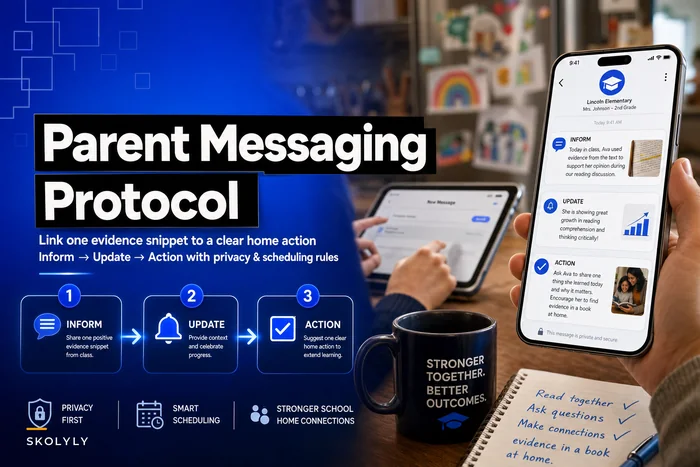
The proportionality is the whole game. Schools that blast every data point at parents burn out the channel. Schools that go quiet until something is serious guarantee the first call is the worst one. If you already run structured family communication that ties evidence to a clear next step, the behavioral cadence should ride on the same rails—the approach in this three-message parent communication protocol translates almost directly, because behavioral outreach lives and dies on the same principle: one clear observation, one clear ask.
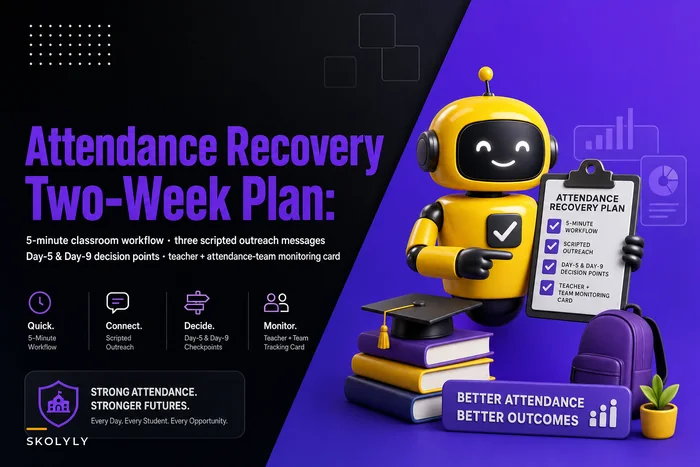
One more pattern worth naming: behavioral flags and attendance flags almost always travel together, and schools treat them as separate systems with separate outreach. A kid whose behavior is deteriorating is frequently also starting to miss school. If your attendance workflow and your behavioral notification cadence don't talk to each other, families get two uncoordinated phone calls in the same week from two different people. The same triage logic in the 5-minute attendance-recovery workflow applies here—early, proportional, scripted contact beats a pile of records nobody acted on.
Role-based access: the difference between support and surveillance
The default in most schools is that behavioral data is either wide open or locked in one person's head. Both are bad. Wide open means a substitute can read a fourth-grader's counseling notes. Locked away means the teacher who needs context to help a kid at 8 a.m. can't get it.
Role-based access solves this by asking a better question: not "who wants to see this?" but "who needs this to do their job for this student, right now?"
| Role | Can see | Cannot see |
|---|---|---|
| Classroom teacher | Active support-plan accommodations and current-year observations for their own students | Counseling case notes, historical discipline detail from prior years |
| Counselor / social worker | Full behavioral and case history for assigned caseload | Records outside their caseload without a documented reason |
| Administrator | Discipline records, escalation logs, aggregate patterns | Raw counseling notes, unless a safety threshold is triggered |
| Substitute / specials | Only what's needed for supervision that day—usually nothing granular | Any historical or diagnostic behavioral detail |
| Support staff (aides) | Plan-specific instructions for students they work with | General behavioral commentary |
The piece most schools miss: access should be scoped by student and time, not just by role. A teacher needs current-year observations for the kids in their room—not the whole school, and not three years of history. The old interpretive note about a kid ("manipulative," from second grade) should age out of general view automatically, because keeping it visible does nothing but bias the next adult.
Age out interpretive notes automatically after the school year to prevent bias.
This is also where the tension between coordination and privacy gets real. Lock it down too hard and your Tier 2 team can't function because the data lives in silos. Open it too wide and you've built a rumor engine. The right cut is role plus caseload plus recency—narrow enough to protect the kid, wide enough that the people responsible for helping can actually see the picture.
Red-flag workflows and escalation rules: the part that can't be informal
Every other section is about preventing quiet harm. This one is about not missing loud harm. And it's the seam that fails most often, because escalation usually depends on a specific person noticing something and knowing what to do—which is exactly the thing that breaks when that person is out, new, or overwhelmed.
An escalation rule has to answer three questions unambiguously: what triggers it, who owns the next step, and what's the deadline. If any of those is fuzzy, the workflow is decorative.
Here's a diagram that shows the trigger, automatic routing, response clock, and closing step for a red-flag workflow.
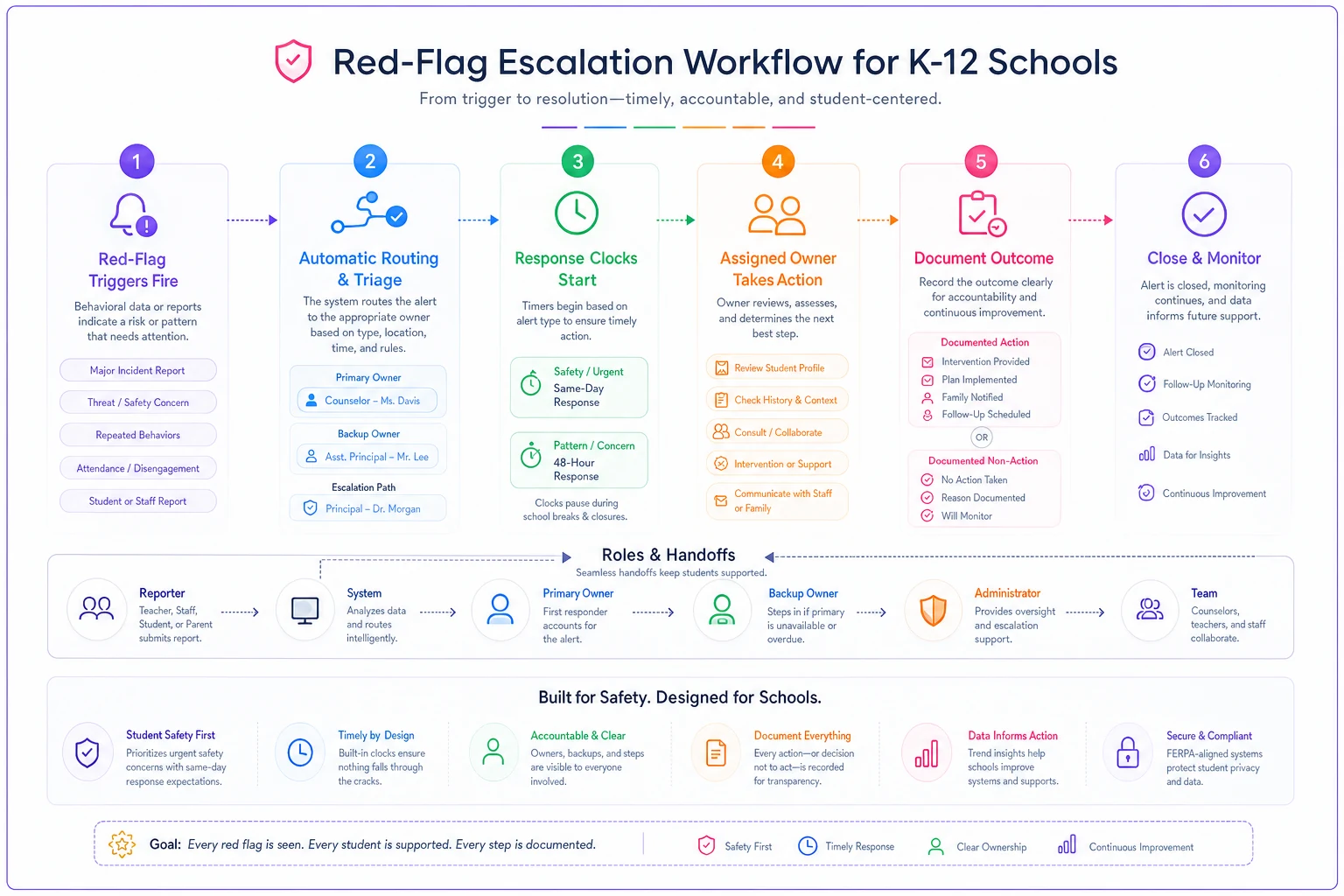
A red-flag workflow that holds up under pressure:
-
Trigger defined by data, not vibe. "Three or more office referrals in ten school days," "any documented mention of self-harm," "a sudden two-tier drop in SEL check-ins." Concrete thresholds so nobody has to judge whether a situation "counts."
-
Automatic routing to a named owner. Not "the counseling team"—a specific role that owns it, with a backup named. Ambiguous ownership is how flags die in a shared inbox.
-
A response clock. Safety triggers
same day. Pattern triggers: 48 hours. The clock starts when the flag fires, not when someone happens to notice.
-
Documented action or documented non-action. If the team reviews a flag and decides no action is needed, that decision gets recorded with a reason. Silence in the record is indistinguishable from a dropped ball later.
-
A closing step. Every flag resolves to something—plan, referral, monitoring, or explicit close. Open flags with no status are the ones that come back to hurt you.
The non-punitive principle has to be baked into the trigger design itself. If your only red-flag thresholds are discipline-based, you've built a surveillance system that finds "problem kids." A behavioral data system that's actually about safety weights change and distress signals as heavily as rule-breaking. A quiet kid whose engagement fell off a cliff is a bigger flag than a chatty kid with three referrals—but only if your triggers are designed to catch it.
The tools matter less than the discipline of routing and closing. But this is genuinely where a coordinated platform earns its place. When flags fire from defined thresholds, route to a named owner automatically, and won't let a record close without a documented resolution, the escalation stops depending on whether one person was paying attention that day. The point isn't the software—it's that the loop closes every time instead of most of the time.
A real scenario: the middle school that fixed the seams
A mid-sized middle school—around 620 students—had behavioral data in five places: the SIS discipline module, a counselor's private notes, a Tier 2 tracking spreadsheet, the SEL platform's dashboard, and a grade-level "watch list" doc. No shared consent language beyond the generic enrollment packet. No notification rule. Access was effectively wide open on the shared docs.
Two things had gone wrong in the prior year. A parent discovered a two-year-old note calling their son "manipulative" and escalated to the district. And a genuine safety flag—a kid whose SEL scores cratered and who'd made a concerning comment—sat unaddressed for about nine days because it lived in a spreadsheet nobody owned.
They didn't buy anything new first. They rebuilt the seams. New consent language that named categories and gave families view/correct rights. A three-tier notification cadence. A role-plus-caseload access map that aged out old interpretive notes. Defined escalation triggers with named owners and response clocks.
The results over the following semester weren't dramatic in a headline way—they were the right kind of boring. Parent complaints about behavioral records dropped to roughly two, down from somewhere north of a dozen. Time-to-contact on pattern flags went from "whenever someone noticed" to inside two days. And in a spot-check, every safety-threshold flag that semester had a documented action within 24 hours. The counselor described it as finally trusting that things wouldn't slip. That's the outcome that matters—not a metric, a nervous system that works.
When a formal system makes sense—and when it's overkill
Not every school needs a heavyweight setup. A small elementary with one counselor and tight communication may run most of this on trust and a shared understanding, and that's fine.
This full system makes sense when:
-
You have more than a couple hundred students and behavioral data in multiple places
-
Multiple staff roles touch behavioral records
-
You've had even one consent or notification incident escalate
-
You're running formal Tier 2/Tier 3 processes with tracking
This is overkill when:
-
You're small enough that one person genuinely holds the whole picture and communicates constantly
-
You'd build so much process that people route around it (an over-locked system that staff quietly ignore is worse than an honest informal one)
Who should not do this halfway: anyone collecting self-harm or safety-related behavioral data. That category demands defined escalation with named owners no matter your size. There's no informal version of that one that's acceptable.
The thread that ties it together
The four seams are one system. Consent sets the boundary of what you're allowed to collect and why. Notification keeps families inside the loop so the data stays supportive instead of adversarial. Access controls make sure the right people—and only the right people—see it, scoped by who they're responsible for and how recent the record is. Escalation guarantees the serious flags actually get acted on.
Pull any one out and the others start leaking. Weak consent poisons notification. Sloppy access turns support into surveillance. Undefined escalation turns a caught problem into a missed one. The reason behavioral data ethics deserves a real checklist—and not just good intentions—is that good intentions don't survive contact with a busy building, staff turnover, and five disconnected spreadsheets. A system does.
The four seams are one system. Consent sets the boundary of what you're allowed to collect and why. Notification keeps families inside the loop so the data stays supportive instead of adversarial. Access controls make sure the right people—and only the right people—see it, scoped by who they're responsible for and how recent the record is. Escalation guarantees the serious flags actually get acted on.
Pull any one out and the others start leaking. Weak consent poisons notification. Sloppy access turns support into surveillance. Undefined escalation turns a caught problem into a missed one. The reason behavioral data ethics deserves a real checklist—and not just good intentions—is that good intentions don't survive contact with a busy building, staff turnover, and five disconnected spreadsheets. A system does.
Ready to elevate your classroom management?
Join 5,000+ educators using Skolyly to save time, engage students, and improve learning outcomes.