

Most parent communication feels like shouting into the void. Teachers send home generic updates about "participation" or "behavior concerns" that get acknowledged but rarely acted on. Meanwhile, parents want to help but genuinely don't know what to do beyond "talk to your child about it."
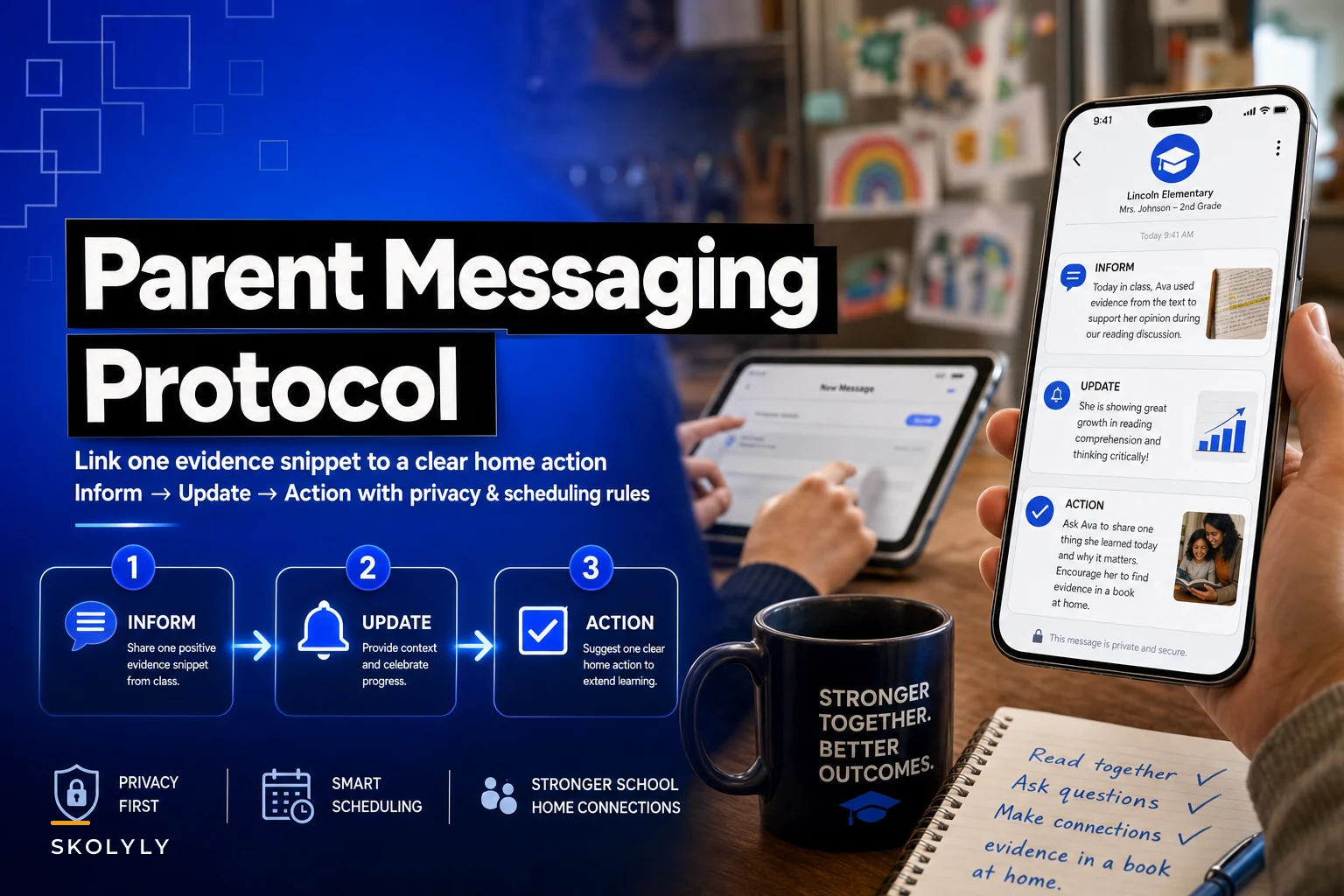
The three-message protocol changes this. Instead of vague updates, you send three structured messages over 48 hours that connect one specific classroom observation to one clear home action. It follows strict privacy rules and scheduling constraints that protect both teacher time and family boundaries.
Why traditional parent communication fails both sides
Parent communication breaks down in predictable ways. Teachers default to either crisis-only communication (reaching out when things are already bad) or newsletter-style updates that cover everything and nothing. Parents receive messages about "focus issues" or "missing assignments" with no real context about what happened or what might actually help.
The problem isn't frequency—it's design. When a third-grader struggles with multi-step math problems, telling parents "your child needs help with math" accomplishes nothing. They don't know if the issue is calculation errors, reading comprehension, or following directions. They don't know if they should drill flash cards, read word problems together, or work on organization.
Even engaged parents struggle to translate teacher observations into home support. A middle school parent might receive six different emails from six different teachers, each requesting vague "support" or "reinforcement." Without specific, actionable guidance, parents either do nothing or do the wrong thing—like piling on extra worksheets when the real issue is anxiety about making mistakes.
The operational cost adds up. Teachers spend three to four hours weekly on parent emails that generate little meaningful action. Parents feel frustrated by messages that sound urgent but lack direction. Students end up caught between school expectations and home confusion.
The three-message structure that drives action
The protocol works because it follows a specific psychological sequence: awareness, processing, and commitment. Each message has a distinct purpose and arrives at a deliberate time.
Keep every student on track with ease.
Skolyly helps you create, assign, and monitor classroom activities efficiently.
- Integrated lesson and assignment management
- Real-time student progress tracking
- Automated class scheduling & notifications
No credit card required
Message 1: The Inform Message (sent within 2 hours of observation)
-
The specific observed behavior with time/location stamp
-
The immediate classroom response taken
-
Acknowledgment that more information will follow
Example: "At 10:45am during independent reading, Marcus chose a book below his level for the fourth consecutive day. I guided him to an appropriate selection. Will share pattern details tomorrow."
The inform message creates awareness without demanding immediate action. Parents know something specific happened but aren't expected to respond right away. The time stamp matters—it helps parents mentally place their child's day and often prompts natural check-in conversations at home.
Message 2: The Progress Update (sent 24 hours later, same time)
-
Pattern frequency (how often this occurs)
-
Impact on learning (specific, not general)
-
What's working in classroom interventions
Example: "Pattern update: Marcus consistently selects books 2-3 levels below ability when given free choice (12 of last 15 opportunities). This limits vocabulary exposure by roughly 40 words per session. When I pre-select three appropriate options, he engages fully. Tomorrow I'll share a specific home support strategy."
The progress update transforms a single incident into a pattern worth addressing. Parents now understand both frequency and impact. The 24-hour delay is intentional—it prevents reactive responses and gives parents time to observe their child at home before they hear from you again.
Message 3: The Action Request (sent 48 hours after initial, includes scheduling)
-
One specific home action with clear steps
-
Expected timeline and frequency
-
How to measure if it's working
Example: "Home support request: During bedtime reading, offer Marcus three book choices you've pre-selected (all at/above grade level). Let him pick from those three. Do this for two weeks, then let him choose freely every third night. Success indicator: He should start requesting harder books independently within 10-14 days. No response needed unless you can't implement."
The action request arrives after parents have processed the pattern and are primed for solutions. The specificity eliminates guesswork. Parents know exactly what to do, when to do it, and how to tell if it's working.
This visual maps the three-message timing and purpose.
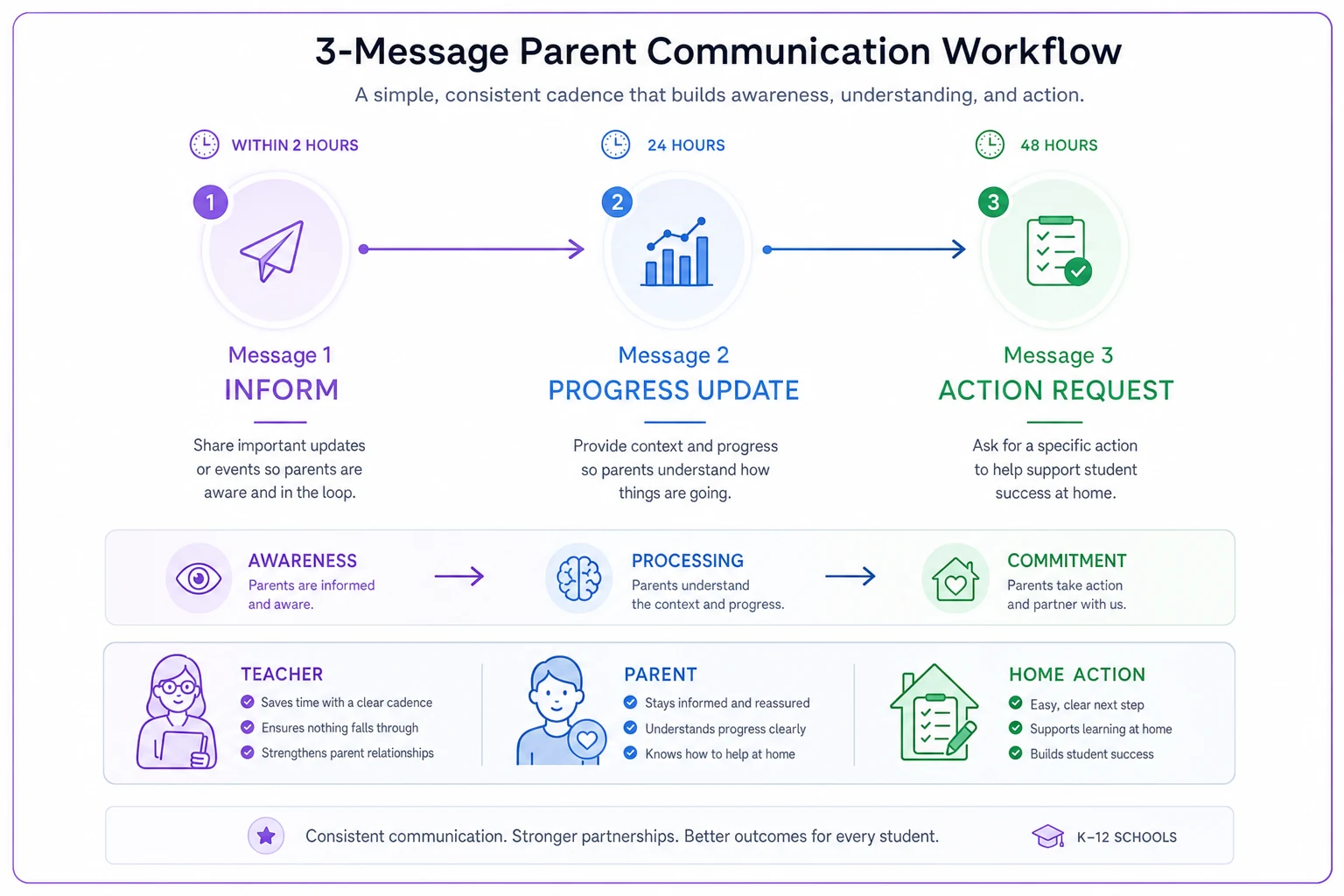
Refer to this flow when training staff so timing and intent are clear.
Privacy rules that protect everyone
The protocol includes strict privacy boundaries that many schools overlook until something goes wrong. These aren't just best practices—they're operational necessities.
Never include comparison data in any message. Even implied comparisons ("below class average," "struggling more than peers") create problems. Parents screenshot and share messages. What starts as helpful context becomes a social media complaint about "the teacher saying my kid is behind everyone else."
Frame everything against individual baselines or grade-level standards instead. "Marcus reads 45 words per minute, grade expectation is 70" works. "Marcus reads slower than most students" doesn't.
Behavioral observations must exclude other students entirely. Never write "pushed another student" or "argument with classmate." Always frame as individual actions: "used hands inappropriately during transition" or "elevated voice during partner work." This prevents parents from demanding to know who was involved and who started it.
Academic struggles require careful language. Avoid medical-sounding terms unless you have specific training and explicit permission. "Difficulty focusing" works better than "attention issues." "Reverses letters" beats "shows dyslexic tendencies." Parents often share teacher messages with pediatricians, and informal diagnoses create liability.
The evidence snippet in Message 1 should be observable and objective. "Completed 3 of 15 problems in 20 minutes" not "wasn't trying." "Left seat 6 times during independent work" not "hyperactive behavior."
Scheduling rules that respect boundaries
Timing matters more than most schools realize. Poor scheduling undermines even well-crafted messages.
Message 1 arrives between 3pm and 5pm. This catches parents during commute or school pickup when they're already thinking about their child's day. Avoid sending during work hours (creates anxiety at the wrong moment) or after 6pm (invades family time).
Message 2 maintains exact timing. If Message 1 went at 3:45pm Tuesday, Message 2 goes at 3:45pm Wednesday. Consistency reduces anxiety and creates predictable communication windows. Parents know when to expect updates.
Message 3 includes a response window. "No response needed" or "Please confirm by Friday at 5pm" sets clear expectations. Most messages should require no response to reduce teacher workload. Save response requests for critical interventions.
Never send on Fridays or before breaks. Parents can't implement support strategies over weekends when routines are different. Monday through Wednesday starts work best, giving families two weekdays to begin before weekend disruption hits.
Batch similar protocols. If you're tracking five-minute behavior logs for multiple students, align their communication cycles. Send all Message 1s at 3:30pm, all Message 2s the next day. This prevents constant email checking throughout the day.
Set calendar reminders for each Message milestone to maintain exact timing.
Emergency exceptions exist but should be genuinely rare. Actual safety issues bypass the protocol entirely—call immediately. Academic or behavioral patterns follow the 48-hour sequence even when they feel urgent to you.
Real scenario: Reading intervention success
Here's how Jefferson Elementary used this protocol to address a third-grade reading slump affecting roughly 30% of students after winter break.
Mrs. Chen noticed a pattern in comprehension scores. Students who previously scored 80-85% dropped to 65-70% on grade-level passages. Instead of sending a class-wide "please read with your child" email, she ran targeted three-message protocols.
For Aiden, whose comprehension dropped from 84% to 67%:
| Example |
|---|
| Day 1, 3:30pm: "During 11:15am reading assessment, Aiden rushed through 'Weather Patterns' passage in 3 minutes (typical is 6-7 minutes). Answered 4 of 6 questions correctly. I had him re-read slowly, improved to 6 of 6. More details tomorrow." |
| Day 2, 3:30pm: "Pattern: Aiden rushes through first reading 8 of last 10 passages, averaging 62% comprehension. When prompted to re-read, jumps to 88%. The gap suggests a speed-over-comprehension issue, not a skill deficit. Classroom intervention: paired reading with a timer showing minimum time. Tomorrow I'll share home support." |
| Day 3, 3:30pm: "Home support: During homework reading, set a visual timer for minimum time (multiply pages by 2 for minutes). Aiden can't close the book until the timer ends. If he finishes early, he re-reads favorite parts. Do this for 10 school days. Success indicator: He should self-pace without the timer by day 11. No response needed unless something's concerning." |
22 of 26 participating families implemented it. Within two weeks, average comprehension scores returned to pre-break levels. The specificity is what made the difference—parents knew exactly what to do instead of guessing at "reading support."
Common implementation problems
The protocol fails in predictable ways you can prevent.
Over-documentation in Message 1 kills the system. Teachers try to include everything they observed, turning a brief inform message into a full report. Parents get overwhelmed and stop reading carefully. Keep Message 1 under 50 words, always.
Vague action requests waste everyone's time. "Practice math facts" means nothing. "Quiz addition facts 0-10 for 5 minutes before breakfast using flashcards I'm sending home" drives specific action. If parents need materials, say what and when they'll receive them.
Protocol creep happens when teachers like the structure and start applying it to everything. Reserve this for patterns requiring home support, not single incidents or classroom-only issues. If you're sending three messages about untied shoes, parents will stop taking any message seriously.
Breaking the timeline destroys trust fast. If Message 2 arrives 36 hours later instead of 24, parents start wondering what else is inconsistent. Set calendar reminders or use scheduling tools. The predictability matters as much as the content itself.
Who shouldn't use this protocol
Some situations make the three-message protocol inappropriate or counterproductive.
IEP-documented behaviors need different communication structures. When behaviors are part of documented disabilities, parents often already know the patterns and need support coordination, not awareness building. Follow IEP-specific communication protocols instead.
Custody complications require modified approaches. When parents have different residences or decision-making rights, the 48-hour timeline might span household transitions. You may need parallel protocols or adjusted timing.
Language barriers limit effectiveness without translation support. The protocol assumes parents can read and process increasingly detailed English messages. Without reliable translation, phone calls through interpreters work better.
Chronic non-responders aren't worth the time investment. After two failed protocol attempts with zero home implementation, switch to documentation-only mode. Record observations for conferences but stop expecting home support that isn't coming.
Building sustainable communication operations
The protocol creates predictable operations that scale across classrooms. Instead of every teacher inventing their own communication style, schools can standardize the approach while allowing flexibility in specific language.
Schools using AI-powered communication platforms reduce the time burden significantly. Teachers input the observation, and the system generates properly formatted messages that follow privacy rules automatically. The scheduling runs in the background, maintaining the 24-hour intervals without anyone tracking it manually. This isn't about replacing teacher judgment—it's about removing the administrative overhead of formatting, scheduling, and monitoring who needs which message and when.
The bigger efficiency gain comes from pattern recognition. When operational software tracks which interventions actually generate home response, teachers stop investing time in approaches that don't work. If book choice protocols consistently produce action but homework reminder protocols don't, you adjust accordingly.
Some schools connect this to broader intervention tracking. The same observation that triggers parent communication also feeds into RTI documentation, progress monitoring, and conference prep. One input, multiple uses.
Making the protocol stick school-wide
Implementation succeeds when schools treat this as an operations improvement, not another initiative layered on top of everything else. Start with volunteer teachers who already struggle with parent communication effectiveness. Let them show results before expanding.
Training takes about 45 minutes. Teachers need examples, practice writing each message type, and a clear understanding of privacy boundaries. The hardest part isn't learning the protocol—it's unlearning habits like over-explaining or sending everything the moment it happens.
Build template libraries for common scenarios. Reading struggles, math confidence issues, social challenges, and homework patterns probably cover about 70% of what comes up. Teachers modify templates rather than starting from scratch. This keeps communication consistent while cutting workload.
Track what actually drives parent action. If your Message 3 requests are generating 30% implementation, something's off—timing, specificity, or parent capacity. Adjust based on what the data shows, not assumptions about what parents should be doing.
Most importantly, protect the protocol's integrity. When administrators push teachers to "communicate more," don't dilute the three-message structure with extra updates. More messages don't create more action. They create more noise.
The three-message protocol works because it respects everyone's time while producing specific, measurable results. Teachers spend less time on email but get better outcomes. Parents know exactly what to do. Students benefit from support that's actually aligned between home and school. When communication becomes operational rather than aspirational, everyone benefits.
Ready to elevate your classroom management?
Join 5,000+ educators using Skolyly to save time, engage students, and improve learning outcomes.