


Schools collect an absurd amount of student data. Between classroom apps, assessment platforms, behavior tracking systems, and communication tools, the average elementary classroom touches somewhere around 20-30 different software platforms storing student information. Across three districts I looked at recently — one rural Iowa district, a suburban Dallas school, and a Chicago elementary — platform counts ranged from 19 to 31, storing everything from reading levels to lunch allergies.
Most principals discover their data privacy gaps the hard way. A parent requests deletion of their child's data from all systems. Nobody knows which vendors have what. The tech coordinator scrambles through vendor agreements. Teachers aren't sure what they can share. The district lawyer gets involved. Three weeks later, you're still not confident you've covered everything.
This happens because schools layer technology without building data governance systems. Each teacher adopts their preferred formative assessment tool. Grade teams pick different behavior tracking apps. The reading specialist brings in an intervention platform. Special ed runs their own IEP software. Nobody tracks the data flows, consent requirements, or retention rules until something breaks.
The vendor sprawl that creates the compliance nightmare
Walk through any elementary school and count the data collection points. Mrs. Johnson uses Seesaw for digital portfolios. Mr. Garcia tracks behavior in ClassDojo. The reading team runs assessments through i-Ready. Math intervention happens in IXL. Special services document in Frontline. The counselor keeps notes in a Google Sheet. The nurse has a separate health tracking system. Each platform holds different pieces of student information with different retention rules, access controls, and parent consent requirements.
The compliance challenge multiplies when you realize each vendor has different terms. Seesaw keeps portfolio data for active accounts indefinitely but purges deleted accounts after one year. ClassDojo maintains behavior points for active students but anonymizes inactive accounts after 12 months. Google Workspace for Education follows district retention settings but defaults to indefinite storage. IXL keeps progress data for three years post-account closure. Nobody reads these terms until a parent asks uncomfortable questions.
Then there's the informal data collection happening outside official systems. Teachers photograph student work for documentation. Paraprofessionals track behavior on paper forms filed in classrooms. Volunteers help with reading assessments and take notes. Substitute teachers create their own tracking sheets. The music teacher records performances. Each creates a potential compliance gap nobody notices until an audit or parent complaint surfaces it.
What breaks when schools ignore data governance
The first crack usually appears during state monitoring visits. The special education director can't produce a clear data retention policy. Documentation exists across multiple systems with conflicting retention periods. Some IEP meeting notes live in the official system while others sit in teacher Google Drives. Progress monitoring happens in three different platforms. When monitors ask for the data governance plan, administrators scramble to create one retroactively.
Keep every student on track with ease.
Skolyly helps you create, assign, and monitor classroom activities efficiently.
- Integrated lesson and assignment management
- Real-time student progress tracking
- Automated class scheduling & notifications
No credit card required
Parent requests expose bigger problems. A family moving out of state wants all their child's data transferred to the new school. Simple request — except the data lives in 20+ systems. Some vendors require district admin access to export. Others only allow teacher-level exports. Several platforms don't offer bulk export at all. The three-day request deadline passes while IT is still searching for login credentials.
The worst scenarios involve data breaches or inappropriate access. A teacher accidentally shares a Google folder containing IEP documents with the wrong parent group. A departed employee still has access to student assessment data six months later. A vendor suffers a breach affecting thousands of student records. Without clear data governance policies and regular audits, these incidents become legal nightmares that consume months of administrative time.
Budget cuts make it worse. When districts eliminate positions, nobody transfers the data responsibilities. The instructional coach who managed the assessment platform leaves. Their account gets deactivated. Two months later, teachers can't access historical assessment data needed for IEP reviews. The data still exists somewhere — nobody knows how to retrieve it.
Building a K-12 student data privacy playbook that actually works
Start with a realistic vendor inventory. Not the official purchasing list — the actual tools teachers use daily. Create a simple spreadsheet: vendor name, data types collected, primary users, consent requirements, retention period, and deletion process. Send teachers a one-question form: "List every app, website, or platform where you enter or store student information." You'll find 30-40% more platforms than IT knows about.
Map your consent workflows to actual parent communication. Most districts have a blanket technology consent form buried in registration paperwork. Parents sign without reading. Teachers assume consent covers everything. Then a parent objects to their child appearing in ClassDojo's parent feed, and nobody's sure if the original consent applies. Build specific consent paths for different data uses: academic assessment, behavior tracking, portfolio sharing, and directory information.
A retention framework that balances compliance with practical operations:
| Data Type | Retention |
|---|---|
| Core Academic Records | Permanent retention for transcripts, final grades, standardized test scores |
| IEP/504 Documentation | Three years after student exits the program or graduates |
| Formative Assessment Data | One academic year after course completion |
| Behavior Tracking | Current year plus one (unless part of IEP/504) |
| Digital Portfolios | Until student graduates or transfers |
| Communication Records | 90 days for routine; one year for discipline-related |
| Classroom Photos/Videos | Current academic year only |
This flow shows the main steps and stakeholders for turning inventory into operational privacy practices.
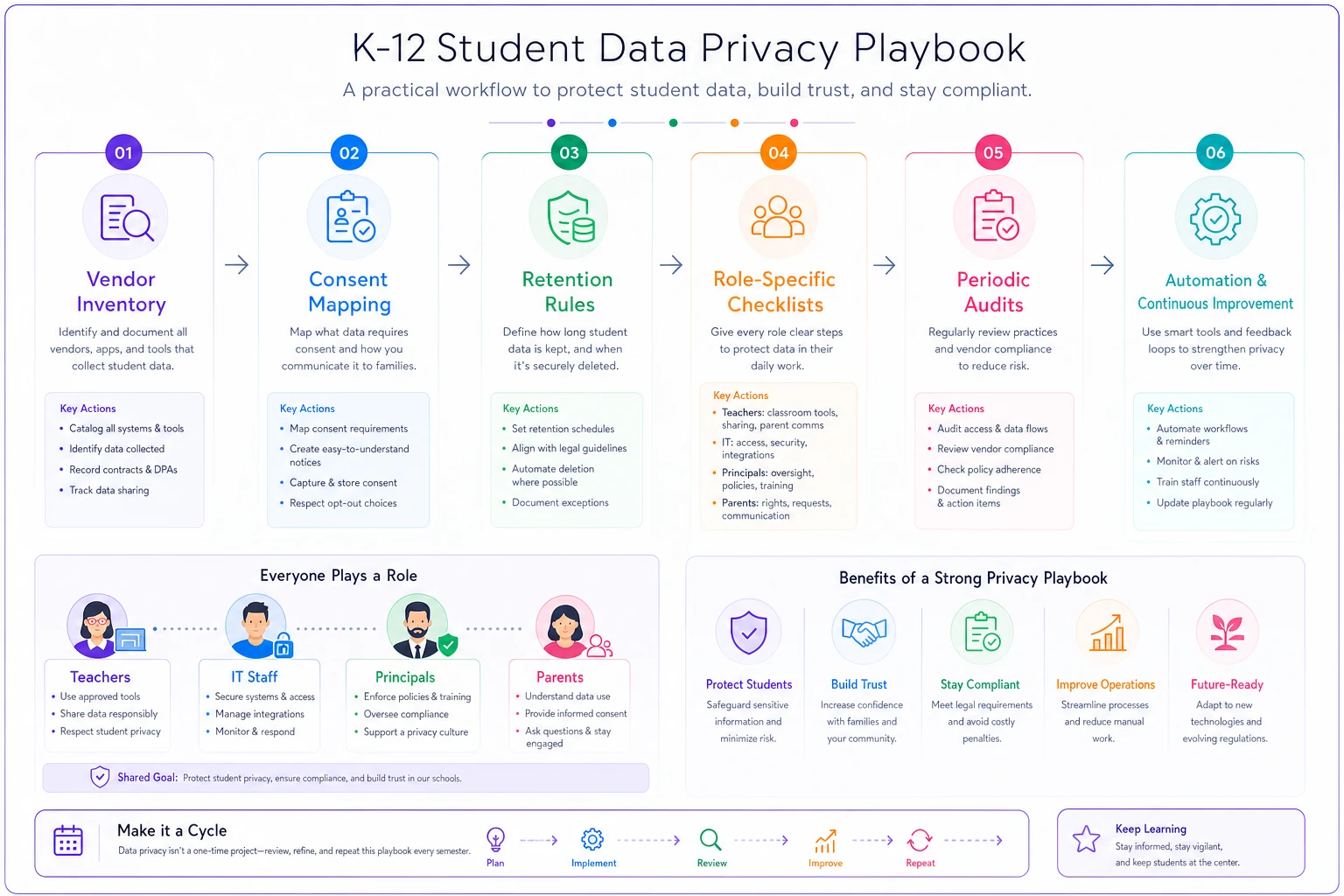
Create role-specific checklists instead of overwhelming policy documents. Teachers need five things: what requires consent, where to store different data types, how long to keep records, what to delete when, and who to ask for help. Principals need vendor oversight, audit schedules, parent request procedures, and breach response steps. IT needs access management, export procedures, and deactivation protocols.
Vendor agreement templates that protect schools without paralyzing procurement
Standard vendor agreements miss critical education-specific requirements. Build addendums that address:
Data Location and Access
-
Where servers physically store data
-
Which vendor employees can access student information
-
Encryption requirements for data at rest and in transit
-
Audit logs for data access
Specific Retention and Deletion Terms
-
Maximum retention periods by data type
-
Deletion procedures and timelines
-
What happens to data if the contract ends
-
Parent/student deletion request procedures
Compliance Certifications
-
FERPA attestation with specific responsibilities
-
COPPA compliance for under-13 students
-
State-specific privacy law requirements
-
Breach notification procedures and timelines
Include operational details that matter during implementation. How do teachers provision student accounts? Can parents access their child's data directly? What export formats are available? How long does account deactivation take? Who provides training and support?
The vendor checklist that saves the most headaches evaluates operational reality, not just compliance checkboxes. Can teachers easily export a student's data when they transfer? Does the platform allow granular permission settings? Can you bulk-delete data for graduated students? How quickly can you disable access for departed staff? These capabilities determine whether privacy policies stay theoretical or become practical.
Parent communication scripts that build trust instead of confusion
Parents worry about student data privacy but rarely understand the specifics. They've heard about data breaches and social media risks. They don't know what FERPA means or how school data differs from commercial platforms. Clear, specific communication prevents anxiety-driven objections.
"Your child's math teacher will use IXL to track progress on multiplication facts. You can see their practice history and scores by logging into the parent portal. This data helps identify where your child needs extra support. IXL keeps this information for three years after your child stops using the program. You can request deletion anytime by emailing our data privacy coordinator."
Not: "The district utilizes various educational technology platforms to support differentiated instruction and data-driven decision making in accordance with FERPA regulations and district policies regarding student information management systems."
Create different scripts for different scenarios. New platform adoption needs benefits-focused messaging. Data breach notifications require transparency without panic. Deletion requests need clear timelines and limitations. Annual privacy notices should highlight what's changed, not repeat boilerplate.
When parents request data deletion, be specific: "I understand you want Marcus's behavior tracking data removed from ClassDojo. Here's exactly what we'll delete and what we're required to keep for his school records. The behavior points and parent messages will be removed within 5 school days. We'll keep any disciplinary documentation required by state law in his confidential file."
Audit schedules and access reviews that catch problems early
Most schools discover access control problems months after they should. The departed teacher still accessing Google Classroom. The transferred paraprofessional viewing IEP documents. The volunteer who helped with reading assessments keeping student data on a personal device. Regular audits prevent these accumulations before they become incidents.
Run monthly access reviews for critical systems. Who has admin rights in your assessment platform? Which teachers have edit access to IEP documents? Who can export student data from your SIS? A monthly check catches departed employees, role changes, and permission creep before something goes wrong.
Check vendor compliance quarterly. Pick three vendors at random. Request their current security certifications. Try the data export process. Test the parent access portal. Submit a mock deletion request. Document response times and completeness. This light-touch audit reveals which vendors actually follow through on their privacy promises.
The annual comprehensive review examines the complete data lifecycle. Pick five students at random. Trace their data across all systems. What got collected? Where does it live? Who accessed it? How long will it be retained? Can you produce everything a parent might request? This exercise exposes gaps between policy and practice that incremental fixes miss.
Schedule these audits during natural slow periods. Monthly access reviews during the first week when administrators handle attendance reconciliation anyway. Quarterly vendor checks during grading periods. Annual comprehensive reviews in July when student data needs migration or archival.
Quick implementation wins without overwhelming staff
Teachers already feel overwhelmed by compliance requirements. Adding complex data privacy procedures triggers resistance or superficial compliance. Start with visible wins that simplify their work while improving protection.
Create a one-page "Data Decision Tree" for common scenarios. Student transfers? Follow the green path. Parent requests deletion? Take the blue route. Need to share assessment data? Check the orange boxes. Post it in workrooms and include it in digital staff resources. Teachers appreciate clear guidance over lengthy policy documents.
Post the one-page "Data Decision Tree" in workrooms and digital staff resources so teachers see it regularly.
Build data privacy into existing workflows rather than adding new procedures. During the weekly grade-level meeting, spend two minutes reviewing which platforms collected student data. Make this part of your existing data-driven improvement cycles rather than creating separate privacy meetings. Include a privacy checkpoint in your lesson plan template — just a simple box for "data collected" and "consent verified."
Standardize file naming conventions to support retention schedules. "2024FAGrade3MathAssessments" automatically signals when this folder needs review. "IEP2024StudentInitialsRETAIN3YR" embeds the retention requirement in the filename. Simple conventions prevent accumulation of outdated data that becomes a compliance liability.
Designate grade-level or department privacy champions rather than centralizing everything through IT or administration. The second-grade team lead knows which reading apps their teachers actually use. The special services coordinator understands IEP documentation requirements. Distributed champions provide faster, more contextual support than distant compliance officers.
Automation opportunities that reduce manual compliance work
The biggest compliance failures come from manual processes nobody maintains. The spreadsheet tracking vendor contracts that hasn't been updated since September. The paper consent forms filed in classroom drawers. The access review that requires checking 30 different systems individually. Manual processes break under operational pressure — not because people are careless, but because schools are busy.
Start with automated retention enforcement. Google Workspace allows retention rules that automatically delete documents after specified periods. Set one-year retention for routine classroom documents. Configure three-year retention for special education folders. Enable permanent retention for official transcripts. The system handles deletion without anyone remembering to audit folders.
Build simple workflows for common requests. When parents email data deletion requests, an automated workflow can acknowledge receipt, notify relevant staff, create a tracking ticket, and set follow-up reminders. This doesn't require expensive software — a Google Form triggering email notifications handles basic cases while ensuring nothing falls through the cracks.
For schools using operational platforms, connect data privacy requirements to existing workflows. When creating data visualizations for board presentations, the system can automatically flag any data requiring special consent. When generating progress reports, it verifies parent communication preferences. When offboarding staff, it triggers access revocation across connected systems.
The key insight from working with multiple districts: automate the tracking and reminders, not the decisions. Teachers still determine what data to collect. Administrators still approve vendor agreements. Parents still choose consent levels. But automated systems track what was decided, when reviews are needed, and what actions are overdue. That combination — human judgment plus automated follow-through — prevents the oversights that create real liability.
The playbook in practice
A mid-sized district in Ohio implemented these approaches after a parent complaint escalated to state education officials. They discovered 47 different platforms collecting student data, with 12 having no formal agreement and 8 storing data on international servers. The cleanup took four months, but the systematic approach prevented future accumulations.
They started with the vendor inventory — not the official version, but reality. Teachers listed everything from Khan Academy to Padlet to obscure math game sites. The technology team discovered their "approved" list covered less than 60% of actual usage. Rather than ban everything unauthorized, they created a rapid review process for teacher-requested tools and a clear rubric for automatic approval versus full review.
The consent workflow simplified from a 12-page packet to targeted forms. Academic platforms need basic consent. Behavior tracking requires specific opt-in. Portfolio sharing gets separate permission. Photo and video use has its own form with granular options. Parents understand what they're agreeing to, and teachers know exactly what's covered.
Their monthly audit caught problems early. A third-grade teacher who transferred to another district still had access to her former students' assessment data three months later. A reading intervention platform was accidentally sharing student progress with a previous year's parent group. The music teacher's YouTube channel included performances from students whose parents hadn't consented to video sharing. Each issue got resolved before becoming a crisis.
Staff adoption worked because the system made their jobs easier, not harder. The data decision tree eliminated guesswork. Automated reminders prevented missed deadlines. Clear retention rules meant less digital clutter. Teachers spent less time wondering about compliance and more time teaching.
Moving forward with practical privacy protection
The K-12 student data privacy playbook doesn't require perfection or paranoia. It needs practical systems that match how schools actually operate. Start with understanding what data you're actually collecting, not what policies say you should collect. Build consent processes parents understand and teachers can implement. Create retention rules that balance compliance with operational needs. Automate the tracking and reminders that humans consistently forget under pressure.
Frame data privacy as protecting students rather than completing compliance checkboxes. Teachers understand protecting student information. They struggle with abstract regulatory requirements. When privacy practices connect to student protection, implementation follows naturally.
The schools getting this right aren't necessarily the ones with the biggest technology budgets or most sophisticated IT departments. They're the ones who built pragmatic systems matching their operational reality — ones that acknowledge teachers will try new tools, that parents have different comfort levels with data sharing, and that continuous improvement matters more than theoretical perfection.
Start with one simple question: Can you confidently tell a parent exactly where their child's data lives and how it's protected? If not, begin with the vendor inventory. Map reality, not policy. Build from that foundation with templates, checklists, and workflows that match how your school operates. Privacy protection becomes manageable when it fits within the daily rhythm of education rather than fighting against it.
Ready to elevate your classroom management?
Join 5,000+ educators using Skolyly to save time, engage students, and improve learning outcomes.