

Most attendance problems don't get missed because nobody cares. They get missed because the window where you can actually turn things around is short, and by the time chronic absence shows up on a dashboard, you're already looking at 15+ missed days and a family that's stopped answering the phone.
The tight version of the problem: a student hits five or six absences by early October. That's not "chronic" yet by the official 10%-of-enrolled-days definition, but it's the exact moment intervention still works. The teacher notices. The attendance clerk notices. And then nothing coordinated happens for three weeks because nobody owns the next move, and the "outreach" that does happen is a robocall going to a disconnected number.
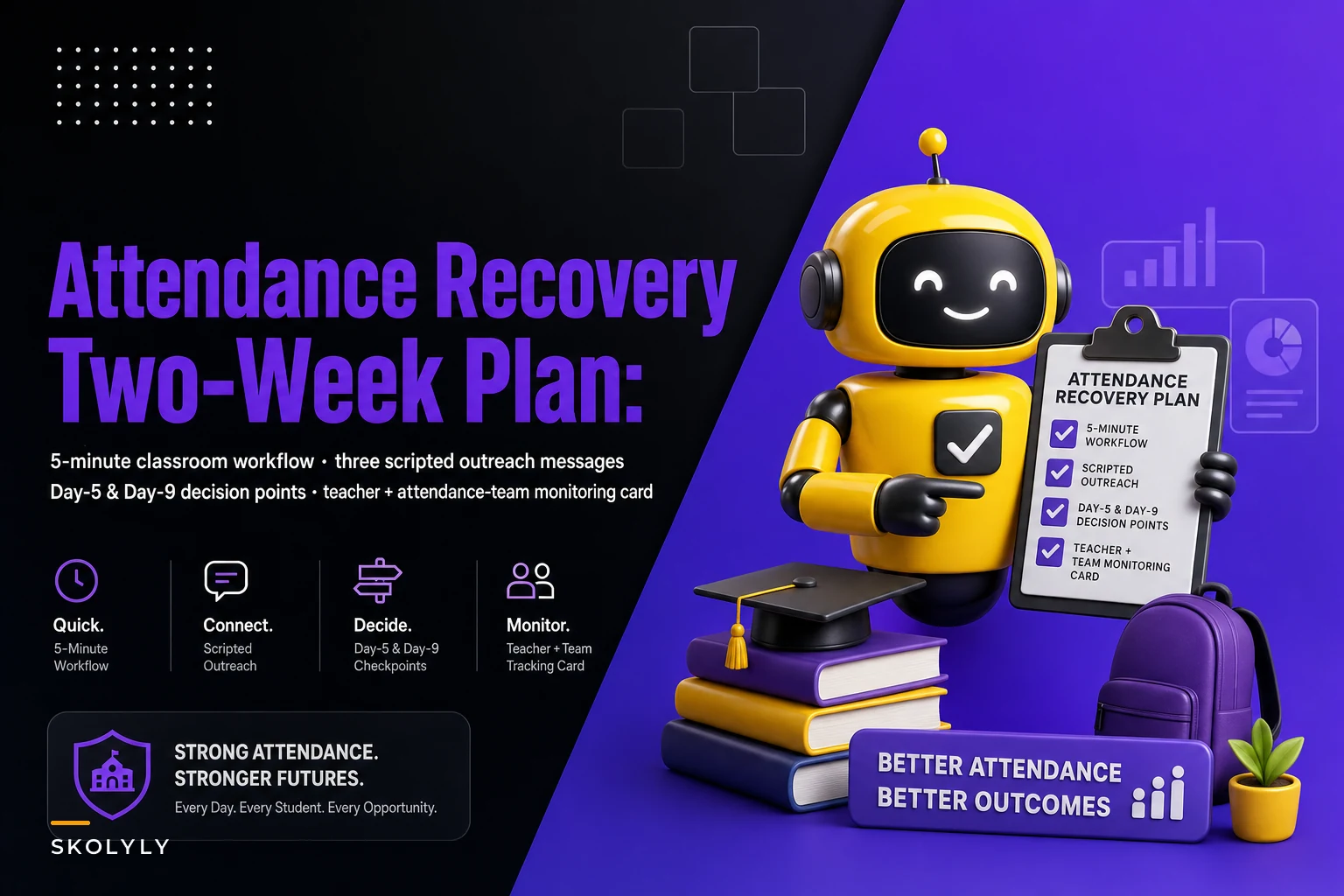
This is a two-week triage you can actually run. It fits in about five minutes a day, assigns a clear owner to every step, and comes with the three exact messages you send families so you're not improvising outreach at 4:45pm.
Why the early window closes so fast
Absence compounds socially and academically at the same time, and that's worth naming. A kid who misses four days in two weeks comes back to a math unit they can't follow, a friend group that's shifted, and a teacher who — understandably — is a little cool because the missed work is piling up. Each of those things makes the next absence easier.
The intervention math is brutal. Reaching a family at day 5 and reaching them at day 15 are not the same task at 3x the effort. They're entirely different tasks. At day 5 you're solving a logistics problem — a car that broke down, a younger sibling who's sick, a work-schedule conflict. At day 15 you're often dealing with a relationship and re-entry problem, which takes far more people and far more time.
The other piece: outreach usually isn't triaged. Schools tend to treat all absences the same and fire the identical automated message at everyone. The family in genuine crisis gets the same text as the family who took a Friday for a dentist appointment. When everything gets the same response, the response gets ignored.
The two-week triage, day by day
The whole point is that this runs on a schedule, not on someone remembering. If you're an attendance team member or a teacher with a small caseload — this is built for people carrying maybe 8–20 flagged students, not 200 — you're touching each case briefly across ten school days.
Keep every student on track with ease.
Skolyly helps you create, assign, and monitor classroom activities efficiently.
- Integrated lesson and assignment management
- Real-time student progress tracking
- Automated class scheduling & notifications
No credit card required
Here's the daily sequence once a student trips the trigger.
-
Trigger (Day 0) Student hits 4 absences in a 15-instructional-day rolling window, OR 3 unexcused in a row. Either one starts the clock.
-
Day 1 — Verify before you act. Pull the actual attendance record. A good chunk of the time, what looks like chronic absence is a coding problem — a period marked absent when the kid was in ISS, or a field trip not entered. Fix the data first. You do not want your first family message to be wrong.
-
Day 1 — Send Message 1 (the check-in). Same day. Warmth, not warning. Script below.
-
Days 2–4 — Watch for return + response. Did the family reply? Did the student show up? Log it on the card.
-
Day 5 — Decision point. If attendance improved and the family responded
downgrade to monitoring. If not: Message 2 (the specific ask) goes out, and a named person owns a live conversation.
-
Days 6–8 — Remove one barrier. This is the step everyone skips. Pick the single most likely obstacle and actually address it — transportation, a schedule conflict, a health note. One barrier resolved beats five referrals filed.
-
Day 9 — Second decision point. Improving? Keep monitoring. Flat or worse? Message 3 (the team offer) goes out and you loop in the counselor or attendance officer.
-
Day 10 — Close or escalate. Either the student is back on track and you move to the light-touch monitoring card, or this becomes a formal Tier 2 case with a documented history you can hand off cleanly.
A quick visual of the day-by-day workflow:
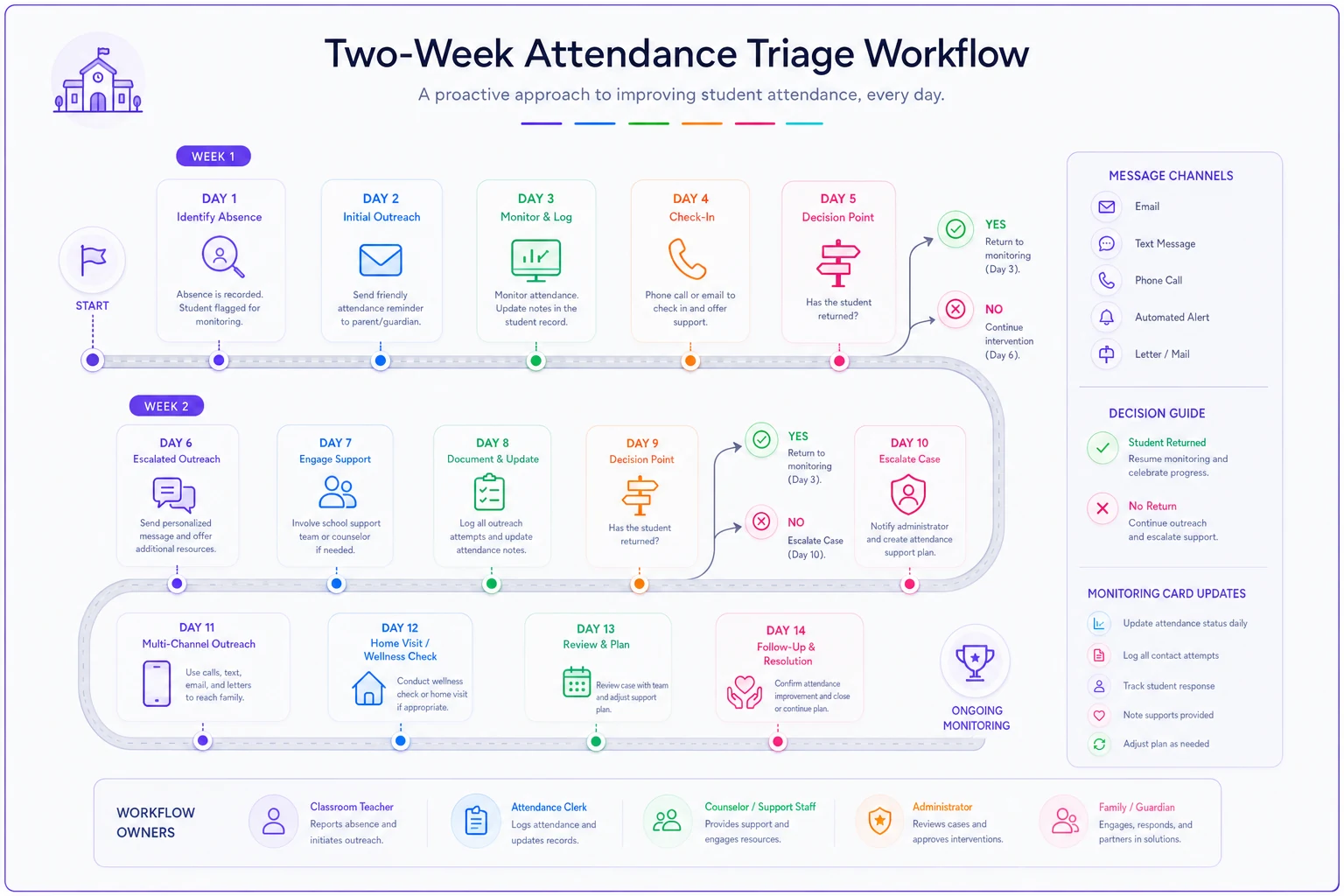
The reason this works isn't the individual steps — it's that the decision points are fixed on Day 5 and Day 9. Nobody has to wonder "should I follow up yet?" The calendar answers that.
The three family messages (exact scripts)
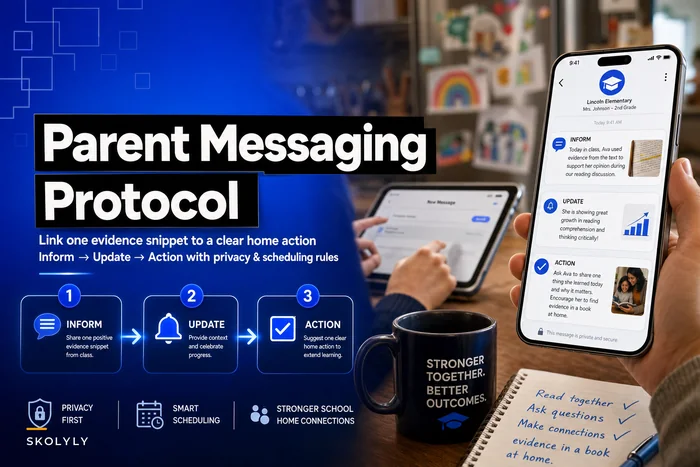
These are built to be copied, lightly personalized, and sent. The sequencing matters more than the exact wording — each message does one job, and you don't skip ahead. If you want the deeper reasoning behind why a three-message cadence outperforms a single "concern" call, we broke that down in a three-message parent communication protocol that links one classroom evidence snippet to a clear home action.
Message 1 — The check-in (Day 1). Tone: someone noticed, and they're on your side.
> Hi [Parent name], this is [Your name] from [School]. I noticed [Student] has missed a few days recently and I wanted to check in — is everything okay at home? No trouble on our end, I just want to make sure [Student] has what they need to get back on track. Text me back here whenever works.
Why it's shaped this way: it opens a door instead of issuing a citation. A surprising number of families reply to this with the actual reason — and the actual reason is usually solvable.
Message 2 — The specific ask (Day 5, if no improvement). Tone: still warm, now concrete.
> Hi [Parent name], following up on [Student]. Since [date] they've missed [X] days, and I want to help before it affects [specific class or credit]. Can we find 10 minutes this week — call or in person — to figure out what would make mornings easier? I have [two time options]. Which works better?
The trick here is naming a specific consequence ("before it affects Algebra credit") and offering a specific small commitment — 10 minutes, two time slots. Vague asks get vague responses.
Message 3 — The team offer (Day 9, if still flat). Tone: we're bringing more help, not more pressure.
> Hi [Parent name], I want to make sure [Student] has real support, so I'd like to bring in [Counselor/Attendance name] who can help with [transportation / scheduling / whatever the identified barrier is]. This isn't about getting anyone in trouble — it's about removing whatever's making it hard to get here. Can we meet [day/time]?
Message 3 explicitly de-escalates the "in trouble" fear, because by day 9 the family often assumes that's what's coming. Naming the fear and defusing it is what keeps the line open.
Who owns what
The single biggest failure mode isn't the scripts. It's that "the attendance team" owns everything, which means nobody owns anything. Assign roles by name before you start.
| Step | Owner | Time cost |
|---|---|---|
| Data verification (Day 1) | Attendance clerk | ~3 min/case |
| Message 1 & 2 send | Homeroom/advisory teacher | ~2 min/case |
| Barrier removal (Days 6–8) | Attendance team lead | 10–20 min/case |
| Live conversation | Whoever has the relationship | varies |
| Message 3 + escalation | Counselor | ~15 min/case |
| Monitoring card upkeep | Teacher (low caseload) | ~1 min/day |
The one that gets fumbled most is "whoever has the relationship." It's tempting to route every call through one attendance officer for consistency. Don't. A message from the coach the kid actually likes, or the teacher who noticed they were gone, lands ten times harder than a message from an office the family has never met.
The two-week monitoring card
Once a student is either de-escalating or you've moved them to watch status, you need something dead simple to track them without it becoming a paperwork project. One card per student, one line a day.
Track only these fields:
-
Present today? (Y/N)
-
On time? (Y/N — tardies are the early warning for the next absence)
-
Which message sent, and date
-
Family response? (none / replied / met)
-
Barrier identified (one word
transport, health, schedule, unknown)
-
Barrier addressed? (Y/N)
-
Day 5 decision and Day 9 decision
Keep the card to one line a day so it's scannable in a quick huddle.
That's it. The whole card should be scannable in five seconds during a huddle. The mistake schools make is building a beautiful intervention log with 14 fields that nobody fills out past week one. Fewer fields filled consistently beats a rich template that dies by mid-October.
One thing worth noting: if your team is already running weekly intervention huddles, fold the attendance card into that existing rhythm rather than creating a separate meeting. The same adoption principles that make a practical school-wide formative assessment cycle teachers will actually use stick here — if it needs a new meeting, it won't survive October.
A real scenario
A rural middle school with around 480 students was flagging chronic absence the usual way: a quarterly report that surfaced kids who'd already crossed 18% attendance loss. By then, most were unreachable through normal channels.
They switched to the day-5 trigger and ran the two-week triage with advisory teachers sending Messages 1 and 2. The first cohort was about 30 flagged students over six weeks.
What changed wasn't dramatic on paper, but it mattered. Roughly two-thirds of families replied to Message 1 — far higher than the near-zero response rate the automated calls had been getting. Most students who got the full triage stabilized before Message 3 was even needed. The barrier data turned out to be the sleeper win: a cluster of absences traced back to a single bus route running consistently late, which was fixable at the operational level in a way no individual family conversation would have revealed. A handful of kids came off the flag list just from that one fix.
The whole thing cost advisory teachers a couple of minutes a day. The attendance clerk actually spent less time overall, because verifying at day 5 is cheaper than chasing at day 30.
When this makes sense — and when it doesn't
This is built for low-caseload triage. It works when the people running it are carrying a manageable number of flagged students and can actually do the daily one-line touch. An advisory or homeroom structure helps a lot because it gives you a natural owner who already has a relationship with the kid.
It's a bad fit if you try to run it at scale through one overloaded attendance office. If a single person is holding 150 flagged students, the daily-touch model collapses and you're back to batch robocalls. In that case, fix the ownership structure first — distribute cases to teachers — before adopting the workflow.
Schools with serious data-quality problems in their SIS should also be cautious. If your attendance coding is unreliable, the Day 1 verification step will eat you alive and your first family messages will be wrong often enough to burn trust. Clean the data pipeline first, then run the triage.
Where lightweight tools quietly help
None of this requires software. You can run the whole thing on a printed card and a shared spreadsheet, and plenty of schools do. But the one place an operational platform earns its keep is the triggering and the decision-point reminders — the "this student hit day 5, someone needs to send Message 2 today" nudge. That's the step humans forget, and it's exactly the kind of rules-based, date-driven prompt that a workflow tool with light automation handles well: it watches the rolling attendance window, flags the trigger, and reminds the named owner on the right day without anyone maintaining a manual tickler file.
The judgment — which barrier to remove, who has the relationship, how to word the hard conversation — stays human. The remembering and the routing can be automated, and that's usually enough to keep a triage like this alive past the first busy month.
The takeaway
Chronic absence isn't usually an intervention-quality problem. Schools know how to help kids. It's a timing and ownership problem: the help arrives three weeks late and nobody's name is on the next step. A fixed two-week triage with a day-5 and day-9 decision point, three messages that each do one job, and a one-line-a-day card fixes both. Run it in the window where a broken-down car is still just a broken-down car — not yet a kid who's given up on showing up.
Ready to elevate your classroom management?
Join 5,000+ educators using Skolyly to save time, engage students, and improve learning outcomes.