

The hardest part of a sub's day usually isn't the lesson plan. It's the moment a kid who's been fine for 40 minutes suddenly isn't—and the sub has no idea what just happened, what works, or who to call. They're standing there holding a worksheet packet while a student is halfway out the door or under a desk, and every decision they make in the next 90 seconds either settles the room or makes the next two hours miserable.
Most sub folders are built for the wrong emergency. Fire drill map, bathroom policy, the "no gum" reminder. What they almost never include is a behavior-specific reference that tells a stranger exactly what to say and do for this class, these students, in the first few seconds of a flare-up.
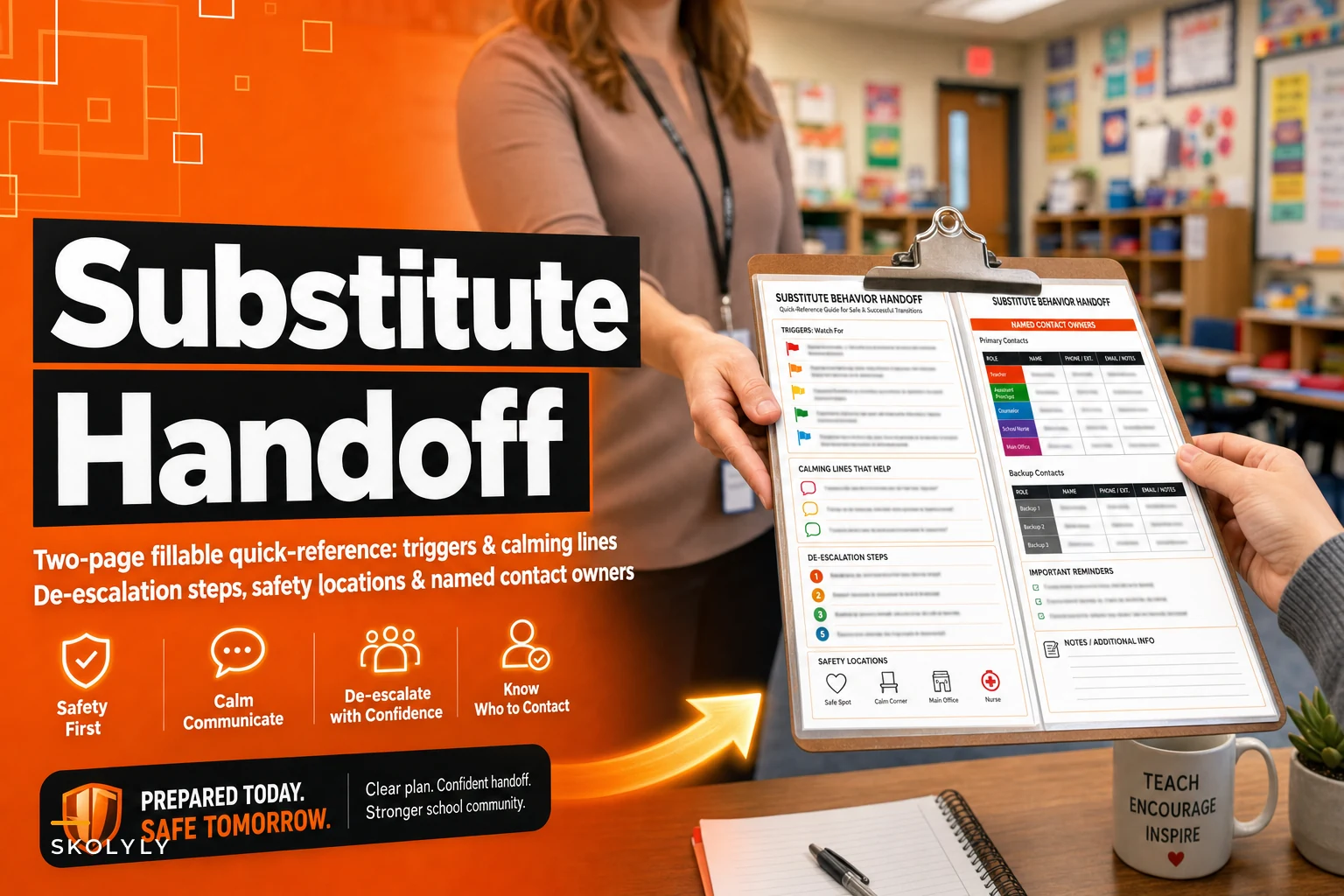
That's the gap a substitute behavior handoff two-page document fills. Two pages. Fillable. Designed to be read while something is already going sideways.
Why the generic sub plan fails at exactly the wrong moment
A regular teacher carries a hundred tiny behavior rules in their head that they've never written down. They know Marcus needs a two-minute warning before transitions or he melts. They know that saying "you need to" to Aaliyah guarantees a standoff, but "when you're ready" gets her moving. They know the back corner by the reading rug is where Devon goes to cool off, and that's fine, leave him.
None of that is in the plans. It's tacit knowledge, and it walks out the door with the teacher.
So the sub defaults to generic classroom management—firm voice, direct commands, consequences stacked fast. For most kids that's fine. For the three or four students who are one bad interaction away from a blowup, it's gasoline. The sub does everything a training video told them to do and the day still falls apart, because the training video didn't know Marcus.
The escalation is almost never random. It's triggered by something specific and avoidable, and the person in the room just didn't have the one sentence that would've prevented it.
What actually belongs on the two pages
The temptation is to cram everything in. Resist it. The whole value of this document is that a panicked adult can scan it in ten seconds and find the student they're dealing with. If it reads like an IEP, it's useless in the moment.
Keep every student on track with ease.
Skolyly helps you create, assign, and monitor classroom activities efficiently.
- Integrated lesson and assignment management
- Real-time student progress tracking
- Automated class scheduling & notifications
No credit card required
Here's the split that works:
-
Page one is the per-student reference. Only students who genuinely need it—usually three to six in a class, not the whole roster. For each one: - Known triggers — the specific things that set this student off (transitions, being called on cold, loud correction, peer proximity) - Calming lines — word-for-word phrases that work, and a short "do NOT say" note - What de-escalation looks like for this kid — give space vs. stay close, offer a job, let them go to the cool-down spot - Their safe location — where this specific student is allowed to go to reset
-
Page two is the shared protocol
the generic de-escalation steps that apply to everyone, the safe locations in and near the room, and—this is the part people forget—contact owners. Not a phone list. A clear "if X happens, call Y" map.
A sample page-one entry
Here's what one student block looks like filled out. Note how little text there is. That's intentional.
| Student | Triggers | Say this | Don't say | De-escalation | Safe spot |
|---|---|---|---|---|---|
| M. (sits front-left) | Surprise transitions, loud correction | "Two minutes, then we switch." / "When you're ready." | "Right now." / "You need to." | Give a 2-min warning, then space. Don't hover. | Reading rug corner |
| D. (back row) | Being told to stop mid-task | "Finish that line, then we'll talk." | "Put it down now." | Let him finish, lower your voice, step back. | Hallway bench outside door |
Two students, maybe 30 seconds to read both. A sub can absorb that before the bell even finishes ringing.
The part everyone skips: contact owners
This is where most handoffs quietly fail. The sub knows something is escalating, decides they need help, and then calls the front office—a general number that routes to whoever picks up, which is sometimes a secretary who has to find someone, and by the time a body shows up the moment has already resolved itself badly.
A contact owner is a specific named person tied to a specific situation. Not "the office." Not "an administrator." A name and a backup name.
The map should be dead simple:
-
Student needs a break but is safe → send to their listed safe spot, no call needed.
-
Student has left the room → call [name], ext. [number]. Backup
[name].
-
Student is refusing all redirection, disrupting the room → call [name], the teacher next door, who knows these kids.
-
Safety risk—physical, to self or others → call [name] immediately and hit the [specific signal/button]. This is the only one that's an interrupt-everything situation.
The reason to tier it this way is that subs over-call and under-call in equal measure. Some panic and call admin for a kid who just needs to pace in the hallway. Others white-knuckle through an actual safety situation because they didn't want to overreact. The tiered owner map removes the judgment call—match the situation to the row, call the name.
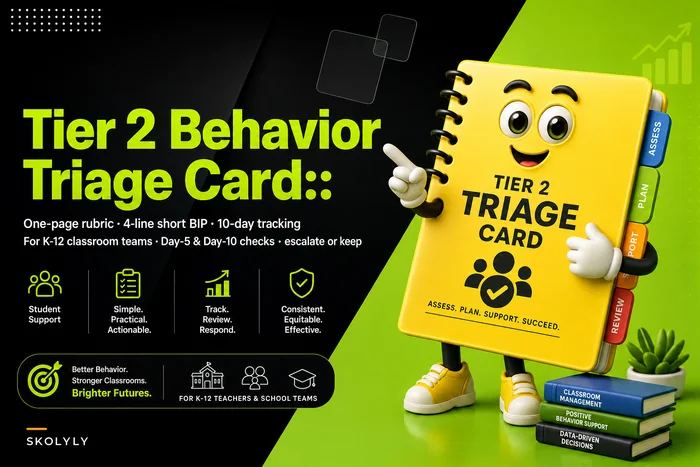
One thing worth pulling from behavior planning more broadly: if you've already built out a Tier 2 behavior triage card with a BIP decision rubric, the trigger and de-escalation language should be copied straight from there. Don't reinvent it for the sub sheet. Consistency between what the regular teacher does and what the sub does is the whole point—kids notice the difference instantly, and inconsistency is itself a trigger.
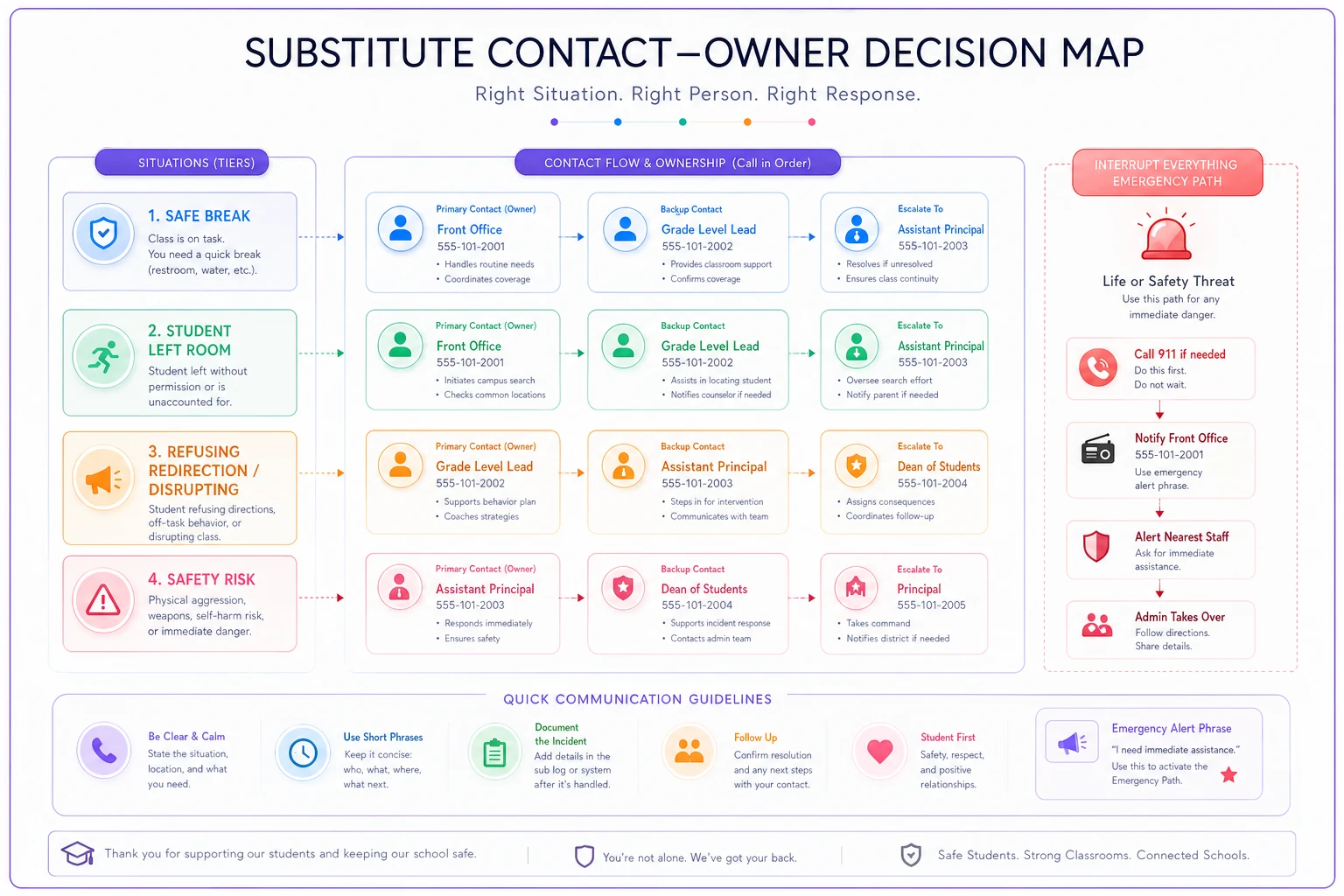
Quick visual of the contact-owner workflow can help subs act fast.
A real scenario
A middle school pulled this together after a rough stretch with one 7th-grade ELA class that had a reputation for chewing through substitutes. Three or four students in that room had documented behavior plans, and whenever the teacher was out—maybe two or three days a month for training and appointments—the sub notes came back describing the same afternoon: a transition goes bad, one kid escalates, two others feed off it, and the last 30 minutes are gone.
They built a two-page handoff for just that class. Took the behavior coach and the teacher about 45 minutes together. Page one had four students. Page two had the protocol and three named contact owners, including the teacher across the hall.
Over the next couple of months, the sub incident write-ups for that room dropped off noticeably—from a near-guaranteed office referral on sub days to maybe one in the whole stretch. Nothing magic happened. The subs just finally knew that when the kid in the back started tapping his pencil hard and bouncing his leg, they should quietly offer him the hallway bench instead of calling him out in front of everyone. One sentence instead of another. That was most of the difference.
The teacher also mentioned something that mattered more than the referral count: she stopped dreading being absent. She'd been skipping optional PD because leaving that class felt irresponsible. The handoff gave her that room back.
Keeping it fillable, not frozen
A behavior handoff goes stale fast. A student who was volatile in September might be solid by November. A new trigger shows up after a schedule change. If the document is a laminated artifact nobody touches, within a few weeks the subs are reading advice that's just wrong.
The practical fix is to make it genuinely fillable—a template where the teacher updates a few fields every few weeks, not a from-scratch rewrite. Fields change, structure stays. Two minutes during a planning period.
Make the handoff a template with fillable fields so teachers can refresh it in two minutes.
This is also where the right system actually earns its keep. If the behavior notes, safe locations, and contact owners already live in whatever platform the school uses to track student plans and daily logs, generating the two-page handoff should be close to automatic—pull the current trigger and calming-line data for the flagged students, drop in the room's protocol and contact map, print. A well-set-up operational platform with some automation behind it can keep the sub sheet in sync with live behavior data instead of forcing a teacher to maintain two versions of the truth that quietly drift apart. The goal isn't fancy—it's that the sub always reads current information without anyone re-typing it.
The same logic applies to planned longer absences. If you're preparing for more than a day or two out, the behavior handoff should ride alongside the academic one in a long-term substitute continuity plan, so the sub inherits both the curriculum momentum and the behavioral knowledge at the same time.
When this is worth building—and when it isn't
Build it when:
-
The class has two or more students with known, specific escalation patterns
-
The teacher is out semi-regularly, or a long absence is coming
-
Past sub days in this room have a track record of blowups or referrals
Don't bother when:
-
It's a class with no flagged behavior concerns—a generic sub plan is genuinely fine, and a behavior sheet just adds noise
-
You'd be listing every student "just in case"—that defeats the scannability that makes it work
-
The information is too sensitive to put on a sheet a stranger carries around; in that case, keep the detail with a named contact owner and just flag "see [name] about student in seat 3" on the sheet
That last one matters. A behavior handoff names students and describes their struggles, and it's being handed to someone the school may not know well. Keep it factual, keep it operational, and keep it away from diagnoses or anything that reads like a private record. "Needs a two-minute transition warning" is fine. Clinical detail is not.
Who should own this
In most buildings this lands best with the behavior coach, counselor, or whoever already maintains the behavior plans—with the classroom teacher filling in the room-specific language. Admin's job is mostly to make sure the contact-owner map is real: that the names on it have actually agreed to be the person who picks up, and that the "safety" tier connects to whatever the school's actual response protocol is.
The failure mode to watch for is a handoff built once and never looked at again, or one where the contact owner left the building in October and nobody updated the sheet. A behavior handoff that points a sub at a dead extension during an actual crisis is worse than no sheet at all—it burns the one thing a sub has least of in that moment: time.
Keep it two pages. Keep it current. Keep the contact owners real. Done that way, it's one of the highest-leverage documents in the whole sub folder—and the only one specifically built for the moment everything's about to tip.
Ready to elevate your classroom management?
Join 5,000+ educators using Skolyly to save time, engage students, and improve learning outcomes.