


You spend September building classroom culture. October establishing routines. November getting every kid to actually understand your expectations. Then December hits—surgery, maternity leave, family medical leave—and six months of careful scaffolding starts crumbling because your substitute has no idea which kids need which supports or what actually matters in your unit.
The standard sub folder doesn't cut it for long-term coverage. Generic lesson plans and seating charts work fine for a day or two, but six weeks? Eight weeks? The substitute either abandons your curriculum entirely or tries to follow every single thing you documented, burning out by week two.
What actually works is a long-term substitute continuity plan built around strategic prioritization. Not a binder stuffed with every possible resource. Not vague instructions about "continuing where I left off." A clear operational framework that tells substitutes what must happen, what should happen if there's time, and what's nice but not essential.
Why traditional handoffs fall apart at scale
Most teachers create substitute plans reactively. You find out Thursday you need surgery next month, then spend every prep period scrambling to document everything. The result is information overload that actually makes the substitute less effective.
Think about what typically ends up in emergency long-term sub prep:
-
Daily lesson plans for four to six weeks
-
Copies of every worksheet and material
-
Detailed notes about every student
-
Assessment schedules and rubrics
-
Behavior management protocols
-
Parent communication templates
The substitute opens this mountain of documentation and immediately gets overwhelmed. They can't tell what's critical from what's a nice-to-have. Should they prioritize finishing the novel study or maintaining math fact fluency? Is the weekly writing journal essential or optional? When parents email about homework, which assignments actually count toward grades?
Without clear prioritization, substitutes default to survival mode. They pick whatever seems easiest, skip anything complicated, and focus on keeping kids occupied rather than maintaining instructional momentum. By week three, they're showing movies on Fridays and assigning word searches because they've completely lost the thread of your curriculum.
The three-tier framework that keeps standards intact without overwhelming coverage teachers
Instead of dumping everything into a sub folder, organize your long-term substitute continuity plan into three tiers: Must-Do, Should-Do, and Nice-to-Do. This turns an overwhelming pile of materials into an operational system substitutes can actually follow.
Keep every student on track with ease.
Skolyly helps you create, assign, and monitor classroom activities efficiently.
- Integrated lesson and assignment management
- Real-time student progress tracking
- Automated class scheduling & notifications
No credit card required
Must-Do items are the non-negotiables. Standards-aligned activities, assessments, and routines that cannot slip. State test prep materials, IEP accommodations requiring documentation, core skill practice that prevents regression. If the substitute does nothing else, these items keep your class on track for end-of-year requirements.
Should-Do items maintain momentum on current units—the novel study you started, science experiments that build on previous lessons, differentiated activities for students working above and below grade level. The substitute tackles these after securing Must-Do items but can modify or skip them during particularly rough weeks.
Nice-to-Do items enrich the curriculum without being essential to standards mastery. Art projects, educational games, extension activities. The substitute can use these as Friday options or for early finishers.
Here's what this looks like in practice for a fourth-grade classroom during a six-week leave:
| Tier | Math | Reading | Writing |
|---|---|---|---|
| Must-Do | Daily 10-min fact fluency practice, Weekly problem-solving assessment (Fridays), Complete Module 4 lessons 1-12 | Guided reading groups M/W/F, Weekly comprehension check (passages provided), Continue novel study - minimum 2 chapters/week | Weekly paragraph writing (prompts provided), Grammar practice - 3x per week using workbook pages marked |
| Should-Do | Math centers rotation (materials in blue bin), Differentiated homework packets, Module 4 lessons 13-18 if time permits | Independent reading time with conferencing, Book club discussions Thursdays, Complete character analysis project | Writing conferences with struggling writers, Peer editing sessions, Start research project if novel study stays on pace |
| Nice-to-Do | Math games for early finishers, Create word problems from student interests, Technology integration with IXL | Author study extension activities, Create book trailers, Reading celebration planned for return | Publishing party preparation, Creative writing choices, Digital storytelling project |
This structure gives substitutes real decision-making authority. When Monday morning chaos hits and three kids are melting down, they know to prioritize fact fluency over math games. When standardized testing prep cuts into instructional time, they can skip book clubs but keep guided reading groups running.
The two-page handoff substitutes actually read
Beyond the tiered unit pack, you need a two-page operational handoff that substitutes will actually reference daily. Not a novel about your teaching philosophy. Not detailed psychological profiles of every student. Two pages capturing the essential information needed to run your classroom.
Page one covers operational basics:
-
Daily schedule with non-negotiables marked
-
Three key students who need extra support (not the whole class roster)
-
Essential routines that prevent chaos (morning work, transitions, dismissal)
-
Emergency contacts for curriculum questions
-
Material locations for Must-Do activities
Page two provides the academic roadmap:
-
Current position in curriculum with specific page and lesson numbers
-
Three learning goals for the coverage period
-
Assessment schedule with "cannot miss" items starred
-
Modified expectations for different scenarios (four weeks vs. eight weeks)
-
Quick reference for differentiating core lessons without creating new materials
Keep the language direct. Instead of "Students should be developing their understanding of fractions through hands-on exploration," write "Complete Lessons 4.1-4.6 in math book. Use fraction bars in red bin for struggling students. Skip extension activities if behind schedule."
Physical and digital infrastructure
The best continuity plan falls apart if substitutes can't find materials or access digital platforms. Before your leave starts, create a command center that makes resource location automatic.
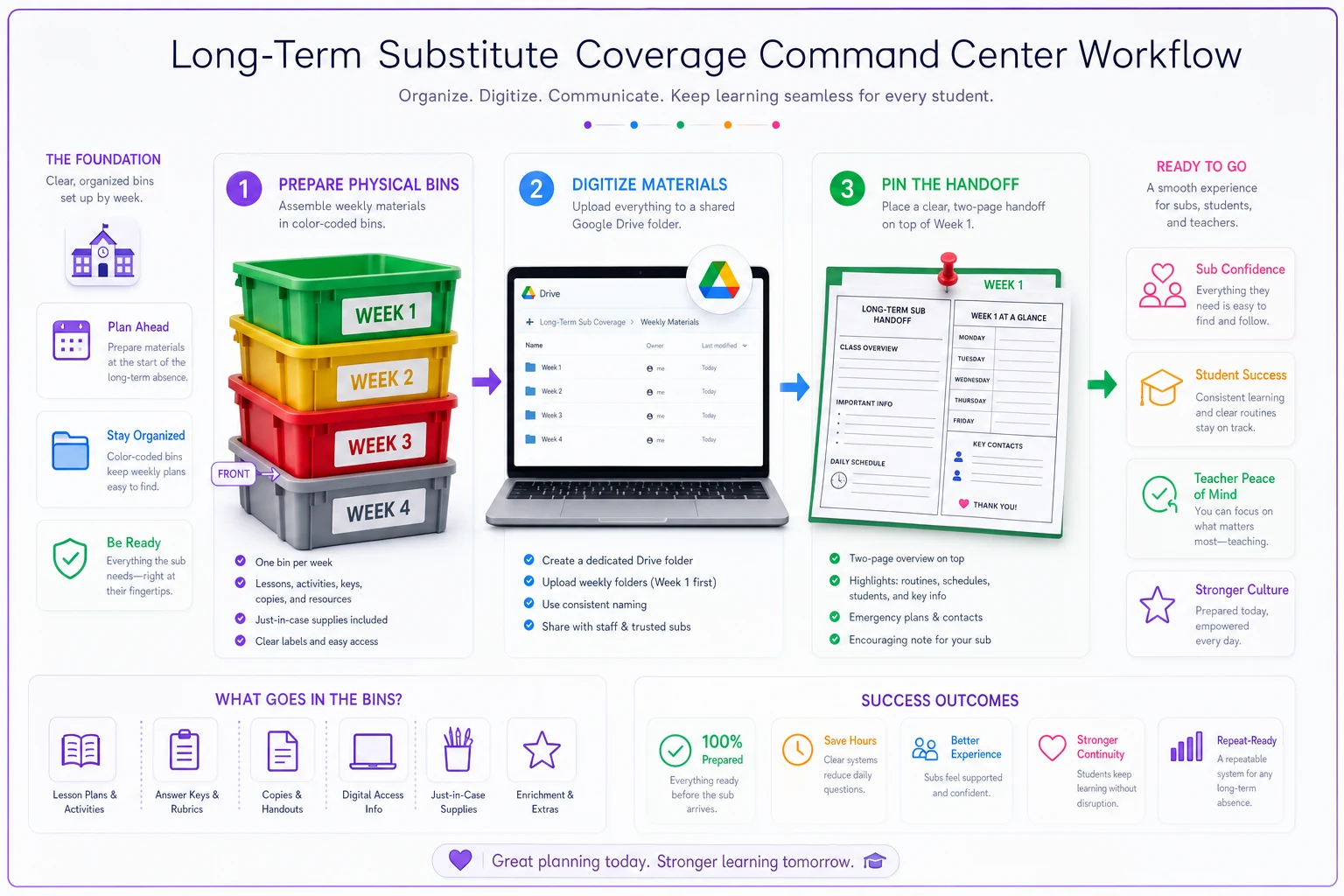
Label three bins or drawers: Must-Do (red), Should-Do (yellow), Nice-to-Do (green). Inside each bin, organize materials by week, not by subject. Week 1 in front, Week 6 in back. This prevents substitutes from accidentally jumping ahead or pulling materials out of sequence.
For each week's materials include:
-
Copies made and paper-clipped by day
-
Answer keys attached to assignments
-
Sticky notes with timing estimates
-
Alternative activities if the primary lesson falls apart
Digital organization needs the same clarity. Create one Google Drive folder titled "SUB PLANS [YOUR NAME]" with subfolders for each week. Pin the two-page handoff at the top. Include view-only links to the grade book with assessment weights explained, a student information spreadsheet covering allergies, IEPs, and parent contacts, curriculum pacing guides with your current position marked, and emergency lesson plans for when everything goes sideways.
Place Week 1 materials at the front of each bin so substitutes can't accidentally skip ahead.
This image shows the command-center setup and workflow so substitutes can follow the system at a glance.
The substitute shouldn't need to hunt through your email or decode your filing system. Everything they need should be immediately visible and clearly labeled.
Managing parent communication
Parents panic when long-term substitutes arrive. They email frantically about homework, worry about academic progress, and sometimes try to micromanage the classroom. Your continuity plan needs clear communication protocols that maintain boundaries while keeping parents informed.
Draft three template emails the substitute can send:
-
Introduction email (sent day one)
-
Weekly update template (sent Fridays)
-
Response template for common concerns
"Mrs. Smith will maintain all instructional standards and assessments during my absence. She has detailed plans for each unit and will follow the established curriculum pace. For questions about grades or IEP accommodations, please contact the principal. For daily homework or classroom concerns, Mrs. Smith can be reached through the school office."
Weekly updates prevent parent anxiety from building. The substitute fills in a simple template—what was covered, what's coming, assessments returned, upcoming reminders. Ten minutes on Friday afternoon prevents dozens of worried parent emails the following week.
Protecting assessment integrity while staying flexible
Assessments can't wait eight weeks, but substitutes shouldn't be creating or significantly modifying your evaluations. Your plan needs to balance assessment integrity with practical flexibility.
For Must-Do assessments, provide everything upfront: test copies made and locked in the filing cabinet, detailed answer keys with point values, rubrics with student anchors attached, and clear instructions about accommodations for IEP students.
Include contingency plans for common problems. Kid absent on test day? Make-up version in the green folder. Multiple students struggling? Allow notes for partial credit. Technology fails during online assessment? Paper backup in the bottom drawer.
For Should-Do assessments, give substitutes modification authority. Provide the original but include a simplified version they can use if students aren't ready. Maybe the original has five constructed response questions; the simplified version has three with sentence starters.
Nice-to-Do assessments become purely optional. That creative project presentation? Convert it to a written response if the substitute isn't comfortable managing presentations. The group debate? Save it for your return.
Building in checkpoints without micromanaging
You want to know your classroom isn't falling apart, but managing every detail from medical leave isn't realistic or healthy. Build structural checkpoints that keep you informed without creating a communication burden.
Designate a colleague as your "curriculum buddy"—someone who checks in weekly with the substitute but isn't their daily support system. This person reviews the Must-Do checklist each Friday, confirms assessments were administered, and sends you a brief text: "Week 3 complete, on track" or "Behind on math, caught up on reading."
Create a simple tracking sheet the substitute updates daily. Not a detailed log, just basic checkboxes:
-
[ ] Morning routine completed
-
[ ] Must-Do math lesson delivered
-
[ ] Must-Do reading activity done
-
[ ] Major behavior issues (if yes, note in log)
-
[ ] End of day routine followed
The substitute spends 30 seconds checking boxes. You review weekly. If multiple Must-Do items get skipped, your curriculum buddy investigates. For longer leaves beyond six weeks, schedule one optional check-in call at the midpoint—keep it to 15 minutes, review what's working, and decide whether to adjust expectations for the remaining time.
Troubleshooting common failure points
The substitute gets overwhelmed week two and starts skipping everything except worksheets. This happens when the honeymoon period ends and behavior management gets hard. Build in a "reset week" plan—a simplified version of week 3 that focuses only on Must-Do items plus extra structure and routine. Include a note: "If classroom management is deteriorating, implement Reset Week plan in purple folder. Return to regular plans when stability returns."
Half the class fails the first major assessment. Your plan should already include re-teaching materials for essential standards. Create a "Recovery Kit" with simplified versions of key lessons, peer tutoring protocols, and alternative assessment options. The substitute doesn't need to diagnose why students struggled—just implement the recovery protocol and keep moving.
Technology completely fails. Every digital Must-Do needs an analog backup. That online math program? Include printed worksheets covering the same standards. Digital reading platform? Have physical books ready. Don't make technology a single point of failure.
A parent escalates concerns to administration. Clear documentation saves everyone here. Your two-page handoff should include a section titled "If questioned about curriculum decisions" with specific standard numbers, page references in adopted curricula, and notes about district requirements. The substitute shouldn't need to defend your pedagogy—just point to the plan.
Making the handoff sustainable with operational tools
Building this level of organization for a long-term substitute takes serious time—time you probably don't have when medical leave suddenly becomes necessary. This is where AI-powered operational software changes the math significantly.
Modern classroom management platforms can generate tiered lesson plans from your existing curriculum materials automatically. Instead of manually copying and organizing six weeks of materials, you upload your unit plans and let the system sort activities into Must-Do, Should-Do, and Nice-to-Do categories based on standard alignment and your stated priorities. The same platforms track assessment schedules, flag IEP accommodations, and create substitute-friendly views of your classroom data. When unexpected leave happens, you're not starting from scratch—you're exporting a pre-organized substitute portal with everything already categorized and sequenced.
Some platforms handle parent communication automatically too. Weekly progress emails generate from activities logged by the substitute. Parent concerns route to appropriate contacts based on issue type. The substitute focuses on teaching while the system handles the operational side.
The difference between manual and automated preparation is real—roughly 40 hours of scrambling versus a few hours of setup. That gap matters a lot when you're trying to rest before medical treatment or manage an unexpected family situation.
The realistic impact on learning outcomes
Even the best long-term substitute continuity plan won't perfectly replicate your teaching. Students will lose some momentum. Some kids will struggle more than usual. The goal isn't perfection—it's preventing serious regression while maintaining core progress.
With a solid three-tier plan and a clear two-page handoff, you can reasonably expect around 85-90% of Must-Do standards to get covered effectively, 60-70% of Should-Do activities to get completed, and maybe 20-30% of Nice-to-Do enrichment to actually happen.
Compare that to no structured plan, where substitutes typically cover around 40% of grade-level standards and fill remaining time with busywork or re-teaching material students already know.
The real payoff shows up when you return. Instead of spending a month figuring out what was covered and re-establishing routines, you can resume actual teaching within a few days. Your substitute maintained the operational backbone. You add back your teaching style and relationships. Students benefit from the structure too—they know what to expect, keep their learning routines, and don't experience the low-grade anxiety that comes from educational chaos.
Creating your plan without burning out
Building a long-term substitute continuity plan doesn't mean sacrificing every weekend. Start with the framework and add detail over time. A basic three-tier structure with two weeks of materials beats an elaborate plan that only covers three days.
Focus first on Must-Do items for your next unit. What absolutely cannot slip? What would cause students to fall behind on end-of-year requirements if skipped? Those become your non-negotiables. Then identify Should-Do items—what maintains momentum without being critical, what would you prioritize if you only had three hours per day to teach. Nice-to-Do items are everything else. Document these quickly, just titles and material locations. Substitutes can figure out the details if they actually get to these activities.
The two-page handoff should take no more than an hour if you focus on operational essentials. Save the template and update it each quarter as a regular maintenance task. When you update units, spend five minutes adjusting the tiered structure. When new assessments get added, drop them into the right category.
Distributed preparation means you're never more than a few hours away from being ready for unexpected leave. That peace of mind alone is worth the investment—knowing your classroom can function without you, not perfectly, but well enough, lets you focus on whatever necessitates the leave.
Your students keep learning. Your substitute has clear direction. You return to a classroom that's still recognizably yours. That's what a real long-term substitute continuity plan actually delivers.
Ready to elevate your classroom management?
Join 5,000+ educators using Skolyly to save time, engage students, and improve learning outcomes.