

Most Tier 2 behavior decisions don't fail because the team picked the wrong strategy. They fail because the decision took three weeks, involved four adults, produced a six-page document nobody reads, and by the time it's "done," the student's behavior has already shifted and the plan is targeting a problem that's half gone.
The fix isn't a better form. It's a faster, tighter decision. You need a single page that tells the classroom team whether this warrants a short Behavior Intervention Plan (BIP), what that plan should actually target, and a way to know—inside ten school days—whether to keep going, adjust, or kick it up to Tier 3.
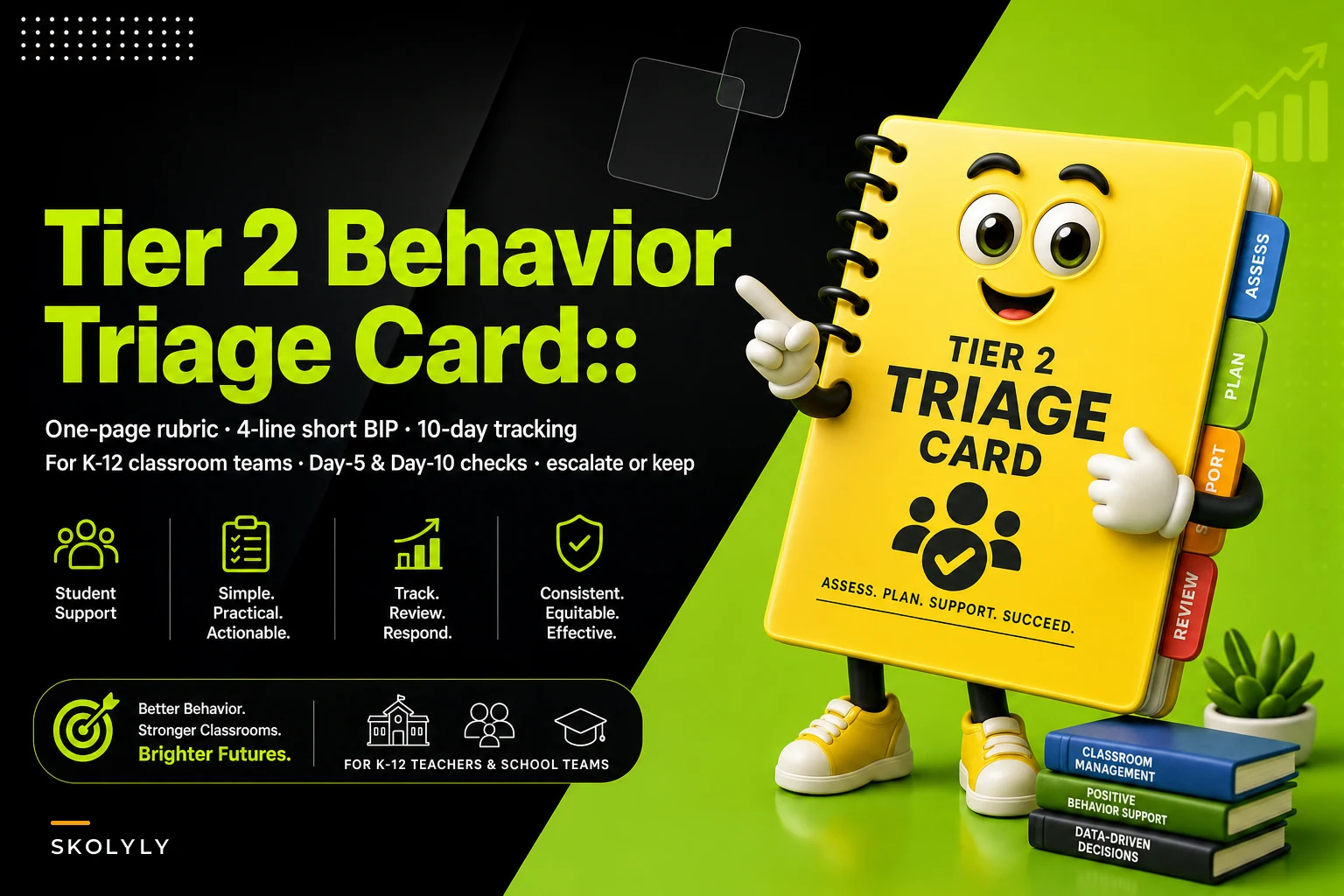
This is the triage card. It's built for the teacher and the grade-level team to use in a hallway conversation or a ten-minute huddle, not for a specialist to write up after the fact.
Why the standard BIP process stalls out
Walk into most schools and the "process" for a struggling student looks something like this: teacher raises a concern, someone suggests a behavior chart, three weeks pass, a referral gets written, a meeting gets scheduled two weeks out, and a formal FBA/BIP gets discussed for the students at the very top of the pile. Everyone below that line just waits.
The problem is the binary. Schools treat behavior support as either "log it and hope" or "full formal FBA/BIP with the whole team." There's almost nothing in between. And the middle is exactly where most Tier 2 kids live—the ones who aren't in crisis but are losing 15–20 minutes of instruction a day, plus pulling the adults around them into constant redirection.
A typical example: a 4th grader who blurts, wanders, and refuses to start independent work. Not dangerous. Not IEP-level. But that kid eats roughly two hours of teacher attention a week that should've gone to the other 24 students. Nobody writes a formal plan because it doesn't feel "serious enough," so the behavior persists into November, December, and eventually becomes serious enough.
The one-page rubric exists to catch that student in week two instead of week twelve.
The decision rubric: does this kid need a short BIP?
The rubric answers one question: Short BIP, keep monitoring, or escalate? Nothing else.
Keep every student on track with ease.
Skolyly helps you create, assign, and monitor classroom activities efficiently.
- Integrated lesson and assignment management
- Real-time student progress tracking
- Automated class scheduling & notifications
No credit card required
Score each row quickly. You're not building a research instrument—you're getting a fast read.
| Factor | Monitor only (0) | Short BIP (1) | Escalate now (2) |
|---|---|---|---|
| Frequency | A few times a week | Daily, multiple times | Constant / every transition |
| Instructional loss | Rarely disrupts learning | Loses 10–20 min/day of the student's own learning | Regularly stops whole-class instruction |
| Function is guessable | Unclear, needs observation | You can name a likely function (escape, attention, access) | Function unclear AND safety concern |
| Safety | None | None | Physical risk to self/others |
| Prior attempts | Nothing tried yet | Seating/proximity/reminders tried, no change | Multiple strategies failed OR crisis |
Reading the score:
-
Any single "2" in Safety → escalate immediately, skip the card.
-
Total 3–6, no safety flag → short BIP zone. Write the card.
-
Total 0–2 → keep it in your regular behavior monitoring. A short BIP is overkill and will just create paperwork.
The most useful column is "Function is guessable." If a classroom team can't name a plausible function—is the kid escaping hard work, seeking attention, or trying to get access to something—then a short BIP is premature. You're guessing at an intervention without enough to go on. Spend two or three days on quiet observation first. The five-minute behavior logs elementary teachers can use daily are enough to surface a pattern without turning the teacher into a data clerk.
When a short BIP actually makes sense
Short BIPs work best for behaviors that are frequent, low-stakes, and functionally clear. Blurting, work refusal, out-of-seat, minor task avoidance. Things where you can pick one replacement behavior and actually reinforce it consistently.
When it's a bad idea
If the behavior is intermittent—big blowup once every ten days—a short BIP built on daily tracking won't generate enough data to tell you anything useful. And if there's any safety dimension at all, a one-pager is the wrong tool. That's a full team, full FBA situation. Don't use the card to feel productive while a real risk sits unaddressed.
Building the short BIP in under 15 minutes
Once the rubric says "yes," the plan itself should fit on the top half of the tracking card. Long BIPs die because nobody remembers what's on page four. A short BIP has exactly four lines.
If your version needs a fifth line, ask whether that line changes what the teacher does tomorrow morning. If it doesn't, cut it.
-
Target behavior (one, observable). Not "disrespect." Write "leaves seat during independent work without permission." If a sub could spot it, it's specific enough.
-
Likely function (one guess). Escape, attention, or access. You'll test this guess with the data. Being wrong is fine—it's information.
-
Replacement behavior + how it's taught. "Raises hand and asks for a break using the break card; taught in a 2-minute role-play Monday." The replacement has to serve the same function as the problem behavior, or the student has no reason to switch.
-
Reinforcement + who delivers it. "Verbal praise + one check mark toward a Friday choice; classroom teacher delivers." Name the adult. Plans with no named owner don't happen.
That's the whole plan. If your version needs a fifth line, ask whether that line changes what the teacher does tomorrow morning. If it doesn't, cut it.
One thing worth flagging: teams love to pick reinforcers the adult thinks are motivating. A sticker chart for a 5th grader who couldn't care less about stickers is a plan designed to fail. Spend thirty seconds asking the kid—or their previous teacher—what actually moves them.
Here's a quick workflow that shows how the rubric, the four-line BIP, and the 10-day tracking connect for a fast decision.
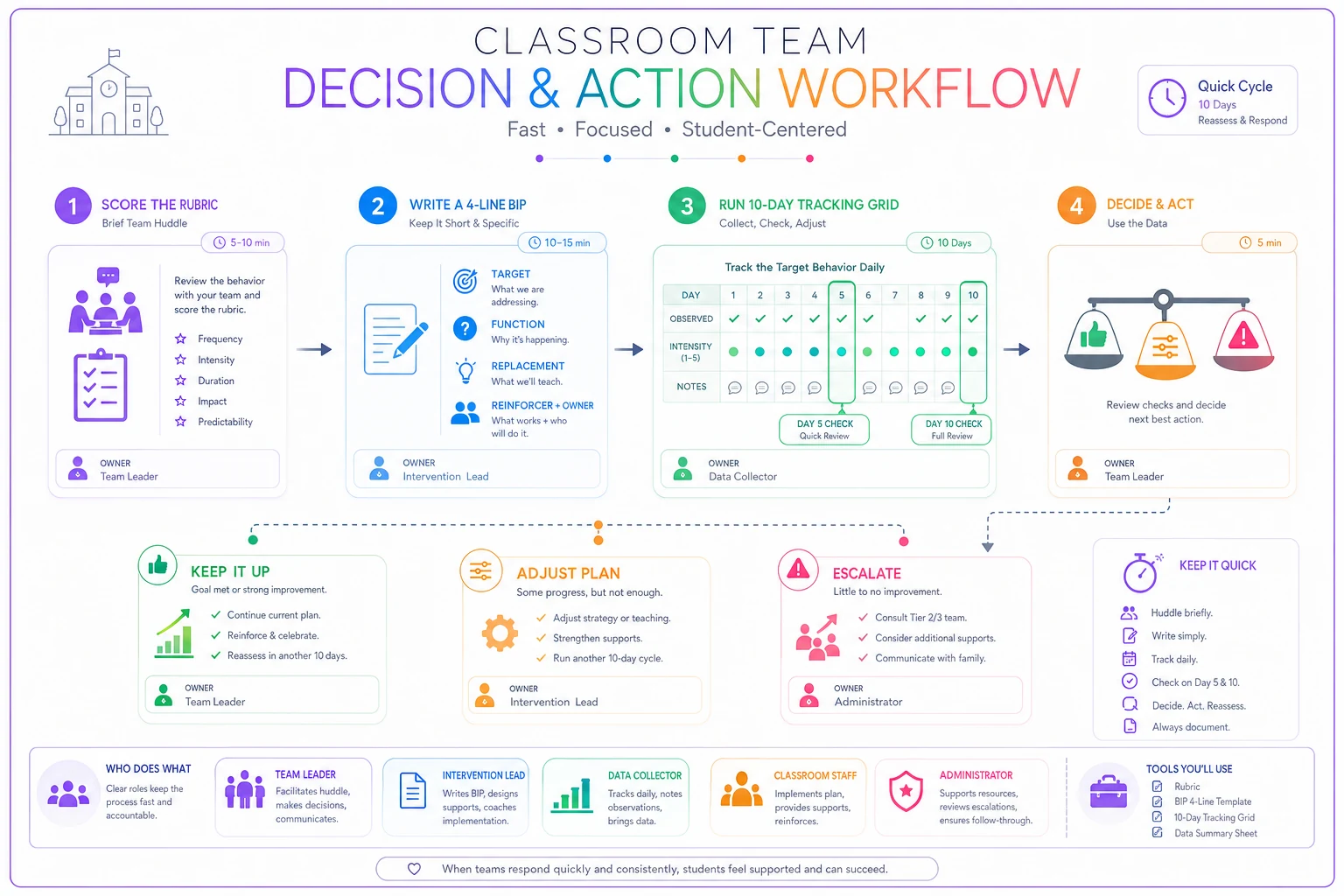
Use the workflow to keep the team focused on writing something the teacher can do tomorrow, tracking for two weeks, and making a data-based decision.
The 10-day tracking card with escalation triggers
The bottom half of the card is a ten-day grid. Two weeks—long enough to see a trend and short enough that you're forced to make a decision instead of letting a plan drift for a quarter.
Each day, the teacher marks two things:
-
Behavior count (tally, or a 0–3 rating if counting is unrealistic that day)
-
Replacement behavior used? (Y/N or a count)
Two marks. If tracking takes more than about 20 seconds a day, teachers will backfill it from memory on day 9, and backfilled data is worthless.
The triggers that force a decision
The card works because the triggers are written before you start, so nobody's arguing about interpretation on day 10.
-
Days 1–3
baseline check.
If the behavior count is dramatically lower than expected early on, the "problem" may have been a rough week, not a real pattern. Consider dropping back to monitoring. -
Day 5
early read.
If the replacement behavior isn't showing up at all by day 5, it probably doesn't match the function, or it wasn't taught well enough. Reteach it—don't wait for day 10 to notice. -
Day 10
the decision.
Compare the last three days to the first three: - Behavior down ~40% or more, replacement rising → keep the plan running another 10 days, then fade. - Flat or slightly down → adjust one variable (usually the reinforcer or the function guess), run 10 more days. - Flat or worse across all ten days, or two crisis days → escalate to the full team/FBA. The card just did its job by getting you there in two weeks instead of two months.
The 40% figure isn't sacred—it's a rule of thumb. The point is having a number decided in advance so the day-10 conversation is "the card says adjust" instead of "well, it kind of felt a little better maybe?"
A real scenario: the day-10 decision that changed the direction
Second-grade team at a mid-sized elementary school. A student was flat-out shutting down at the start of every independent math block—roughly six refusal incidents a day, each costing five to ten minutes of the teacher circling back.
The team almost went straight to a referral. Instead they ran the rubric: frequency high, instructional loss clear, function guessable (escape from work that felt too hard), no safety flag. Score landed squarely in short-BIP territory.
Target behavior: refusing to start math independent work. Function guess: escape. Replacement: student could request a "starter pass"—doing the first two problems with the teacher before continuing alone. Reinforcement: brief praise plus progress toward Friday's classroom-job pick.
The first five days barely moved. Still four to five refusals a day. But the day-5 check caught something: the student wasn't using the starter pass. The replacement wasn't being prompted. The teacher started explicitly cueing it at the transition, and by day 10 refusals were down to one or two a day, with the starter pass being requested most sessions.
Total time cost to the team: the initial 15-minute card setup, plus roughly two minutes of tracking a day. No formal meeting until they had actual data to bring. That day-5 catch is the whole point—without a mid-point trigger, they'd have declared the plan a failure on day 10 and escalated a kid who didn't need it.
Keeping the cards from becoming their own paperwork problem
The honest risk: a triage card system done on loose paper becomes twelve half-finished cards in a teacher's desk drawer that nobody looks at during the huddle. The card solves the decision problem but can quietly create a tracking problem if it lives on paper.
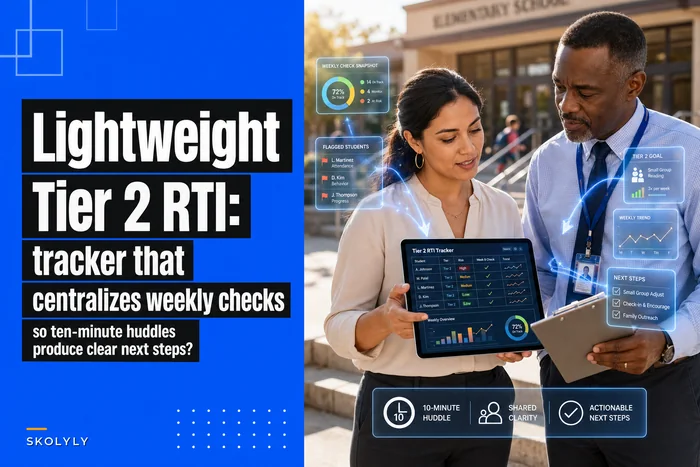
The lightweight fix is connecting these cards to whatever your team already uses for its weekly review. If your grade-level team runs a short huddle, the day-5 and day-10 triggers should surface in that meeting automatically instead of depending on someone remembering to dig out a card. A lightweight Tier 2 RTI tracker that makes weekly huddles productive is the natural home for this—the tracking card feeds the huddle, and the huddle's job becomes acting on the triggers, not re-collecting data.
Put the day-5 and day-10 triggers on the team's calendar and assign the plan owner to review them.
Paper or shared system, the operational rule is the same: the person who owns the plan is the person who looks at the card, and the trigger dates are non-negotiable calendar events. A day-10 decision that slides to day 18 defeats the entire purpose.
The one-page checklist to run this tomorrow
Paper or shared system, the operational rule is the same: the person who owns the plan is the person who looks at the card, and the trigger dates are non-negotiable calendar events.
-
[ ] Print the rubric and tracking card on one sheet (rubric top, 10-day grid bottom)
-
[ ] Score the rubric during a normal huddle, not a special meeting
-
[ ] If any safety "2" appears, stop and escalate—don't use the card
-
[ ] Write the four-line BIP
target, function, replacement, reinforcer + owner
-
[ ] Pick a reinforcer the student actually cares about
-
[ ] Set the day-5 and day-10 dates on the calendar now
-
[ ] Track two marks a day, under 20 seconds
-
[ ] On day 5, check whether the replacement behavior is appearing at all
-
[ ] On day 10, compare last three days to first three and follow the trigger
-
[ ] Keep, adjust, or escalate—no "let's give it more time" without a reason
Keep, adjust, or escalate—no "let's give it more time" without a reason
The point of the card
The value isn't the form itself—you could sketch this rubric on a sticky note. The value is forcing two decisions that schools normally avoid: is this worth a plan at all, answered in ten minutes instead of three weeks, and is the plan working, answered on a fixed date instead of whenever someone gets around to checking.
Most Tier 2 behavior support drifts because nobody set a deadline for the decision. The triage card is really just a deadline with a rubric attached. Give a classroom team those two things and they'll catch the November problem in September—which is the only version of behavior support that actually protects instructional time.
The value isn't the form itself—you could sketch this rubric on a sticky note. The value is forcing two decisions that schools normally avoid: is this worth a plan at all, answered in ten minutes instead of three weeks, and is the plan working, answered on a fixed date instead of whenever someone gets around to checking.
Ready to elevate your classroom management?
Join 5,000+ educators using Skolyly to save time, engage students, and improve learning outcomes.