

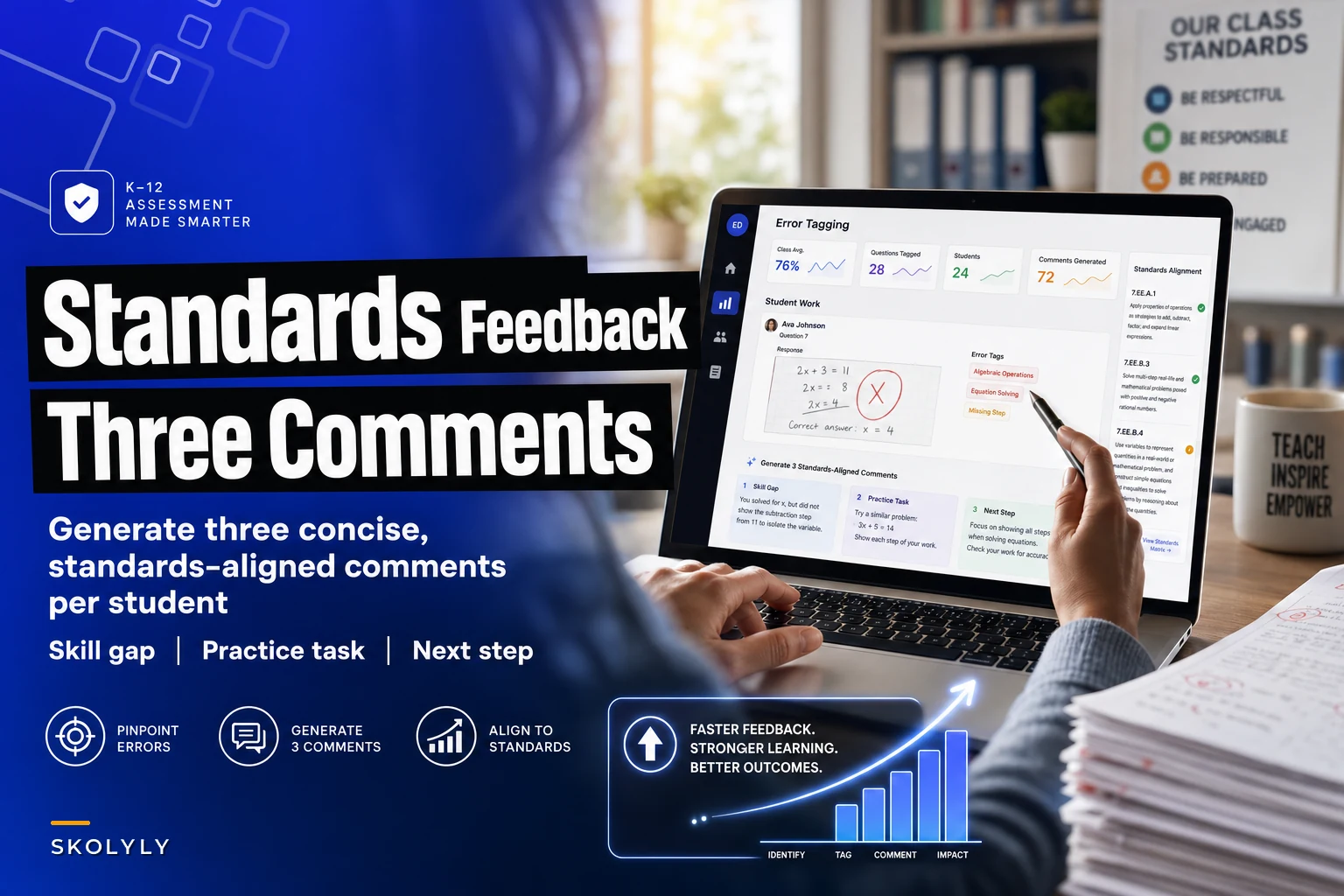

The pile of graded quizzes tells you two things: who missed what, and that you're now supposed to say something useful about it. The first part takes a scanner. The second part is where teachers lose entire evenings—writing "review this" thirty-two times in slightly different words, or worse, writing nothing at all because there's a staff meeting in eight minutes.
The problem isn't that teachers don't know how to give good feedback. It's that good feedback, done one student at a time from scratch, doesn't scale past a class or two before it starts eating time you don't have. The feedback either gets skipped, gets generic ("nice work, keep it up"), or gets so detailed on a handful of students that the rest get nothing.
This is a structure problem. Structure problems have structural fixes. What follows is a protocol that produces exactly three comments per student—skill gap, practice task, next step—each tied to a standard, that you can run at scale after any common assessment.
Why "personalized feedback" quietly collapses at scale
Almost every feedback breakdown follows the same pattern. A teacher grades a common assessment across four sections of 28 students. That's around 110 kids. The intention is real: give each one a note that actually helps. But somewhere around student 40, the notes shrink. By section three they're a checkmark and a circled number. By the last stack, it's a raw score and nothing else.
The failure isn't laziness. It's that the teacher is solving a different problem for every single student when in reality most students clustered into a handful of the same errors. On a fractions assessment, you don't have 110 unique problems. You have maybe six or seven common misconceptions—denominator addition, forgetting to simplify, converting mixed numbers incorrectly—and each student lands in one or two of them.
The mistake is treating 110 students as 110 feedback problems instead of 7 error patterns applied to 110 students. Once you flip that, the whole thing becomes buildable.
The three-comment frame (and why exactly three)
Every comment a student gets does one of three jobs. Naming a fourth or fifth doesn't help—it dilutes. Here's the frame:
Keep every student on track with ease.
Skolyly helps you create, assign, and monitor classroom activities efficiently.
- Integrated lesson and assignment management
- Real-time student progress tracking
- Automated class scheduling & notifications
No credit card required
-
Skill gap — the specific thing that broke, tied to a standard, in plain language a student can act on.
-
Practice task — one concrete thing to do, not "study harder."
-
Next step — what happens after the practice, so the student knows the loop closes.
Three is deliberate. Two feels incomplete—you named the problem but didn't hand them a path. Four or more turns into a wall of text students skim past. Three fits on a sticky note, an LMS comment box, or the margin of a returned quiz.
The other reason three works: it maps cleanly to how you already reteach. If you've run something like a 30-minute end-of-unit reteach triage, the mini-lessons you build there are the practice tasks. The comment protocol and the reteach protocol are the same operation, just viewed from the student side versus the class side.
Build the error bank first (this is the whole trick)
Before you write a single comment, build a small bank of error patterns for the assessment. One-time cost per assessment, pays off across every class and every year you reuse it.
Sit down with the assessment and your standards list. For each item, ask: what are the two or three ways a student typically gets this wrong? Not every wrong answer—the common ones. You'll usually land on 6 to 10 error patterns for a full unit assessment.
For each error pattern, pre-write the three comments once. So an error pattern isn't just "student added denominators." It's a small record:
| Field | Example content |
|---|---|
| Error pattern | Added denominators when adding unlike fractions |
| Standard | 5.NF.A.1 |
| Skill gap comment | "You added the bottom numbers straight across. With unlike fractions, the denominators have to match first." |
| Practice task | "Redo #3 and #7. Before adding, rewrite each fraction so both have the same denominator." |
| Next step | "Bring both to Thursday's warm-up; if they're clean, you're cleared on this standard." |
Do this once, and grading stops being writing—it becomes tagging. You read a student's paper, tag the one or two error patterns they hit, and the comments auto-attach. A stack that used to take 90 minutes to comment on drops to the time it takes to sort.
The insight most people miss: the error bank is the reusable asset, not the comments. Comments are disposable. The bank of "here are the 8 ways students break on this unit, and here's what to say about each" is what you keep and refine each cycle.
The workflow, start to finish
Here's how a full run looks in practice, from graded stack to comments in students' hands.
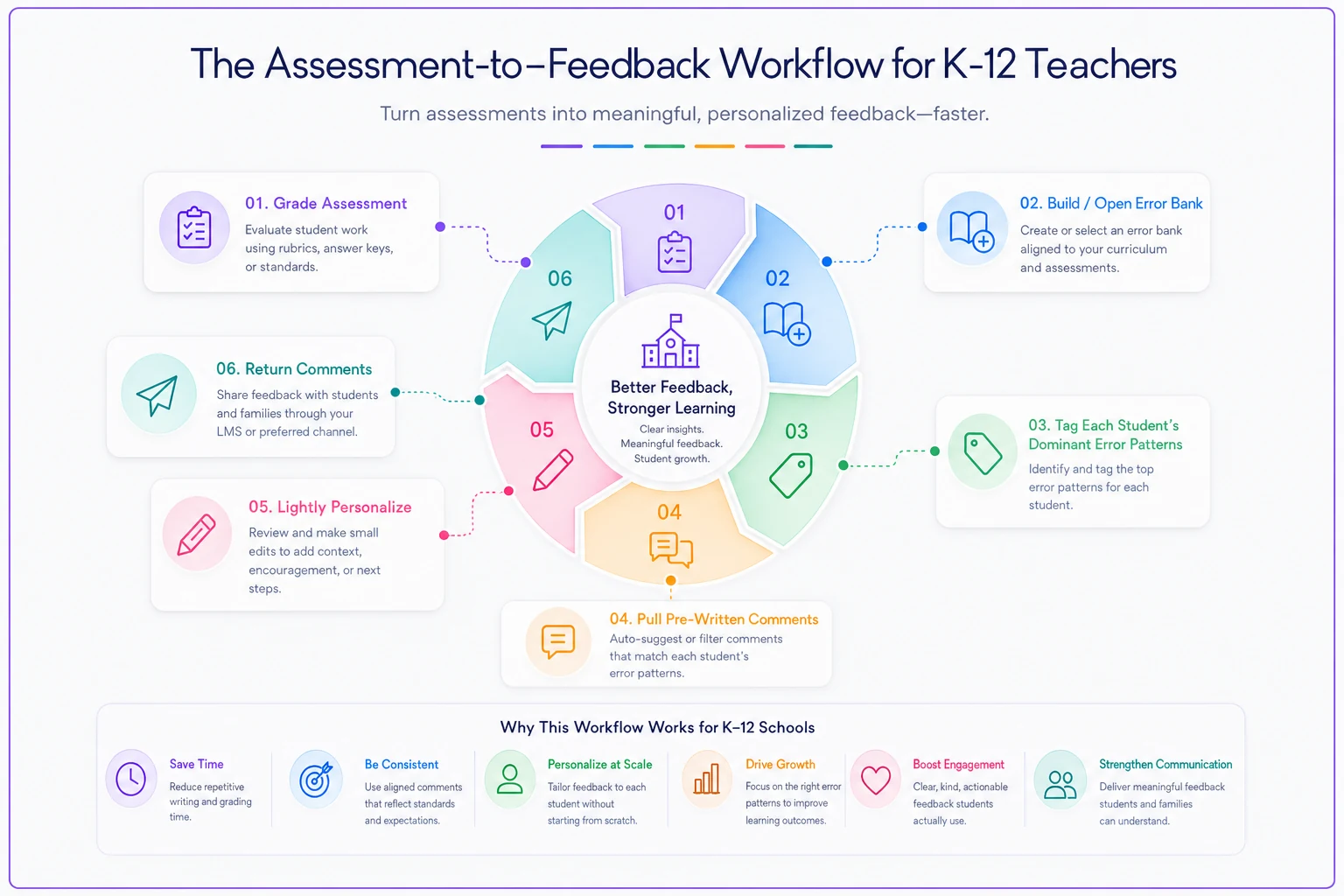
A simple diagram like this keeps the steps clear when you're moving quickly.
-
Grade the assessment normally—just scores, no comments yet.
-
Open your error bank for that assessment (or build it if it's the first time).
-
Go student by student and tag their one or two dominant error patterns. Ignore the noise; you're looking for the pattern that actually cost them the standard.
-
Pull the three pre-written comments for each tagged pattern.
-
Lightly personalize only where it matters—a name, a specific problem number, a "you nailed the harder ones, this is the only gap."
-
Return everything the next day, before the errors go cold.
The personalization step is where teachers over-invest. You don't need to rewrite the skill-gap comment for each kid. Swap in the specific problem numbers they missed and, occasionally, add one human line. That's it. Ninety percent of the value is in the pre-written spine; the last ten percent is a light touch.
If your assessment is math and you're building the error bank from scratch, the item-type thinking in how quick math formatives reveal instructional gaps is a fast way to figure out which wrong answers actually signal a misconception versus a careless slip. That distinction matters—you don't want an error pattern for "arithmetic mistake," because there's no useful practice task attached to it.
A real scenario with numbers
A 7th-grade math team ran a common assessment across three teachers, roughly 220 students total, on ratios and proportional relationships. Before this protocol, "feedback" was a returned paper with a score and, on a good day, one circled problem. Two of the three teachers admitted they'd basically stopped writing comments because it took an evening per section.
They spent about 40 minutes together building the error bank—landed on 7 error patterns, each mapped to a standard, each with the three comments pre-written. Split the writing three ways. That was the entire upfront investment.
The next assessment, tagging and returning comments for all 220 students took each teacher roughly 25–30 minutes for their own sections. Not per section—total. Every student got three specific, standards-tagged comments. The reteach warm-ups the following week were noticeably tighter because students showed up already knowing which two problems to redo.
Worth noting: one teacher's classes clustered heavily into just two error patterns, so her tagging was almost instant. Another had students spread across five or six, which took longer. The protocol scales, but it scales unevenly depending on how your kids actually broke.
When this makes sense—and when it doesn't
This works best on common assessments with a defined standard set, where the same error patterns recur across sections and years. Unit tests, benchmark assessments, end-of-module checks. Anywhere you're grading 60+ students on the same items, the error-bank payoff is significant.
It's a bad fit for open-ended, one-off work—a personal essay, an original project, a lab where every student took a different path. There's no reusable error bank because there's no common set of errors. For that kind of work, individualized feedback is genuinely the right tool, and trying to force a template produces feedback that feels canned because it is.
Who should not do this: anyone tempted to skip the tagging and just blast the same three comments to a whole class. That's not this protocol—that's a form letter. The tagging step, where you actually diagnose each student's dominant error, is what keeps it honest. Drop that, and you've built a machine for pretending to give feedback.
Keep the bank alive
The error bank isn't a one-time build. After each cycle, two things happen. First, you'll spot a new error pattern you didn't anticipate—add it. Second, you'll notice some comments land and some get blank stares—rewrite the ones students don't act on.
Over two or three cycles the bank stabilizes and barely changes. At that point the maintenance cost is close to zero—you're tweaking, not building.
Store it somewhere your whole team can reach it, not in one teacher's private folder.
The entire advantage compounds when three teachers share seven error patterns instead of each maintaining their own half-built version. If your team already keeps common assessments consistent through a shared moderation or item-review routine, the error bank slots right into that same shared space—same governance instinct, applied to feedback instead of grading.
Some teams keep this in a shared doc; others use whatever assessment platform already holds their common assessments, so the error bank sits next to the item bank and tagging happens in the same place they grade. The tool matters less than the discipline of keeping one shared bank instead of five private ones.
The point
You will never out-hustle 110 students' worth of from-scratch feedback with more evenings. The teachers who give consistent, standards-aligned comments at scale aren't working harder—they've stopped writing 110 unique notes and started tagging 110 students against a small, reusable set of error patterns.
Build the bank once. Tag fast. Personalize lightly. Return the comments before the errors go cold. That's the whole protocol, and it turns the most time-expensive part of assessment—telling each student something useful—into something you can actually finish before the next unit starts.
You will never out-hustle 110 students' worth of from-scratch feedback with more evenings. The teachers who give consistent, standards-aligned comments at scale aren't working harder—they've stopped writing 110 unique notes and started tagging 110 students against a small, reusable set of error patterns.
Build the bank once. Tag fast. Personalize lightly. Return the comments before the errors go cold. That's the whole protocol, and it turns the most time-expensive part of assessment—telling each student something useful—into something you can actually finish before the next unit starts.
Ready to elevate your classroom management?
Join 5,000+ educators using Skolyly to save time, engage students, and improve learning outcomes.