



You just finished grading 82 unit tests over the weekend. Now it's Monday morning, 7:15 AM, and you're staring at a stack of papers trying to figure out how to help the 31 students who scored below 70%.
The traditional move is pulling struggling students for individual conferences, scheduling makeup sessions after school, or just pressing forward and hoping they catch up. There's a better way that takes about 30 minutes and gives you everything you need for targeted reteaching.
The error-pattern clustering approach most teachers never learn
Traditional test analysis focuses on individual student scores. Maria got a 64%, so Maria needs help. James scored 58%, so James needs remediation. This student-by-student approach sounds logical but it misses how reteaching actually works in a real classroom.
What works is clustering errors by type, not by student. When you shift from "who failed" to "what concepts failed," the path forward gets a lot clearer.
Take a typical middle school math unit on linear equations. After grading, you might find:
-
12 students who can't isolate variables
-
9 students who mess up when variables appear on both sides
-
8 students who get confused by word problems requiring equation setup
-
2 students who struggle across the board
That's three distinct mini-lessons, not 31 individual tutoring sessions.
Why teachers default to inefficient reteaching methods
The problem starts with how grading software shows you data. Most platforms give you:
Keep every student on track with ease.
Skolyly helps you create, assign, and monitor classroom activities efficiently.
- Integrated lesson and assignment management
- Real-time student progress tracking
- Automated class scheduling & notifications
No credit card required
-
Individual student scores
-
Class average
-
Maybe a question-by-question breakdown
None of that answers the actual question you need answered: "What are my three highest-impact reteach groups for tomorrow?"
There's also the psychological pull. When you see a student struggling, you want to help that specific student. It feels more personal. But grouping by error type ends up helping more students more effectively, even if it feels less intuitive.
Teachers spend entire planning periods building individualized remediation plans for each struggling student, meanwhile 70% of those students made the same two or three mistakes.
The 30-minute triage protocol
Here's the exact protocol that turns a pile of graded tests into actionable reteach groups:
Minutes 0-10: Rapid Error Tagging
Grab a blank sheet of paper. Create three columns. As you flip through each test—spend no more than 7 seconds per test—mark tally marks for the most common error types you're seeing. Don't overthink the categories. Use whatever makes sense for your content.
For a recent 8th-grade science unit on chemical reactions, one teacher's tally sheet looked like this:
-
Balancing equations
18 marks
-
Identifying reaction types
14 marks
-
Conservation of mass calculations
11 marks
-
Drawing particle diagrams
7 marks
You're not recording student names yet. Just tallies.
Minutes 10-15: Group Formation
Take your top three error categories. These become your reteach groups. Flip back through the tests one more time, now writing student initials under each category. Students can appear in multiple groups if needed.
One operational rule worth keeping: cap groups at 12 students. If "balancing equations" pulls 18 students, split it into two sessions or pick the 12 who need it most based on overall performance.
Cap groups at 12 students to keep reteaches manageable and ensure enough practice time.
Minutes 15-20: Mini-Lesson Selection
This is where the prewritten mini-lesson bank becomes critical. You need three ready-to-go 15-minute reteach lessons that target those identified error patterns.
The bank doesn't need to be elaborate. A shared Google Drive folder with 10-12 common error-pattern lessons per unit works fine. Each lesson should have:
-
A 2-minute warm-up problem
-
5-minute direct reteaching with different examples than the original lesson
-
8-minute guided practice with immediate feedback
Minutes 20-25: Logistics Planning
Decide when these groups meet. The most workable schedules tend to be:
-
During independent work time the next day (pull one group while others complete practice)
-
First 15 minutes of class over three consecutive days
-
Station rotation where one station is teacher-led reteaching
Write the schedule on a sticky note and post it on your board before you leave.
Minutes 25-30: Communication Setup
Send one message to parents of students in reteach groups. Keep it short: "Based on our recent assessment, [Student] will participate in a targeted mini-lesson on [specific skill] during class tomorrow. No additional homework required."
For administrative tracking, log the groups in whatever system your school uses. Most just need: date, standard addressed, student names, intervention type.
| Field | Example Entry |
|---|---|
| date | 2026-04-12 |
| standard addressed | 8.EEI.3 |
| student names | A. Smith, J. Lee, M. Patel |
| intervention type | 15-minute reteach, small group |
Most schools only need those four pieces of information for basic tracking.
The manual protocol is compact and fast enough to run between grading and teaching the next day.
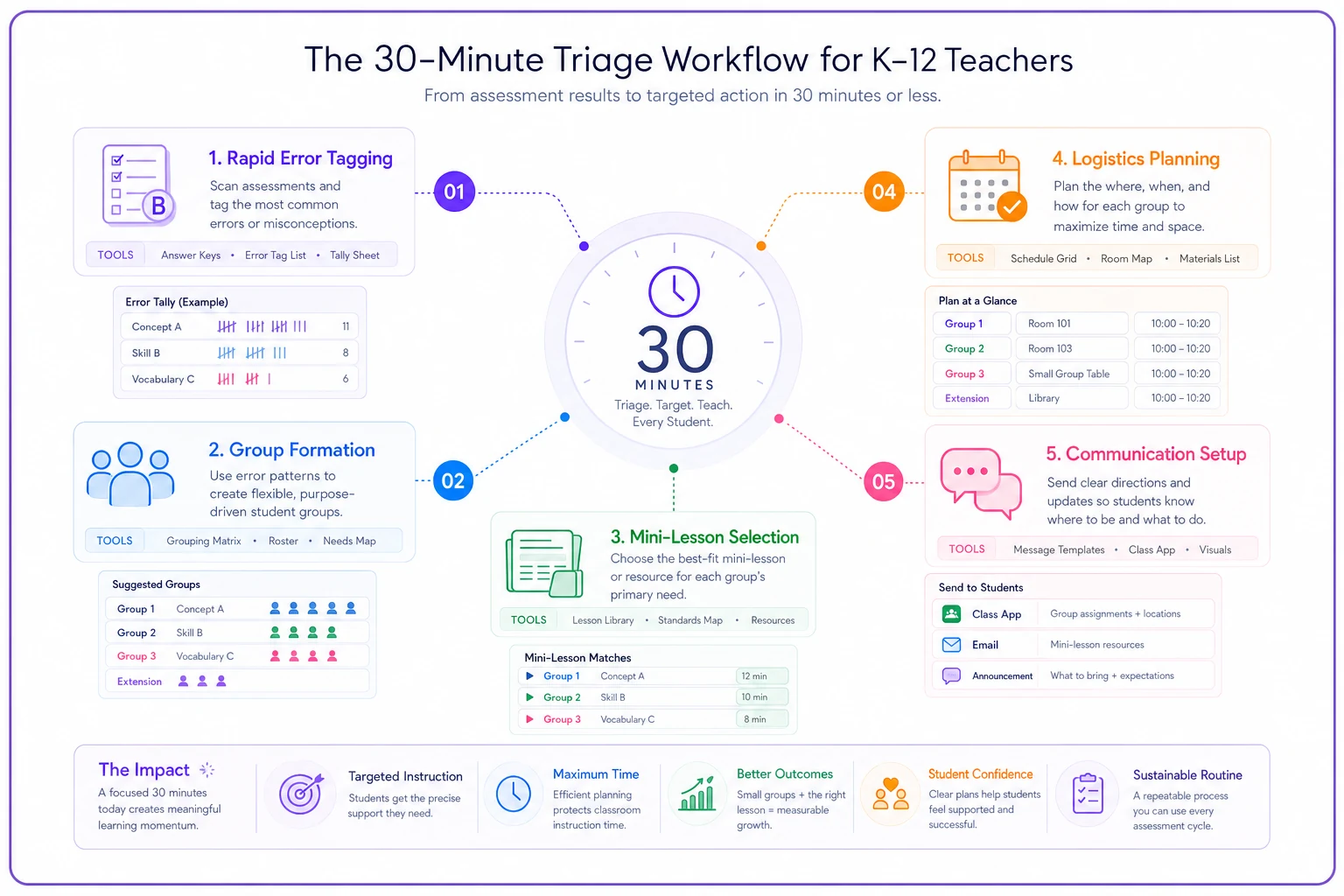
Here's a quick visual of the step-by-step flow to keep on your wall.
Building your mini-lesson bank (the part nobody talks about)
The whole protocol falls apart without ready-to-use mini-lessons. Creating them on the fly defeats the purpose of a rapid triage system.
Start small. After each unit, identify the three most common error patterns from your assessments and write one mini-lesson for each. By year two, you'll have most of what you need already built.
Structure each mini-lesson around a single correction. If students can't balance equations, don't reteach all of chemical reactions. Focus on the balancing skill with fresh examples.
Here's what one "Isolating Variables" mini-lesson might look like:
-
Warm-up (2 min) Solve 3x + 7 = 22 on whiteboards
-
Reteach (5 min) Use a balance scale visual. Physical demonstration with actual objects if possible. Three new examples, each showing the "undo" sequence
-
Practice (8 min) Six problems, increasing difficulty. Students work in pairs and check each other after each one
These aren't full lessons. They're surgical strikes on specific misconceptions.
Implementation barriers teachers actually face
The biggest barrier isn't time or resources—it's the guilt of not giving every struggling student individual attention.
You might think: "But Jackson needs more than just balancing equations help. He needs confidence building, processing time, maybe testing accommodations."
That's fair. But the triage protocol isn't trying to solve every learning challenge. It's designed to efficiently address the most common conceptual gaps so you have time left for those deeper individual needs.
Another real barrier: department pressure to maintain pacing. Some schools expect you to start the next unit immediately. The data helps here. When you can show administration you're addressing specific standards gaps for identified student groups in roughly 45 minutes of class time—three 15-minute sessions—it's hard to push back on.
Measuring whether your triage actually works
Track one metric: performance on the same error type on the next assessment.
If 12 students couldn't balance equations on the Unit 3 test, how many still struggle on Unit 4? You're not looking for perfection. Even dropping from 12 to 6 students with that same error means you've halved the reteaching load going forward.
One 7th-grade team tracking this found targeted mini-lessons reduced recurring errors by roughly 60% compared to whole-class review or no intervention at all. Not a miracle, but meaningful progress that builds over a school year.
The workflow automation potential
While the core triage protocol is manual, several pieces naturally lend themselves to operational automation. Error pattern identification from digital assessments can be automated to instantly group similar mistakes. The mini-lesson bank becomes searchable and tagged by standard. Parent communication can trigger automatically when students are assigned to groups.
Some schools have started building these workflows into their assessment platforms—turning individual data points into actionable improvement cycles. The manual protocol works fine on its own, but when you're managing 150+ students across multiple classes, having software handle the clustering and communication frees you up for the actual teaching part.
When this protocol isn't the right fit
Skip this approach if:
-
Your assessment was project-based without clear right/wrong elements
-
Fewer than 20% of students struggled (just do whole-class review)
-
The errors are primarily procedural rather than conceptual, like formatting citations
-
You have adequate time for individual conferencing with each struggling student
The protocol works best for content-heavy subjects with clear conceptual chunks: math, science, grammar, foreign language fundamentals. For project-based assessments, you need different workflows.
Common mistakes in implementing reteach triage
Creating groups that are too broad: "Students who need math help" isn't a group. "Students who confuse area and perimeter" is.
Over-explaining during mini-lessons: You have 15 minutes. If you spend 10 explaining, students get 5 minutes of practice. Flip that ratio.
Mixing skill levels within groups: If Sophie missed one problem on isolating variables while David can't identify what a variable is, they shouldn't be in the same mini-lesson.
Not having materials ready: The mini-lesson bank isn't optional. Without it, you'll spend 45 minutes creating materials for a 15-minute lesson.
The compound effect over a school year
A teacher running this protocol after each of their 8 major units will conduct roughly 24 targeted mini-lessons throughout the year—3 per unit. That's 24 chances to stop error patterns from becoming entrenched misconceptions.
Compare that to the alternative: those same gaps persist, layer on top of each other, and suddenly you're trying to reteach half your curriculum during state test prep in April.
The real value isn't in any individual mini-lesson. It's in the systematic approach. Students start recognizing their own error patterns. They know that if they struggle with word problems, targeted help is coming. That reduces test anxiety and, over time, actually improves how students engage with assessments.
Making it sustainable
The protocol takes 30 minutes because everything is constrained. You're not building comprehensive remediation plans or designing new curriculum. You're rapidly sorting errors and deploying pre-built solutions.
Keep it lightweight:
-
Use the same error-tagging sheet format every time
-
Hard cap mini-lessons at 15 minutes
-
Rotate through your existing bank rather than creating new lessons
-
Track only the essential data
The teachers who stick with this are the ones who resist overcomplicating it. They trust that targeted, repeated interventions on specific skills will outperform heroic attempts at comprehensive remediation—because in practice, that's exactly what happens.
Building your first mini-lesson bank
Start with your next unit. After grading, identify three common errors. Write one mini-lesson for each—just 15 minutes of content per lesson. Use them immediately.
The following unit, do the same. Within one semester you'll have 12-15 lessons ready. By year's end, around 24. Most teachers find they need roughly 30-35 total to cover the recurring error patterns across their curriculum.
Store them simply. One folder per unit. File names like "Unit3BalancingEquations15min.pdf." Include answer keys directly in the file. You want zero friction when pulling these during your 30-minute triage.
This protocol isn't about perfection. It's about having a systematic, time-boxed approach to addressing the most common learning gaps before they compound. When you can form three targeted groups and schedule the sessions in the same time it used to take to sort through your gradebook, you've meaningfully improved your capacity to help the students who actually need it.
This protocol isn't about perfection. It's about having a systematic, time-boxed approach to addressing the most common learning gaps before they compound. When you can form three targeted groups and schedule the sessions in the same time it used to take to sort through your gradebook, you've meaningfully improved your capacity to help the students who actually need it.
Ready to elevate your classroom management?
Join 5,000+ educators using Skolyly to save time, engage students, and improve learning outcomes.