



Math misconceptions compound faster than any other subject. A student who misunderstands fraction division on Monday will struggle with mixed numbers on Tuesday, tank the quiz on Friday, and carry that gap into the next unit's proportional reasoning work. Yet most middle school math teachers still grade exit tickets after dinner, identify common errors around 9pm, then scramble to adjust tomorrow's lesson plan before bed.
The problem isn't collecting formative data—teachers already do that constantly through exit tickets, warm-ups, and check-for-understanding questions. The breakdown happens in the 16-hour gap between identifying a misconception at 2:15pm and addressing it at 7:45am the next morning. By then, students have completed homework incorrectly, reinforced the wrong process, and mentally filed the misconception as "correct."
This cycle destroys math confidence. Not because teachers don't care or don't assess—they do both, constantly—but because the traditional formative workflow treats data collection and instructional response as two separate events instead of one continuous operation.
Why traditional exit tickets fall short as instructional tools
Exit tickets work fine for identifying who gets it and who doesn't. They fail at telling you exactly which cognitive step broke down and what instructional move will actually fix it tomorrow morning.
Consider what operationally happens when Ms. Rodriguez gives a three-problem exit ticket on solving two-step equations: Problem 1: 3x + 7 = 22 Problem 2: 2x - 5 = 11 Problem 3: 4x + 9 = 25
She collects 28 exit tickets at 2:47pm. After school, parent emails, and planning period, she starts grading around 7:30pm. Eleven students got problem 2 wrong—but their wrong answers vary: some got x = 3, others got x = 16, a few got x = 6. Without required shown work (who has time to grade shown work on daily exit tickets?), she can't tell if students added 5 instead of subtracting, divided by 2 before isolating the variable, made arithmetic errors, or confused positive and negative operations.
So she makes an educated guess, plans a general review for tomorrow, and hopes it addresses the actual misconception. It usually doesn't, because she's working with incomplete information.
The scoring itself creates another problem. She needs grades for the gradebook, data for PLC meetings, and evidence for RTI documentation. Scoring 28 tickets with 3 problems each means 84 individual data points to track. Even with a simple check/X system, that's close to 10 minutes of pure data entry after already spending 20 minutes trying to interpret student work.
Three formative item types that diagnose the exact instructional need
Effective quick formatives in middle school math don't just check answers—they reveal thinking patterns. Three item types consistently provide the clearest diagnostic data while remaining fast to score.
Keep every student on track with ease.
Skolyly helps you create, assign, and monitor classroom activities efficiently.
- Integrated lesson and assignment management
- Real-time student progress tracking
- Automated class scheduling & notifications
No credit card required
Type 1: The Strategic Error Problem
""Jamie solved 2(x + 3) = 14 and got x = 4. Find Jamie's error and solve correctly.""
-
Recognize the distribution error (common response
"Jamie did 2x + 3 instead of 2x + 6")
-
Can articulate the correct process
-
Actually solve it correctly themselves
Scoring shorthand: E (identified error correctly), P (solved problem correctly), EP (both). Takes about 3 seconds per student.
Students who understand the concept will spot the error quickly. Those who share Jamie's misconception won't see anything wrong—and that tells you exactly who needs reteaching versus who just needs more practice.
Type 2: The Sorting Task
Give students 4-6 expressions or equations and ask them to sort into two categories:
-
3x + 2x
-
5x + 7
-
2(x + 4)
-
8x
-
x + x + x
-
3x + 2y
Scoring shorthand: Record only the incorrectly sorted items (e.g., "B, E" means they mis-sorted the second and fifth items).
The diagnostic value here is significant. A student who puts "5x + 7" in the "can be simplified" pile doesn't understand like terms. Someone who marks "2(x + 4)" as already simplified hasn't grasped distribution. The sorting forces students to apply conceptual understanding rather than procedural memory.
Type 3: The Comparison Problem
"Which solution is correct? Circle one and explain why in one sentence."
-
Method A
- 5x - 3 = 17 - 5x = 20 - x = 4
-
Method B
- 5x - 3 = 17 - 5x = 14 - x = 2.8
Scoring shorthand: A or B, plus "+" if explanation is mathematically sound.
Students who choose B reveal inverse operation confusion. Those who choose A but can't explain why understand procedures without concepts. The one-sentence explanation requirement prevents guessing while keeping grading time under 5 seconds per response.
The minute-by-minute mini-lesson framework
Each formative item type maps to a specific 5-7 minute intervention structure for the very next day.
For Strategic Error Problems revealing conceptual gaps:
Minutes 0-2: Project the original problem with the common error highlighted in red. Say explicitly: "Fourteen of you made this same move yesterday. Let's see why it breaks the math."
Minutes 2-4: Work through the problem correctly alongside the incorrect version, using different colored markers. Students copy both versions.
Minutes 4-6: New problem, same concept. Students solve while you circulate to the students who struggled yesterday.
Minute 6-7: Quick peer check with pre-assigned partners—struggle students paired with those who succeeded the day before.
For Sorting Tasks revealing classification confusion:
Minutes 0-1: Display yesterday's sort with the most commonly mis-sorted items starred. "Most of you put these in the wrong category. Let's figure out why."
Minutes 1-3: Create the classification rule together. Students verbalize why each starred item belongs where it does.
Minutes 3-5: New sorting task, slightly harder. Students sort on whiteboards.
Minutes 5-7: Gallery walk where students see other sorts and mark any they disagree with.
For Comparison Problems revealing procedural errors:
Minutes 0-1: Show both methods again. "Yesterday, about 40% of you picked the wrong method. Both look convincing. What's actually different?"
Minutes 1-3: Students work backwards from both answers to verify. This usually illuminates exactly where the error creates impossible situations.
Minutes 3-5: Students create their own "which is correct?" problem for a partner.
Minutes 5-7: Partners trade and solve, then explain their reasoning.
These aren't full reteaching lessons. They're targeted corrections, delivered while the error is still fresh and before homework cements the wrong approach.
A quick visual of this minute-by-minute flow can help teachers queue materials and time transitions.
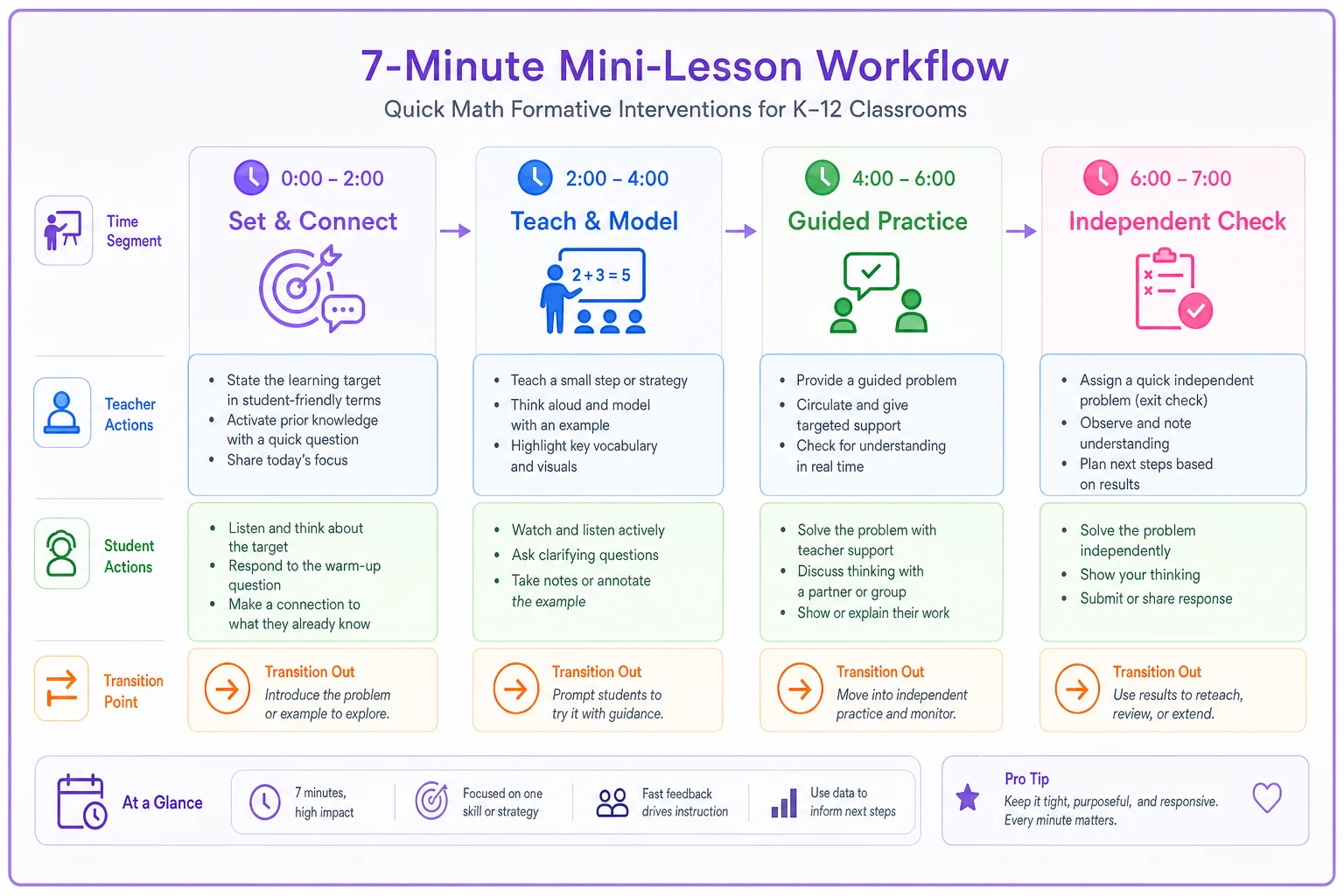
A simple diagram makes it easy to run the opener on time and ensures the struggle group gets the targeted attention they need.
Why misconceptions spread exponentially in middle school math
Sixth and seventh grade math operates like a pyramid where each concept becomes a prerequisite for three others. A student who thinks 3(x + 2) equals 3x + 2 will struggle with factoring, multi-step equations, the distributive property in geometry, simplifying algebraic fractions, and basically everything in Algebra 1.
Traditional unit tests catch these gaps too late—after students have practiced incorrectly for two weeks. Daily formatives catch them early but usually lack the diagnostic precision to inform specific fixes. That's why the same students struggle with the same concept types year after year. We identify the symptom (wrong answer) without diagnosing the cause (specific cognitive breakdown).
The three-item framework changes this because each item type reveals not just who's struggling but exactly where their thinking goes wrong. When you know that Sarah adds instead of subtracts when solving for negative coefficients, you can address that specific move rather than reteaching "solving equations" in general.
Operational scoring that takes 4 minutes for 30 students
The scoring system has to balance three competing demands: gradebook requirements, instructional planning data, and time. Here's the workflow:
During class (last 5 minutes): Students complete the formative on half-sheets of paper. Collect and rubber-band by class period. While students pack up, quick-sort into two piles—"Got it" and "Need support." That takes about 30 seconds.
After school (roughly 4 minutes total): Work through the "Need support" pile only—typically somewhere between 8 and 12 students. Use shorthand to mark specific error types on your tracking sheet. Transfer to three categories: "Tomorrow's mini-lesson group," "Check in during practice," and "Parent contact needed." Enter a single completion grade for all students (formatives are 10% of grade, completion-based).
Keep a one-line shorthand key for error types so after-school transfers and planning stay under five minutes.
Evening planning (2 minutes): Select tomorrow's mini-lesson from your bank based on the most common error. Print or queue up the materials. Message the two or three parents whose kids need extra support.
The key is that you're not grading every problem for every student. You're diagnosing error patterns for struggling students, then using that diagnosis to drive tomorrow's opening activity. Students who demonstrated mastery don't need your scoring attention—they need enrichment, which you provide while working with the struggle group during the mini-lesson.
Building your formative item bank by unit
Creating these diagnostic formatives feels daunting until you realize you only need 3-4 per major concept. For a typical middle school math unit covering 8-10 concepts, that's roughly 35 formative items total—a one-time investment.
Start with your highest-impact concepts. In sixth grade, that's usually operations with fractions, integer operations, one-step equations, and ratios and rates.
For each concept, create two Strategic Error problems targeting the most common misconception, one Sorting Task that reveals conceptual understanding, and one Comparison Problem highlighting procedural variations.
Store these in a simple spreadsheet with columns for concept, item type, common error it reveals, mini-lesson response, and scoring shorthand.
| Column | What Goes Here |
|---|---|
| Concept | E.g., "Solving two-step equations" |
| Item Type | Strategic Error / Sorting / Comparison |
| Common Error It Reveals | Specific cognitive breakdown |
| Mini-Lesson Response | Which intervention structure to use |
| Scoring Shorthand | E, P, EP or A/B notation |
Within one semester, you'll have a complete bank. More importantly, you'll start recognizing error patterns on sight. When you see a student write "x = 3" for "2x = 6," you instantly know they divided by the wrong number and can address it in tomorrow's warm-up.
The compound effect on math confidence
When students see their specific confusion addressed the very next day, something shifts. They stop believing they're "bad at math" and start recognizing that math is learnable through targeted practice.
One seventh-grade teacher in Phoenix implemented this system mid-year. In September, her formative data showed around 65% of students making conceptual errors that persisted into unit tests. By February, that number was closer to 30%—not because she changed how she delivered main lessons, but because she caught and addressed misconceptions within 24 hours instead of letting them compound.
The psychological piece matters as much as the academic one. Middle schoolers are particularly vulnerable to math anxiety because abstract thinking is still developing. When an error goes uncorrected for days, students internalize failure. When that same error gets specifically addressed the next morning—"I noticed several of you made this move yesterday, let's look at why it breaks down"—it becomes a learning moment rather than confirmation that they can't do math.
Converting formative data to gradebook entries without the hassle
The gradebook is every teacher's operational headache, especially for daily formatives. Here's the simplified system:
-
Daily Formatives (10% of grade) Completion-based, entered weekly as a single score
-
Formative Mastery (15% of grade) Accuracy-based, entered bi-weekly
For daily formatives, students get full credit for a reasonable attempt. You enter one grade per week: "Formatives Week 12: 5/5" if they completed all five.
For mastery scores, select one formative every two weeks to score for accuracy. Students know it's coming but not which day. This maintains accountability without daily grading burden.
Your diagnostic data—the error analysis—lives separately from your gradebook entries. The gradebook shows compliance and progress. Your tracking sheet drives instruction. Related, but not redundantly connected.
When quick formatives actually slow you down
This system breaks in three predictable situations:
Scenario 1: You're introducing brand new content. First exposure to a concept needs full worked examples, not diagnostic assessment. Save formatives for day 2 or 3 when students have initial understanding to diagnose.
Scenario 2: Your class has extreme skill variation. When half your class is two grade levels behind and half is on track, a single formative item can't diagnose effectively. You'd need differentiated assessments, which breaks the "quick" part entirely.
Scenario 3: You're a first-year teacher running on fumes. The cognitive load of managing behavior, delivering instruction, and analyzing formative data simultaneously is genuinely a lot. Get basic classroom operations running smoothly first, then layer in diagnostic formatives.
Using AI to generate your initial item bank
AI-powered operational software can turn a month-long project into an afternoon. Instead of creating every formative item from scratch, AI automation can generate initial items that you then refine based on what you know about your students.
The workflow looks something like this:
-
Input your unit's learning objectives
-
AI generates 3-4 formative items per objective, categorized by type
-
You review and modify based on your students' typical errors
-
The platform organizes them into a searchable bank with attached mini-lessons
This isn't about replacing teacher judgment—you still need to know your students' specific struggle points. But the heavy lifting of item creation gets handled automatically, leaving you time to focus on the instructional response.
The same operational software can track error patterns across multiple class sections, flagging when the same concept is tripping up students in different periods. Instead of noticing patterns through intuition over several days, you see them in something closer to real-time as you input your quick scoring data. Some platforms now include pre-built mini-lesson templates matched to common middle school math errors—when formative data shows 40% of students adding fractions incorrectly, the system can suggest a specific 6-minute intervention with materials already queued up.
Making next-day adjustments without derailing your scope and sequence
The most common pushback on responsive teaching: "I can't slow down—we have to cover everything before state testing." Fair concern. Here's how to be responsive without wrecking your pacing:
Build buffer lessons into your scope and sequence. Every three weeks or so, plan one "skill clinic" day with no new content. Use formative data to determine which previous concepts need reinforcement. If everyone's solid, it becomes enrichment day.
Use parallel practice time strategically. While advanced students work independently on challenge problems, pull your struggling group for targeted reteaching. The formative data tells you exactly who needs to be in that group.
Stack mini-lessons efficiently. If Monday's formative reveals integer confusion and Tuesday's shows fraction struggles, Wednesday's opener can address both through a combined problem set. You're not adding time, just being intentional about practice problem selection.
Next-day adjustments don't mean full reteaching. They mean targeted 5-7 minute interventions that prevent small misconceptions from becoming major gaps.
Starting tomorrow: your first three formative items
Don't overhaul your entire assessment system at once. Start with your next lesson's most crucial concept and create three diagnostic items:
-
One strategic error problem targeting the mistake you see every year
-
One sorting task that reveals conceptual understanding
-
One comparison problem showing correct vs. incorrect methods
Use them in the last five minutes of class. Quick-score that evening using the shorthand system. Plan a 6-minute mini-lesson for tomorrow based on what you find.
Within two weeks, you'll have the rhythm down. Within a month, the diagnostic precision becomes hard to give up.
The real shift isn't in the assessment items themselves—it's in closing the feedback loop from 16 hours to something closer to 16 minutes of focused analysis. When students know their specific confusion will be addressed the next day, they engage differently. When you know exactly which cognitive step broke down, you teach with precision instead of delivering general review and hoping something lands.
That's how quick formative assessments in middle school math become more than data collection. They become the operational backbone of instruction that actually responds.
Ready to elevate your classroom management?
Join 5,000+ educators using Skolyly to save time, engage students, and improve learning outcomes.