


Every principal builds a master schedule in the summer believing this year the intervention block and the PLC period will survive intact. Then September hits. A section runs over-enrolled, a special education teacher's caseload shifts, a bus route changes the arrival window, and suddenly the 30-minute intervention block becomes a study hall in three of eight sections. By November, PLC time is where you cram in the fire drill make-up, the vaccine clinic, the assembly nobody remembered in June.
The block didn't disappear because anyone decided it wasn't important. It disappeared because it was the softest thing on the calendar. Nothing was legally required to happen there, no parent was watching, no state report tracked it. When the schedule needed to absorb pressure, that's where the pressure went.
This is a systems problem, not a willpower problem. If your only defense of intervention and PLC time is your own memory and good intentions, you will lose that time every single year. What actually protects it is structural: how the master week is built, what you've agreed to in writing with staff and unions, and whether you have a monitoring check that catches erosion before it becomes permanent.
Why these two blocks are structurally fragile
Intervention and PLC time share a specific vulnerability. They're both collective and both non-instructional-facing in the eyes of the calendar. A math class has a roster, a grade, a parent expectation, and a bell. An intervention block often has a floating roster, no grade, and a fuzzy purpose that shifts by student. PLC time has no students in the room at all, which makes it look — to anyone hunting for coverage — like free adult time.
The pattern that shows up across schools of very different sizes is pretty consistent. The schedule gets built around fixed constraints first: core content minutes, teacher certification limits, room capacity, lunch waves. Intervention and PLC get placed last, in whatever gaps remain. Because they're placed last, they're also the least protected by any hard constraint. Anything that shifts later in the year — a resignation, an enrollment bump, a testing window — pushes into them because they're the only flexible space left.
The deeper issue is that protecting a protect intervention PLC time schedule requires treating these blocks as constraints, not leftovers. A constraint is something the rest of the schedule bends around. A leftover is something that bends around everything else. Most master schedules quietly file intervention and PLC as leftovers, and all the downstream fragility comes from that one filing decision.
What breaks as the school scales
In a small building — say 18 to 25 teachers — you can hold the line informally. The principal knows every conflict personally, walks past the intervention rooms, and notices when a block gets hijacked. Coordination happens in hallways.
Keep every student on track with ease.
Skolyly helps you create, assign, and monitor classroom activities efficiently.
- Integrated lesson and assignment management
- Real-time student progress tracking
- Automated class scheduling & notifications
No credit card required
That informal control breaks somewhere around 40+ staff, multiple grade bands, or any shared-staffing arrangement — a reading specialist split across two buildings, a counselor covering three grade levels. At that scale, three things tend to go wrong at once:
-
No single person sees all the erosion. Each department chair knows their own block got eaten, but nobody sees that six blocks got eaten across six teams.
-
Trade-off decisions get made locally and invisibly. An assistant principal reassigns an interventionist to cover a leave for "just two weeks," and nobody logs that the intervention block for 40 kids just went dark.
-
PLC time fragments by team. One team meets consistently, another team's period got absorbed by testing proctoring, a third quietly turned it into planning-and-grading because their intervention data never showed up.
The common failure isn't dramatic. It's drift. A block loses 10 minutes here, a week there, a purpose everywhere, and by mid-year the thing you built is a shadow of what the master schedule says exists on paper. The gap between the published schedule and the lived schedule is where all the damage accumulates — and at scale, nobody can see that gap without deliberately measuring it.
If you haven't already tightened the front end of this, the master-calendar governance playbook covers how to align staffing and assessment windows so fewer conflicts land on these blocks in the first place. This article picks up where that leaves off: defending the blocks once the year is running and pressure starts hitting.
The decision framework: constraint, cost, and trade-off rules
Before you build a template or negotiate anything, you need a small set of rules that decide what may and may not touch these blocks. Write these down before the year starts, because in the middle of a staffing crisis you won't have time to reason from first principles.
1. Classify every block by protection tier.
| Tier | What it means | What can override it |
|---|---|---|
| Locked | Intervention core, PLC core | Nothing short of a documented emergency signed off by the principal |
| Protected | Secondary intervention, flex tutoring | Only pre-approved, time-boxed trade-offs logged in advance |
| Flexible | Study halls, enrichment | Normal operational coverage |
The point of the table isn't the labels. It's forcing an explicit answer to the question everyone avoids: when we're short-staffed, what do we cannibalize first? If intervention is Locked, the answer can't be "intervention."
2. Require a trade-off cost to be named before any raid.
If someone wants to pull an interventionist for coverage, the rule is simple: state the cost out loud. "This removes reading intervention for 34 second-graders for 8 school days." Naming the cost changes the decision more often than you'd expect. The abstract "we need coverage" becomes "we're taking 8 days of reading from struggling second-graders," and suddenly a different solution appears.
3. Set a replacement rule, not a cancellation rule.
Locked blocks can't be canceled — they can only be moved. If a fire drill kills Tuesday's PLC, the rule pre-commits to when it reappears (say, the following Thursday's flex block). This one rule prevents roughly half of all permanent erosion, because most blocks don't die from a single hit. They die because the single hit never got rescheduled.
Here's a visual workflow for the decision process when a raid is proposed.
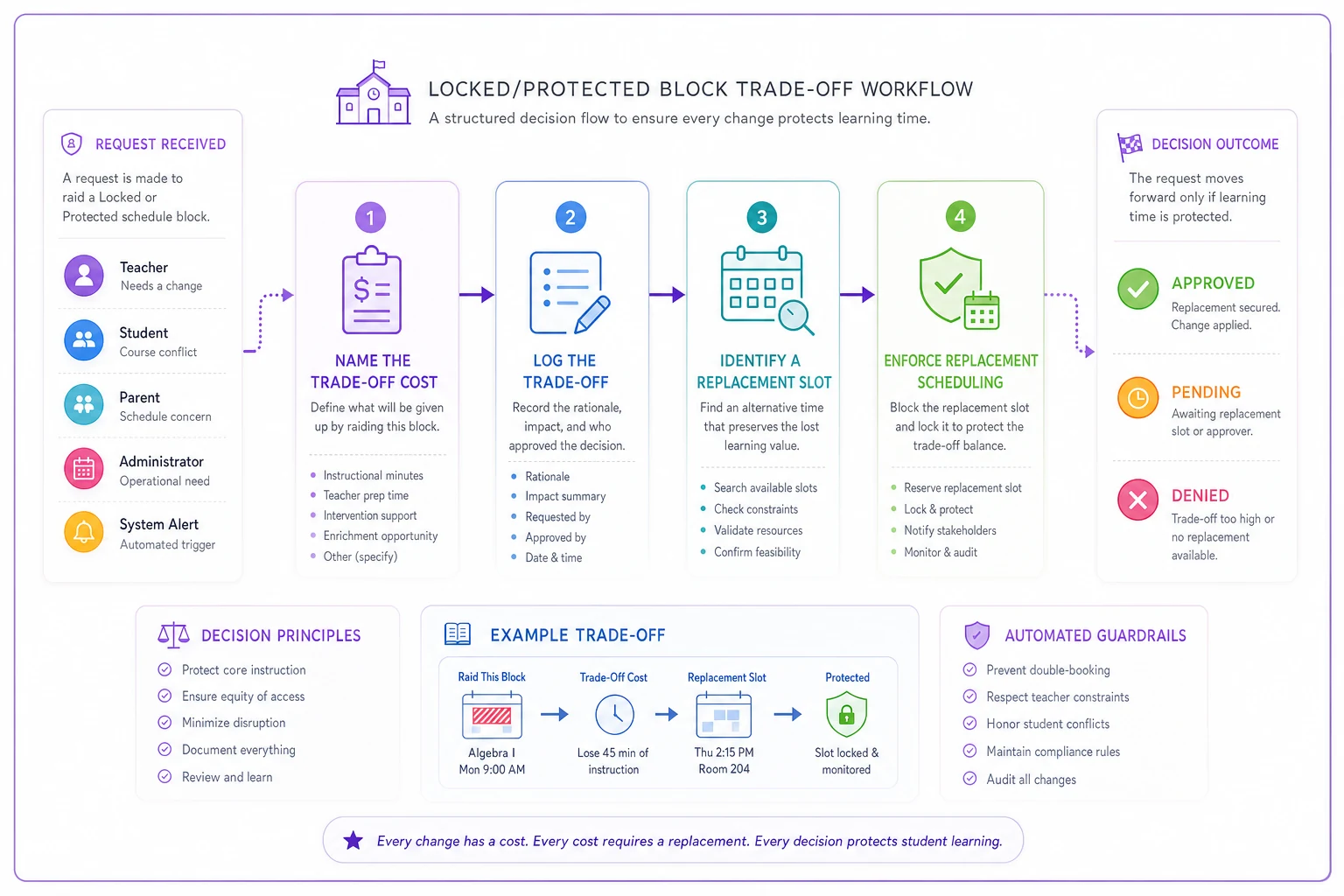
Use this to clarify steps during conversations.
Sample master-week templates
Two patterns hold up under pressure better than the rest. Neither is complicated. What makes them work is that intervention and PLC are placed first, and the rest of the week gets fit around them.
Template A — Elementary, shared specialists (five-day week)
The core move here is putting the schoolwide intervention block at the same time every day so no specialist has a scheduling conflict.
-
Fix a 30-minute all-school intervention block at the same clock time daily (e.g., 9:15–9:45). No pull-outs, no specials, no assemblies scheduled here — it's Locked.
-
Rotate PLC into one early-release or one covered period per grade band per week, protected by a coverage plan built in advance, not improvised the morning of.
-
Place specials and lunch waves around the fixed intervention block, not through it.
-
Reserve one Flexible slot per week specifically as the "replacement" landing spot for any Locked block that got bumped.
Template B — Secondary, rotating drop schedule
Rotating schedules are where PLC quietly dies, because a period that "drops" on the day PLC was scheduled just vanishes. The fix:
-
Anchor PLC to a fixed weekday, not a rotating period, so it never drops out of the rotation.
-
Give intervention its own dedicated period in the rotation rather than sharing with study hall — shared blocks always drift toward the lower-effort use.
-
Build the coverage roster for PLC time up front, listing exactly who covers what if a teacher is out. No PLC period should depend on hoping nobody's absent that day.
One pattern worth noting: schools that protect PLC time best don't just schedule it — they schedule what happens in it tightly enough that it can't quietly become grading time. A well-run block is much harder to justify canceling than a vague one. The operational side of that is covered in the PLC meeting playbook.
Negotiation scripts for unions and staff
Most schedule protection eventually runs into a contract or a staff expectation. You can't lock blocks by decree if doing so quietly adds duties or changes working conditions. Handle it directly and early.
Script for union leadership (protecting PLC as collaborative, not coverage):
> "We want PLC time genuinely protected, which means it doesn't get raided for coverage. In exchange, we're committing that PLC won't be used for administrative tasks or duties outside the collaborative purpose. Can we agree on what it's for and what it's not for, in writing, so neither side has to relitigate it in March?"
The trade is the key. You're offering purity of the block — no admin dumping — in exchange for stability — no raiding. That's a trade most staff actually want.
Script for a teacher whose class overlaps the intervention block:
> "I know the schedule shift affected your planning. Here's the constraint I'm working under: the intervention block is Locked for the whole building, so I can't move it. What I can move is your other flex period. Let's find the version that costs you the least."
Script for an administrator asking to raid intervention for coverage:
> "That block is Locked, so before we touch it I need us to name the cost — this pulls intervention for 34 kids for how many days? — and where it gets replaced. If we can't answer the replacement question, we need a different coverage plan."
The consistent thread: you're never saying "no, because I said so." You're saying "here's the constraint, here's the cost, let's find the least-damaging option." That framing survives grievances and hard conversations far better than authority alone.
Mid-year trade-off checks: the monitoring that catches drift
Everything above is front-loaded. The part almost everyone skips is the check — a small, repeatable audit that surfaces erosion while it's still reversible. Drift is invisible until you measure it, so measure it lightly and regularly.
-
Weekly 5-minute block audit. For each Locked/Protected block, one question: did it happen as intended this week? (yes / partial / no). Partial and no get a one-line reason.
-
Monthly erosion tally. Count the "no" and "partial" answers by block. A block that's partial three weeks running is already half-dead — that's your signal to act.
-
Trade-off log review. Every time someone raided a block, was the cost named and was it replaced? If replacements aren't happening, your replacement rule only exists on paper.
-
Mid-year full check (once, around January). Compare the published schedule to the lived schedule block by block. Where's the gap? Which team lost the most? Why?
Here's the checklist for that mid-year check:
-
[ ] Every Locked block still runs at its scheduled time
-
[ ] No PLC period has quietly converted to grading/planning
-
[ ] Every raid this year was logged with a named cost
-
[ ] Every bumped Locked block was replaced, not canceled
-
[ ] Shared specialists' intervention time is intact across all buildings
-
[ ] No single team has absorbed more than its share of disruptions
Most schools track none of this, which is exactly why they can't tell you in March how much intervention time actually happened. The audit is cheap. Not having it is expensive.
Schedule the weekly 5-minute block audit at a consistent time so it doesn't get skipped.
Where the tracking gets genuinely hard is at scale — reconciling the intended schedule against dozens of lived schedules across teams, buildings, and shared staff. That kind of repetitive cross-checking is where operational software with light automation earns its place: flagging blocks that went "partial" three weeks in a row, or surfacing that a specialist's intervention time quietly dropped when they picked up a leave. The value isn't the software itself; it's that the drift becomes visible the week it starts instead of the semester it's already gone. That said, even a shared spreadsheet with an honest weekly entry beats the most common system, which is no system at all.
When this framework makes sense — and when it doesn't
When it's worth the effort: Any building where intervention or PLC time has been eroding, where staff is 40+, where specialists are shared across buildings, or where you genuinely can't answer "how much intervention actually happened this month" without guessing. The bigger and more distributed the staff, the more you need explicit tiers and monitoring, because informal control has already broken down.
When it's overkill: A very small building with one or two intervention providers and a principal who genuinely sees every block. Formalizing tiers and running weekly audits there can add ceremony without adding protection. Keep the replacement rule — it's cheap and useful everywhere — and skip the heavier monitoring until you grow.
Who should not do this: Anyone treating it as a compliance exercise to point at later. The tiers and scripts only work if the trade-off costs actually get named and the replacements actually get scheduled. A protection framework nobody enforces is worse than none, because it creates false confidence that the blocks are safe while they quietly erode anyway.
A real scenario
A mid-sized elementary school — around 32 teachers, one reading specialist and one math interventionist shared across grade bands — was losing intervention time steadily by winter. On paper, every K–3 student had daily reading intervention. In practice, by January the interventionist had been pulled for leave coverage and testing proctoring often enough that intervention had actually run maybe 60–65% of scheduled days for the youngest grades. Nobody had decided this; it just accumulated.
They changed three things, none expensive. Intervention became a Locked block at a fixed daily time. Every raid required naming the cost and a replacement date. And they added a weekly 5-minute audit — one row per block, yes/partial/no.
By spring, intervention was running consistently in the low-to-mid 90s percent of scheduled days. The specialist still got pulled occasionally, but now every pull got replaced within the week instead of disappearing entirely. The part worth noting: enforcement got easier over time, not harder. Once the cost of a raid was said out loud, people mostly found other coverage on their own. The framework did most of its work before anyone had to say no.
The takeaway
Intervention and PLC time don't disappear because leaders stop caring. They disappear because they're built as leftovers, defended by memory, and never measured. Fix those three things — build them as constraints, protect them with written agreements, and watch for drift with a lightweight check — and the blocks hold. Skip any one of the three, and you'll be rebuilding them from scratch again next August, wondering where they went.
Ready to elevate your classroom management?
Join 5,000+ educators using Skolyly to save time, engage students, and improve learning outcomes.