



I spent three hours observing PLCs at a middle school last month. Teachers brought their laptops, opened shared drives full of templates, discussed student data for exactly 45 minutes, then went back to teaching the exact same way they did before the meeting. The principal later showed me their PLC documentation—pristine meeting notes, completed protocols, action items tracked in spreadsheets. Zero classroom change.
This disconnect between PLC documentation and actual instructional shifts happens in roughly 70% of the schools I work with. Not because teachers don't care. Not because administrators aren't trying. But because most PLC structures optimize for compliance documentation rather than operational change.
The problem runs deeper than bad agendas. Schools have built elaborate PLC systems that generate evidence of collaboration without any real mechanism to translate discussion into classroom practice. Meeting after meeting, teachers analyze data, identify gaps, share strategies—then return to isolated classrooms where old habits persist.
Why PLCs fail to change instruction
Most PLCs operate like academic conferences rather than operational meetings. Teachers present data, discuss trends, share ideas. Everyone nods, takes notes, agrees on next steps. Then Monday arrives and nothing changes because the meeting structure never connected discussion to actual classroom workflows.
Traditional PLC frameworks assume that awareness leads to action. Give teachers time to collaborate, the thinking goes, and instruction will naturally improve. But classroom instruction is an operational system with established routines, resource constraints, and competing priorities. Changing instruction requires more than awareness—it needs specific protocols that bridge the gap between the meeting room and what happens in class on Thursday morning.
The typical PLC spends 80% of meeting time on analysis and discussion, 15% on documentation, and maybe 5% on implementation planning. No pre-work means the first 20 minutes get wasted on context-setting. No evidence artifacts means discussions stay theoretical. No decision rules means every conversation ends with "let's think about it." No follow-up protocol means agreements evaporate by Tuesday.
I've watched grade-level teams spend entire PLCs debating whether to use exit tickets without ever defining what data they'd collect, who would create them, or how results would inform tomorrow's lesson. They leave with a vague commitment to "try exit tickets" that dies the moment they face their next stack of grading.
The operational gaps that kill follow-through
Three structural failures consistently derail PLC outcomes.
Keep every student on track with ease.
Skolyly helps you create, assign, and monitor classroom activities efficiently.
- Integrated lesson and assignment management
- Real-time student progress tracking
- Automated class scheduling & notifications
No credit card required
-
First, meetings lack concrete evidence requirements. Teams discuss student performance using memory and impressions rather than specific work samples or assessment data. Without actual evidence on the table, conversations drift toward generalities that can't drive specific instructional changes.
-
Second, PLCs operate without clear decision authority. When teams identify an instructional problem, who decides what changes? The team leader? Consensus vote? Individual teacher choice? That ambiguity creates a responsibility vacuum where everyone agrees changes are needed but nobody owns implementation.
-
Third, follow-through happens through hope rather than system. Teams make commitments in meetings then rely on individual accountability to ensure execution. No structured check-ins. No implementation evidence. No adjustment protocols when initial attempts fail. The next PLC meeting starts fresh, often revisiting the same problems without acknowledging the previous week's abandoned commitments.
These gaps compound over time. Teachers learn that PLC decisions are suggestions, not operational changes. They participate in discussions knowing real instructional decisions happen later, alone, under time pressure. The PLC becomes a parallel universe disconnected from actual classroom operations.
Building evidence-based pre-work protocols
Effective PLCs start before the meeting. Every participant needs specific evidence artifacts prepared according to clear protocols. Not lengthy documents or elaborate presentations—targeted evidence that directly informs instructional decisions.
Pre-work protocols should take less than 15 minutes to complete but must be non-negotiable.
For a PLC focused on improving paragraph writing, each teacher brings three student work samples: one above grade level, one approaching, one below. Same prompt, same conditions, collected within the past week. The samples get uploaded to a shared folder 24 hours before the meeting using a standard naming convention. During the meeting, teams analyze actual student work, not abstract discussions about "writing challenges."
A math PLC reviewing fraction understanding might require each teacher to bring their last exit ticket results in a simple three-column format: concept tested, percentage correct, and most common error. This evidence becomes the foundation for instructional decisions, not just discussion topics.
Specificity is what makes this work. "Bring student data" is not a pre-work protocol. "Screenshot your last Thursday's Kahoot results showing question-level performance" is. When teachers know exactly what evidence to prepare, preparation becomes routine rather than burden.
Creating decision rules that stick
PLCs need explicit decision frameworks that determine when discussion converts to action. Without these rules, every conversation ends with soft commitments that dissolve under classroom pressure.
Start with threshold rules. If more than 40% of students miss the same concept across classrooms, that triggers a mandatory reteach protocol. Below that, teachers can address it individually. If only one classroom shows difficulty, that teacher gets targeted support rather than changing everyone's instruction. These thresholds remove the debate about whether action is needed—the data decides.
Next, establish ownership rules. Instructional changes affecting multiple classrooms require a designated owner who coordinates implementation. This isn't about hierarchy—it's about operational clarity. When the third-grade team decides to implement a new paragraph structure protocol, one teacher owns creating the anchor chart, another owns the practice materials, a third owns the parent communication. Similar to how we've covered differentiation planning, ownership prevents duplicate effort while ensuring coverage.
Finally, create modification boundaries. Teachers need autonomy to adapt PLC decisions to their classroom context, but unlimited modification defeats alignment. Define what must stay consistent (the core instructional sequence) versus what can vary (specific examples used). This balance maintains coherence without forcing cookie-cutter implementation.
The six-week implementation cycle
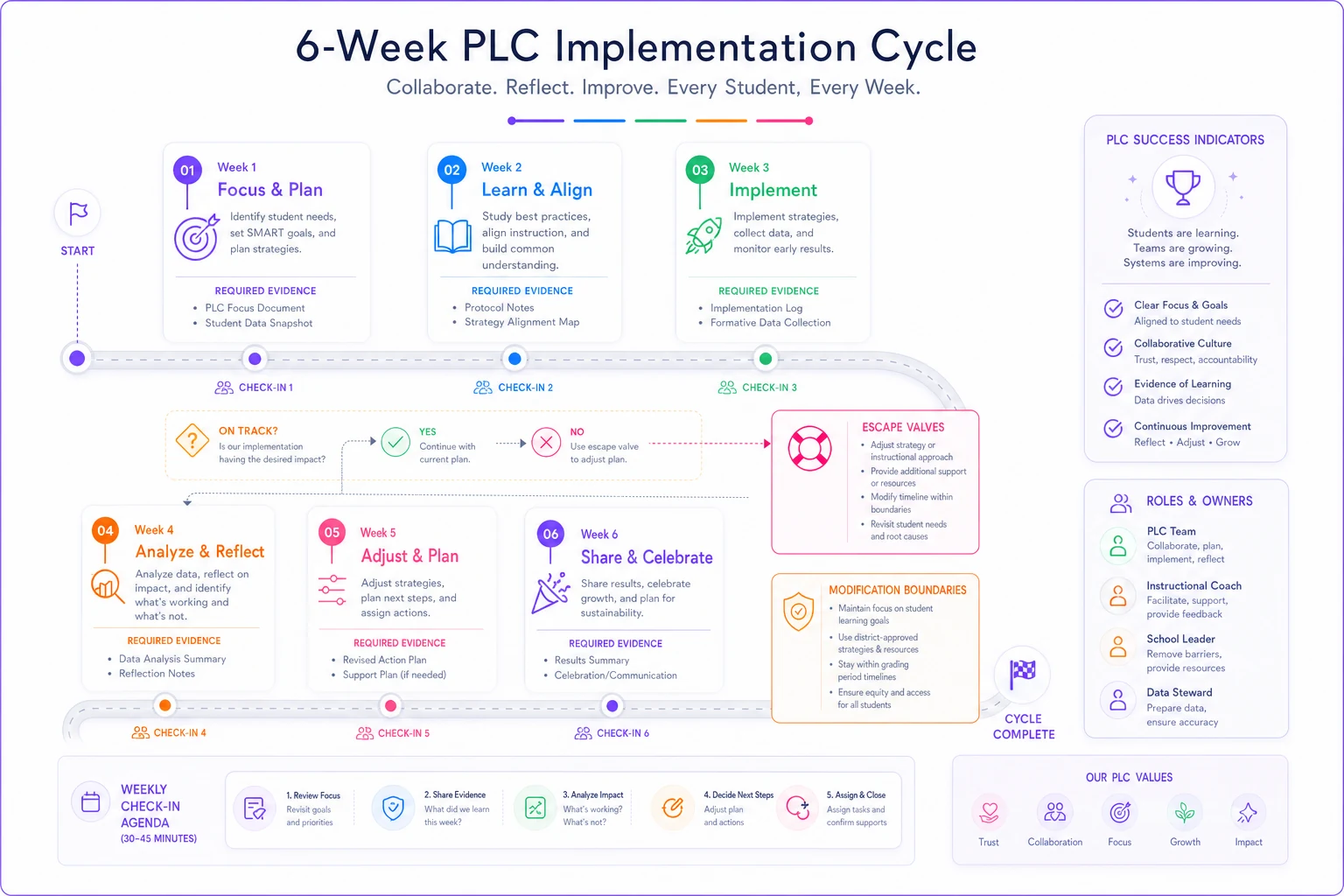
Instructional change happens in six-week cycles, not single meetings. Week one establishes baseline evidence and identifies the specific instructional change. Week two is collaborative planning—teachers create materials and align approaches. Weeks three through five are implementation weeks with structured check-ins. Week six evaluates impact and decides whether to maintain, modify, or abandon the change.
| Week | Requirement |
|---|---|
| Week one | Week one needs baseline assessment data. |
| Week two | Week two requires lesson plan modifications showing the instructional change. |
| Weeks three through five | Weeks three through five need implementation artifacts—a photo of the new anchor chart in use, a sample of student work using the new method, a quick video of the modified instruction. |
| Week six | Week six needs comparative data showing impact. |
| Escape valves | If implementation evidence shows major problems by week three, teams can modify without waiting for week six. |
| Barriers | If a teacher encounters scheduling conflicts or resource limitations, they document the barrier and the team problem-solves rather than abandoning the change silently. |
The cycle includes escape valves. If implementation evidence shows major problems by week three, teams can modify without waiting for week six. If a teacher encounters scheduling conflicts or resource limitations, they document the barrier and the team problem-solves rather than abandoning the change silently.
This isn't about creating more meetings. The six-week cycle happens within existing PLC time, just structured differently. Instead of treating each PLC as an isolated event, teams work through connected cycles that build momentum toward measurable change.
A quick visual of this cycle helps teams follow the workflow.
This isn't about creating more meetings. The six-week cycle happens within existing PLC time, just structured differently. Instead of treating each PLC as an isolated event, teams work through connected cycles that build momentum toward measurable change.
Implementation artifacts that prove change
Traditional PLCs document what was discussed. Operational PLCs document what changed in classrooms. The difference lies in required implementation artifacts that prove instructional shifts actually happened.
Instead of meeting minutes, require classroom evidence. When a team commits to implementing numbered problem-solving steps in math, teachers submit photos of student notebooks showing the steps in use. When they agree to increase wait time after questions, someone records a two-minute video segment showing the technique. When they adopt a new vocabulary routine, they share a completed student organizer from their classroom.
These artifacts serve multiple purposes. They prove implementation happened. They surface implementation challenges that need troubleshooting. They create a library of examples for teachers who join later. Most importantly, they shift PLC focus from talking about change to documenting change.
Keep artifact requirements lightweight but specific. "Evidence of implementation" is too vague. "Photo of three student notebooks showing the new problem-solving format, taken during Tuesday's lesson" is actionable. Teachers know exactly what to capture and when.
Accountability without micromanagement
Owner accountability drives PLC effectiveness, but heavy-handed monitoring kills teacher buy-in. The solution is transparent progress tracking that emphasizes support over surveillance.
Each instructional change needs one owner who maintains a simple progress tracker. Not a complex project plan—a basic spreadsheet showing who committed to what, target dates, and completion status. The tracker lives in a shared folder where anyone can check progress without asking. Updates happen during PLC time, not through additional reporting requirements.
When commitments slip, the owner's job isn't to punish but to problem-solve. Teacher hasn't submitted their implementation photo? The owner sends a quick message: "Need help capturing your evidence?" Teacher struggling with the new routine? The owner offers to model during their prep period or share video from their own classroom.
This distributed ownership model prevents the PLC facilitator from becoming a taskmaster. Different teachers own different instructional changes, spreading both responsibility and expertise. The math intervention owner might be the second-year teacher who excels at differentiation. The vocabulary routine owner might be the veteran who's refined the approach over years.
Connecting PLCs to actual workflow patterns
PLCs fail when they exist outside teachers' natural workflow. Effective implementation protocols integrate with existing classroom routines rather than adding separate tasks.
If teachers already do exit tickets, PLC decisions should modify that existing practice rather than creating new assessments. If they already use warm-ups, instructional changes can adjust warm-up structure rather than adding another routine. This reduces resistance and increases follow-through since teachers are modifying existing habits rather than building new ones.
The PLC meeting agenda should mirror the classroom planning sequence. Start with the immediate need (this week's instruction), then move to medium-term adjustments (next unit modifications), and finally address long-term changes (semester-two planning). This alignment helps teachers see PLC decisions as part of their regular planning rather than additional work.
Technology integration should support existing tools, not require new platforms. If teachers already use Google Classroom, PLC resources and evidence collection happen there. If they prefer paper planning, implementation tracking uses printed templates. Like the data cycles we've explored, the system works with teachers' operational reality, not against it.
Measuring classroom impact, not meeting compliance
Traditional PLC assessment counts meetings held, attendance rates, and documentation completed. These metrics measure activity, not impact. Operational PLCs track classroom-level changes and student outcome shifts.
Primary metrics focus on implementation fidelity. What percentage of committed instructional changes actually reached classrooms? How many teachers sustained changes beyond the initial week? Which modifications survived the full six-week cycle? These numbers reveal whether PLCs are driving real change or generating discussion.
Secondary metrics examine student impact. Not standardized test scores that lag by months, but immediate indicators like exit ticket performance, assignment completion rates, or participation patterns. If the PLC implemented numbered problem-solving steps, did student work show more complete solutions? If they increased wait time, did participation spread beyond the usual volunteers?
Quality over quantity matters here. Five sustained instructional changes beat twenty abandoned initiatives. Three classrooms showing measurable improvement beat ten classrooms with perfect documentation but no student growth. The goal isn't more PLC activity—it's instructional changes that actually improve student learning.
Avoiding template library syndrome
Many PLC systems devolve into template libraries where teachers exchange worksheets without examining instructional practice. Shared folders overflow with resources that may or may not align with actual classroom needs. Teachers spend PLC time browsing materials rather than solving instructional problems.
The antidote is evidence-first planning. Before creating or sharing any resource, teams must present evidence of the instructional problem it solves. What student work samples show this need? What assessment data confirms the gap? Without this evidence, resource sharing becomes academic rather than operational.
When teams do share resources, they must include implementation context. Not just the worksheet, but when to use it, what prior instruction it assumes, what follow-up it requires. A fraction practice sheet means nothing without knowing whether it's for initial instruction, guided practice, or assessment. This context transforms resources from isolated artifacts into connected instructional tools.
Resource creation happens after instructional decisions, not before. The PLC first determines what instructional change is needed based on evidence. Then they identify what resources that change requires. Finally, they assign creation responsibilities. This sequence ensures resources serve specific instructional purposes rather than becoming solutions looking for problems.
Breaking the compliance documentation trap
Schools often measure PLC success by documentation quality rather than classroom impact. Pristine meeting notes, completed protocols, and detailed action plans create an illusion of productivity while instruction stays unchanged. This compliance focus drains energy from actual improvement work.
Shift documentation from retrospective recording to prospective planning. Instead of detailed minutes about what was discussed, require simple commitments about what will happen in classrooms. Instead of elaborate data analysis protocols, demand straightforward decision records: what changed, who owns it, when it happens.
Make documentation serve implementation rather than compliance. A photo of students using a new strategy proves more than pages of meeting notes. A three-minute video of modified instruction reveals more than any written reflection. A simple tracking spreadsheet showing who did what beats elaborate narrative reports that nobody reads.
The most effective PLCs keep documentation minimal but meaningful. One page per meeting: problem identified, evidence reviewed, decision made, owner assigned, implementation timeline set. Everything else is operational evidence from actual classrooms, not administrative paperwork about meetings.
Technology's role in operational PLCs
Not every school needs sophisticated software, but technology can meaningfully improve PLC operations when used strategically. The key is choosing tools that support evidence collection and progress tracking rather than adding administrative burden.
Simple shared folders can house evidence artifacts if organized properly. Each PLC cycle gets its own folder with subfolders for pre-work evidence, implementation artifacts, and impact data. Standard naming conventions make resources findable. Version control prevents confusion about which materials are current.
Video tools transform implementation support. A teacher struggling with a new routine can record themselves, share with the PLC, and get specific feedback. A successful implementation can be captured and shared as a model. These videos don't need production value—phone recordings during actual instruction provide the most useful evidence.
Progress tracking benefits from basic automation. A Google Form can collect weekly implementation check-ins. Automated reminders can prompt evidence submission. Simple dashboards can visualize implementation rates without manual calculation. These tools reduce administrative burden while increasing transparency.
For schools ready to scale operational improvements, AI-powered platforms can identify patterns across PLCs, suggest evidence-based interventions, and track implementation automatically—transforming PLCs from isolated team meetings into connected improvement networks where successful changes spread across grade levels and buildings without someone manually pushing them along.
Moving from theory to practice
The gap between PLC discussion and classroom change isn't about teacher motivation or administrator support. It's about operational structure. When PLCs lack pre-work protocols, evidence requirements, decision rules, and implementation tracking, even the best intentions dissolve under daily classroom pressures.
Building an effective PLC meeting structure that actually leads to instructional change starts with recognizing that collaborative planning time is scarce. Every minute in meetings is a minute away from students. That time only generates returns when it produces specific, measurable changes in classroom instruction.
The playbook outlined here isn't theoretical—it's based on observing what actually works in schools that have moved beyond compliance documentation to genuine instructional improvement. These schools don't have more resources or better teachers. They have PLC structures that bridge the gap between meeting rooms and classrooms through concrete protocols, clear ownership, and systematic follow-through.
Start with one six-week cycle focused on a single instructional change. Require specific evidence artifacts. Assign clear ownership. Track implementation weekly. Measure classroom impact, not meeting attendance. Build from what works, adjust what doesn't, and gradually expand the system as teams develop operational discipline.
The schools that transform PLCs from talk to action share one characteristic: they treat instructional improvement as an operational challenge requiring systematic processes, not just good intentions. When PLCs embrace that mindset, collaborative planning time finally delivers on its promise.
Start with one six-week cycle focused on a single instructional change. Require specific evidence artifacts. Assign clear ownership. Track implementation weekly. Measure classroom impact, not meeting attendance. Build from what works, adjust what doesn't, and gradually expand the system as teams develop operational discipline.
The schools that transform PLCs from talk to action share one characteristic: they treat instructional improvement as an operational challenge requiring systematic processes, not just good intentions. When PLCs embrace that mindset, collaborative planning time finally delivers on its promise.
Ready to elevate your classroom management?
Join 5,000+ educators using Skolyly to save time, engage students, and improve learning outcomes.