

Most SEL data dies in a spreadsheet nobody opens twice. A counselor runs a universal screener in September, colors some cells red, and by November the file is buried three folders deep while the kid who flagged for "low engagement" is still slipping through fourth period unnoticed.
The gap isn't caring. Teachers care. The gap is that SEL rarely gets packaged as something a teacher can act on in the two minutes between transitions. Behavior triage cards work because they're one page. Attendance recovery works because it's a short script plus a monitoring card. SEL needs the same treatment — a one-page SEL monitoring dashboard with clear triage rules, a handful of ready scripts, and a weekly fidelity check so it doesn't quietly rot.
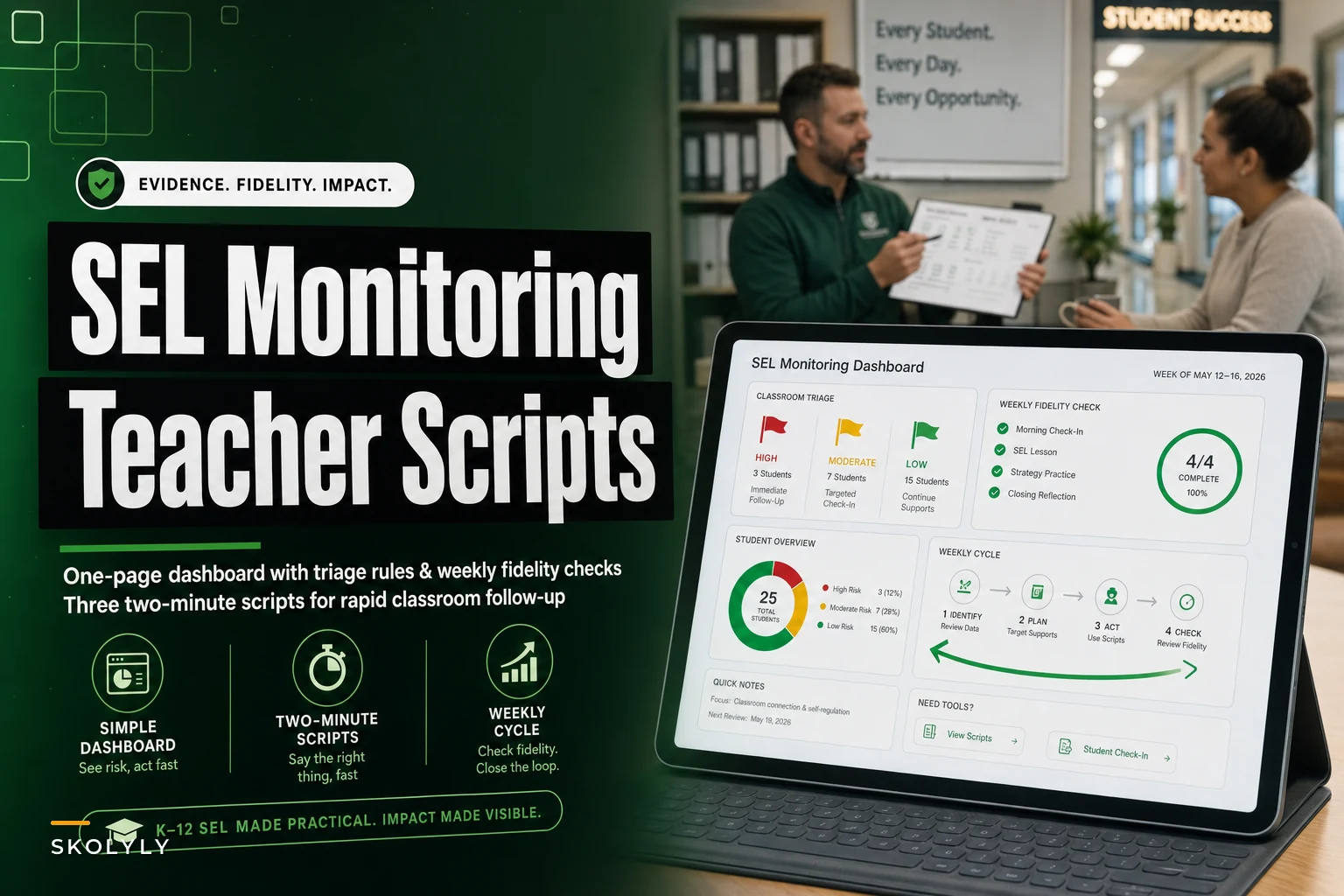
This brief lays out exactly that. One dashboard, three two-minute scripts, and a coach–teacher usage loop that keeps follow-up happening in the same week the flag appears.
Why SEL screeners stall out after the first run
The screener itself is usually fine. The problem is what happens next.
A universal SEL screener spits out a bunch of subscale scores — self-regulation, social awareness, engagement, sometimes a "risk" band. That's useful for a counselor building a caseload. It's nearly useless for a general-ed teacher who has 28 kids and a lesson to teach. The scores don't tell them what to do on Tuesday. So they do nothing — not out of neglect, but because there's no obvious next step attached to the number.
The second failure is timing. Screeners run on a semester or quarterly cadence. But a kid's regulation can fall apart in a single rough week — a family move, a friendship blowup, a death in the family. By the time the next screening window rolls around, you've missed the moment where a 90-second conversation would've mattered.
Third: ownership drift. When SEL "belongs" to the counselor, classroom teachers assume it's handled elsewhere. When it "belongs" to everyone, it belongs to no one. The dashboard has to name who watches what, and how often.
The design goal is narrow. Take screener data plus quick teacher observation, compress it onto one page, attach a triage rule to each band, and give the teacher a script they can run without prep. That's the whole thing.
What goes on the one page
The dashboard is not a data warehouse. It's a decision surface. If it can't be read in 20 seconds and acted on in two minutes, it's the wrong tool.
Keep every student on track with ease.
Skolyly helps you create, assign, and monitor classroom activities efficiently.
- Integrated lesson and assignment management
- Real-time student progress tracking
- Automated class scheduling & notifications
No credit card required
Here's the layout that's held up best in classroom use — small roster, three tracked signals, a status color, and a "next action" column that isn't optional.
| Student | Regulation | Connection | Engagement | Status | Next action (this week) |
|---|---|---|---|---|---|
| M. R. | ↓ | steady | ↓ | Watch | Script A — 2-min check |
| J. T. | steady | ↓ | steady | Watch | Script B — connection |
| D. L. | ↓↓ | ↓ | ↓ | Act | Script C + counselor loop |
| A. P. | steady | steady | steady | Hold | none |
Three columns of signal, not twelve. Regulation (can they manage frustration and transitions), Connection (do they have an adult and peers they feel safe with), Engagement (are they participating and turning in work). Those three cover most of what a classroom teacher can actually see and influence.
The status column runs on three bands only: Hold, Watch, Act. No five-point rubrics, no percentile talk. The teacher glances, sees the color, reads the next action, and moves.
The last column is where this either works or doesn't. Every "Watch" and "Act" row has a specific script attached — not "provide support," which means nothing, but "Script A, two-minute check, do it before Thursday." That's the difference between a dashboard that drives action and one that just describes a problem.
The triage rules that assign each band
The bands need rules, or teachers will assign them by gut and things get inconsistent across classrooms. Keep the rules simple enough to memorize.
-
Hold — All three signals steady or trending up. Screener in the typical range. No action needed beyond normal instruction. Most of the roster lives here, and that's fine.
-
Watch — One signal dropping, or a screener flag in a single subscale, or a teacher noticing a change over the last week or two. Trigger a two-minute script and re-check in a week.
-
Act — Two or more signals dropping, a sharp single-week decline, or any safety-adjacent signal (withdrawal, statements of hopelessness, sudden isolation). Run the script and loop the counselor same day.
One rule that saves a lot of confusion: a signal only moves to Watch or Act on a change, not a baseline. A kid who's always quiet but stable isn't a Watch. A normally-chatty kid who's gone silent for a week is. SEL triage is about trajectory, not personality.
Teachers should also be able to move a kid to Watch on observation alone, even if the screener said they were fine. Screeners lag reality. The teacher who sees the kid every day is often the first sensor, and the dashboard should trust that.
Three two-minute teacher scripts
Scripts get a bad reputation because people imagine robotic recitation. That's not the point. The script is a starting frame so the teacher doesn't freeze, doesn't over-talk, and doesn't accidentally turn a check-in into an interrogation. Two minutes, private-ish, low stakes.
Script A — Regulation check (when self-regulation is dropping)
> "Hey, I noticed the last couple days felt kind of heavy for you. Nothing wrong — I just pay attention. On a scale of rough to okay, where are you today?" > > Listen. Reflect back one thing. Then: "If today gets hard, what's one thing that usually helps you reset? Let's make sure you can get to that."
The goal isn't to fix anything. It's to signal I see you and hand them a regulation tool they already own. Ninety seconds, done.
Script B — Connection check (when connection is dropping)
> "Quick question — who's someone here you'd go to if you had a rough day? Doesn't have to be me." > > If they name someone: good, you've confirmed a support exists. If they hesitate or say "nobody," that's data — you just found a kid without an anchor adult, and that moves them toward Act.
This one surfaces isolation fast. A kid who can't name a single trusted person in the building is a higher priority than most screener scores would suggest.
Script C — Combined check with escalation (Act band)
> "I've noticed some things feel harder for you lately, and I want to check in for real. How are you actually doing — not the automatic 'fine.'" > > Listen fully. Do not problem-solve on the spot. Then: "Thanks for being honest with me. I want to loop in [counselor] because they're really good at this — is that okay with you?"
Script C is not the teacher trying to be a therapist. It's a warm handoff. The teacher's job is to notice, connect, and route — not to carry a mental health case alone.
Print these on the back of the dashboard. When a teacher sees "Script B" in the action column, they flip the page and the exact words are right there. No hunting, no improvising under pressure.
The weekly fidelity check
This is where most SEL rollouts collapse. Everyone agrees to the dashboard in the PD session, uses it for two or three weeks, then drifts. The fidelity check is the thing that keeps it alive, and it has to be light or it becomes another dropped ball.
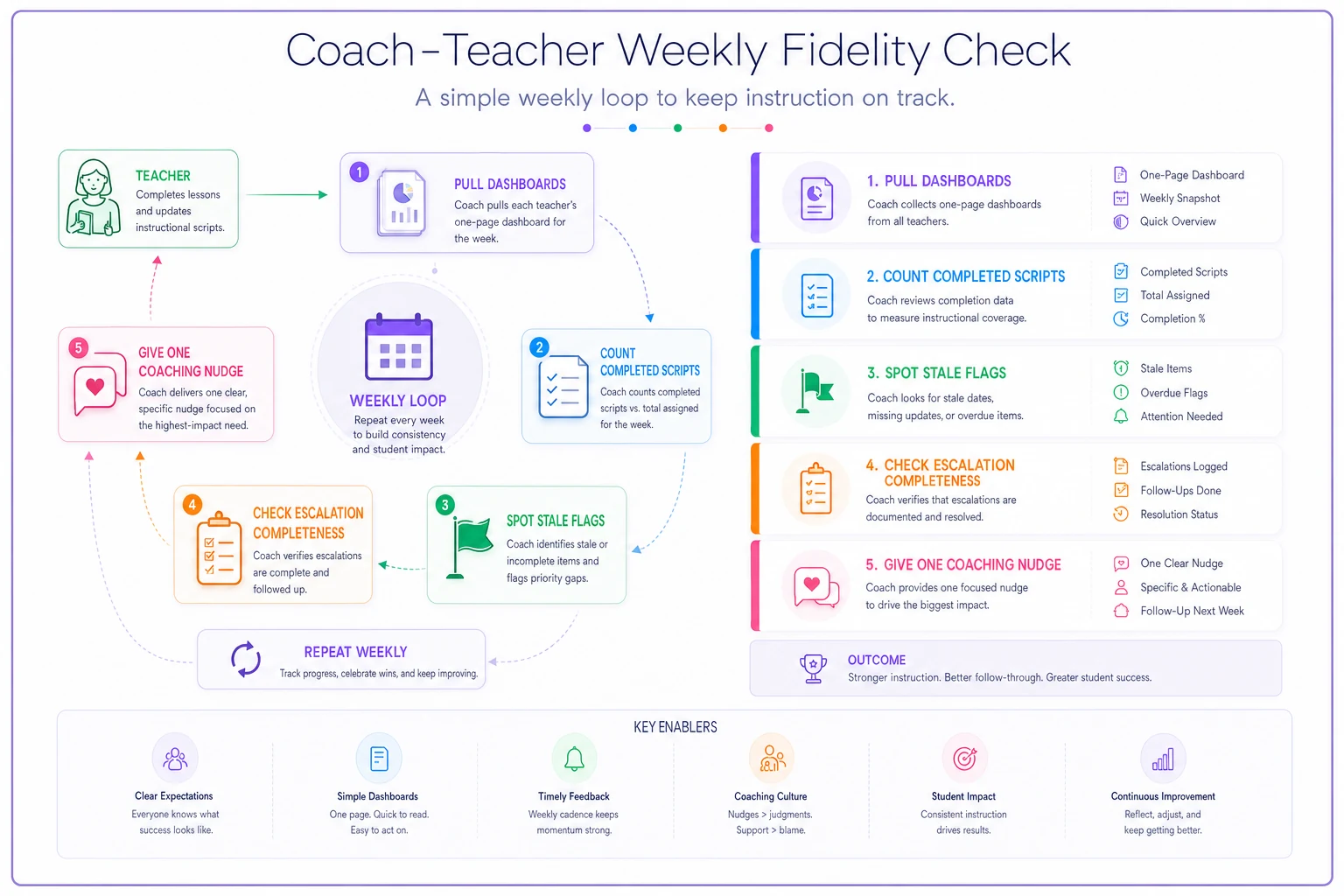
Here's a quick visual of the coach–teacher weekly loop.
-
Pull the dashboards. Coach collects (or opens) each teacher's one-pager. Just looking.
-
Count the actions. How many Watch/Act rows had a script actually run this week? Not the intent — the completion.
-
Spot the stale flags. Any student sitting in Watch for three-plus weeks with no movement and no escalation is a miss. Flag it.
-
Check escalation integrity. Every Act row should show a counselor loop. If one doesn't, that's the first conversation.
-
One coaching nudge. The coach picks a single thing per teacher — "you've got four Watches and ran one script, let's pick two to hit by Friday." Not a lecture. One nudge.
The fidelity check isn't about catching teachers slacking. It's about protecting the follow-up from the natural gravity of a busy week. Without a weekly external touch, SEL check-ins are always the thing that gets bumped when a fire drill eats your prep.
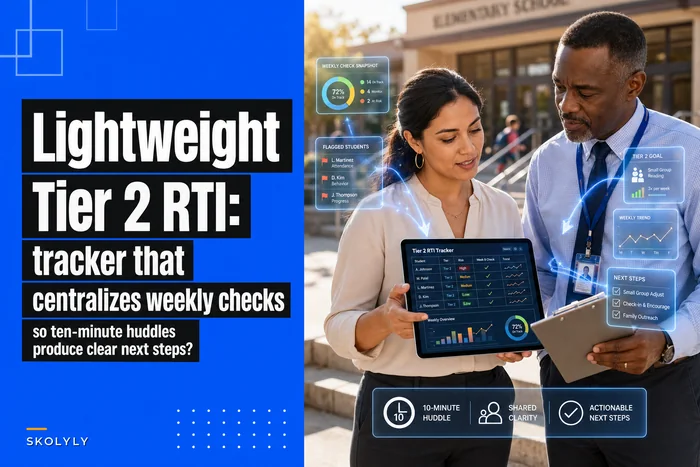
If your building already runs a Tier 2 rhythm, this folds neatly into it. The same discipline that makes a lightweight Tier 2 RTI tracker productive in a ten-minute huddle applies here — short cycle, named owner, visible next action, quick re-check.
A real scenario: middle school team, one quarter
A 7th-grade team — four core teachers sharing around 110 students — was drowning in a familiar way. The fall SEL screener flagged roughly 20 kids across various subscales. The counselor had a caseload that could realistically touch maybe eight of them with any regularity. The other twelve were "on a list" and functionally unwatched.
They put the one-pager in place. Each teacher tracked their section of the shared roster, the coach ran the ten-minute weekly check, and scripts got attached to every Watch and Act.
What changed over the quarter wasn't dramatic on paper, but it mattered. Script B surfaced two kids who couldn't name a single trusted adult — neither had flagged high on the screener. Both got quietly connected to a check-in mentor. A handful of Watch kids resolved on their own once a teacher noticed and named it, which is often all a wobbling kid needs. The number of stale, forgotten flags dropped to basically zero, because the fidelity check kept surfacing them before they could disappear.
The counselor's comment was the tell: for the first time, referrals arriving her way came with context — a teacher had already run a script, already knew who the kid trusted, already had a week of observation. The warm handoff meant she spent less time re-discovering what the classroom already knew.
Roughly 15 minutes of teacher time a week, spread across scripts and quick dashboard glances. Not free, but cheap for what it caught.
When this works — and when it doesn't
This makes sense when:
-
You have universal screener data that's currently going nowhere.
-
Teachers see students daily and can observe trajectory, not just baseline.
-
A coach or counselor can commit to the weekly ten-minute-per-teacher loop.
-
Leadership will accept "trajectory and observation" as legitimate triggers, not just screener percentiles.
This is a bad idea when:
-
Nobody owns the fidelity check. Without it, the dashboard is dead in three weeks — guaranteed.
-
The building treats the scripts as a compliance checkbox rather than genuine check-ins. Kids can smell that instantly, and it does more harm than doing nothing.
-
You try to track twelve signals instead of three. The whole value is compression. A busy dashboard is an ignored dashboard.
Who should NOT run this as-is: buildings without a clear escalation path to a counselor or mental health support. Script C hands a kid off — if there's nobody to hand off to, you're opening a door you can't walk through. Fix the escalation path first, then run the dashboard.
Keeping it low-effort enough to survive
The reason one-page tools survive and comprehensive systems don't is friction. Every extra field, every duplicated entry, every "log it in two places" step is a chance for the whole thing to get abandoned by week four.
Observation data ideally lives where teachers already work — the same place they track behavior or attendance signals — so a status change is a single tap, not a separate portal login. Some lightweight workflow platforms roll individual dashboards up for the coach automatically, so the weekly fidelity check becomes "open the summary" instead of "chase four teachers for their spreadsheets." The point isn't the software; it's removing the collection tax that quietly kills follow-up loops. Whatever tool you use, the test is simple: can a teacher update a kid's status in under five seconds, and can the coach see the whole team in one view?
Prioritize embedding the status field where teachers already record attendance or behavior so updates take under five seconds.
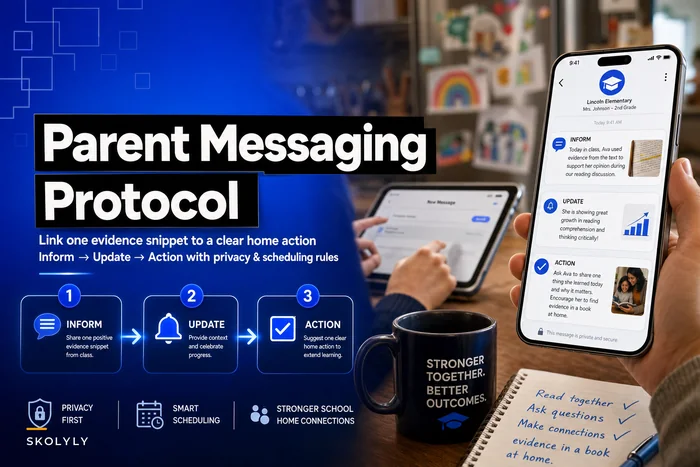
When a Watch or Act resolves, that's also a natural moment to loop the family in — a short, specific note beats a vague "we're a little worried." The same discipline behind a three-message parent communication protocol tied to one classroom evidence snippet applies here: one observation, one clear message, one home action. Keep it concrete and it lands.
Bottom line for coaches and teachers
SEL follow-up doesn't fail because teachers don't care. It fails because the data arrives in a form nobody can act on before the moment passes. The fix is unglamorous — three signals on one page, three triage bands, three scripts, and a ten-minute weekly check that refuses to let flags go stale.
Start with one grade-level team and one quarter. Track trajectory, not personality. Trust teacher observation as much as the screener. And protect the fidelity loop above everything else, because that ten minutes a week is the whole difference between a dashboard that changes outcomes and one more colored spreadsheet nobody opens twice.
Ready to elevate your classroom management?
Join 5,000+ educators using Skolyly to save time, engage students, and improve learning outcomes.