
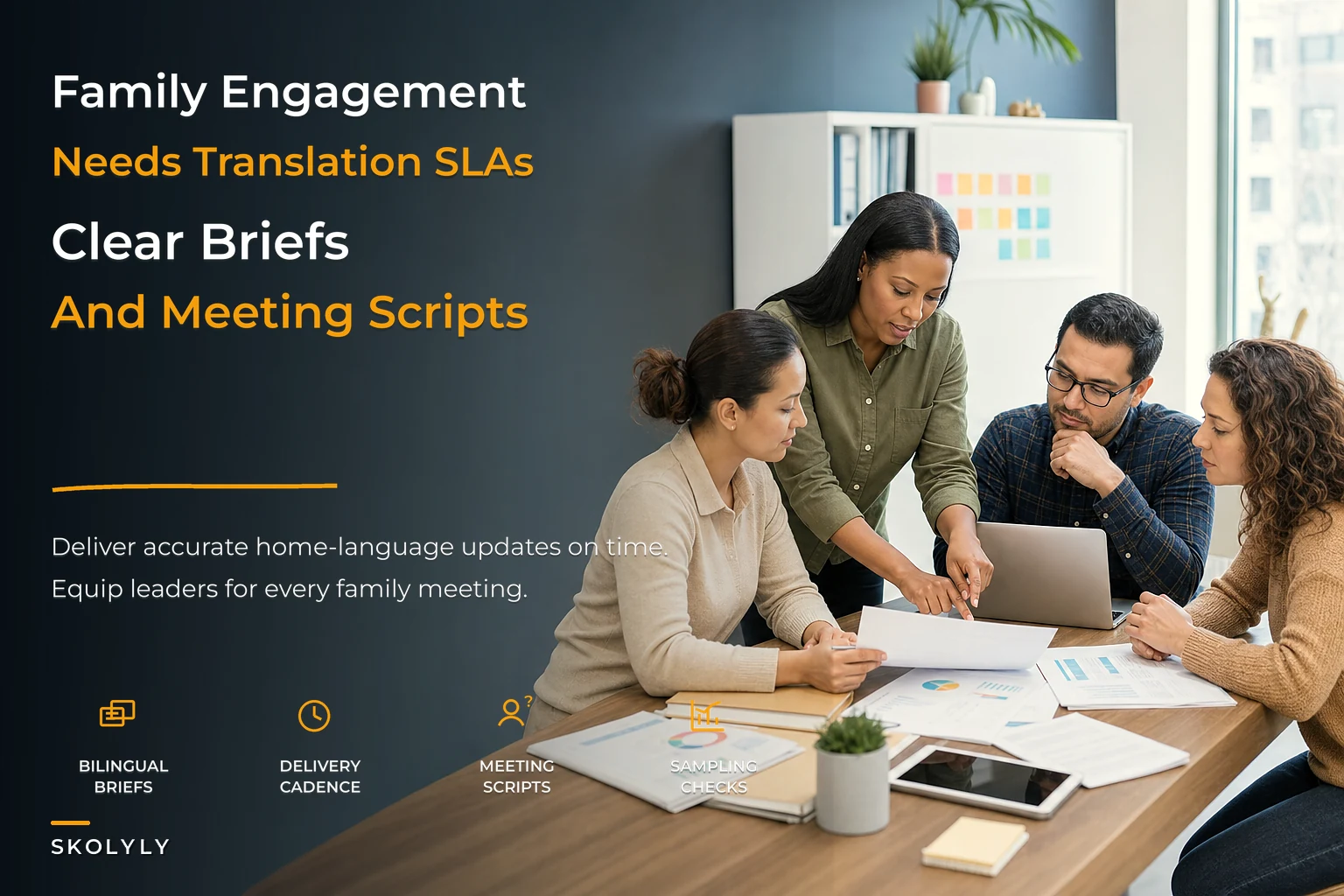

Most schools don't fail at multilingual engagement because they don't care. They fail because the whole thing runs on goodwill and whoever happens to be bilingual in the building that week. A letter goes out in English on Monday. The Spanish version shows up Thursday. The Vietnamese version never shows up at all because the one staff member who translates it is out on medical leave. By the time families get the message, the assessment window it referenced is already closed.
That's not a translation problem. It's a governance problem. And it breaks in predictable ways once you look at it as a system instead of a stack of one-off letters.
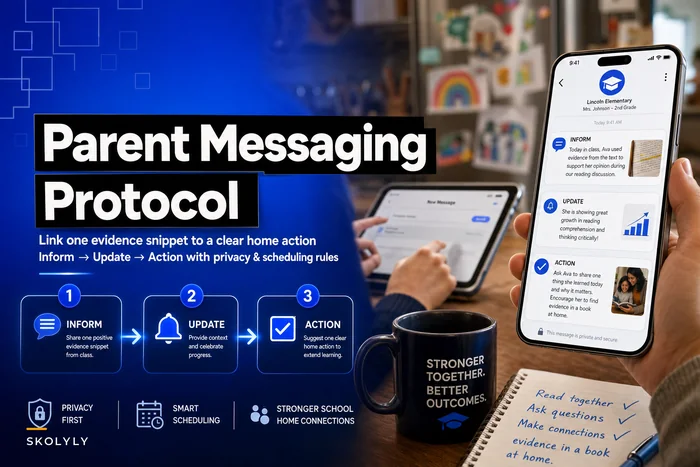
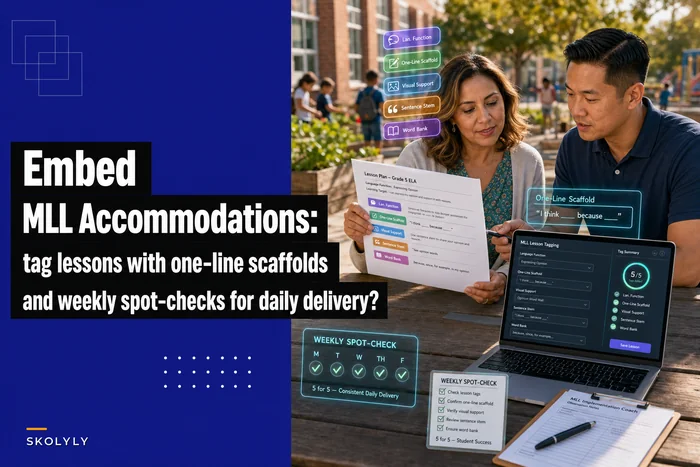
This is the pillar piece for how the engagement pipeline actually works — the SLAs that keep translation honest, the distribution cadence that keeps families inside the decision window, the sampling checks that catch quality drift, and the leader-facing meeting scripts that tie it all back to assessment actions. If you're already doing the classroom-level work (your three-message parent communication protocol and your embedded MLL accommodations), this is the layer that sits above it and keeps the whole thing from collapsing at scale.
The core problem: engagement is a relay race, and the baton keeps getting dropped
Think of a single family communication as a baton moving through a relay. It starts with an assessment event — a benchmark score, a screener flag, a reclassification decision. Someone turns that into a brief. Someone translates the brief. Someone distributes it through the right channel. Someone confirms it landed. And ideally, someone checks that the translation actually said what the English said.
In a small school, one person might run three of those legs. In a district, five different people and two vendors touch it. The more handoffs, the more places the baton drops.
What shows up consistently in schools that struggle here isn't a lack of effort — it's a lack of defined ownership at each leg. Everyone assumes someone else has it. The counselor assumes the front office sent the Spanish version. The front office assumes the teacher handled it. The family, meanwhile, gets a Google-translated text that says their child "needs to be classified" with no context, no action, and no deadline they can actually do anything with.
The fix is boring and it works: every leg of the relay gets a named owner, a time limit, and a quality gate.
Why it breaks across almost every building
Translation happens reactively. There's no queue, no priority, no turnaround commitment. Translation is a favor, not a function. So urgent items — a 10-day special education timeline notice — get the same casual treatment as a field trip permission slip.
Keep every student on track with ease.
Skolyly helps you create, assign, and monitor classroom activities efficiently.
- Integrated lesson and assignment management
- Real-time student progress tracking
- Automated class scheduling & notifications
No credit card required
Nobody distinguishes compliance from informational. A reclassification notice has legal weight. A "come to math night" flyer doesn't. When both move through the same undefined process, the high-stakes item inherits the casual timeline of the low-stakes one.
Quality is invisible. Once a translation goes out, nobody checks it again. A single staff member or an auto-translate tool can quietly produce messages that are confusing, or worse, inaccurate — and leadership never finds out until a parent complains or an assessment action gets challenged.
The cadence drifts. Early in the year, things go out on time. By February, translated communication is running weeks behind English, and families who speak the target languages are structurally receiving late information all year.
The insight most leaders miss: a late translation is functionally the same as no translation when it's tied to a deadline. If the parent conference sign-up closes Friday and the Hmong version arrives Saturday, those families didn't get a slower version of the message. They got excluded from the decision.
What a translation SLA actually looks like
An SLA just means you've decided, in advance, how fast each category of message has to move and who's accountable if it doesn't. You don't need a legal document. You need a tiered table that everyone can see.
| Message tier | Examples | Translation turnaround | Owner | Quality gate |
|---|---|---|---|---|
| Tier 1 — Compliance / time-sensitive | Reclassification notices, SpEd/504 timelines, assessment opt-out windows | 24–48 hours | Designated translation lead + reviewer | Mandatory second-reader check |
| Tier 2 — Assessment-linked, non-legal | Benchmark results, intervention placement, conference invites tied to data | 3 school days | Grade-level or program lead | Spot-check sampling |
| Tier 3 — General informational | Newsletters, event flyers, reminders | 5–7 school days | Communications staff | Periodic sampling only |
The point of tiering isn't bureaucracy. It's protecting the fast lane. When everything is "urgent," nothing is — so you reserve the 24–48 hour commitment for the handful of items that genuinely carry legal or assessment consequences.
A realistic example: a district serving around 2,400 students with roughly 18% multilingual learners across five home languages found that Tier 1 items were averaging 6–9 days to translate because they sat in the same undifferentiated pile as everything else. After tiering, Tier 1 dropped to inside two days, and the backlog that used to build every quarter stopped forming — mostly because Tiers 2 and 3 were allowed to wait without guilt.
Distribution cadence: landing inside the decision window
Translation speed is only half the equation. The other half is when it goes out relative to the action the family needs to take.
-
Day 0 — Assessment event closes (benchmark, screener, reclassification decision finalized).
-
Day 1 — English brief drafted using a standard template (not a free-write).
-
Day 2–3 — Translation completed per tier SLA.
-
Day 3 — Quality gate clears (second reader for Tier 1).
-
Day 4 — Distribution across all channels simultaneously — not English first, translations later.
-
Day 5–6 — Delivery confirmation / read receipts reviewed; non-responses flagged.
-
Day 7+ — Follow-up in home language for anyone who hasn't engaged.
The non-negotiable in that list is step 5: everything goes out at once. The most common equity failure isn't bad translation — it's staggered release, where English-speaking families get a four-day head start on signing up for limited conference slots. Simultaneous release is a governance decision, and it has to be enforced, because the path of least resistance is always "send the English one now, I'll do the rest later."
This diagram shows the ideal end-to-end cadence so teams can map roles and deadlines quickly.
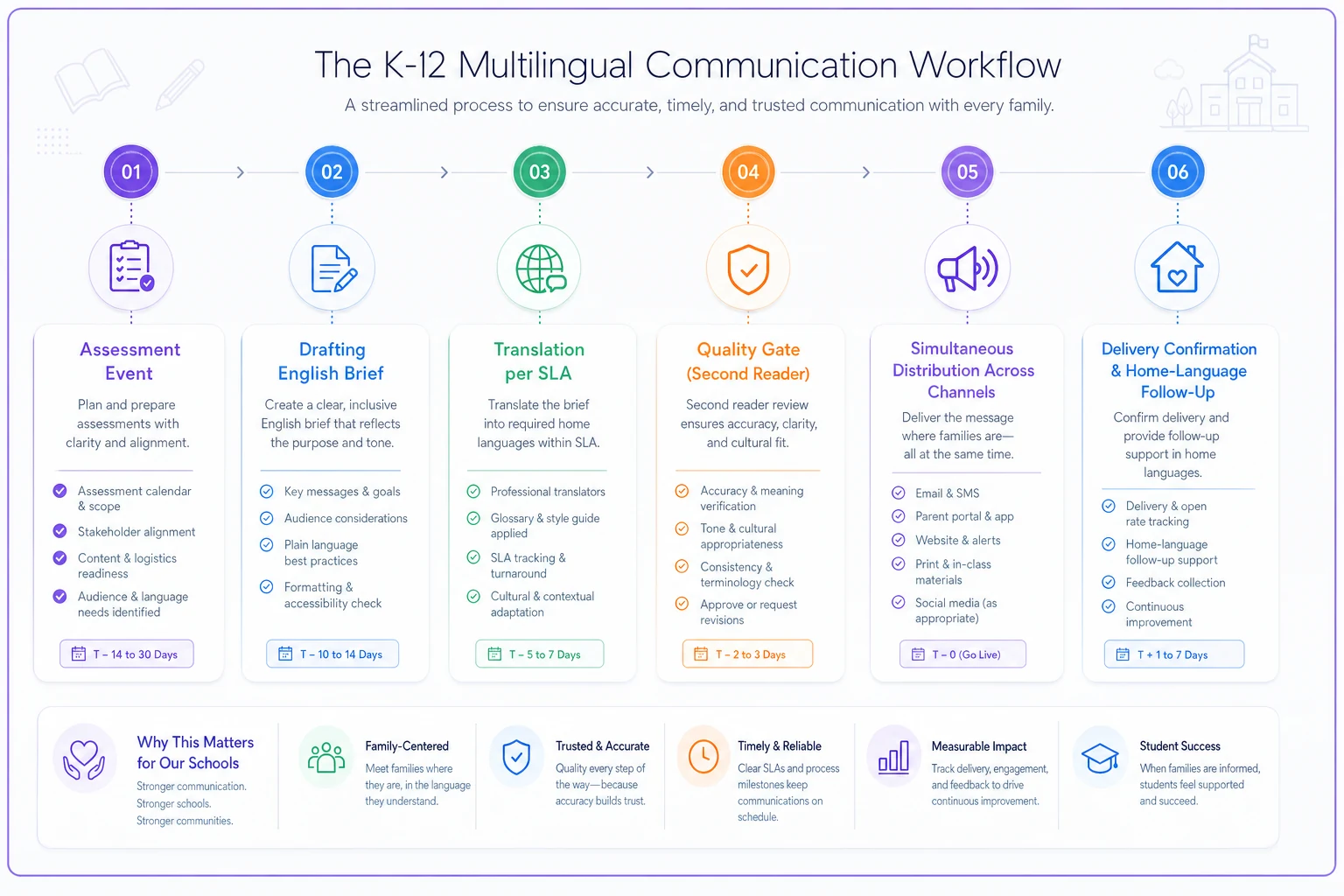
The simultaneous distribution step is the equity guardrail — it prevents English-first advantage and keeps families inside the decision window.
Sampling checks: catching drift before a parent does
You cannot review every translation. You can review enough to know whether quality is holding.
The practical move is a small monthly sample — pull maybe 8–12 translated messages across languages and tiers, and have a qualified reviewer (bilingual staff, a trusted community partner, or a contracted linguist) score them on three plain questions:
-
Accuracy — Does it say what the English said, including the action and the deadline?
-
Clarity — Would a parent with limited formal education understand what to do next?
-
Tone — Does it sound like a human invitation, or a machine-translated legal threat?
Score each 1–3. Anything that scores a 1 on accuracy gets pulled apart in the next governance meeting as a process question — why did this get through? — not as a blame exercise on the translator.
One pattern worth watching for: auto-translation tools tend to fail most on exactly the words that matter most — "reclassification," "proficiency," "intervention," "eligible." They handle the pleasantries fine and mangle the stakes. When you sample, weight your attention toward the sentences that carry the action, not the greeting.
Weight your sampling toward sentences that carry the action and deadline rather than greetings.
A governance checklist you can use directly:
-
[ ] Every message tier has a named owner and a turnaround time
-
[ ] Tier 1 items require a second-reader quality gate before release
-
[ ] All language versions distribute simultaneously, never English-first
-
[ ] A monthly sample of 8–12 translations is scored on accuracy, clarity, tone
-
[ ] Any accuracy failure is reviewed as a process gap in the next leadership meeting
-
[ ] Delivery confirmation is tracked, and non-responders get a home-language follow-up
-
[ ] There's a named backup for every translation role (vacation, leave, turnover)
That last one quietly prevents more failures than any of the others. Single-point-of-failure translation — one bilingual aide holding the whole thing — collapses the moment that person is out.
Leader-facing meeting scripts and templates
Governance lives or dies in the meeting where someone has to say "this slipped" out loud. If your engagement data never reaches a leadership table, there's no pressure to fix the cadence. The briefs and the scripts matter as much as the SLAs.
The one-page leader brief should fit on a single screen and answer four things:
-
What assessment actions drove family communication this cycle?
-
Did each tier hit its SLA? (Simple on-time percentage per tier.)
-
What did sampling reveal about quality?
-
Which language groups are under-responding, and what's the follow-up plan?
A short script for the monthly review — roughly 12 minutes:
> "Let's start with Tier 1. We sent [X] compliance items this month. On-time rate was [X%]. For anything that missed, walk me through where it stalled — translation, review, or distribution." > > "Now sampling. We scored [X] translations. Any accuracy ones? If yes — that's a process question. What let it through, and what's the fix before next cycle?" > > "Last, response by language group. Where are we seeing families not engage? Is that a timing issue, a channel issue, or a trust issue? What's one change we test next month?"
Notice the framing: where did it stall, not who messed up. The fastest way to kill honest reporting is to turn the meeting into a blame exercise. You want staff surfacing problems, not hiding them until a parent escalates.
A family-facing brief template that keeps the assessment action front and center:
> [Student name] recently completed [assessment]. Based on the results, we are recommending [specific action]. Here is what this means for [student], and here is what we're asking you to do: [one clear action, one deadline]. If you'd like to talk with us first, here's how and by when.
One action. One deadline. One contact. Translated to that same clean structure — because a clean English brief translates well, and a cluttered one translates into confusion.
When tight governance makes sense — and when it's overkill
This full system is built for a specific reality: multiple home languages, assessment actions with real consequences, and enough volume that informal goodwill can't keep up.
When it clearly makes sense:
-
You serve several language groups, not just one
-
Reclassification, special education, or opt-out timelines run through family communication
-
You've already had a late or inaccurate translation create a real problem
When it's probably overkill:
-
A small school with one dominant home language and a stable, reliable bilingual staff member who already turns things around same-day. In that case, formalize the backup plan and the simultaneous-release rule, and skip the heavy tiering.
Who should not do this: Don't build an elaborate SLA table if you can't yet staff the quality gate. A second-reader requirement with no second reader is just a rule you'll quietly break, which trains everyone to ignore the rest of the system too. Build to what you can actually sustain, then expand.
A short real scenario
A K–8 school serving around 1,100 students, with four home languages and about 22% multilingual learners, kept running into the same February problem: translated benchmark communications arrived days after English, and conference sign-ups skewed heavily toward English-speaking families who'd simply gotten the message first.
They didn't buy anything new. They did three things. They tiered their messages so benchmark-linked invites got a three-day turnaround with a named owner. They enforced simultaneous release — nothing went out until every language version was ready. And they started a small monthly sample, maybe ten messages, scored by a bilingual counselor and a community partner.
The shift wasn't dramatic in a flashy way. Conference sign-up rates across the four language groups moved much closer together — the gap that used to be wide narrowed to something they described as "finally comparable." Just as important, the backlog that used to pile up every spring stopped forming, because low-stakes items were allowed to wait while the high-stakes ones moved first. The staff member who used to carry all translation alone got a named backup, and the first time she was out for a week, nothing fell through.
Where software fits — and where it doesn't
None of this requires a platform. You can run it on a shared tracker and a disciplined calendar. But once you're coordinating multiple languages, multiple owners, tiered SLAs, and sampling across a whole district, the tracking itself becomes the bottleneck — and that's where a management platform earns its place.
The genuinely useful role for AI-assisted operational tools here is narrow and specific: flagging which messages are approaching their SLA deadline, routing the right item to the right owner automatically, pulling a randomized sample for review so you're not hand-picking, and surfacing on-time and response-rate numbers for the leader brief without someone building it by hand every month. AI automation handles the watching-and-routing work well — deadline tracking, "this one's about to miss," the sampling draw. It should not be writing your Tier 1 compliance translations unsupervised; that's exactly what the second-reader gate is for. Used that way, the tooling removes coordination overhead so your people spend their time on judgment, not on chasing down whether the Vietnamese version went out.
The real takeaway
Multilingual family engagement isn't a translation task bolted onto the end of your communication workflow. It's a pipeline with distinct legs, each of which can fail silently, and each of which needs an owner, a clock, and a check.
The schools that get this right aren't the ones with the best translators — they're the ones that treated engagement as a governed system tied directly to the assessment actions families actually need to respond to. Define the SLAs, protect simultaneous release, sample for drift, and keep the whole thing visible at a leadership table where someone can say "this slipped" before a family ever has to.
Multilingual family engagement isn't a translation task bolted onto the end of your communication workflow. It's a pipeline with distinct legs, each of which can fail silently, and each of which needs an owner, a clock, and a check. The schools that get this right aren't the ones with the best translators — they're the ones that treated engagement as a governed system tied directly to the assessment actions families actually need to respond to. Define the SLAs, protect simultaneous release, sample for drift, and keep the whole thing visible at a leadership table where someone can say "this slipped" before a family ever has to.
Ready to elevate your classroom management?
Join 5,000+ educators using Skolyly to save time, engage students, and improve learning outcomes.