


When language support disappears between planning and delivery—and students fall through the cracks
Teachers know the drill with multilingual learners. You plan accommodations during Sunday prep, add scaffolding notes to your planner, maybe even highlight where to pause for vocabulary support. Then Monday hits, the lesson flows, and those carefully planned supports vanish into the chaos of actual teaching. By Friday, you're wondering why Miguel still looks lost during group work and why Fatima's writing hasn't progressed despite everything you planned.
The gap between planned MLL accommodations and actual classroom delivery creates a cascade of problems most schools don't even track. Students who need language support most get it least consistently. Teachers burn out replanning the same accommodations that never quite stick. And administrators scratch their heads wondering why their ELL programs show minimal growth despite significant investment.
The operational breakdown hiding in plain sight
Walk into any classroom with multilingual learners and you'll spot the pattern. The teacher has a lesson plan—probably detailed, probably compliant. Somewhere in that plan, buried in differentiation notes or tucked into a margin, are MLL accommodations. Sentence frames. Visual supports. Vocabulary pre-teaching. All the right elements.
But watch what happens during instruction. The teacher launches into the lesson, momentum builds, content flows. Those accommodation notes? Three pages back in a binder. The sentence frames? Still in the planning app on a laptop across the room. The visual supports? Printed but sitting under tomorrow's materials.
This isn't teacher negligence. It's an operational failure. The system asks teachers to track accommodations in one place, reference them in another, and execute them in real-time while managing twenty-five students. No wonder the supports evaporate.
Embedding a multilingual learner accommodation checklist directly into daily workflows changes this dynamic. Instead of separating accommodations from instruction, you weave them into the natural flow of teaching.
Why traditional MLL tracking fails in actual classrooms
Most schools approach MLL accommodations like they approach IEP accommodations—as compliance checkboxes rather than instructional tools. The accommodation gets documented somewhere, usually in multiple places, then everyone hopes it translates to classroom practice.
Keep every student on track with ease.
Skolyly helps you create, assign, and monitor classroom activities efficiently.
- Integrated lesson and assignment management
- Real-time student progress tracking
- Automated class scheduling & notifications
No credit card required
What typically happens: the ELL coordinator creates thorough accommodation matrices. Teachers receive them at the start of the year, file them, maybe review them quarterly. These documents list every student's language level, recommended supports, and modification guidelines. Comprehensive. Compliant. Completely disconnected from daily teaching.
Meanwhile, teachers create lesson plans that might reference "ELL supports" generically. During district observations, they can point to where accommodations appear in their documentation. But between the planning and the teaching, something breaks. The accommodation that looked clear on Sunday gets fuzzy by Tuesday. The scaffolding that made sense in isolation gets lost in the flow of actual instruction.
The cost compounds quickly. Multilingual learners participate less, understand less, produce less—not because they lack capability, but because the supports they need arrive inconsistently or not at all. Teachers feel the guilt of knowing they planned accommodations they couldn't deliver smoothly. Administrators watch achievement gaps persist despite resources allocated to ELL programs.
The one-line tag system that actually works
Instead of treating MLL accommodations as separate from instruction, embed them directly into the lesson flow using one-line tags. These aren't lengthy descriptions or complex matrices. They're action prompts that appear exactly when and where teachers need them.
A tagged lesson plan looks like this:
-
Opening (5 min) - Review yesterday's concept - [MLL
Visual - concept map on board before speaking] - Ask for examples from homework
-
Direct Instruction (10 min) - Introduce new vocabulary - [MLL
Pre-teach - escribir/revisar with gestures] - Model the writing process - [MLL: Think-aloud - slow pace, point to each step]
-
Guided Practice (15 min) - Partner work on practice problems - [MLL: Scaffold - sentence starter strips at tables] - Circulate and check understanding - [MLL: Check - thumbs up/down for Ana, Luis, Priya specifically]
The tags appear inline with instruction, not buried in a separate section. They're specific actions, not general reminders. They name students when individual attention matters. And they take about five seconds to read and act on.
The language functions drive which tags you use. If today's lesson focuses on comparing and contrasting, your tags emphasize sentence frames for comparison. If students need to explain processes, your tags highlight sequencing words and transition supports. The accommodation matches the actual language demand, not some generic "ELL support" category.
Building your tag library without overwhelming teachers
Creating effective tags starts with identifying your most common language functions, then matching each to a one-line scaffold. Not hundreds of options—the right dozen or so that cover most situations.
Start with these core language functions and their matching tags:
-
Describing - [MLL
Vocabulary - adjective word bank visible] - [MLL: Visual - label parts while describing]
-
Explaining - [MLL
Scaffold - First/Next/Then cards on desks] - [MLL: Model - think-aloud with gestures]
-
Comparing - [MLL
Frame - "Similar because..." / "Different because..." posted] - [MLL: Visual - Venn diagram template ready]
-
Analyzing - [MLL
Scaffold - question stems on cards] - [MLL: Partner - pair with English-proficient peer]
-
Evaluating - [MLL
Support - opinion phrases anchor chart] - [MLL: Wait - extra think time before calling on]
Teachers don't memorize these. They sit on a simple reference sheet—digital or printed—alongside planning materials. When Monday's lesson involves comparing fractions, grab the comparing tags. When Tuesday focuses on explaining solutions, use the explaining tags.
Keep tags actionable and brief so teachers can scan and act in seconds during instruction.
Keep tags actionable and brief. "[MLL: Scaffold - sentence frames]" is too vague. "[MLL: Frame - 'Similar because...' / 'Different because...' posted]" tells the teacher exactly what to do. That specificity is what makes them usable mid-lesson.
The weekly spot-check routine that ensures follow-through
Tags in lesson plans mean nothing if they don't translate to classroom practice. That's where the weekly spot-check comes in—not another observation system or compliance check, but a five-minute operational rhythm that keeps accommodations visible and active.
-
Monday Planning Pulse (2 minutes) Teacher reviews the week's language functions and adds relevant tags to lessons. Not every moment needs a tag, just the spots where language support matters most. Three to five tags per lesson usually hits the sweet spot.
-
Wednesday Walkthrough (5 minutes per classroom) Instructional coach, assistant principal, or peer teacher does a brief pop-in. They're looking for one thing: are the tagged accommodations actually happening? They might see the sentence frame posted, hear the think-aloud with gestures, notice the word bank on student desks. Simple checklist, no lengthy forms.
-
Friday Reflection (3 minutes) Teacher notes which tags worked smoothly and which felt clunky. Maybe the sentence frames were too complex for current language levels. Maybe the visual supports needed to be bigger. These notes feed into next week's tags.
This routine creates visibility without burden. Teachers know someone will notice if accommodations happen. Administrators get real data about MLL support implementation. Students get consistent language scaffolding instead of hit-or-miss support.
Here's a simple visual of that routine.
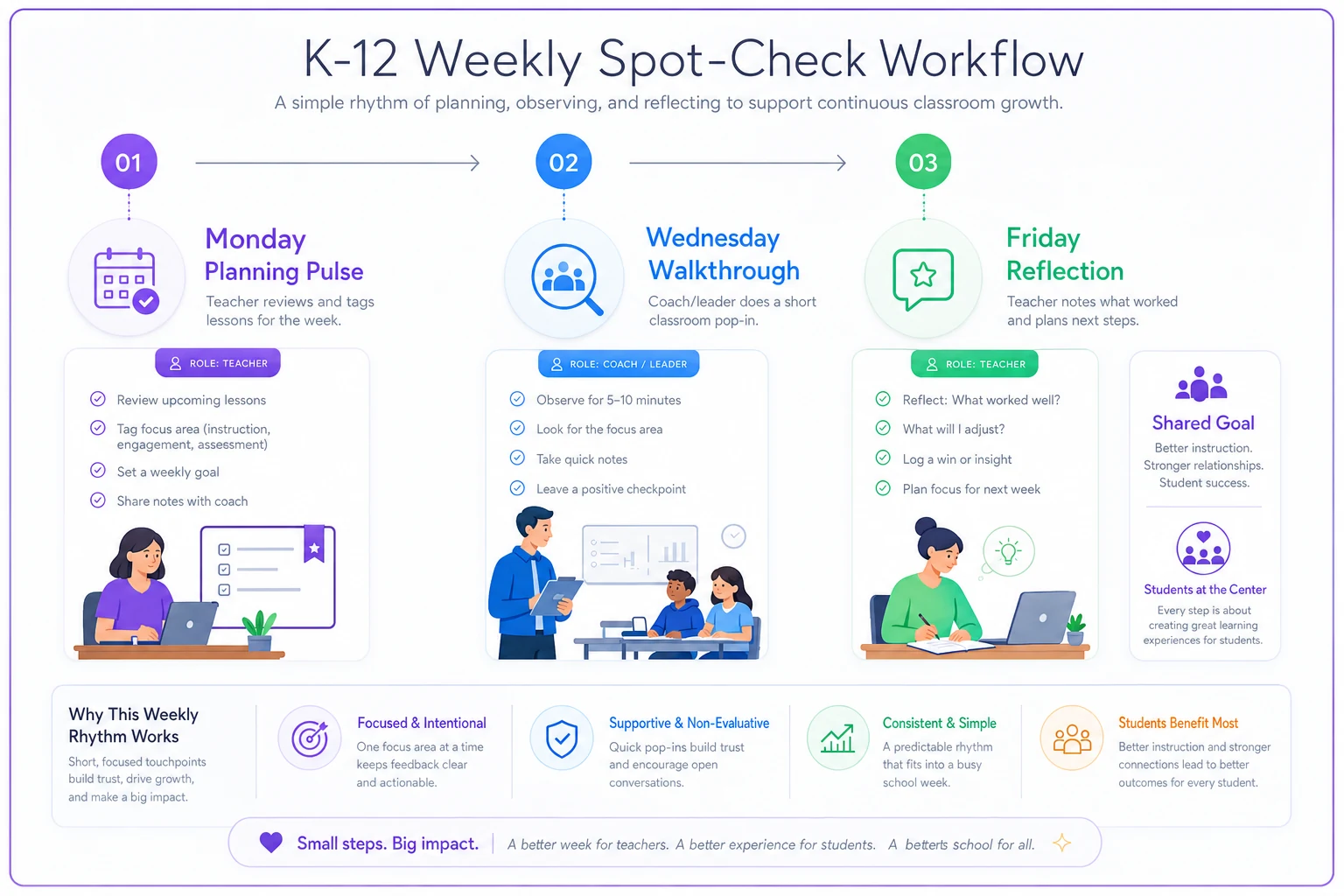
The visual highlights how quick, recurring checks keep tags active without heavy paperwork.
Implementation pitfalls that derail MLL accommodation systems
The most common failure happens when schools try to make the system too comprehensive from the start. They create fifty different tags, require tags for every lesson segment, demand detailed documentation of tag effectiveness. The system collapses under its own weight within weeks.
Start small. Pick five language functions that appear most often in your curriculum. Create two or three tags for each. Use them for two weeks before adding more. Let teachers find their rhythm before expanding.
Another failure point is treating all MLLs as needing identical support. A newcomer student needs different scaffolding than a long-term English learner. Your tags should reflect this. Consider level-specific tags:
-
- [MLL-1
Visual - picture cards for every noun]
-
- [MLL-3
Scaffold - academic phrase bank posted]
-
- [MLL-5
Extension - peer teaching opportunity]
Some schools stumble by making spot-checks feel punitive. The moment teachers feel like they're being caught not using tags, the system becomes about compliance rather than student support. Frame spot-checks as support: "What tags are working well? What additional scaffolds would help?" The conversation shifts from gotcha to growth.
Technology can help or hinder here too. Digital lesson planning platforms make it easy to copy-paste tags, but they can also bury them in menus and clicks. Some teachers work better with printed lesson plans where they can highlight tags with actual highlighters. Let teachers choose the format that keeps tags visible during instruction.
The tag system works best when it reflects the way teachers already think about instruction—not as an add-on, but as a natural part of how they move through a lesson. That mindset shift is where most implementations either take hold or quietly die.
Real numbers from a middle school implementation
A roughly 750-student middle school in suburban Texas implemented this system after struggling with a rapidly growing MLL population—they'd jumped from around 12% to 31% multilingual learners over three years, and traditional accommodation methods weren't scaling.
-
Week 1–2
ELL coordinator introduced five basic language function tags
-
Week 3–4
Grade-level teams practiced adding tags during common planning
-
Week 5–6
Assistant principals began Wednesday spot-checks
-
Week 7–8
System expanded to include level-specific tags
After one semester:
| Metric | Before | After |
|---|---|---|
| Observed lessons with visible accommodation implementation | Inconsistent | ~78% |
| Teacher planning time for MLL accommodations per week | 20–25 min | 5–8 min |
| MLLs showing improved engagement indicators | Baseline | ~67% |
| Teacher confidence in supporting language development | Low | Noticeably improved |
The breakthrough came when teachers realized tags weren't extra work—they replaced the mental energy spent trying to remember accommodations mid-lesson. A seventh-grade math teacher put it plainly: "I used to plan accommodations then forget them when I'm actually teaching. Now they're right there in my lesson flow. I just do them."
Beyond compliance: when accommodations become instruction
The shift from accommodation-as-compliance to accommodation-as-instruction changes everything about MLL support. Instead of viewing language scaffolds as something extra you do for certain students, they become part of how you teach content.
This integration shows up most clearly in differentiated lessons. When you're already thinking about readiness levels, language proficiency becomes another lens for differentiation, not a separate planning burden.
Consider how this plays out in a lesson on analyzing character motivation:
-
Traditional approach - Teach the lesson - Remember (maybe) to give sentence frames to ELL students - Hope they can participate in discussion
-
Embedded tag approach - [MLL: Pre-teach - motivation, influence, react] - Introduce character analysis concept - [MLL: Visual - emotion chart visible during discussion] - Partner discussion on character choices - [MLL: Scaffold - "The character felt... because..." strips at MLL desks] - Whole class share-out - [MLL: Wait - count to 5 before calling on MLL students]
The accommodations don't interrupt instruction—they enhance it. Every student benefits from seeing the emotion chart. Native English speakers might grab sentence strips too if they help organize thoughts. The pre-teaching happens naturally as vocabulary introduction, not as a separate "ELL moment."
Making spot-checks productive, not punitive
The weekly spot-check routine succeeds or fails based on how it's positioned. When administrators use spot-checks to catch teachers not implementing accommodations, the system becomes another compliance hurdle. When they use it to support and refine accommodation delivery, the system actually improves.
Productive spot-checks focus on three questions:
-
Which tagged accommodations are happening smoothly? This celebrates what's working and helps identify best practices worth sharing.
-
Which accommodations seem to need adjustment? Maybe the sentence frames are too complex. Maybe the visual supports aren't visible enough. The spot-check identifies refinements, not failures.
-
What additional support would help? Sometimes teachers need materials—printed sentence strips, laminated word banks. Sometimes they need coaching on specific scaffolding techniques. The spot-check surfaces these needs.
The spot-checker uses a simple form:
Date: Teacher: Lesson: Tags observed in action: □ □ □ Tag implementation notes: _ Support needed: _ Follow-up: __
Two minutes to complete, actionable feedback, and the focus stays on improving the system rather than evaluating the teacher.
Creating sustainable systems through automation
The manual version of this system works, but it requires consistency that many schools struggle to maintain long-term. This is where thoughtfully designed operational software can turn a good idea into sustained practice.
Imagine lesson planning software that suggests MLL accommodation tags automatically based on the language functions you identify in your objectives. As you plan Monday's lesson on comparing decimals, the system recognizes the comparison function and surfaces appropriate tags. You select which ones fit your specific MLLs, and they appear in your lesson display during instruction—not buried on page three of a binder.
During instruction, accommodations surface exactly when needed. The visual reminder appears as you transition to guided practice. The sentence frame displays during discussion time. Simple teacher input can track which accommodations actually get implemented, building a record over time without creating extra paperwork.
Spot-checks become more streamlined too. Observers mark which accommodations they see on a tablet, and the system aggregates patterns across classrooms—which language functions get strong support, which need more scaffolding options. For administrators, dashboards show implementation rates across grade levels and subjects. Not for compliance reporting, but for identifying where teachers need support. If eighth-grade science consistently struggles with explanation scaffolds, that's a professional development opportunity, not a personnel issue.
The compound effect of consistent language support
When multilingual learner accommodations actually happen consistently, the effects compound in ways most schools never get to see. Students who receive reliable language support don't just understand today's lesson better—they build academic language systematically over time.
After a month of consistent tagging and spot-checks, MLLs start anticipating supports. They know sentence frames will appear during discussions. They expect visual supports during new vocabulary introduction. That predictability reduces cognitive load, letting students focus on content rather than constantly decoding language.
Teachers report an unexpected benefit too: the tag system makes them more intentional about supporting all students. Once you start thinking explicitly about language functions, you notice when any student struggles with explanation or comparison or analysis. Scaffolds designed for MLLs end up helping struggling native speakers as well.
The operational efficiency improves gradually but noticeably. Teachers spend less mental energy wondering if they've included accommodations and more time refining instruction. Administrators spend less time on compliance documentation and more on instructional improvement. ELL coordinators shift from creating accommodation paperwork to actually coaching teachers on language development strategies.
Most importantly, multilingual learners stop falling through the cracks between planning and instruction. They get the language support they need, when they need it, in a way that feels natural rather than othering. Their participation increases, their confidence grows, and their academic achievement follows.
Moving from good intentions to operational reality
Every school wants to support multilingual learners effectively. Most have the knowledge, the resources, and the commitment. What they lack is an operational system that bridges the gap between accommodation planning and classroom delivery.
One-line tags and a weekly spot-check routine provide that bridge. Not another initiative or program—a simple operational adjustment that makes existing efforts actually work.
Start small. Pick three language functions. Create two tags for each. Try them for one week in one grade level. Run one spot-check. Refine based on what you learn. Build from there.
The path from scattered accommodation attempts to systematic language support doesn't require revolutionary change. It requires operational discipline: clear tags, visible placement, consistent checking, continuous refinement. When those elements align, MLLs finally get the support everyone agrees they deserve—not just in planning documents, but in actual daily instruction where it matters.
Ready to elevate your classroom management?
Join 5,000+ educators using Skolyly to save time, engage students, and improve learning outcomes.