

Most districts don't have a translation problem. They have a coordination problem that only shows up when translation gets involved.
Here's what that looks like in practice. An assessment window closes. Scoring happens. English reports go out roughly on schedule. Then the Spanish, Vietnamese, Arabic, or Haitian Creole versions trickle out two or three weeks later—sometimes with slightly different score bands, sometimes with a translated rubric descriptor that quietly means something else in the target language. By the time a bilingual family gets their brief, the parent-teacher conference has already happened. The report they finally receive doesn't quite match what the teacher said out loud, and now a family that was already unsure about the system trusts it a little less.
That's the real cost of weak multilingual assessment governance. Not the translation itself—the drift between languages and the lag between when English-speaking families and everyone else gets usable information.
This piece is about building the system that prevents both.
Why translation quietly breaks scoring integrity
When people think about scoring integrity, they think about rater calibration, moderation protocols, item banks. Fair. But translation introduces a second scoring surface that almost nobody governs with the same rigor.
Consider a performance-task rubric. In English, "elaborates with relevant detail" is a level-3 descriptor. A vendor translator—working fast, paid per word, with no assessment background—renders "elaborates" as a word closer to "decorates" or "embellishes." Now the Spanish rubric is subtly rewarding a different behavior than the English one. If a bilingual family reads that descriptor to understand why their kid landed at a 2 instead of a 3, they're reading a rubric that no longer maps to the one the scorer used.
That's a scoring-parity failure, and it's invisible until someone bilingual on staff happens to notice. In most districts, nobody's job is to notice.
The pattern comes up repeatedly: districts treat translation as a publishing step (get the words into another language, ship it) instead of an assessment step (make sure the translated instrument and the translated report preserve the same meaning and the same score interpretation). Publishing steps get outsourced and rushed. Assessment steps get governed. Translation needs to sit on the assessment side of that line.
The three things that actually break at scale
A small district with 400 multilingual families and two dominant home languages can muscle through this manually. One coordinator, a couple of trusted bilingual staff, a shared folder. It works because everything fits in one person's head.
Keep every student on track with ease.
Skolyly helps you create, assign, and monitor classroom activities efficiently.
- Integrated lesson and assignment management
- Real-time student progress tracking
- Automated class scheduling & notifications
No credit card required
Scale changes the math. A district with 6,000+ multilingual families across nine or ten languages hits three predictable failure points.
1. Turnaround time diverges by language. English reports go out in 5 business days. The two high-volume languages go out in 10–12. The "long tail" languages—the ones with 30 families instead of 3,000—go out whenever someone gets to them, which is sometimes never. The families with the least access to the system get the slowest service. This is the quiet inequity nobody puts on a slide.
2. Version control collapses. Someone fixes a scoring band in the English template after the first batch ships. That fix never propagates to the seven translated versions already in progress. Now you have an English report that says "approaching standard: 340–360" and a Vietnamese report still showing the old cut score. Both are "official." Both are wrong in different directions.
3. Nobody owns parity. Translation quality lives with a vendor. Scoring integrity lives with the assessment office. Family communication lives with the family-engagement team. When a mismatch surfaces, three departments each assume it was another department's job. The gap between them is where trust leaks out.
A governance model built around parity, not translation
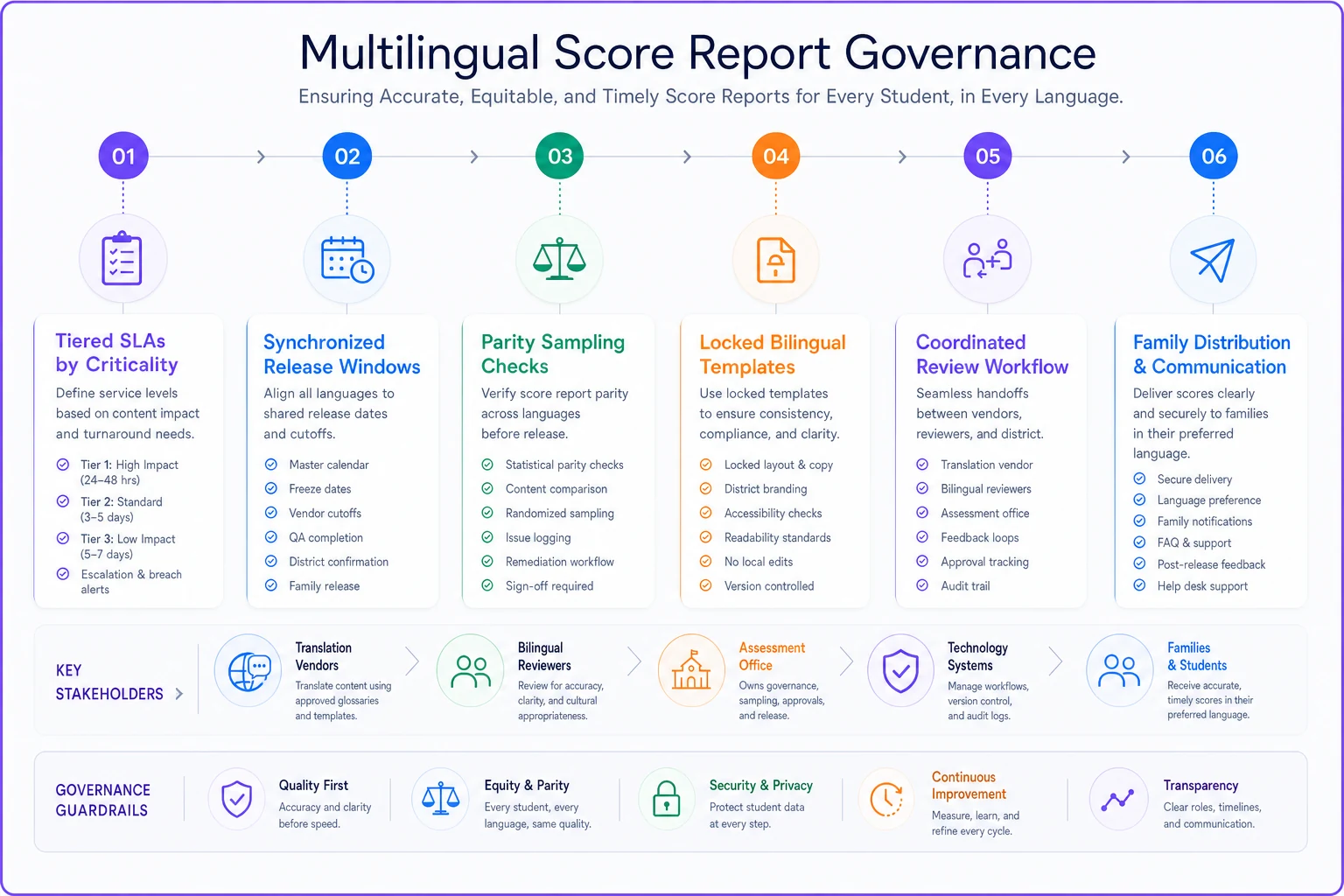
The fix isn't "hire better translators." It's building a system where accuracy and timeliness are structural, not dependent on any one person being careful.
-
Translation SLAs that bind turnaround time to language, tiered by family volume so no language falls off the map
-
Scoring-parity sampling checks that catch meaning-drift before reports ship, not after complaints arrive
-
A report distribution cadence that releases all languages close enough together that no family is structurally behind
-
Bilingual family-brief templates that lock the score-critical language so translators can't accidentally reinterpret it
Translation SLAs that don't punish smaller language groups
The instinct is to write one SLA: "all translations delivered within X days." That fails immediately, because a 3,000-family language and a 30-family language genuinely have different logistics. So instead of a flat deadline, tier the SLA by volume—but cap the gap between English and the slowest language.
| Tier | Family volume (per language) | Turnaround target (from English release) | Parity check level |
|---|---|---|---|
| Tier 1 | 1,000+ families | Same day to +2 business days | Full sample check |
| Tier 2 | 200–999 families | +3 to +5 business days | Standard sample check |
| Tier 3 | Under 200 families | +5 to +7 business days | Score-critical fields only |
The hard rule that makes this work: no language releases more than 7 business days after English, ever. That single constraint kills the "long tail gets it whenever" problem. A family with a rarely-spoken home language might wait a week longer than an English-speaking family—but not a month, and never "we forgot."
One thing worth building into the SLA that districts routinely leave out: a correction clause.
When a scoring error is found in the English version after release, the SLA should specify how fast the correction hits every translated version. Without it, corrections propagate at random and version control dies.
Here's a simple workflow that ties those four components together.
Scoring-parity sampling checks
You cannot back-translate and verify every report. In a district shipping thousands of reports across ten languages, that's not a workflow, that's a fantasy. So you sample—but you sample intelligently, weighted toward the fields where a translation error actually changes score interpretation.
Not all text in a report carries equal risk. The school's address translated a little awkwardly costs nothing. A cut-score label or a rubric descriptor translated wrong costs trust and can trigger an appeal. Concentrate your checking budget on the high-risk fields.
A workable sampling routine looks like this:
-
Pull a fixed sample per language per assessment cycle—somewhere around 8–12 reports for Tier 1 languages, 5–6 for Tier 2, 3–4 for Tier 3.
-
Route each sampled report to a bilingual reviewer who is not the original translator. Fresh eyes catch drift the translator normalized.
-
Have the reviewer verify only the score-critical fields
performance-level labels, cut-score ranges, rubric descriptors, and any "what this means / what to do next" language.
-
Log every mismatch by field type, not just pass/fail. Over two or three cycles, patterns emerge—maybe one vendor consistently mistranslates rubric verbs, or one language consistently drifts on proficiency-band names.
-
Feed those patterns back into a locked glossary so the same error can't recur.
That last step is what turns sampling from a gotcha into a system. The point isn't to catch translators being wrong. It's to build an institutional memory of exactly which phrases are dangerous, so they get pre-translated once, correctly, and reused everywhere.
The mistake that shows up most often: districts run parity checks after distribution, as a quality-assurance afterthought. By then the report is in the family's hands. Parity sampling has to be a gate before release for the sampled batch, with sample results standing in for the whole batch's confidence level.
A distribution cadence that keeps families in sync
Timing is its own integrity issue. A report that's accurate but arrives after the conference is operationally worthless.
The cadence that works treats the whole multilingual set as a release event, not a series of individual finishes. Instead of "ship each language when it's done," you define release windows:
-
Window 1 (Day 0) English + all Tier 1 languages release together.
-
Window 2 (Day 3–5) Tier 2 languages release.
-
Window 3 (Day 7 max) Tier 3 languages release.
Conferences, portal openings, and family outreach get scheduled against Window 3, not Window 1. That's the counterintuitive part. You pace family-facing events to when the last family can participate, not the first. Otherwise you've built a system where English-speaking families are always a step ahead in the conversation—which is precisely the inequity governance is supposed to prevent.
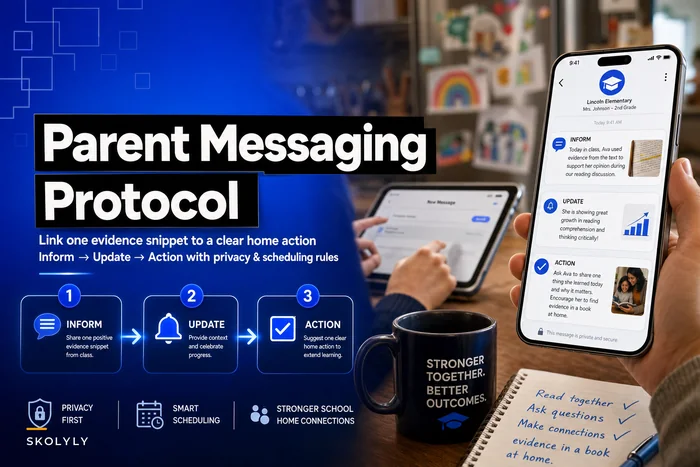
This connects directly to how you structure the outreach itself. The same discipline behind a three-message parent communication protocol that links one classroom evidence snippet to a clear home action applies here—except now every message in the sequence has to exist in every language, released on the cadence, tied to the same evidence.
Bilingual family-brief templates that lock the risky language
The single highest-leverage move is templating the family brief so translators aren't reinventing score language every cycle.
A good bilingual brief separates the report into two zones:
-
Locked zone performance-level names, cut-score bands, rubric descriptors, standard proficiency statements. These come from a pre-approved, parity-checked glossary and cannot be freely translated per cycle. They're inserted, not rewritten.
-
Variable zone the student's specific scores, the personalized "next steps" note, the teacher's comment. These change per student and get translated per cycle—but they sit inside a scaffold that's already correct.
Format the brief side-by-side or stacked, home language and English together, so a family can read their language while a teacher or older sibling references English. That single design choice cuts an enormous amount of "the report says something different than the teacher" friction, because the family can literally see both versions at once.
This mirrors the tagging discipline used in instruction. Districts that already embed MLL accommodations in daily lessons with a one-line tag checklist and weekly spot-check routine tend to adapt to locked-zone reporting faster, because the mental model—standardize the reusable part, spot-check the rest—is already familiar.
A real scenario
A mid-sized district—call it around 14,000 students, roughly 3,800 multilingual families across eight home languages—was running translation the old way. English reports out in about a week. The two high-volume languages (Spanish, around 2,100 families; a Southeast Asian language, around 600 families) landing two to three weeks later. The remaining six languages "as capacity allowed," which in practice meant some families got translated reports well after the reporting window closed, if at all.
Two problems compounded. First, appeals. Bilingual families were filing more score-clarification requests, and when staff dug in, a chunk of them traced back to translated rubric language that didn't match the English scoring rubric. Second, conference attendance among non-English-speaking families was noticeably lower—hard to show up for a conversation about a report you haven't received.
They restructured around the four components above. Tiered SLAs with a 7-day hard cap. A locked glossary built from the first cycle's parity findings. Sampling checks as a pre-release gate. Conferences paced to the final release window.
The results after two cycles weren't dramatic in a headline way—but they were meaningful operationally. The gap between English and the slowest language shrank from weeks to under a week. Score-clarification requests tied to translation dropped substantially once the locked glossary eliminated the recurring rubric-verb error. Conference participation among the affected families rose enough that the family-engagement team stopped treating it as a chronic problem. No new headcount. The wins came almost entirely from sequencing, locking the risky language, and refusing to let any language fall off the calendar.
Where the tooling actually helps
None of this requires exotic technology, and it's worth being honest about that. Plenty of districts run a version of this on a well-disciplined spreadsheet, a shared glossary doc, and a coordinator who guards the cadence.
Where a workflow or business-management platform earns its place is at the seams—the coordination points that break as language count and family volume grow. Specifically: propagating a corrected English cut-score to every translated version automatically instead of by memory; flagging which sampled reports still need a parity reviewer's sign-off before the release gate opens; tracking SLA countdowns per language so a Tier 3 language can't silently blow past the 7-day cap. Those are exactly the version-control and handoff failures that manual systems lose track of once you're managing more than a couple of languages.
The useful mental frame: the platform isn't translating anything or making scoring judgments. It's holding the coordination state—who owns what, what's been checked, what's late, what changed—so the humans doing the actual assessment and translation work aren't also playing air-traffic controller in their heads.
When this level of governance makes sense—and when it doesn't
When it's worth building:
-
You serve more than three or four home languages at meaningful volume.
-
You've had score appeals or family confusion that traced back to translation.
-
Reporting timelines already slip for non-English families.
-
You're accountable for equity metrics tied to family engagement or communication.
When it's overkill:
-
One or two home languages, a few hundred families total, one reliable bilingual coordinator who has capacity. Formalizing SLAs and sampling tiers here adds process without solving a real bottleneck. Keep it lightweight.
Who should be careful:
Districts tempted to solve this by simply buying faster machine translation. Speed without a parity gate just ships wrong reports faster. The locked glossary and the sampling check are the parts that protect integrity—automation layered on top of those is powerful, automation instead of them is a liability.
The point most districts miss
Multilingual assessment governance isn't really about language. It's about making sure the score a family reads means the same thing, arrives close enough to on-time, and holds up when they compare it to what the teacher said.
Get the coordination right—tiered SLAs with a hard cap, parity sampling as a pre-release gate, a synchronized distribution cadence, and templates that lock the risky language—and translation stops being the weak link in your reporting system. It becomes just another well-governed part of it. That's the whole goal: not more translation, but translation you can actually trust, delivered to every family while it still matters.
Multilingual assessment governance isn't really about language. It's about making sure the score a family reads means the same thing, arrives close enough to on-time, and holds up when they compare it to what the teacher said.
Get the coordination right—tiered SLAs with a hard cap, parity sampling as a pre-release gate, a synchronized distribution cadence, and templates that lock the risky language—and translation stops being the weak link in your reporting system. It becomes just another well-governed part of it. That's the whole goal: not more translation, but translation you can actually trust, delivered to every family while it still matters.
Ready to elevate your classroom management?
Join 5,000+ educators using Skolyly to save time, engage students, and improve learning outcomes.