

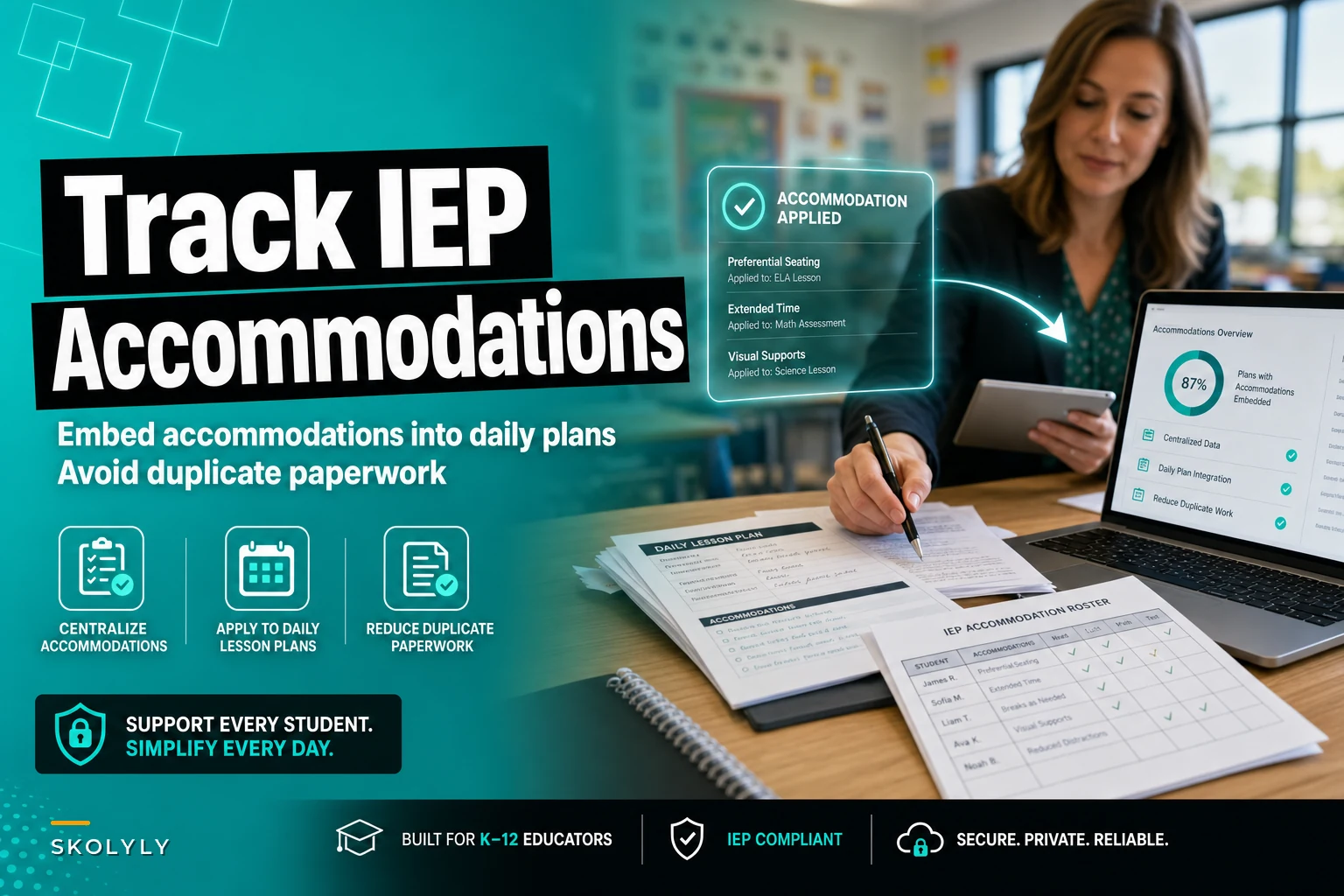

Pull up any middle school teacher's desk at 7:15 AM and you'll find three documents spread across their screen: today's lesson plan, the IEP accommodation master list, and sticky notes mapping which students need what. By the time first period starts, they've cross-referenced these documents four times, made handwritten notes in their plan book, and still missed that Marcus needs his math problems on graph paper.
This isn't about being disorganized. It's about working with systems that treat accommodations as an afterthought instead of building them directly into daily instruction.
Why accommodation tracking stays disconnected from lesson planning
Most schools handle IEP accommodations through a central database that lives completely separate from where teachers actually work—their daily lesson plans. The special education team maintains detailed accommodation records in one system. Teachers write lesson plans in another. And somehow, educators are supposed to mentally merge these two workflows every single day for every single student.
Take a typical 7th-grade science teacher with 125 students across five periods. Roughly 18 of those students have IEPs, another 8 have 504 plans, and a few more have temporary accommodations from recent evaluations. That's close to 30 different accommodation profiles to remember and implement correctly throughout the day.
The compliance documentation makes this worse. Teachers need to prove they're implementing accommodations, but the proof lives in different places. The lesson plan shows what was taught. The IEP system shows what accommodations exist. But nowhere does a single document show "Today in Period 3, I gave Jamie extended time on the lab worksheet and provided Sam with the modified vocabulary list."
Schools typically handle this through accommodation checklists that teachers fill out weekly or monthly. These checklists just become another layer of paperwork disconnected from actual instruction. By Friday, teachers are struggling to remember whether Tyler got preferential seating on Tuesday or Wednesday, and the whole thing becomes a memory exercise rather than anything resembling real compliance tracking.
The hidden cost: compliance anxiety overshadows actual teaching
When accommodation tracking stays separate from lesson planning, teachers develop a kind of background anxiety about missing something. It peaks during IEP meetings when parents ask specific questions about daily implementation.
Keep every student on track with ease.
Skolyly helps you create, assign, and monitor classroom activities efficiently.
- Integrated lesson and assignment management
- Real-time student progress tracking
- Automated class scheduling & notifications
No credit card required
A parent asks, "How often does Emma use her text-to-speech accommodation in your class?" The teacher knows Emma has the tool available but can't quickly pull data on actual usage because nothing gets tracked alongside daily lessons.
This disconnect creates three specific problems that compound throughout the school year:
-
Morning inefficiency multiplies across the week. Teachers spend 8-12 minutes each morning manually checking accommodations against their lesson plans. Across a 180-day school year, that's roughly 30 hours of cross-referencing—almost a full work week lost to administrative friction.
-
Substitute confusion undermines accommodation delivery. When a teacher calls in sick, the substitute gets a lesson plan and a separate accommodation list. Merging those documents while managing an unfamiliar classroom means accommodations often get missed. One high school noted their substitute compliance rate drops to around 60% simply because the information isn't integrated anywhere useful.
-
Documentation gaps create legal vulnerabilities. During due process hearings, schools need to show consistent accommodation implementation. When tracking lives separate from planning, creating that documentation means hours of reconstructing past lessons and trying to match them against accommodation records.
When tracking lives separate from planning, creating that documentation means hours of reconstructing past lessons and trying to match them against accommodation records.
Building a classroom-facing workflow that embeds accommodations naturally
The most effective accommodation tracking happens when it becomes invisible—woven directly into lesson planning rather than added as an extra step.
Start with a lesson plan template that includes accommodation fields for each activity, not just a general accommodation box at the top. Instead of listing "Extended time for tests" once, the template prompts for accommodations at each transition point: warm-up, direct instruction, guided practice, independent work, and assessment.
During guided practice, for example, the template might show:
-
General
Students solve three proportion word problems
-
Marcus
Problems provided on graph paper with worked example
-
Jamie
Extended time, may complete two problems
-
Sam
Problems read aloud, verbal response option
This embedded structure means accommodations appear exactly where teachers need them—not in a separate document they have to remember to check.
Create a quick-reference roster that lives with your plans. Rather than maintaining a separate accommodation master list, build a simplified grid that sits directly in your planning document. List students down the left, then create columns for the 5-6 most common accommodations you implement daily. Simple codes work fine: ET for extended time, PS for preferential seating, MM for modified materials.
| Student | ET (Extended Time) | PS (Preferential Seating) | MM (Modified Materials) | RA (Read Aloud) | VR (Verbal Response) |
|---|---|---|---|---|---|
| Marcus | ✓ | ||||
| Jamie | ✓ | ||||
| Sam | ✓ | ✓ | |||
| Emma | ✓ | ✓ | ✓ | ||
| Tyler | ✓ |
Use two-letter codes for common accommodations and keep a legend at the top of your roster.
This grid takes about 10 minutes to set up at the start of each term and saves hours of cross-referencing throughout the semester.
The weekly compliance check that takes 5 minutes
Traditional compliance tracking asks teachers to document accommodations after the fact, turning it into a memory exercise. A more effective approach builds documentation into the natural weekly planning rhythm.
Every Friday afternoon, spend 5 minutes running a quick sweep through next week's lesson plans. This isn't about checking whether you'll provide accommodations—it's about flagging lessons where documentation matters most.
Mark lessons that include:
-
Formal assessments where accommodation delivery is critical
-
New instructional formats that might challenge standard accommodations
-
Group work where accommodation needs might shift
-
Days with substitute coverage planned
For flagged lessons, add a simple documentation line directly in the plan: "Accommodation delivered: Y/N, Notes:___". This creates a real-time compliance trail without separate paperwork.
-
Build lesson plan using template with accommodation fields at each activity stage
-
Reference student accommodation roster (using shorthand codes) during planning
-
Flag high-stakes lessons requiring closer documentation on Friday sweep
-
Add Y/N documentation line to flagged lessons before the week begins
-
Mark delivered accommodations at the end of each class period
-
Add brief notes for any adjustments or missed accommodations
-
Run a 5-minute monthly review to spot patterns across tracked lessons
The whole loop runs inside your existing planning documents. Nothing lives in a separate system you have to remember to update later.
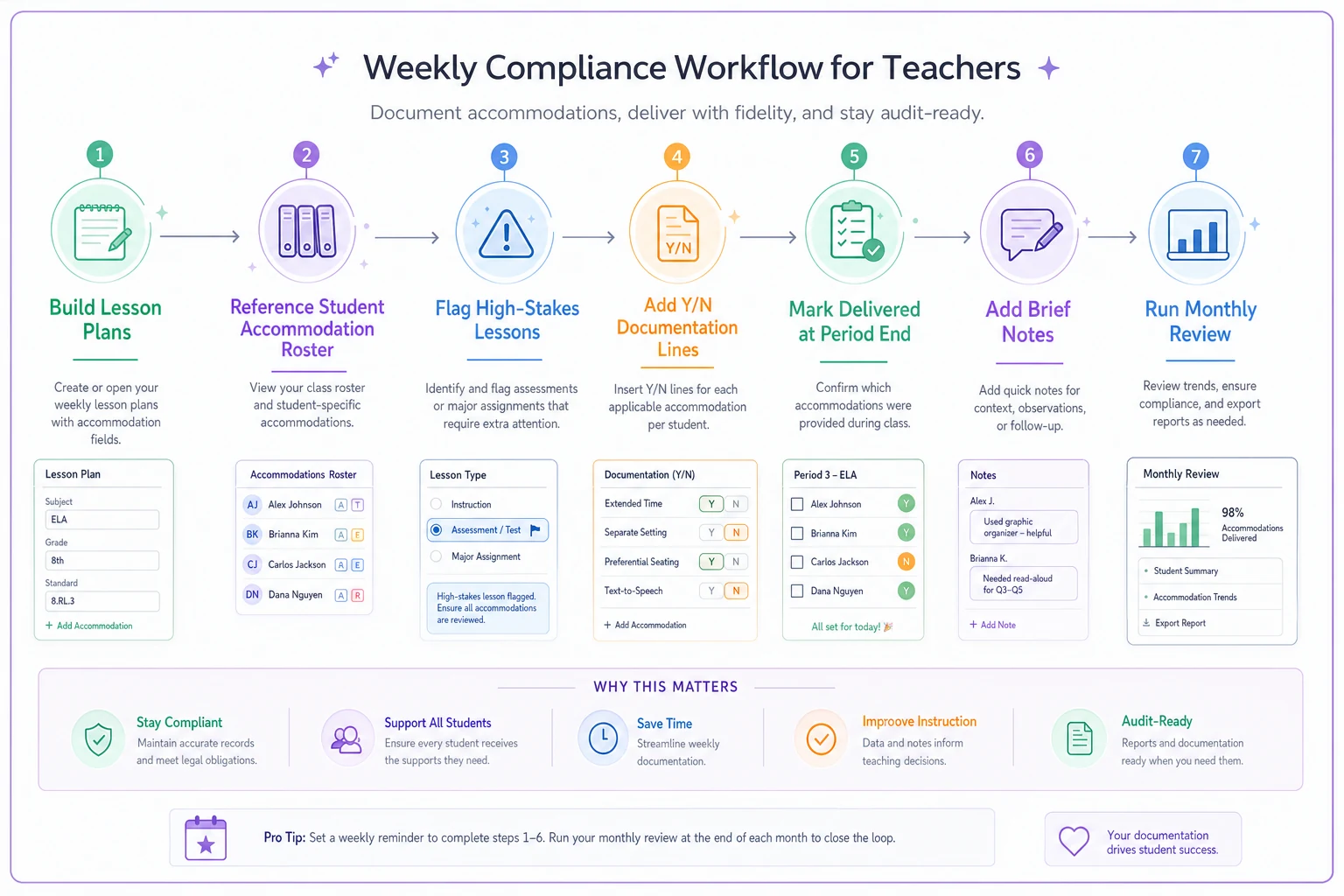
Use this visual as a quick reference for the 5-minute weekly sweep and the in-class documentation steps.
How AI automation reduces the manual matching work
The repetitive nature of accommodation tracking makes it a reasonable candidate for automation support. Rather than manually copying accommodation details into each lesson plan, AI-powered operational software can automatically populate accommodation fields based on your student roster and activity type.
Picture planning next Tuesday's math lesson. You enter "Fraction operations practice" as your independent work activity. The system automatically pulls up relevant accommodations for each student: Marcus gets the graph paper note, Jamie sees extended time parameters, Sam's verbal response option appears. You're not digging through IEP documents—the relevant information flows directly into your instructional planning.
This becomes especially useful for routine accommodations that apply across multiple activities. Preferential seating, extended time, reduced problem sets—these can automatically populate throughout the week's plans without anyone re-entering the same information repeatedly. Teachers review and adjust rather than rebuild from scratch each time.
The practical improvement for substitute coverage is also significant. When you mark yourself absent, the platform generates a sub-friendly plan with accommodations already embedded at each transition point. Instead of handing substitutes two separate documents to decode, they get one integrated guide showing exactly what each student needs during each activity.
Making compliance documentation actually useful for instruction
Most compliance tracking systems generate reports that satisfy legal requirements but offer zero instructional value. Treating compliance documentation as data that actually improves accommodation delivery over time is a much better use of the same effort.
Track accommodation patterns within your lesson plans to spot what's working. If Marcus consistently completes work successfully with graph paper in math but struggles even with accommodations in science, that pattern becomes visible when tracking lives inside daily plans rather than on separate compliance sheets. That kind of insight rarely surfaces when records are scattered across different systems.
Build a simple monthly review into your planning routine. Look across the past month's lessons and ask:
-
Which accommodations got marked "N" most often, and why?
-
Where did you add notes about accommodation adjustments?
-
Which lessons created unexpected accommodation challenges?
This takes maybe 15 minutes but reveals patterns that improve both instruction and compliance. You might notice that extended time works well for independent work but creates management challenges during group activities. That insight leads to proactive adjustments rather than repeated struggles.
Common mistakes that break accommodation workflows
Treating all accommodations equally in planning. Some accommodations require real preparation—modified materials, for instance. Others happen naturally during instruction, like preferential seating. Tracking both with the same intensity creates unnecessary documentation burden. Focus detailed tracking on accommodations that require preparation or might get questioned during compliance reviews.
Creating overly complex tracking systems. Teachers sometimes build elaborate spreadsheets with 15 columns for different accommodation types. These tend to collapse by October. Keep tracking simple enough that you'll actually maintain it during a chaotic week in November.
Separating accommodation planning from differentiation planning. Many accommodations overlap with good differentiated instruction anyway. When you plan varied difficulty levels for an activity, you're often addressing accommodation needs at the same time. Build one integrated planning process rather than treating these as separate tasks.
The operational reality of sustainable accommodation tracking
The pattern across teachers who manage this well is pretty consistent: sustainability beats perfection. The most compliant teachers aren't those with the most detailed tracking systems—they're those who've built simple workflows they can maintain during the actual chaos of a full teaching week.
An integrated accommodation workflow saves somewhere around 35-40 minutes of weekly administrative time while improving implementation quality. When accommodations live inside lesson plans rather than alongside them, they become part of instruction rather than an addition to it.
Teachers who sustain this approach share three practices: they build accommodation fields directly into lesson plan templates, they do quick weekly compliance sweeps rather than massive monthly reports, and they use simple codes rather than lengthy descriptions for routine accommodations.
It's not about adding more tracking. It's about placing tracking where the work actually happens.
Moving from parallel systems to integrated planning
The fundamental problem with accommodation tracking isn't teacher dedication or system complexity. It's that we've built parallel workflows that require constant mental merging. IEP accommodations live in one world. Lesson planning lives in another. Teachers serve as the human bridge between these systems every single day.
When schools embed accommodation tracking directly into lesson planning templates, compliance becomes a natural byproduct of good instruction rather than an additional burden. Teachers plan once, document naturally, and create an authentic record that serves both instructional and legal purposes.
The shift from tracking accommodations separately to embedding them in daily plans typically takes a few weeks to feel natural. After that, teachers consistently report spending less time on compliance paperwork while feeling more confident about accommodation delivery. The anxiety of "Did I remember everyone's accommodations?" gets replaced by the confidence of seeing needs addressed directly inside instructional plans.
That's when accommodation support stops feeling like compliance work and starts feeling like good teaching.
That's when accommodation support stops feeling like compliance work and starts feeling like good teaching.
Ready to elevate your classroom management?
Join 5,000+ educators using Skolyly to save time, engage students, and improve learning outcomes.