

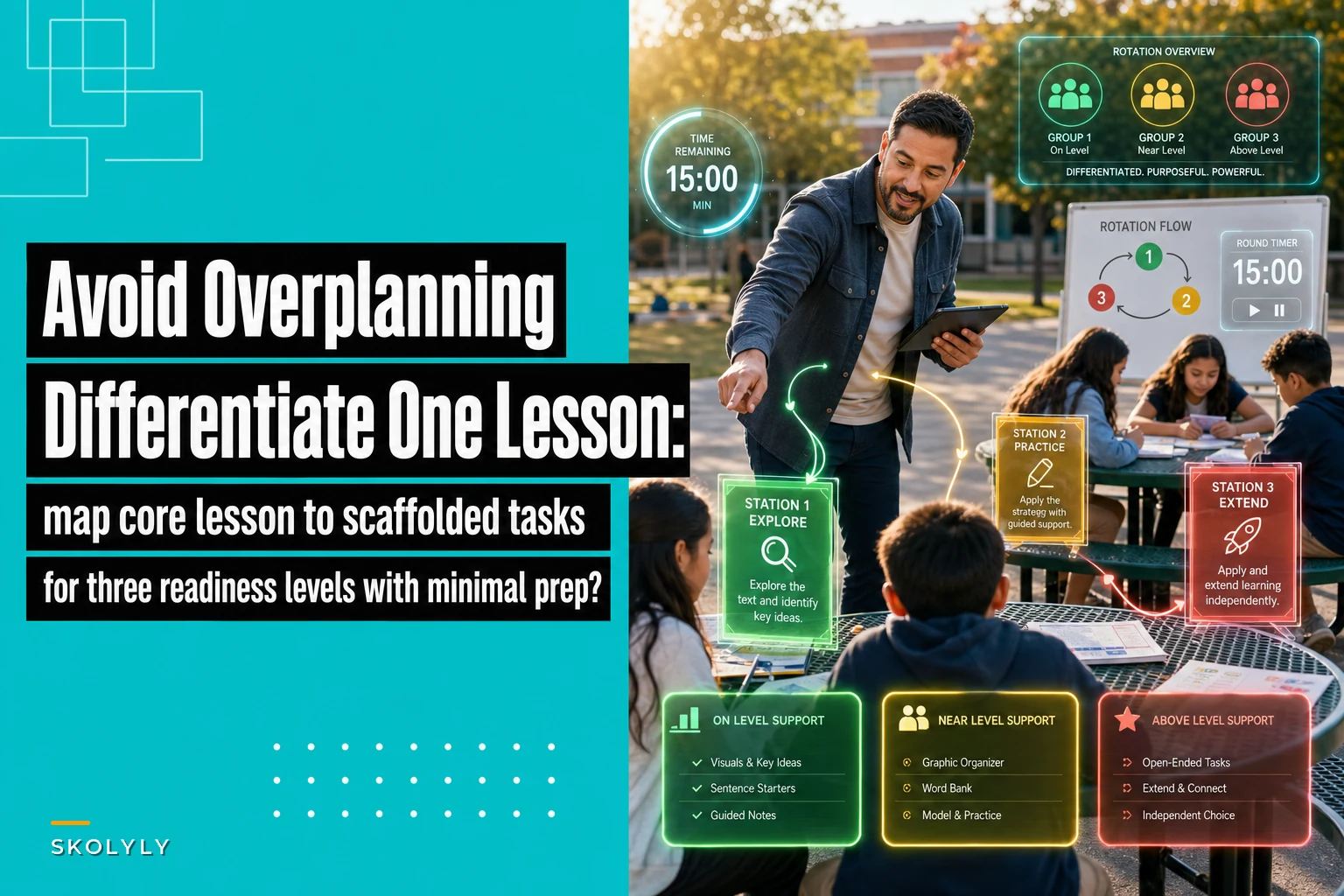

You know that moment when your principal walks by during planning period and sees you surrounded by three different versions of tomorrow's lesson? Color-coded worksheets scattered everywhere, sticky notes marking which student gets which version, and you're only halfway through Tuesday's prep.
Most differentiation advice assumes you have unlimited time. You're trying to reach struggling readers, on-level students, and kids ready for enrichment—all in the same 50-minute block. And you need something that won't have you burning out by October.
The template that changed my differentiation game
After years of overcomplicating this and losing entire Sundays to prep, I landed on a simpler approach that honestly works better. One core lesson. Three access points. Minimal prep.
Stop thinking about differentiation as three separate lessons. You're building one strong lesson with flexibility built in—like a video game with difficulty settings. Same game, different entry points.
Here's the basic structure:
-
Core Learning Target (same for everyone) - Single, clear objective - Measurable outcome - Grade-level standard
-
Access Tasks (varies by readiness) - Below-level
Scaffolded entry with supports - On-level: Standard approach - Above-level: Extended thinking required
-
Rotation Planning (keeps it manageable) - 15-minute teacher-led instruction - 20-minute independent/partner work - 15-minute synthesis/share
You're planning one lesson, not three. The differentiation lives in task complexity and support levels, not completely different content.
Why traditional differentiation burns teachers out
Traditional differentiation usually means multiple versions of everything. Three worksheets. Three rubrics. Three sets of directions. By Wednesday, you're running on fumes and your "differentiated" lessons start looking suspiciously identical to your regular ones.
Keep every student on track with ease.
Skolyly helps you create, assign, and monitor classroom activities efficiently.
- Integrated lesson and assignment management
- Real-time student progress tracking
- Automated class scheduling & notifications
No credit card required
The overplanning trap catches experienced teachers too. You spend hours building tiered activities, then watch your struggling students finish early while your advanced students need more support than expected. The carefully planned levels just don't match the room.
Then there's the logistics. Keeping track of who has which version, making sure the right materials land on the right desks, trying to give meaningful feedback on three different assignments. It drains mental energy that should go toward actual teaching.
And students notice. They know who gets the "easy" work. Advanced students feel isolated on solo enrichment tasks. Struggling students feel singled out. The social dynamics alone can quietly undermine the whole thing.
The single-lesson framework that works
Start with your grade-level standard. Identify the core skill—not the nice-to-haves, not the extensions. Just what every student needs to walk away with.
Core Target: Students will identify and explain an author's purpose using text evidence
Instead of three different texts, use the same text and vary the entry point:
-
Below-Level Access - Provide purpose options to choose from - Highlight key signal words in text - Sentence starters for explanation - Partner reading option
-
On-Level Access - Identify purpose independently - Find text evidence - Write explanation with basic framework
-
Above-Level Access - Compare author's purpose across two texts - Analyze how structure supports purpose - Evaluate effectiveness of author's choices
Same text. Same core skill. Different depths of thinking.
The rotation keeps you sane. While you're working with your below-level group on signal words, on-level students are working through the standard task, and above-level students are digging into the comparison piece. Everyone's doing something meaningful.
Real classroom example: 4th grade fraction lesson
Here's how this plays out in an actual lesson. Fourth grade math, comparing fractions, 24 students with reading levels ranging from roughly 2nd to 6th grade.
Core Target: Compare two fractions with different denominators
15-Minute Launch (whole group):
-
Visual model with fraction bars
-
Real-world context (pizza slices)
-
Think-pair-share warmup
20-Minute Differentiated Work Time:
-
Group A (6 students, below-level)
- Fraction manipulatives available - Comparing fractions with same denominators first - Guided practice cards with visual supports - Teacher check-in after 10 minutes
-
Group B (12 students, on-level)
- Standard comparison problems - Mix of same and different denominators - Work in pairs to explain reasoning - Self-check station available
-
Group C (6 students, above-level)
- Compare three fractions - Create word problems for others - Explore equivalent fractions connection - Challenge card if finished early
15-Minute Synthesis:
-
Each group shares one comparison strategy
-
Exit ticket (same question, different support levels)
-
Preview tomorrow's connection
Total prep time? Around 35 minutes. Compare that to the two-plus hours it used to take to build three separate lessons.
Building your rotation schedule without losing your mind
The rotation piece makes or breaks differentiated instruction. Too complicated and you'll abandon it by week two.
Here's the schedule that actually holds up:
| Time | Teacher | Group A | Group B | Group C |
|---|---|---|---|---|
| 0–15 min | Whole group launch | All students together | — | — |
| 15–25 min | Work with Group A | Teacher-led | Independent work | Extension task |
| 25–35 min | Float/check Group B | Guided practice | Teacher check-ins | Continue extension |
| 35–45 min | Quick check Group C | Practice/review | Partner work | Teacher check/share |
| 45–50 min | Whole group close | All students together | — | — |
You're not running three simultaneous lessons. You're running one lesson with strategic touch points for different groups.
Monday through Wednesday, keep the same rotation pattern. Thursday goes flexible—sometimes whole group, sometimes choice work based on self-assessment. Friday is often mixed-level collaborative groups where students end up teaching each other, which is usually more effective than anything you planned anyway.
Materials prep that doesn't eat your weekend
The biggest time-saver: stop creating separate materials for each level. Build one set with differentiation baked in.
Single worksheet approach:
-
Core problems everyone completes (problems 1–5)
-
On-level practice (problems 6–10)
-
Challenge extension (problems 11–12)
-
"Choose your own" section for early finishers
Scaffolding tools (create once, use all year):
-
Sentence frames on cardstock
-
Visual vocabulary cards
-
Strategy reminder sheets
-
Manipulatives organized in grab-bags
Digital differentiation helpers:
-
One Google Form with branching questions
-
Playlist of support videos (record once)
-
Extension resources linked in one doc
-
Self-check answer keys available
Set these up in September and you'll save hours every week. The infrastructure handles the differentiation—you just plug in new content.
Common mistakes that make differentiation harder
Mistake 1: Different content for each group
When struggling students get completely different material, everyone notices. It creates a tracking system inside your classroom. Same content with different support levels maintains dignity while still meeting needs.
Mistake 2: Always grouping by ability
Static ability groups become identity markers fast. Mix it up—sometimes by interest, sometimes by learning style, sometimes let students choose. Flexible grouping keeps expectations from calcifying.
Mistake 3: Over-scaffolding struggling learners
When you remove all challenge, you remove growth. Productive struggle matters for every student. Provide support, but don't do the thinking for them.
Mistake 4: Under-challenging advanced students
"Early finisher activities" aren't differentiation. Advanced students need deeper engagement with the same concept—not busy work or defaulting to helping others.
Mistake 5: Trying to differentiate everything
Not every lesson needs three levels. Sometimes whole-group is the right call. Save your differentiation energy for new concepts, skill practice, and assessment prep.
When differentiation actually helps (and when it doesn't)
Differentiation makes sense when you're introducing new concepts where prerequisite skills vary widely. That fraction lesson works because students come in with different number sense foundations.
It's also worth it during practice and application. Once you've taught the concept, students need to work at their challenge level—too easy and they're bored, too hard and they shut down.
Assessment prep is another good spot. Three weeks before state testing, differentiated review stations can target exactly what each student needs without whole-class remediation that wastes half your students' time.
But it's not always the right tool.
Skip differentiation during initial engagement. Building interest or activating prior knowledge usually works better as whole-group—the shared energy and discussion benefit everyone.
Don't differentiate your routines and procedures. Everyone follows the same process for turning in work, transitioning, participating. Consistency there saves significant mental load.
Avoid over-differentiating during collaborative projects too. Mixed-ability groups working on open-ended problems often outperform segregated ability groups. The peer teaching that happens organically tends to be more effective than your best tiered worksheet.
The small-group choreography that keeps everything flowing
Managing multiple groups without chaos is more choreography than systems. Think conductor, not juggler.
The anchor activity principle:
Every group needs meaningful work they can do independently when you're not with them. Not busy work—purposeful practice tied to your core target. Good anchor activities are self-explanatory, self-checking, flexible on timing, and actually connected to the lesson goal.
The transition routine:
-
2-minute warning to wrap up current work
-
30-second transition
-
Visual cue for next activity posted on the board
-
Materials already staged at stations
By October, students can move between activities in under a minute without you saying anything.
The help protocol:
"Ask three before me" falls apart in differentiated instruction because students are doing different work. Instead, use help cards (red = stuck, yellow = question, green = good), designate an "expert" for each activity, keep a parking lot for non-urgent questions, and do quick 30-second check-in rounds per group.
Here's a quick visual of the small-group choreography.
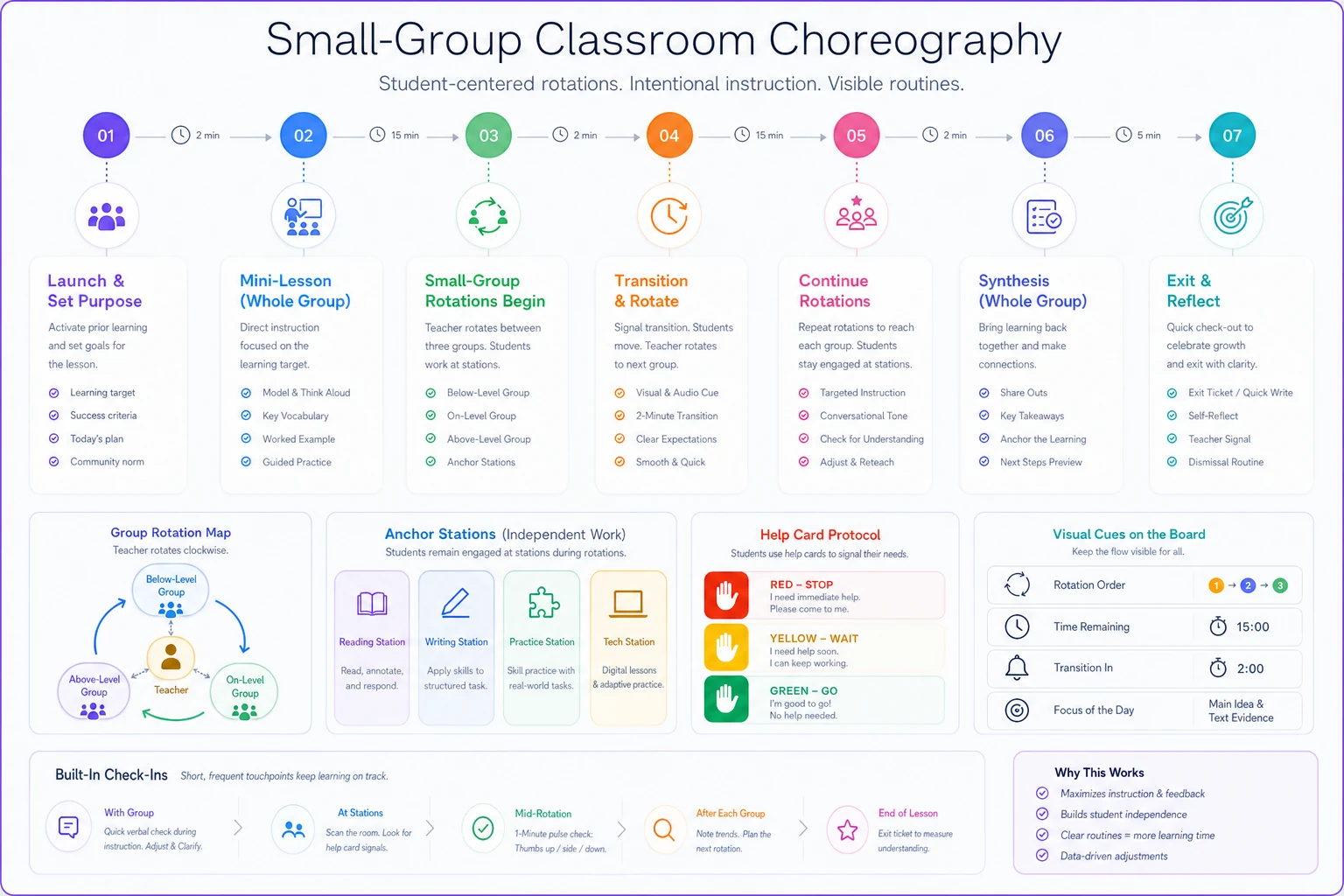
The visual highlights teacher touch points, station activities, and the transition flow so you can see where to invest your time.
Tracking progress without drowning in data
You need enough data to adjust instruction, not so much that tracking takes longer than teaching.
Daily snapshot (5 minutes end of class):
-
✓ Got it
-
~ Getting there
-
? Needs support
Weekly skills check (one per group):
-
Below-level
Focus on prerequisite skills
-
On-level
Grade-level skill mastery
-
Above-level
Application and transfer
The portfolio approach:
Each student keeps one work sample weekly showing their best thinking. Four samples by month's end showing growth—without grading everything.
This gives you enough to adjust groups, spot whole-class reteaching needs, and communicate progress without the paperwork spiral.
Making differentiation sustainable all year
The plans that survive past November are the ones that become routine, not special events.
Start with twice-weekly differentiation—Tuesday and Thursday, say. Get comfortable with the rhythm before expanding. Quality over frequency, every time.
Create template lessons you can just plug content into:
-
Station rotation template
-
Tiered assignment template
-
Choice menu template
-
Jigsaw discussion template
Once the structure exists, you're just swapping in new content each week.
Batch your prep. Sunday evening, 45 minutes, set up the week's differentiated activities all at once. Print everything, organize materials, queue up digital resources. Way better than scrambling each morning.
And share the load with your team. You handle differentiated math materials, your teammate covers reading. Trade and modify. Nobody needs to rebuild this from scratch individually.
The bottom line: one lesson, three access points, sustainable practice
Differentiation doesn't require three lesson plans or color-coded everything. It requires one solid lesson with multiple entry points and a rotation system you can actually maintain.
The teachers who do this well aren't the ones with the most elaborate plans. They're the ones who found a rhythm they can sustain when report cards are due, when they're covering recess duty, when there's a staff meeting after school.
The template—core target, varied access tasks, simple rotation—gives you structure without making you rigid.
More importantly, it keeps the focus where it belongs: on student learning, not on managing complicated systems. When differentiation becomes automatic, you have mental energy left for the actual work—reading the room, adjusting on the fly, building relationships with kids.
Your struggling readers still need you. Your grade-level students still need you. Your advanced learners still need you. But they don't need three different teachers or three different lessons. They need one teacher with a smart, sustainable approach.
Start with the template. Run it two weeks. Adjust what doesn't work. Keep what does. By the end of the month, you'll have a system that actually serves students without burning you out.
That pile of color-coded worksheets on your desk? You won't miss them.
Ready to elevate your classroom management?
Join 5,000+ educators using Skolyly to save time, engage students, and improve learning outcomes.