

Most contract problems in schools don't show up at signing. They show up eighteen months later — when a teacher can't export a class roster, when a vendor "sunsets" a feature your entire assessment cycle was built around, or when someone in the business office notices you're paying for 900 licenses and only 210 are active.
By then, the leverage is gone. You're mid-year, the tool is baked into daily routines, and renewal happens on the vendor's terms instead of yours.
The frustrating part is that almost none of this is about picking bad vendors. It's about contracts and SLAs written to close a deal, not to run an operation. A solid procurement process gets you a decent tool. A solid contract and SLA system is what protects you when the tool, the vendor, or your own priorities shift — and they always do.
This is the operational layer that sits underneath your district edtech governance pipeline. Governance decides what gets in the door. The contract decides what happens when things go sideways.
How the whole thing connects (and where it breaks)
Think of a single edtech vendor relationship as three systems that have to stay in sync:
-
The legal/contract layer — data rights, liability, term length, exit terms.
-
The service layer (SLA) — uptime, support response, feature roadmap commitments.
-
The adoption layer — whether teachers and students actually use the thing.
When these three drift apart, you get the classic failure modes. A rock-solid privacy contract on a tool nobody logs into. A beloved classroom app with a data-export clause that turns out to be worthless. A generous SLA on paper that meant nothing because nobody tracked whether the vendor actually met it.
The single biggest pattern worth naming: schools treat the contract and usage data as unrelated files. Legal lives in one folder, license counts live in the business office, and adoption numbers live in whatever dashboard the vendor controls. Nobody owns the connection between them. So renewals get decided on relationship and inertia instead of evidence.
Everything below is about closing that gap before it costs you.
Where contracts break at scale
A district running 6 edtech tools can manage vendor risk on gut feel. A district running 40+ cannot. What changes as you scale isn't the difficulty of any single contract — it's the coordination cost across all of them.
Keep every student on track with ease.
Skolyly helps you create, assign, and monitor classroom activities efficiently.
- Integrated lesson and assignment management
- Real-time student progress tracking
- Automated class scheduling & notifications
No credit card required
-
Renewal dates cluster and blur. Twelve contracts auto-renew in a 90-day window every spring. Nobody has time to evaluate all of them, so most sail through untouched.
-
Data lives in more places than anyone tracks. Each new tool touches student records. Without a running inventory, you genuinely can't answer "where does our student data live?" during an audit.
-
Feature dependencies compound. Your gradebook syncs to your LMS, which syncs to your assessment platform. One vendor changes an API and three workflows break — but the SLA only covered the one tool.
-
License waste hides. At 40 tools, a 20% over-purchase across the portfolio is real money. Somewhere in the $30k–$60k range annually for a mid-size district, and it's invisible unless someone reconciles seats against actual usage.
The fix isn't heroic contract review. It's a repeatable structure you apply to every vendor the same way, so the 40th contract takes the same effort as the 4th.
The contract clauses that actually protect you
You don't need a 60-page master agreement. You need a small number of clauses to be non-negotiable and unambiguous. These are the ones that quietly determine your fate at renewal.
Data rights and ownership
The mistake here is accepting vague language like "the District retains ownership of its data." Ownership is meaningless if you can't get the data out in a usable form. Spell it out.
> Sample clause — Data ownership & access: "All student, staff, and District-generated data (collectively, 'District Data') remains the sole property of the District. Vendor is granted a limited license to process District Data solely to provide the contracted services. Vendor shall not use District Data for product development, model training, advertising, or any secondary purpose without prior written consent from the District."
That last sentence — barring use for product development or model training — is the one people forget, and it's increasingly the one that matters most.
Export and portability
This is the clause that saves you at exit. Vague export rights let a vendor hand you a PDF dump that's functionally useless.
> Sample clause — Data export & portability: "Upon request and at no additional cost, Vendor shall provide a complete export of all District Data in a non-proprietary, machine-readable format (CSV or JSON), including field-level documentation. Vendor shall provide such export within 15 business days of request and again upon contract termination. Vendor shall securely delete all District Data within 30 days of termination and provide written certification of deletion."
Two details do the heavy lifting: "non-proprietary, machine-readable format" and "at no additional cost." Without the cost clause, some vendors charge a "data migration fee" that's really just an exit tax.
Feature and roadmap stability
Vendors change products. The question is whether they can pull a feature you depend on with zero notice.
> Sample clause — Material change notice: "Vendor shall provide no less than 90 days' written notice before deprecating, removing, or materially altering any core feature in use by the District. If a material change reduces functionality the District relies upon, the District may terminate the agreement without penalty and receive a pro-rated refund of prepaid fees."
Uptime and support (the real SLA)
Uptime percentages are meaningless without teeth. "99.9% uptime" with no remedy is a sentence, not a commitment.
> Sample clause — SLA remedies: "Vendor guarantees 99.5% monthly uptime during school hours (7 a.m.–5 p.m. local, school days). For each 0.5% below target, the District receives a 5% service credit on that month's fees. Support tickets affecting instruction shall receive a response within 4 business hours and resolution target within 1 business day."
Notice the uptime window is scoped to school hours on school days. A vendor hitting 99.9% overall but going down every Tuesday at 10 a.m. is failing you while technically passing.
Red flags to catch before you sign
Some warning signs show up in the contract language itself. Others show up in how the vendor negotiates. Both matter.
In the contract:
-
Auto-renewal with a short cancellation window (anything under 60 days is a trap).
-
"Data may be used to improve our services" — an undefined blank check.
-
Export rights that mention a fee, a proprietary format, or "reasonable efforts."
-
No breach notification timeline, or one longer than 72 hours.
-
Liability capped at "fees paid in the prior month" — trivially small for a data breach.
-
Silence on subprocessors. If they use third parties to process your data and won't name them, that's a gap.
In the vendor's behavior:
-
Resistance to editing any clause ("this is our standard agreement").
-
Reluctance to show you real adoption and usage reporting during the pilot.
-
Vague answers on where data is physically stored and who can access it.
-
Pushing a multi-year prepay before you've validated adoption.
That last one deserves attention. A vendor pushing hard for a 3-year prepay before teachers have used the tool for a full semester is optimizing for lock-in, not your outcomes. The privacy side of these red flags connects directly to your broader student data privacy playbook — the contract is where those privacy commitments either become enforceable or stay decorative.
Tying renewals to classroom adoption, not habit
The shift that changes everything: stop renewing on satisfaction, start renewing on evidence.
Satisfaction is a survey and a champion who likes the tool. Evidence is usage data tied to the outcomes you actually bought the tool for. The two diverge constantly. A tool can be well-liked by three enthusiastic teachers and ignored by everyone else.
Define your renewal KPIs before the tool goes live, and write the target into the contract review calendar. A workable set:
| KPI | Weak signal | Renewal-worthy |
|---|---|---|
| Active teacher adoption | < 40% of licensed teachers | ≥ 70% weekly active |
| Active student usage | Sporadic, unit-based | Sustained across term |
| License utilization | < 60% of seats active | ≥ 85% of seats active |
| Depth of use | Login only | Core feature used weekly |
| Support burden | Frequent unresolved tickets | Low, resolved quickly |
| Outcome linkage | No connection to goals | Tied to a measurable goal |
The depth of use row is the one people skip and regret. A teacher logging in to take attendance inside a tool you bought for formative assessment is a login, not adoption. Measure the behavior you actually paid for.
Evidence-based renewal thresholds
-
Full renewal ≥ 70% active adoption and a clear link to at least one instructional goal.
-
Renew with reduced license count strong depth of use but utilization under 65% — cut seats to match reality.
-
Renew probationary (1 year, not multi-year) promising but adoption between 40–70%; set a written improvement target.
-
Do not renew under 40% adoption after a full year with no credible path up.
Publishing these thresholds ahead of time does something subtle but important — it takes the renewal decision out of "who likes the vendor rep" territory and turns it into a shared, defensible standard.
A vendor-risk register you'll actually maintain
The register is the connective tissue — the single file that ties contract terms to service performance to adoption. If you build nothing else from this article, build this.
Keep it to one row per vendor, reviewed quarterly. Columns worth having:
-
Vendor & product
-
Data sensitivity (student PII? special ed records? none?)
-
Contract start / renewal date / cancellation deadline
-
Auto-renew? (Y/N)
-
Annual cost & license count
-
Current active adoption %
-
SLA performance (met / missed last quarter)
-
Export tested? (date last verified)
-
Renewal recommendation (renew / reduce / probation / drop)
-
Owner (a named person, not a department)
Two columns quietly prevent most disasters. "Cancellation deadline" — because missing it converts a decision into a default. And "Export tested?" — because an export clause you've never exercised is a promise, not a capability. Actually run a test export once a year. The first time you try it during an exit is exactly when you discover it doesn't work the way the contract implied.
A quarterly workflow that keeps it honest
The register only works if something forces you to update it. A lightweight cycle that runs four times a year:
-
Pull usage data from each vendor (or your own systems) for the quarter. Focus on active adoption and depth of use, not raw logins.
-
Check SLA performance against the contract — uptime during school hours, support response times, any outages.
-
Flag renewals coming due in the next 120 days. Anything with an auto-renew and a near cancellation deadline goes to the top.
-
Update the register and assign each near-renewal a preliminary recommendation using your published thresholds.
-
Run one export test on a rotating vendor so every tool gets verified once a year.
-
Brief leadership with a one-page summary
what's renewing, what's at risk, what to cut.
The whole cycle is a couple of hours per quarter once the register exists. The reason it fails in most districts isn't difficulty — it's that no single person owns it, so the data is scattered across vendor dashboards, business office spreadsheets, and someone's inbox.
The whole process looks simple when visualized.
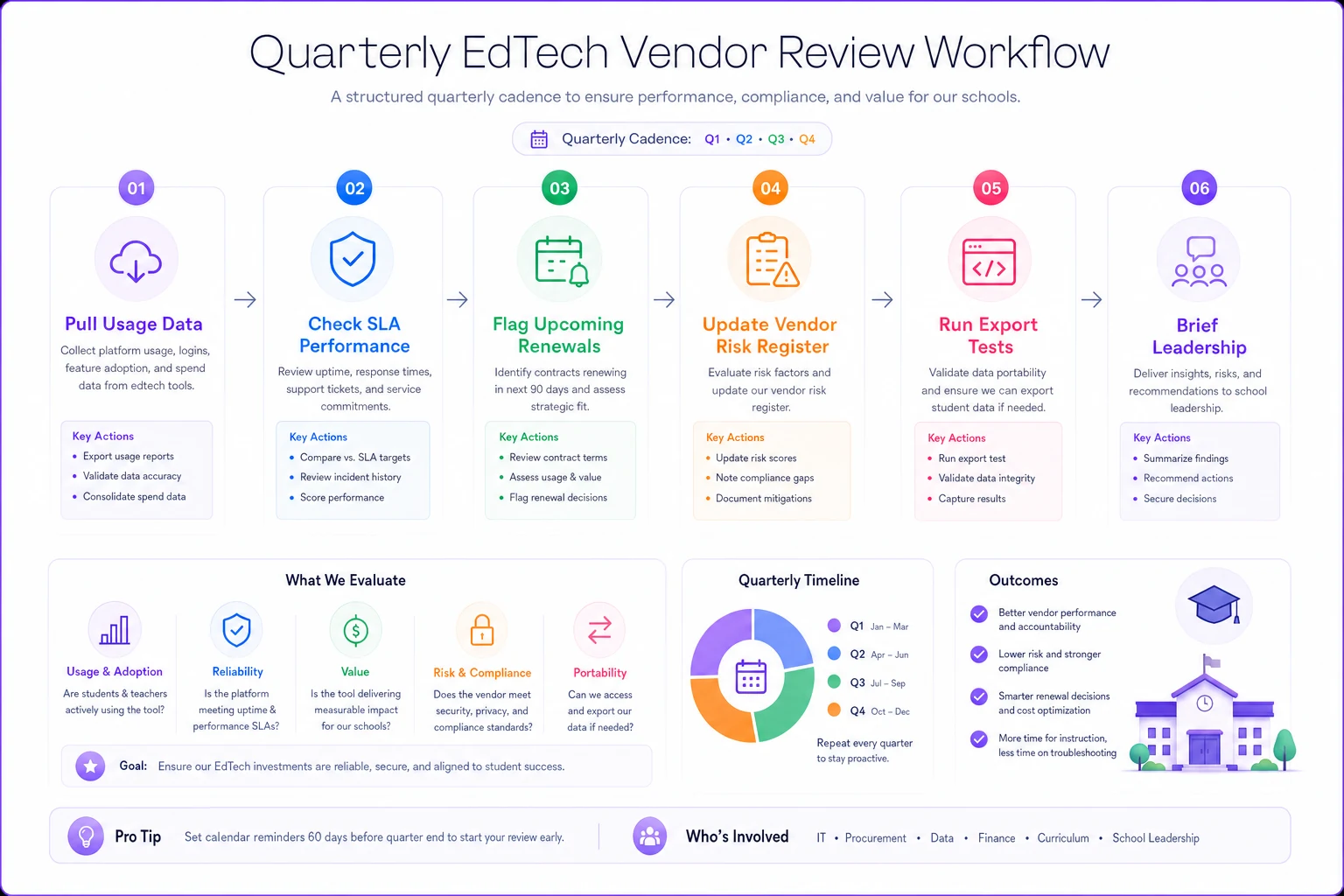
Automate pulling license and usage data where possible; it saves hours each quarter.
This is the kind of coordination where operational software helps. Pulling license and usage data into one place, flagging renewal and cancellation dates automatically, keeping the risk register current without someone manually re-entering it every quarter. The value isn't the automation itself — it's that contract terms and adoption reality finally sit in the same view, so renewal decisions get made on evidence instead of memory.
When this level of rigor makes sense — and when it's overkill
When it's worth it: You're running more than a handful of tools, any of them touch student PII, or your renewal spend is large enough that a 20% waste rate is real money. Districts and mid-to-large schools basically all fall here.
When it's lighter-touch: A single small school with three tools and one person who knows every contract cold can run a simpler version. The register still helps, but you won't need the full quarterly cadence.
Who should not skip the data clauses regardless of size: Anyone using tools that store special education records, health data, or that feed student data into any kind of model. Size doesn't reduce that risk — the export, deletion, and secondary-use clauses are non-negotiable even for your smallest vendor.
A quick real scenario
A mid-size district — roughly 4,500 students, around 30 active edtech contracts — kept auto-renewing on relationship. Their spring renewal window bunched 14 contracts into about 10 weeks, and reviewing them properly was impossible, so almost everything renewed untouched.
When they finally built a risk register and pulled real usage data, two things surfaced quickly. A literacy platform they'd renewed twice was sitting at roughly 25% active teacher adoption. And across the portfolio, they were paying for close to 900 more licenses than were actually active. They dropped two low-adoption tools, right-sized seats on four others, and moved the rest to probationary one-year terms with written adoption targets.
The result wasn't dramatic in a headline way — somewhere in the $40k–$55k range recovered in the first year, plus fewer tools competing for the same instructional minutes. The bigger change was quieter: renewal season stopped being a scramble, because the evidence was already sitting in one file.
The takeaway
Vendor contracts and SLAs aren't a legal formality you handle once and forget. They're an operating system that decides, every renewal cycle, whether your money buys tools that get used or tools that just get billed.
The districts that get this right don't have better lawyers. They have a small set of non-negotiable clauses, published renewal thresholds tied to real classroom adoption, and one living register that keeps contract terms, service performance, and usage data in the same place. Build those three things once, keep them honest quarterly, and the renewal conversation shifts from the vendor's court to yours — which is exactly where it should be.
Ready to elevate your classroom management?
Join 5,000+ educators using Skolyly to save time, engage students, and improve learning outcomes.