



Most districts that start a micro-credential program get the learning design right and the money part wrong. They build thoughtful competency pathways, pick a decent platform, launch with real enthusiasm—and then two years in, nobody can answer the simplest questions. How much did this actually cost? Did anyone get paid more for earning something? Does HR even recognize these credentials as real? Did it change who we hired or how we staffed?
That gap is the whole problem. A micro-credential that doesn't connect to a budget line and an HR decision is just professional development with a nicer certificate. The value lives in the connective tissue between what a teacher demonstrates, what it costs to run, and what changes in staffing and pay as a result. This guide is about building that connective tissue on purpose.
If you're earlier in the rollout—designing the evidence checkpoints themselves—start with the companion piece on integrated teacher induction with micro-credentials and 30/60/90 evidence checkpoints. This article picks up where that one leaves off: once teachers are earning credentials, how does your budget and HR system actually use them?
Why micro-credentials budgeting in K-12 falls apart quietly
The failure mode here is rarely dramatic. No one cancels the program in a board meeting. It just goes dormant.
What usually happens is that the credential work and the money work live in two different buildings—sometimes literally. Curriculum and PD own the pathways. HR and finance own the compensation schedule and the position control system. Those two worlds coordinate during launch, then drift. By year two, a teacher earns a credential in literacy intervention, and there's no mechanism for that to show up anywhere a staffing decision gets made.
-
The credential has no price tag. Nobody ever calculated the fully loaded cost per teacher—release time, stipends, platform seats, assessor hours. Finance treats it as a vague PD expense and can't defend it when budgets tighten.
-
HR never built a recognition pathway. The credential exists, but there's no place in the employee record to log it, no policy that says what it entitles someone to, and no connection to the salary schedule or hiring rubric.
-
The pilot never became policy. It ran as a special initiative with soft rules. When the champion who launched it moves on, there's no board-approved language keeping it alive.
These aren't three separate problems. They're one system problem showing up in three places. The budget, the HR pathway, and the pilot-to-policy transition all have to be designed together, or the whole thing quietly unravels.
The budget template: what a credential actually costs
The first honest thing you can do is price a single credential end to end. Most districts dramatically underestimate this because they only count the stipend and ignore everything around it.
Keep every student on track with ease.
Skolyly helps you create, assign, and monitor classroom activities efficiently.
- Integrated lesson and assignment management
- Real-time student progress tracking
- Automated class scheduling & notifications
No credit card required
Here's a realistic breakdown for one competency-based credential completed by one teacher. These are the categories that matter, with ranges you can adapt:
| Cost category | What it covers | Typical range per teacher |
|---|---|---|
| Stipend or salary adjustment | Direct incentive paid on completion | $300–$900 |
| Release time / subs | Coverage for job-embedded practice or observation | $150–$400 |
| Assessor / reviewer time | Staff hours to evaluate submitted evidence | $80–$220 |
| Platform or seat cost | Per-user share of the credentialing system | $25–$75 |
| Coaching / support | Portion of coach time tied to the pathway | $100–$300 |
| Administration overhead | Tracking, reporting, HR processing | $40–$120 |
Add those up and a credential that looks like a "$500 stipend" is often closer to $900–$1,500 all in. For a cohort of 40 teachers earning two credentials each, you're looking at a program cost somewhere in the $70k–$120k range, not the $40k the stipend line suggests.
The insight here isn't that it's expensive—it's that the invisible costs, assessor time and release coverage in particular, are usually the biggest ones, and they're the ones nobody budgets for. Districts fund the stipend because it shows up on a paystub, then starve the evaluation side. That's exactly what makes credentials feel low-quality. If reviewers are rushing through evidence on their own time, the credential stops meaning anything and the whole investment gets hollowed out.
A usable budget template separates these into fixed costs (platform, administration—mostly flat regardless of cohort size) and variable costs (stipends, subs, assessor time—scaling with the number of teachers). That split lets you model different cohort sizes and actually answer the finance question that always comes: "What does it cost if we double it?"
30/60/90 evidence windows and what they do to your budget
Evidence windows aren't just an instructional design choice. They're a cash-flow and staffing tool, and treating them that way changes how you plan.
The basic structure: a teacher has defined checkpoints at roughly 30, 60, and 90 days where they submit evidence that gets reviewed. Each window is a spending event—assessor hours get used, and depending on your model, partial stipends or completion payments trigger.
-
Set a baseline window map before the cohort launches. Decide when each checkpoint falls and roughly how many teachers hit each one per week.
-
Cap submissions per review cycle. If one assessor can fairly review eight evidence packets a week, don't let twelve land on the same Friday. Stagger cohort start dates if you need to.
-
Tie payment release to the window, not the calendar. Teachers get paid when evidence clears a checkpoint, which naturally spreads payroll impact across the year instead of a single lump at the end.
-
Reserve a buffer window. Some teachers miss a checkpoint. Build one catch-up cycle into the schedule so a missed 60-day window doesn't force someone to restart or fall off entirely.
Cap submissions per review cycle based on assessor weekly capacity to keep turnaround times reasonable.
Evidence windows that are well-sequenced protect both your assessors' capacity and your budget's rhythm. Windows that collapse into one deadline create a bottleneck that makes the program feel chaotic even when the underlying pathway is solid. It's the same coordination logic that makes PD, coaching, and accountability cycles actually stick instead of fizzling—the cadence matters as much as the content.
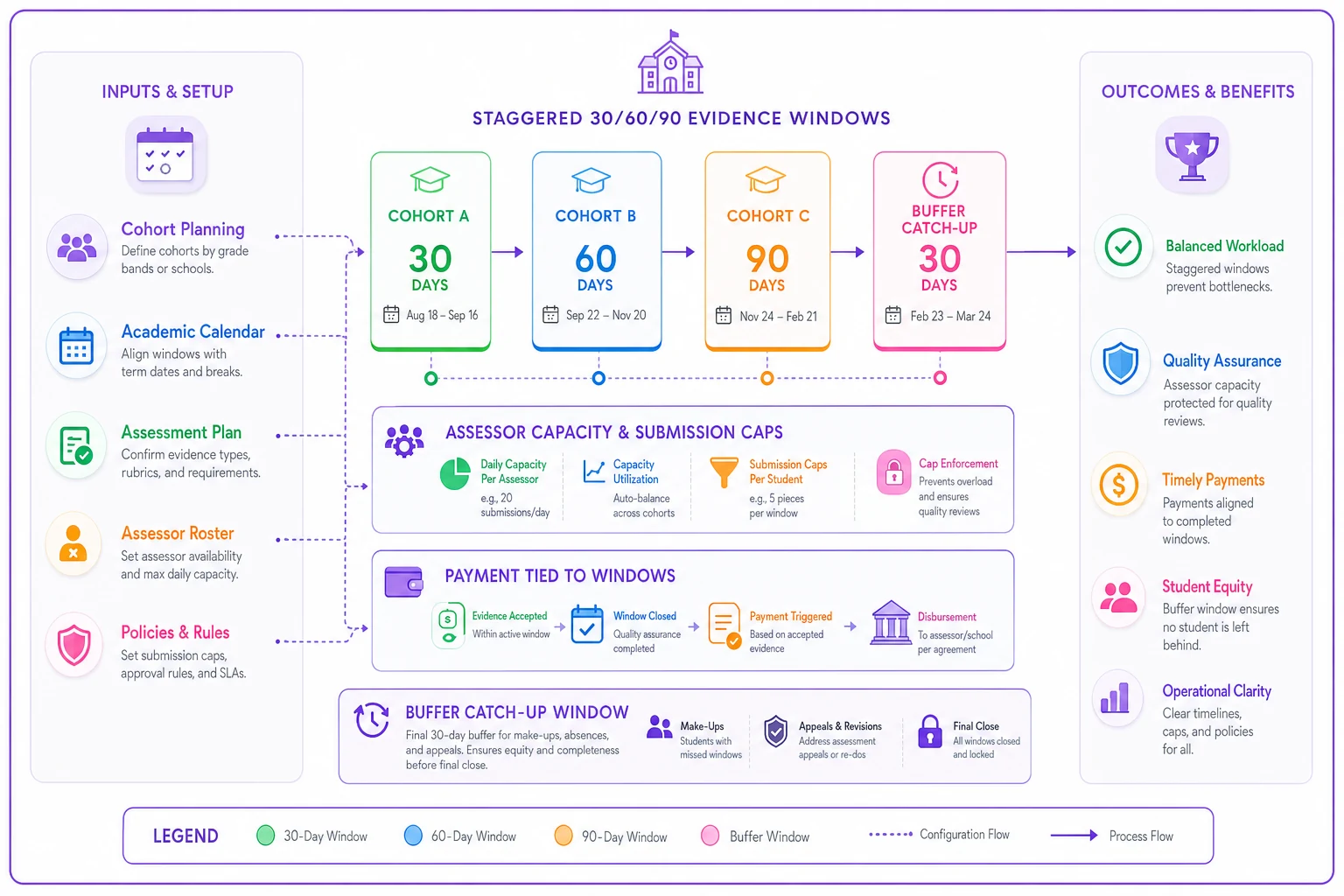
A simple visual helps teams plan capacity and cash flow.
HR pathways: turning a credential into a record that means something
This is the section most PD leaders skip, and it's the one that determines whether any of this survives.
A credential has to live somewhere in the employee record where HR decisions actually happen. If it only exists in the credentialing platform, it's invisible to the people doing hiring, placement, and compensation. The goal is a clean path from earned to recognized to acted on.
-
A recognition policy. Board-approved language that states what credentials the district formally recognizes and what each one entitles a teacher to. Without this, every conversation becomes a one-off negotiation.
-
A record home. The credential logged in the HRIS or personnel system, with an expiration or renewal status if applicable, so it surfaces when someone pulls a teacher's file.
-
A compensation link. A defined connection to the salary schedule—whether that's a one-time stipend, a lane movement, a recurring differential, or a role-based bump. The key is that it's defined in advance, not improvised.
-
A placement signal. A way for the credential to show up in staffing decisions, so when you're filling an intervention slot or a lead role, the people who've demonstrated the competency are actually visible.
The mistake districts make is treating credential recognition as an informal "we value this" gesture. HR systems don't run on sentiment. If there's no policy, no record field, and no compensation rule, the credential has no operational weight—and teachers figure that out fast. Enrollment drops in year two because the first cohort told everyone that earning the thing changed nothing.
One more pattern worth noting: decide early whether credentials stack toward something. A single micro-credential is a weak compensation lever. But three related credentials that combine into a recognized specialization—a tiered-intervention endorsement, for instance—gives you something meaningful to attach pay and placement to. Stacking is what turns a scattered PD menu into an actual career pathway.
Pilot-to-policy transition: the criteria that keep it alive
Almost every micro-credential program starts as a pilot. The dangerous part is that pilots are designed to be forgiving—soft rules, flexible timelines, a champion personally holding it together. Policy has to be the opposite: durable, specified, and independent of any one person.
The transition doesn't happen automatically. You need explicit criteria that say "this is ready to become permanent." Without them, programs stay stuck in pilot mode for years, which conveniently means they never have to prove their worth and never get protected funding.
-
- [ ] At least two full cohorts have completed the pathway end to end
-
- [ ] Fully loaded cost per credential is known and documented
-
- [ ] Completion rates are high enough to justify the per-teacher cost (watch for anything under ~60%—that usually signals the pathway is too heavy or support is too thin)
-
- [ ] Evidence quality has been audited by someone other than the original designers
-
- [ ] A compensation rule exists and has been tested on real teachers
-
- [ ] The credential appears in the HRIS and is pullable in a staffing report
-
- [ ] Board-approved recognition language is drafted
-
- [ ] A named office owns the program after the champion leaves
-
- [ ] Renewal/expiration rules are defined
The honest test buried in that list is the "named office" line. Pilots die when the passionate assistant principal who built the thing takes a job in another district. If the program can't survive that transition, it isn't policy yet—it's a personality. Making it policy means the system runs on documented process, not on one person's calendar.
When this actually makes sense
Moving from pilot to policy is worth it when credentials are already changing behavior—when you can point to teachers using the demonstrated skill in classrooms and to staffing decisions that referenced credentials. If the pilot generated real evidence and real completions, formalizing it protects the investment.
When it's a bad idea
Don't formalize a program with low completion rates or weak evidence review. Policy locks in whatever you have. If the pathway is still too burdensome or the credential quality is thin, codifying it just makes a weak program permanent and harder to fix. Clean up the pilot first.
Who should not do this
Small districts with no HRIS capacity to log credentials, or districts that can't fund the assessor time to review evidence honestly, shouldn't rush into a formal program. A credential nobody has time to evaluate rigorously is worse than no credential—it trains teachers to expect recognition for low-quality work, and that expectation is genuinely hard to walk back.
Sample role descriptions: where credentials meet staffing and pay
The clearest way to show how this connects is to look at how a credential changes an actual role. Here are three sketches showing the credential-to-staffing-to-compensation link in practice.
Tier 2 Intervention Lead (building-level). This role is only open to teachers holding a recognized intervention-design credential plus a data-use credential. Responsibilities include running small-group intervention blocks and coaching peers on progress monitoring. Compensation: a recurring annual differential in the $2,000–$3,500 range, because it's an ongoing role, not a one-time task. The credentials here are an eligibility gate—you can't be placed without them.
Assessment Literacy Facilitator (department-level). Open to teachers who've earned the assessment-literacy pathway. They support common-assessment calibration and item review within a department. Compensation: a stipend per semester rather than a salary lane change, because the work is cyclical. The credential functions as a qualification signal—it tells the principal who's genuinely ready to facilitate rather than just willing.
New Teacher Mentor (district-level). Requires an induction/mentoring credential and at least three years of experience. Compensation: a modest stipend plus release time for mentoring load. The credential here does double duty—it qualifies the mentor and ensures mentors share a common framework, so new teachers get consistent support regardless of building.
The pattern across all three is the same: the credential is never the reward by itself. It's the gate to a role, and the role carries the pay. When districts pay directly for the credential alone, costs balloon and the link to actual work gets fuzzy. When the credential gates a role that carries real responsibility, the pay is tied to something the district is genuinely buying.
A real scenario: a mid-sized district tightening a loose program
Consider a district of roughly 1,100 staff that launched a micro-credential program with real energy and almost no financial scaffolding. Year one, about 60 teachers earned at least one credential. The stipend line showed roughly $30k spent. But when a budget review came, finance couldn't reconcile that number with actual impact—assessor time had been absorbed invisibly into existing staff workloads, and no one could say whether a single staffing decision had referenced a credential.
The fix wasn't flashy. They priced a credential fully and discovered the real cost was closer to $55k–$65k once assessor and release time were counted honestly. That number was uncomfortable but useful—it forced a decision about what the program was for. They narrowed the pathways from eleven down to four that mapped to actual staffing needs: intervention, assessment literacy, mentoring, and MLL support. They built an HRIS field so credentials showed up in personnel files. And they created two gated roles with recurring differentials instead of paying for every credential individually.
Completion rates went up the following year. Fewer, clearer pathways will do that. The budget became defensible because every dollar mapped to a role or a documented competency. And for the first time, the staffing office could pull a report showing which teachers were credentialed for intervention work before placement season started.
The program ended up costing more than that original $30k stipend line suggested—but it was finally buying something, and the board could see what.
Pulling the system together
The reason micro-credential programs stall isn't that educators design bad pathways. It's that the three systems that have to cooperate—budget, HR, and the pilot-to-policy transition—get built in isolation and never wired together.
A credential with no price tag, no HR record, and no gated role is a certificate. A credential with all three becomes a lever you can actually pull when you're deciding who to hire, where to place them, and what to pay. Those are very different things, and the gap between them is almost always an infrastructure problem, not a design problem.
Start by pricing one credential honestly, including the hidden assessor and release costs. Stagger your evidence windows so review quality and cash flow both stay manageable. Build the HR recognition pathway before you scale, not after. Set hard criteria for when a pilot earns the right to become policy—especially the test of whether it survives the departure of the person who built it. Get those connections right and micro-credentials stop being an expense you have to defend and start being infrastructure you can actually plan around.
Start by pricing one credential honestly, including the hidden assessor and release costs. Stagger your evidence windows so review quality and cash flow both stay manageable. Build the HR recognition pathway before you scale, not after. Set hard criteria for when a pilot earns the right to become policy—especially the test of whether it survives the departure of the person who built it. Get those connections right and micro-credentials stop being an expense you have to defend and start being infrastructure you can actually plan around.
Ready to elevate your classroom management?
Join 5,000+ educators using Skolyly to save time, engage students, and improve learning outcomes.