
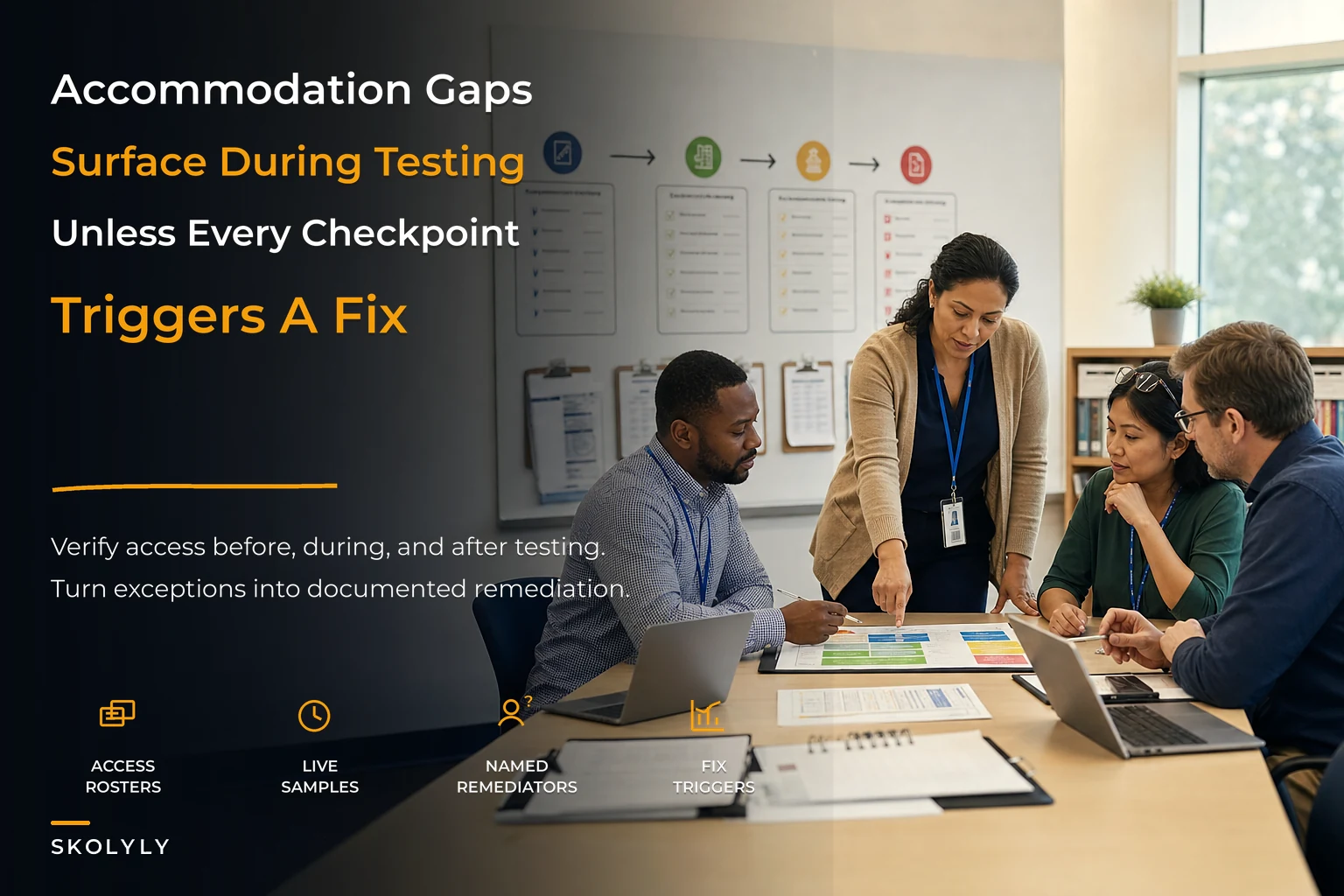

Most districts don't have an accommodations problem on paper. The IEPs are written. The 504s are signed. The MLL rosters exist. The policies are clear. On paper, every student who needs extra time, a read-aloud, a bilingual glossary, or small-group testing is covered.
Then testing week arrives, and the gap between what's documented and what's delivered opens up fast. A student with approved extended time gets pulled back to class with everyone else. A read-aloud accommodation gets skipped because the proctor didn't know it was on the list. A newcomer MLL student who's supposed to have a translated word bank sits down to a monolingual form. Nobody meant for it to happen. The system just didn't catch it in time.
That delivery gap — between what students are entitled to and what they actually experience — is the real subject of assessment equity governance K-12. It's not a compliance binder. It's an operational question: does your process reliably put the right support in front of the right student at the right moment, across hundreds of kids and dozens of proctors, under time pressure? Most of the time, it doesn't, and the reasons are structural, not malicious.
This is a playbook for closing that gap. Pre-assessment verification, in-administration sampling, post-assessment access checks, and the remediation triggers that tie them together — plus the rosters and templates that make it run without burying your staff in paperwork.
Why accommodations break down even when everyone's doing their job
The failure almost never happens at the policy level. It happens in the handoffs.
Think about how an accommodation travels from a document to a desk. It starts in a student's IEP or 504, maintained by a case manager. It needs to end up in the hands of whoever is proctoring that specific student on that specific day — who might be a teacher, a sub, a paraprofessional, or someone pulled from another department because testing week ate the schedule. Between those two points, the information passes through the testing coordinator, the master schedule, the room assignments, and whatever last-minute changes happened because three kids were absent and two proctors called in sick.
-
The accommodations roster was built two weeks before testing and never updated when a new student enrolled or an IEP was amended.
-
The proctor got a list of who's in the room but not a list of who needs what, so they're matching names to supports on the fly.
-
A support that requires setup — a separate room, a scribe, a device with text-to-speech — wasn't staffed because nobody translated "extended time for 14 students" into "we need three extra rooms and two extra adults."
-
MLL supports fell into a gray zone because language supports live in a different office than special education, and the two rosters were never reconciled.
That last one is worth sitting with. Special education accommodations and multilingual learner supports are almost always managed by separate teams, separate systems, and separate people. A student who is both an MLL and has an IEP needs both sets of supports, and that's exactly the student most likely to get a partial delivery — because no single person owns the full picture. If you've worked on embedding MLL accommodations into daily lessons, you already know how easily language supports slip when they're not baked into the routine. Testing week makes that fragility worse, not better.
What breaks as you scale
A single teacher proctoring 22 students they know well will deliver accommodations fine, most of the time. They know Marcus needs his breaks. They know Fatima gets the glossary. The knowledge lives in their head, and for a small group, that works.
Keep every student on track with ease.
Skolyly helps you create, assign, and monitor classroom activities efficiently.
- Integrated lesson and assignment management
- Real-time student progress tracking
- Automated class scheduling & notifications
No credit card required
It collapses at scale, and it collapses in a specific pattern.
At the building level — say 400 to 900 students — you're no longer relying on a teacher's memory. You're relying on a roster, a room assignment, and a proctor who may not know the students at all. The accommodation now depends entirely on whether the information traveled correctly. At the district level, multiply that by every building, every grade, every testing window, and every staffing substitution, and you get a system where the average delivery rate looks fine but the variance is brutal. Building A nails it. Building C misses a third of its read-aloud accommodations and nobody notices until scores come back oddly low for a specific group.
The pattern worth naming: accommodation delivery doesn't fail evenly, it fails in clusters. It fails for the schools with the most substitute proctors. It fails for students with complex, multi-support profiles. It fails in the rooms where setup requirements weren't staffed. When you only measure averages, the system looks healthy while specific groups of students are getting shortchanged every single window.
| Scale | Primary delivery risk | What usually fails first |
|---|---|---|
| Single classroom (20–30 students) | Proctor memory lapses | One-off supports forgotten on a busy day |
| Building (400–900 students) | Roster-to-room handoff | Setup-dependent supports (separate room, scribe, devices) |
| District (multiple buildings) | Cross-system reconciliation | Students with both IEP and MLL supports; sub-staffed rooms |
| Across windows / year | Drift and stale data | Rosters not updated for new enrollments or amended plans |
Each level of scale introduces a new failure mode on top of the old ones. You don't replace the classroom risk — you stack the building risk and the district risk on top of it.
The four-checkpoint QA spine
The way to make delivery reliable isn't a bigger binder or a longer policy. It's a small number of checkpoints placed at the exact moments where delivery tends to fall off. Four of them, running before, during, and after the assessment.
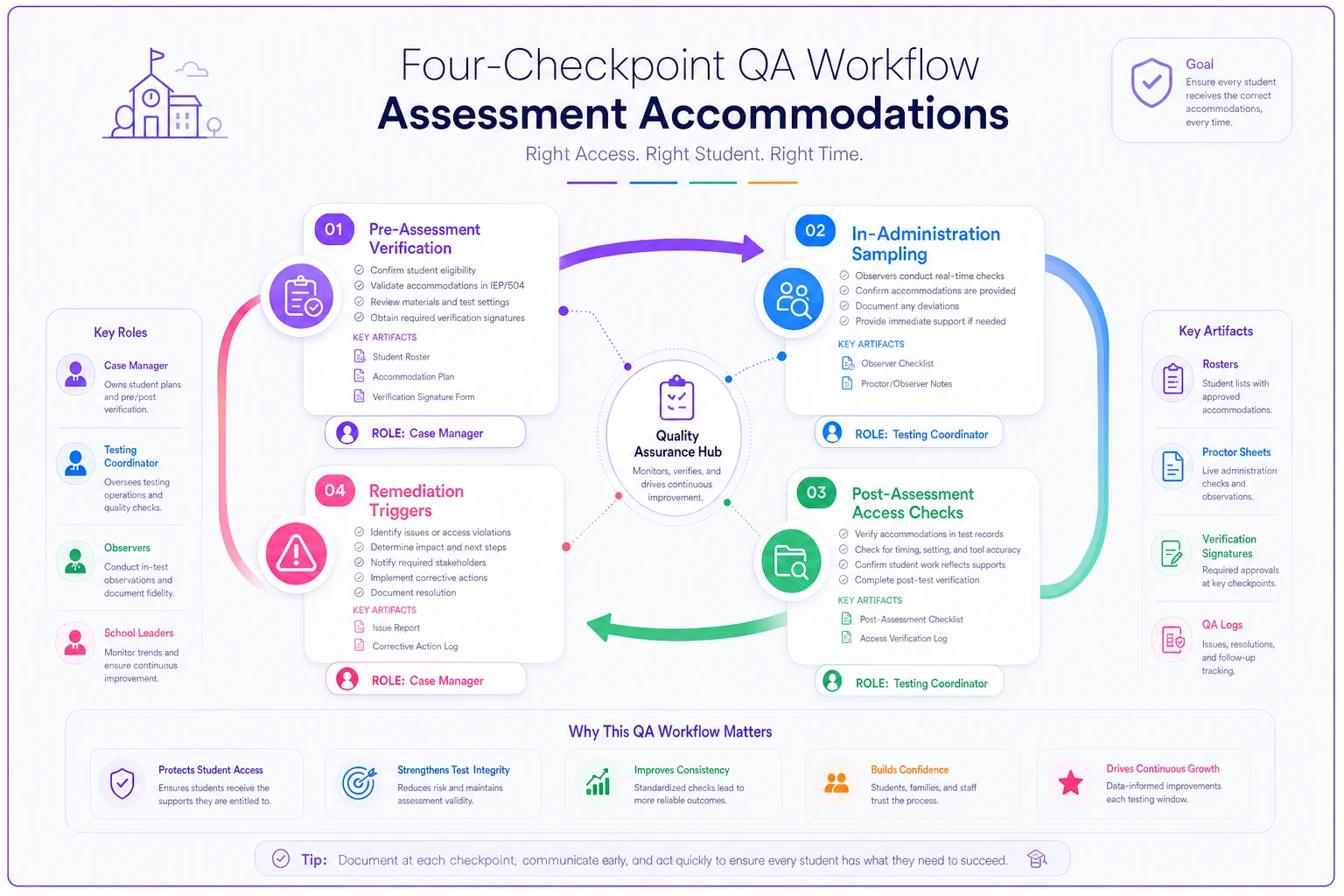
Here's a simple visual of how the checkpoints link together.
1. Pre-assessment accommodation verification
This is the checkpoint that prevents most failures, and it's the one most districts skip under time pressure. The job: before testing week, confirm that every student's current, active accommodations are (a) on the proctor's room-level sheet and (b) actually staffable given room and personnel assignments.
The critical word is current. A verification run from a roster that's two weeks stale will confidently certify the wrong thing. Pull the roster from the source of truth — the IEP/504 system and the MLL system — within 2–3 days of test day, not two weeks out.
-
Pull the live accommodations roster from both the special education system and the MLL/language services system. Not last month's export. The current one.
-
Reconcile the two lists so students who appear on both show a combined support profile. This is where dual-identified students stop falling through.
-
Translate supports into logistics. Convert "extended time
18 students" into room counts, proctor counts, device needs, and separate-setting requirements.
-
Push a room-level sheet to each proctor that lists only their students and only the supports those students need — not the district master list.
-
Get a verification signature from each proctor confirming they've reviewed the sheet and have what they need. This isn't bureaucracy; it's the moment someone realizes the scribe hasn't been assigned.
The signature step matters more than it looks. It converts "the information was sent" into "a specific human confirmed they can deliver." Those are completely different operational states, and the gap between them is where a lot of equity failures live.
Pull the live rosters within 2–3 days of test day to avoid certifying stale accommodation lists.
2. In-administration sampling
You can't observe every room. You can observe enough rooms, chosen deliberately, to catch failures while there's still time to fix them.
The mistake is random sampling that spreads your limited observer time evenly. Don't do that. Weight your sampling toward the highest-risk rooms — the ones with substitute proctors, the ones with the most setup-dependent supports, the ones with dual-identified students. A proctor who's taught these kids all year is low risk. A sub running a separate-setting room for six students with read-aloud and extended time is high risk. Spend your observation minutes where failures cluster.
-
Are the approved supports visibly in use (read-aloud happening, glossary available, breaks being honored)?
-
Is the separate setting actually separate, or did two groups get combined because a room fell through?
-
Do the devices with assistive features actually work, and is the student using them?
-
For MLL supports — is the correct language form or glossary in front of the right student?
-
Does the proctor's sheet match the students actually in the room?
A missed read-aloud caught at 9:15 on day one can be fixed for day two and across the building. A missed read-aloud discovered when scores come back in six weeks cannot be fixed at all.
3. Post-assessment access checks
After the window closes, before the data gets locked, you run a reconciliation: did the accommodations that were supposed to be delivered get recorded as delivered, and do the two match?
This is where you compare the pre-assessment roster against the actual administration records and the proctor sign-offs. You're looking for mismatches:
-
Students who had an approved support with no record of it being delivered.
-
Students who were marked for a separate setting but appear in a general-room record.
-
MLL students whose language form of record doesn't match their designation.
Post-assessment checks won't fix this year's test for the students who missed out — but they do two important things. They flag any student whose results may be invalid due to a missed accommodation, and they give you the only honest measure of your delivery rate, broken down by building and by student group. That breakdown is what reveals the clustering problem. Without it, you're flying blind.
4. Remediation triggers
A QA system that finds problems but doesn't route them anywhere is just an anxiety generator. Each checkpoint needs defined triggers — specific findings that kick off a specific response.
-
Pre-assessment A proctor can't verify they can deliver a support → the testing coordinator reassigns or adds staff before test day. Hard stop; no room goes unverified.
-
In-administration An observer finds a support not in use → immediate correction for the remaining session, plus a same-day check of similar rooms.
-
Post-assessment A student's required support has no delivery record → the case manager is notified, the result is flagged for interpretation, and a re-test is considered where policy allows.
-
Pattern-level Any building shows a delivery gap above a set threshold for any group → it goes on the review list for the next window with targeted support.
The triggers are what turn four checkpoints into an actual governance system rather than four separate activities. This is the same logic that makes assessment-literacy governance keep common assessments reliable — defined roles, defined cadence, and lightweight checks that route findings to someone who can act.
A real scenario: the dual-identified cluster
A mid-sized district — roughly 5,400 students across eight buildings — kept seeing a strange dip in interim assessment scores for students who were both MLL and on IEPs. Not every window, and not every building. The dip was intermittent, which is exactly what made it hard to diagnose.
When they ran a post-assessment access check for the first time, the picture got clear fast. For dual-identified students, the delivery gap was sitting somewhere around 25–30% in two of the eight buildings — meaning roughly a quarter of those students were missing at least one approved support on test day. The other six buildings were in the single digits. The two outlier buildings had something in common: both used a high number of floating proctors during testing, and neither had reconciled the special ed roster against the MLL roster before building room assignments. Dual-identified kids were getting their IEP supports or their language supports, rarely both.
The fix wasn't dramatic. They added the reconciliation step to pre-assessment verification and started weighting in-administration sampling toward floating-proctor rooms. By the next window, the gap in those two buildings dropped to under 10%. The intermittent score dip mostly disappeared — not because the students suddenly got better, but because they were finally taking the test under the conditions they were entitled to.
The problem looked like an achievement gap. It was actually a roster-reconciliation gap wearing an achievement gap's clothing.
Where the right systems quietly carry the load
None of this requires exotic technology, but the manual version gets heavy fast. Reconciling two rosters by hand across eight buildings, days before testing, is the kind of task that's fine once and then quietly stops happening when staff get busy. That's where workflow and roster platforms earn their keep — not by making decisions, but by removing the friction that causes checkpoints to get skipped.
-
Pulling live accommodation rosters from both the IEP/504 system and the MLL system on a schedule, so nobody's working from a stale export.
-
Flagging dual-identified students automatically and surfacing their combined profile in one place.
-
Generating room-level proctor sheets from the current roster and the room assignments, so the right supports print on the right sheet without someone copy-pasting.
-
Tracking which proctors have signed off on verification and nudging the ones who haven't.
-
Rolling up post-assessment delivery rates by building and by group so the clustering pattern is visible without a manual data pull.
The value here isn't intelligence; it's reliability. The checkpoints that matter are the ones that run every window under every staffing condition, not just the windows when someone had time. Operational software enhanced with automation is mostly good at exactly that — making sure the boring, critical step happens even when everyone's slammed. The judgment stays with your case managers, coordinators, and observers. The system just makes sure they're working from good information and that nothing silently falls off a list.
When this full playbook makes sense — and when it's overkill
Not every setting needs all four checkpoints running at full weight.
This makes sense when: you're administering assessments across multiple rooms or buildings, you use substitute or floating proctors during testing, you have a meaningful number of dual-identified students, or your special ed and MLL supports are managed in separate systems. If any two of those are true, the manual approach is already failing in ways you can't see without the post-assessment check.
This is lighter-weight than it needs to be when: a single teacher is proctoring their own small group of students they know well. The four-checkpoint spine is designed for the handoff problem, and a handoff you don't make doesn't need a checkpoint.
Who should be careful: very small districts or single schools trying to stand up all four checkpoints at once, with full automation, in one testing window. Start with pre-assessment verification and the post-assessment access check. Those two give you the most protection for the least overhead. Add sampling and formal remediation triggers once the first two are routine. Trying to build the whole thing at once is how these efforts die after one exhausting cycle.
The quiet truth about equity on test day
Accommodation delivery is treated as a compliance topic, which is why it's usually handled with documents. But documents describe intentions. Delivery is an operations problem — rosters, handoffs, staffing, and timing, under pressure, at scale. The districts that get it right aren't the ones with the best-written policies. They're the ones who built a few well-placed checkpoints to catch the failures that happen between the policy and the desk.
Start with your post-assessment access check this window, even if it's the only thing you add. Run the delivery rate by building and by student group. If the number is lower than you expected — and for dual-identified students, it almost always is — you'll have found exactly where to put your attention next. You can't fix a gap you can't see, and right now, most districts can't see this one at all.
Ready to elevate your classroom management?
Join 5,000+ educators using Skolyly to save time, engage students, and improve learning outcomes.