

Most time audits for teachers die for the same reason diet apps die: they ask for too much on day one. You get a spreadsheet with 14 columns, instructions to log your day in 15-minute blocks for a full week, and a cheerful note that says "we'll review the data in a month." Nobody does it. Not because teachers don't want their time back—they obviously do—but because the audit itself becomes another task competing with grading, lesson prep, and the kid who needs to talk after class.
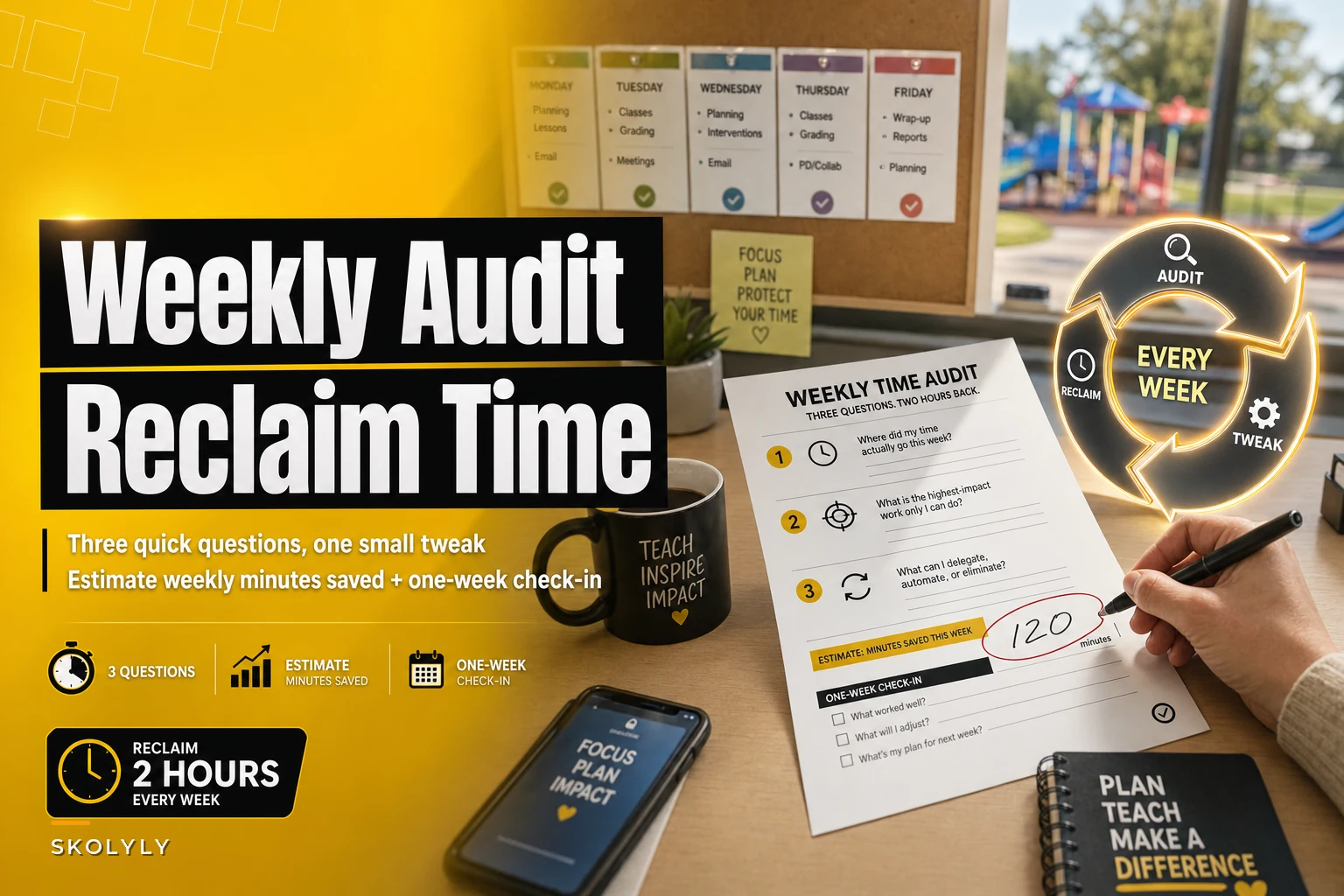
The version that actually sticks is embarrassingly small. Three questions, answered Friday afternoon in under five minutes, pointed at exactly one change for the following week. No columns. No block-by-block logging. No pretending you'll remember what you did at 1:45 on Tuesday.
This is about the teacher weekly time audit that people actually complete more than twice—and what makes the difference between a worksheet that gets abandoned and a routine that quietly gives back an hour or two a week.
Why the detailed audits fail
The theory behind long time logs is sound: you can't fix what you don't measure. The problem is the measurement cost is higher than the thing being measured.
A teacher logging time in 15-minute increments is doing roughly 30+ entries a day. That's a real cognitive tax, and it changes behavior while you're doing it—you work differently when you know you're being watched, even by yourself. So the data is both expensive to collect and slightly distorted. After three or four days, most people quietly stop.
There's a second failure mode that's less obvious. Even when someone completes a full week of logging, they end up with a pile of data and no decision. They look at it, nod, feel vaguely bad about how much time went to email, and change nothing. The audit produced awareness but not action. Awareness without a specific next step is just guilt with a timestamp.
The fix isn't a better spreadsheet. It's cutting the audit down to the point where completing it is trivial and the output is a single, obvious move.
The three questions
Here they are. The whole thing.
Keep every student on track with ease.
Skolyly helps you create, assign, and monitor classroom activities efficiently.
- Integrated lesson and assignment management
- Real-time student progress tracking
- Automated class scheduling & notifications
No credit card required
-
What one task this week took longer than it should have?
-
What's one small change I could make to shrink it next week?
-
How much time would that change realistically save me—per week?
That's it. You're not auditing everything. You're finding the single most annoying time sink from the past five days and making one small adjustment. One tweak per week. Over a semester, that's 15–18 small changes, and the compounding is where the real hours come from.
Notice what these questions don't ask. They don't ask you to categorize your time. They don't ask you to be comprehensive. They don't ask you to be honest about every inefficiency—just the one that bugged you most this week, which is usually the one worth fixing anyway. The stuff that actually irritates you is the stuff you'll follow through on changing.
Why "one tweak" beats a full redesign
People who try to overhaul their whole week usually end up back where they started within two weeks. The overhaul requires willpower you don't have in November.
A single small tweak is different. Small enough that it doesn't require a new identity or a new system—just a minor adjustment to an existing one. A typical example looks like this:
-
"Grading warm-ups one by one took forever" → "Next week I'll spot-check five, mark the rest for completion only" → saves ~25 min/week
-
"I rewrote the same three emails to parents" → "Save them as canned responses" → saves ~15 min/week
-
"Setting up the projector every period ate my passing time" → "Leave it on the right slide deck tab all day" → saves ~10 min/week
None of these are impressive on their own. Added up across a semester, they're the difference between leaving at 4:15 and leaving at 5:30.
The pattern worth noticing: the tweaks that survive are almost always subtractions, not additions. You're removing a step, batching something, or lowering the fidelity of a task that didn't need high fidelity in the first place. The tweaks that fail are the ones that add a new tool or a new habit you have to maintain.
The part everyone skips: the time estimate
Question three—the time savings estimate—is the one most people want to drop, and it's the one that makes the whole thing work.
Estimating the savings does two things. First, it forces you to pick tweaks that actually matter. If a change saves you two minutes a week, you'll naturally skip it in favor of something bigger. Second, the estimate becomes the thing you check against next Friday. Without a number, there's nothing to hold yourself to. With a number, you've got a cheap little accountability loop.
The estimate doesn't need to be precise. "Roughly 20 minutes" is fine. You're not building a case for a grant. You're giving next-week-you something to compare against.
The one-week accountability check
This is the quiet engine of the whole routine, and it's one sentence long.
The following Friday, before you do the next audit, you ask: "Did last week's tweak actually save me the time I expected?"
Three outcomes:
| Outcome | What it means | What you do |
|---|---|---|
| Yes, saved about what I expected | The tweak worked, keep it | Make it permanent, move on to the next tweak |
| Saved some, but less than expected | Partial win, usually fixable | Adjust once more, then keep or drop |
| Didn't help / I didn't do it | The tweak was wrong or too hard | Drop it without guilt, pick a different target |
That last row matters more than it looks. A lot of self-improvement routines collapse because people feel bad when something doesn't work and then avoid the whole system. Building "drop it without guilt" directly into the check keeps the routine alive. Not every tweak works. You only need a decent hit rate.
A realistic example
Take a middle school ELA teacher with five sections, around 140 students. Her biggest recurring complaint in the first audit: entering warm-up and exit-ticket scores into the gradebook, which she was doing in scattered five-minute chunks across the week and losing track of.
-
- Week 1 tweak Stop entering warm-ups individually; mark them complete/incomplete in a single batch on Fridays. Estimated savings: ~30 min/week.
-
- Week 1 check (following Friday) Actually saved closer to 20 minutes, not 30—but real, and less mental clutter. Kept it.
-
- Week 2 tweak Project the exit ticket as a slide instead of printing and collecting paper. Estimated savings: ~15 min/week.
-
- Week 3 tweak Move all parent emails to one 20-minute block on Wednesday instead of reacting throughout the day. Estimated savings: ~25 min/week.
By week four, three small tweaks were saving her somewhere around an hour a week. Not dramatic in any single week. But an hour a week over a semester is close to 18 hours—most of a full workday every month she wasn't getting back before.
The grading side of this often becomes its own rabbit hole. If evening grading is the thing eating your time, there's a more detailed breakdown in this hybrid grading workflow that pairs well with the audit. Same idea: find the step that's too expensive and lower its cost without lowering the feedback quality that actually matters.
Why this works for teacher adoption specifically
Administrators who want staff to actually use a time audit tend to over-engineer the rollout. They build a shared tracker, schedule a PD session on it, ask for data to be submitted. Every one of those steps lowers adoption.
What raises it:
-
- It fits in the five minutes teachers already spend decompressing on Friday. You're not asking for new time, you're attaching to time that already exists.
-
- The output is private. No one's submitting their inefficiencies to a dashboard. The moment it's monitored, people game it or abandon it.
-
- It produces a win fast. The first tweak usually lands within a week, and that first visible time savings is what keeps someone going for week two.
-
- Nothing gets logged in real time. The entire audit is retrospective, done once, at the end of the week.
Protect five minutes at the end of the Friday staff meeting—or just the Friday afternoon—and otherwise stay out of the way.
If a school wants to support it without killing it, the move is to protect five minutes at the end of the Friday staff meeting—or just the Friday afternoon—and otherwise stay out of the way. The behavior-tracking world has the same lesson: routines that survive are the ones that cost almost nothing to do, which is exactly why something like five-minute daily behavior logs actually gets used while elaborate logging systems don't.
When this makes sense—and when it doesn't
This works well when:
-
You feel busy but can't point to exactly where the time goes
-
You've tried and quit a detailed time log before
-
Your week has recurring tasks (grading, email, setup) that repeat predictably
This is a bad fit when:
-
Your time problem is structural, not behavioral. If you have six preps and no planning period, a weekly tweak won't fix a scheduling problem that only administration can solve. That's a master-schedule conversation, not a personal-habit one.
-
You're already highly optimized and just overloaded. At some point the answer isn't a smaller tweak, it's less work—and that's above your pay grade to fix alone.
Who should skip it entirely: first-year teachers in the first two months. The job is too new and too in-flux to audit meaningfully yet. Give it until things settle into a rhythm, otherwise every week's "biggest time sink" is just "everything, I'm drowning," which isn't actionable.
The version to actually use
If you want the whole routine on one sticky note:
-
Friday, five minutes. Answer the three questions.
-
Pick one tweak. Subtraction over addition. Small enough to do without thinking.
-
Write down the estimated weekly savings. Rough is fine.
-
Next Friday, check it first. Did it save what you thought? Keep, adjust, or drop—no guilt.
-
Then do the next audit. One tweak a week, repeat.
Here's a visual of the week-to-week flow.
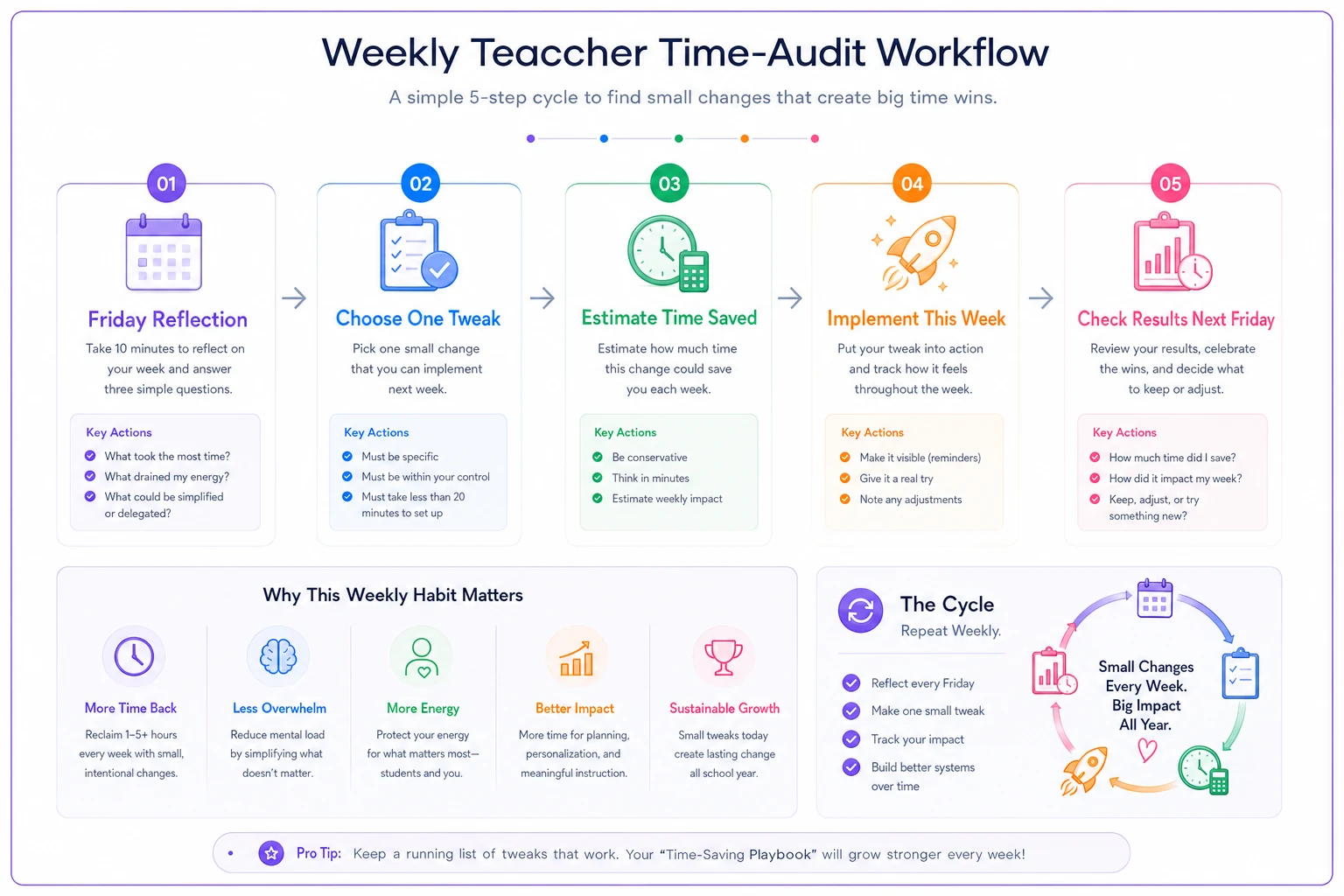
The reason this reclaims time when bigger systems don't is that it respects how little capacity teachers have left by Friday. It doesn't ask you to analyze your whole week. It asks you to fix one annoying thing, confirm it worked, and move on. Do that fifteen times across a semester and the two hours a week show up on their own—not from one heroic change, but from a pile of small ones you barely noticed making.
The reason this reclaims time when bigger systems don't is that it respects how little capacity teachers have left by Friday. It doesn't ask you to analyze your whole week. It asks you to fix one annoying thing, confirm it worked, and move on. Do that fifteen times across a semester and the two hours a week show up on their own—not from one heroic change, but from a pile of small ones you barely noticed making.
Ready to elevate your classroom management?
Join 5,000+ educators using Skolyly to save time, engage students, and improve learning outcomes.