

Conference night has a rhythm you can feel by 5:45. The hallway fills, families sign in on a clipboard nobody can read, and inside the room a teacher is quietly panicking because the 4:00 slot ran twelve minutes long and now everything after it is stacked like dominoes. By 7:30 you're apologizing to the last three families, half your student work samples are in the wrong folders, and the kids—who were supposed to be leading this—are mostly staring at their shoes while adults talk over their heads.
The fix most people reach for is "more structure." Which usually means a longer agenda, more forms, more prep. That's backwards. The real problem with student-led conferences isn't that they lack structure—it's that they lack time discipline and a shared artifact both the student and the family can actually point at.
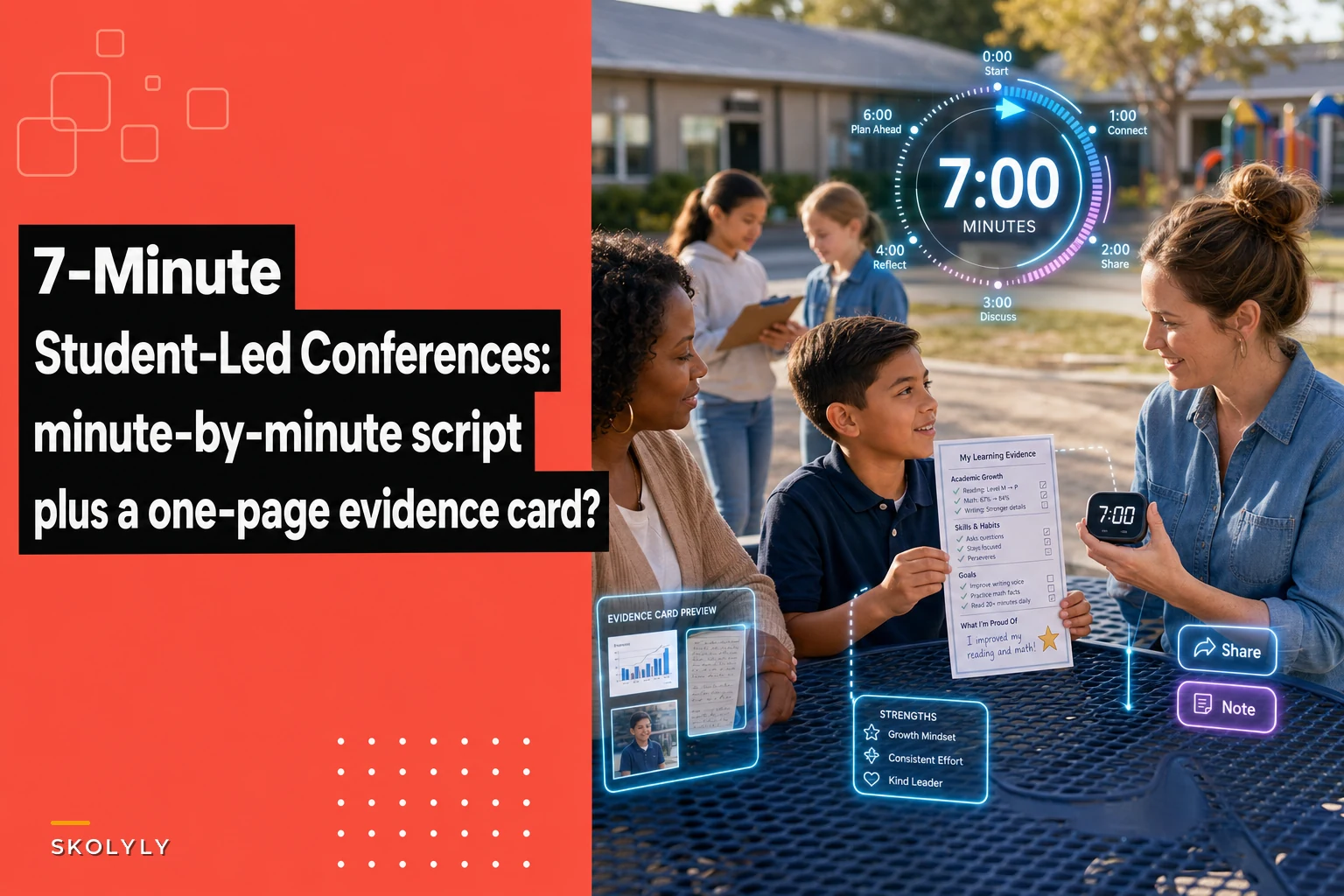
So this is a tight one. A 7-minute student-led conference protocol built around a single fillable page the student owns. No binders. No 20-minute monologues. Seven minutes, a card, a clock, and a kid who does most of the talking.
Why conferences drift into 15–20 minutes when they were supposed to be short
Watch a few unstructured conferences back to back and the same pattern shows up. The teacher opens by summarizing the student's progress. That alone eats four or five minutes, because there's a lot to say and nothing stopping it. Then the family asks a question, the teacher pulls up a gradebook to answer it, and now you're digging through an LMS live while two people wait. Then someone remembers a missing assignment, and suddenly it's a full parent meeting.
The student, in all of this, has no job. They're a topic, not a participant.
That's the core failure. When the adult owns the narration, three things happen: the meeting expands to fill available anxiety, the student disengages, and the family walks away with a vague sense of "doing okay" instead of one concrete thing to work on at home. Conferences don't run long because families are chatty. They run long because nobody decided, in advance, who says what and for how long.
The one-page student evidence card
This is the whole thing. One page, filled out by the student before conference night during a 20–25 minute class period. It's not a portfolio and it's not a reflection journal. It's a conversation script disguised as a worksheet.
Keep every student on track with ease.
Skolyly helps you create, assign, and monitor classroom activities efficiently.
- Integrated lesson and assignment management
- Real-time student progress tracking
- Automated class scheduling & notifications
No credit card required
-
My name / date / grade or subject — top line, obvious, but it prevents mix-ups when 28 cards are sitting in a stack.
-
One thing I've gotten better at — plus the specific piece of evidence. Not "reading." Instead: "I can find the main idea now—here's my annotation from The Watsons."
-
My evidence — the student names the actual artifact and has it ready. A quiz, a draft, a lab, a rubric score. One item, not five.
-
One thing I'm still working on — again, specific. "Showing my work on multi-step problems," not "math."
-
My goal for next term — written in the student's own words, one sentence.
-
What I need help with at home — this is the family's takeaway. One concrete action.
-
A number that shows my progress — a score, a reading level, a count of assignments turned in on time. One data point they chose.
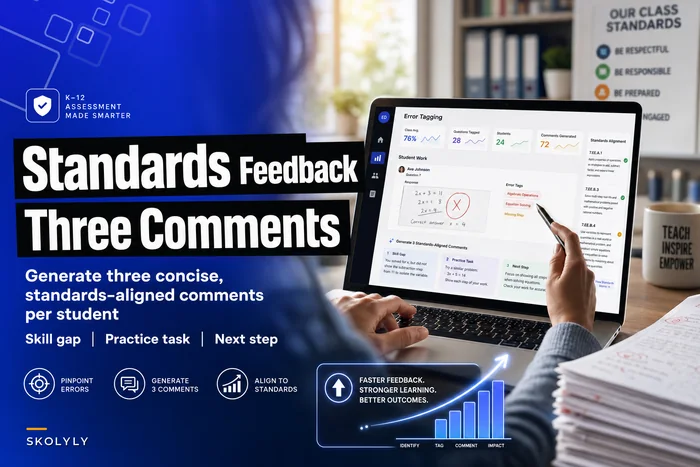
That last line matters more than it looks. When a student picks their own number and can explain it, the family stops asking the teacher to interpret the gradebook. The kid does it. If you want a deeper approach to helping students name evidence in language that maps to standards, the thinking behind turning assessment errors into three standards-aligned comments per student translates almost directly—students can borrow that same "here's the skill, here's the proof" framing for their card.
The minute-by-minute script
Seven minutes sounds impossibly short until you time it. Then it feels generous, because there's no wasted motion.
| Time | Who leads | What happens |
|---|---|---|
| 0:00–1:00 | Student | Greets family, states the goal of the conference in one sentence, hands them the card |
| 1:00–3:00 | Student | Walks through "what I've gotten better at" + shows the evidence |
| 3:00–4:30 | Student | Explains "what I'm still working on" and the number they chose |
| 4:30–5:30 | Family | Asks the student one or two questions (not the teacher) |
| 5:30–6:30 | Teacher | Adds one thing—affirmation or a single clarification, no gradebook dives |
| 6:30–7:00 | Everyone | Agrees on the one home action written on the card, family keeps the card |
The teacher's role here is deliberately tiny. Ninety seconds. That's the hardest part to hold, because teachers are wired to fill silence and answer every question fully. The moment you take back the narration, the student shrinks and the meeting balloons.
A quiet trick: put a visible timer on the desk facing the family. Not a threat—a shared expectation. When everyone can see the clock, nobody feels rushed, because the pace was agreed to up front.
The prep period that makes it work
None of this happens cold. The evidence card gets filled out in class, and the walk-through gets rehearsed once. Here's the sequence:
-
Day 1 (25 min) Students fill out the card. You circulate and push on vague answers. "Better at reading" gets sent back until it names a skill and an artifact.
-
Day 2 (15 min) Pair students up. They practice the 7-minute walk-through on each other while you listen to two or three. You're checking one thing: does the student do the talking?
-
Day 3 (optional, 10 min) Fix the weak cards. Usually about a quarter of the class needs a second pass on the "number" line because they picked something they can't explain.
For students who struggle to organize the "still working on" section, giving them a sentence stem beats a blank box every time. "I need to get better at because ." Two blanks, done.
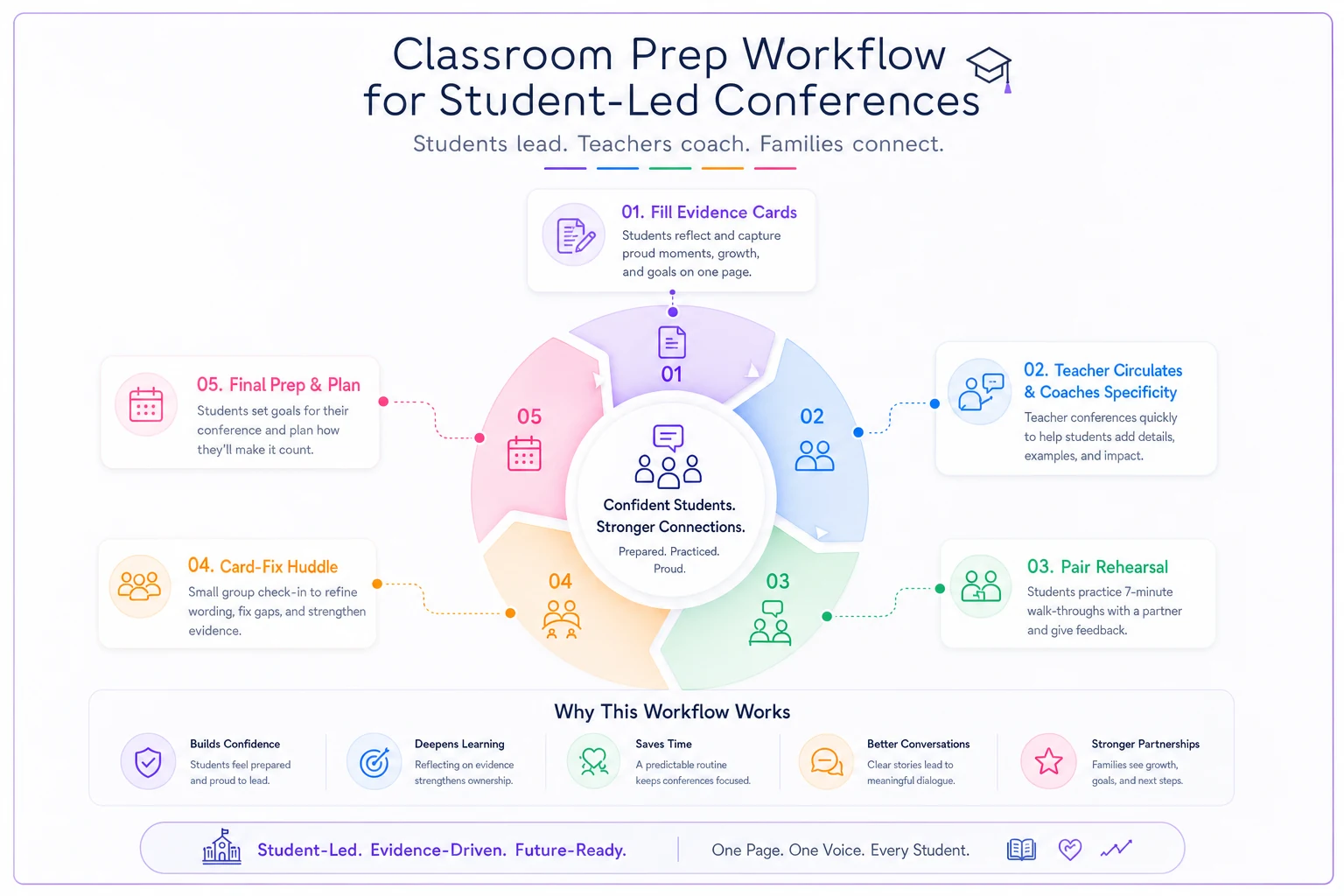
A simple visual of the prep steps—fill, rehearse, fix—makes it easier for teams to replicate the sequence.
Give struggling students the sentence stem 'I need to get better at because ' to help them complete the 'still working on' box.
The evidence card gets filled out in class, and the walk-through gets rehearsed once.
A real scenario
A middle-school team—around 110 students across four sections—switched to this format after a fall conference night that ran until almost 8:15 with a dozen families still waiting. The old average slot was landing somewhere around 16–18 minutes once you counted the overruns.
Spring conferences with the 7-minute protocol came in just under nine minutes per family on average, including the natural buffer between slots. Not everything hit exactly seven; a few ran to eleven when a family had a real concern, which is fine—that's what the buffer absorbs. But the room stayed on schedule, the last family was seen before 7:00, and teachers described the conversations as lighter because the kids were carrying them.
The bigger shift wasn't time. Families left holding a card with one home action on it. Follow-up the next month showed a noticeable bump in students who could actually name their own goal when asked in class—because they'd said it out loud to a parent, not just written it in a folder that went in a drawer.
Where the card actually earns its keep after conference night
The card doesn't die at 7:00 PM. That's the part most teams miss. The "number that shows my progress" line and the "home action" line become the backbone of the next conference. Next term, the student pulls out the old card and reports whether the number moved. That's a growth story the kid tells, in their own words, three months apart.
If you're tracking those numbers across a whole roster and want to spot patterns—which skills are stalling schoolwide, which home actions actually stuck—the same sampling-and-summary discipline from building one-page narrative briefs for school leaders keeps you from drowning in 110 individual cards. You don't read all of them. You sample, you summarize, you act.
This is also where a lightweight workflow platform quietly earns its place. When the card is a shared template that auto-populates each term with last term's number and goal, students spend the prep period reflecting instead of copying. The teacher isn't collating stacks of paper or re-typing goals into a spreadsheet at 9 PM. AI-assisted tools can pre-fill the routine parts—last term's goal, the prior data point—so the human time goes to the conversation, not the clerical work. But that's a convenience, not the protocol. The protocol works with a photocopier and a kitchen timer.
When this makes sense—and when it doesn't
This format shines for the standard progress conference: a family, a teacher, a student who can speak to their own work. Upper elementary through high school is the sweet spot.
-
A conference that's really about a serious concern—a suspected learning disability, a significant behavior escalation, a wellbeing issue. Those need time and privacy, not a seven-minute clock. Book them separately.
-
The youngest grades (K–1), where the student can't yet self-narrate. You can use a scaled-down two-line card, but the timing and ownership shift considerably.
-
Families needing interpreters—double the clock, minimum, and prep the interpreter with the card in advance so the flow doesn't stall on translation.
Who should not adopt this as-is: teams that haven't built any prep time into the school day. If the card gets filled out as homework the night before, half of them come back blank or copied off a friend, and the whole thing collapses. The 20–25 minutes of in-class prep isn't optional. It's the load-bearing wall.
The one mistake that quietly wrecks it
Teachers reclaim the microphone. It happens in the 5:30–6:30 slot—a parent asks a pointed question, the teacher instinctively takes over and delivers a full three-minute answer, and the student is suddenly a spectator at their own conference again.
The fix is a habit, not a rule: when a family asks a question, the teacher turns to the student first. "Good question—can you tell your mom how that went?" Nine times out of ten the kid can answer it, and when they can't, the ninety-second teacher window is exactly the place to fill the gap. Redirect first, answer second. Hold that one discipline and the whole thing holds.
Bottom line worth keeping
Short conferences aren't about rushing families out the door. They're about deciding, ahead of time, who owns the story—and then handing that ownership to the person it's supposed to belong to.
The card gives the student a script and a takeaway. The seven-minute clock gives everyone permission to be brief without feeling rude. Get those two pieces right and conference night stops being a scramble and starts being what it was always supposed to be: a kid, standing next to their own work, telling their family what they've figured out.
The card gives the student a script and a takeaway. The seven-minute clock gives everyone permission to be brief without feeling rude. Get those two pieces right and conference night stops being a scramble and starts being what it was always supposed to be: a kid, standing next to their own work, telling their family what they've figured out.
Ready to elevate your classroom management?
Join 5,000+ educators using Skolyly to save time, engage students, and improve learning outcomes.