

Most rubric-writing meetings die the same way. Someone shares a Google Doc, forty minutes pass, and you've written three descriptors for "level 4," had a ten-minute argument about whether to use "advanced" or "proficient," and closed with a promise to "finish it over email." The email never comes. The rubric sits half-built until grades are due, and then someone just wings it.
The problem isn't that teachers can't write rubrics. It's that the meeting has no structure, no forcing function, and nothing concrete to anchor the language to. The conversation floats. People argue about wording before they've agreed on what good work actually looks like, which is completely backwards.
What follows is a 30-minute rubric creation protocol built around one idea: pick the student work first, argue about words last. You anchor every level to a real piece of student work, score independently before talking, and time-box every step so the meeting can't drift. Done right, a team of three to five teachers walks out with a five-point rubric they can use the next day.
Why rubric meetings collapse (and it's not the standard's fault)
Two things go wrong, almost always.
The first is that teams start from the standard and try to reason their way down to descriptors. You read something like "cite textual evidence to support analysis," then try to describe—in the abstract—what a 5 looks like versus a 3. That's incredibly hard without examples in front of you. You end up writing descriptors that sound fine on paper ("thoroughly supports claims with relevant evidence") but mean nothing when you're grading an actual stack of papers. Everybody interprets "thoroughly" differently, which is precisely the inconsistency problem you were trying to solve.
The second failure is that the loudest person anchors the whole rubric. One teacher says "in my class a 4 means they used two quotes," and now everyone is calibrating to that teacher's classroom instead of to the actual range of student work. This is the same reliability drift that shows up in cross-class grading—something we've written about separately in the time-boxed moderation protocol for common-assessment grading. Rubric-writing has the same disease; it just shows up earlier in the process.
The fix for both is the same: put real student work on the table before anyone starts describing it.
The anchor-paper approach: let the work define the levels
Before the meeting, whoever's facilitating pulls 5–7 samples of student work on the target standard. Not perfect ones—a spread. A couple clearly strong, a couple clearly weak, and a few messy middles. These are your anchor candidates.
Keep every student on track with ease.
Skolyly helps you create, assign, and monitor classroom activities efficiently.
- Integrated lesson and assignment management
- Real-time student progress tracking
- Automated class scheduling & notifications
No credit card required
Here's the step people skip: strip the names off and assign each one a code letter (A through G). No names, no handwriting-recognition, no "oh that's obviously Marcus's paper." You want the team reacting to the work, not the student.
The reason anchors work is that a five-point rubric is really just a description of five recognizable kinds of student response. If you can point at Paper C and say "that's a 3," the descriptor writes itself—you just describe what makes it a 3 and not a 4. You're translating something concrete into words, which is a task human brains handle reasonably well. Reasoning from an abstract standard to a descriptor is not.
One thing worth flagging: don't pull all your anchors from the same class. If every sample comes from one section, you're quietly baking that teacher's instruction into the rubric. Spread the sourcing across classrooms if you can.
The 30-minute protocol, step by step
Set a visible timer. Phone, projected clock, whatever. The time-boxing isn't a suggestion—it's the mechanism that keeps the meeting from becoming a two-hour swamp. When the timer goes, you move on even if a step feels unfinished. It almost always turns out to be finished enough.
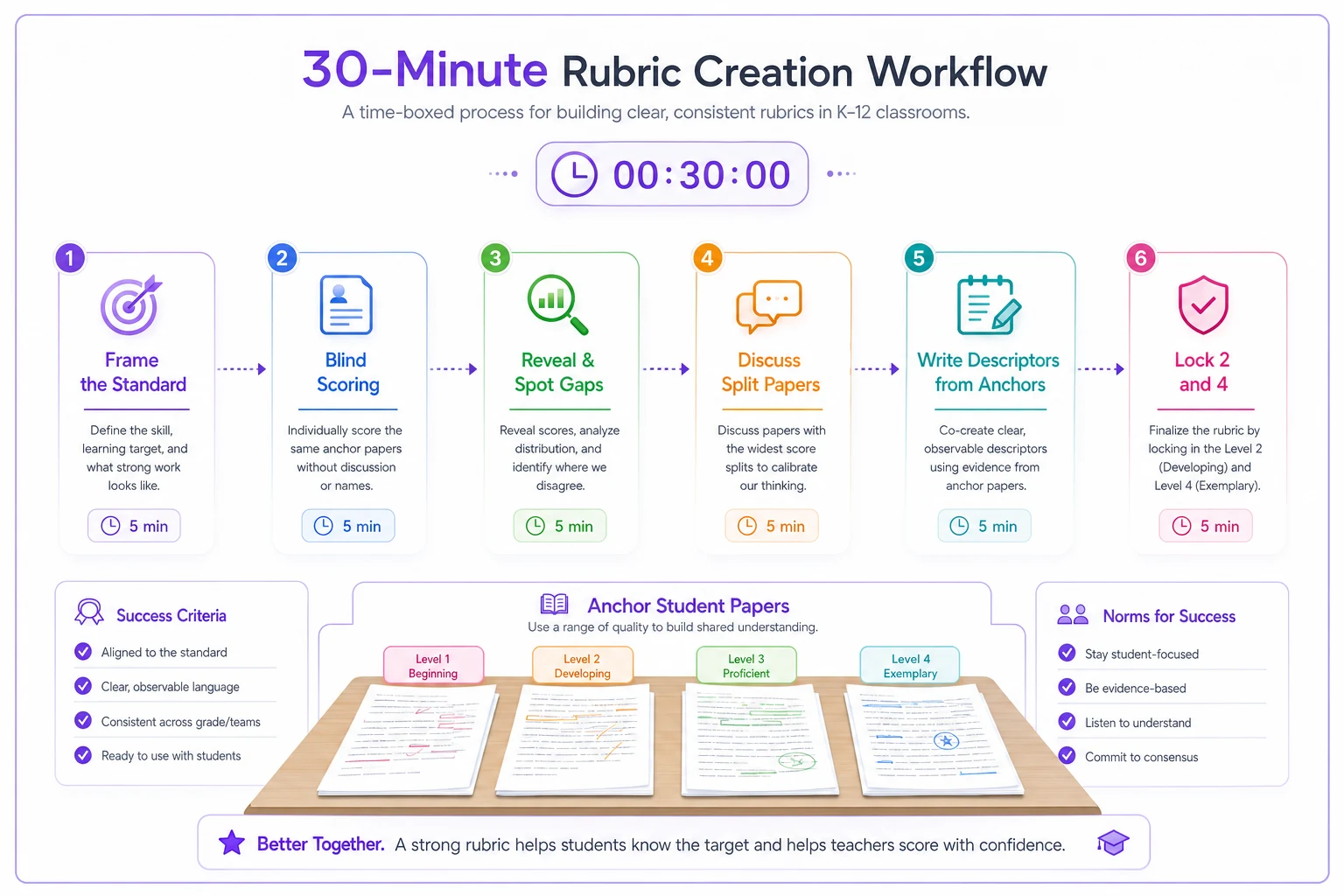
| Time | Step | What happens |
|---|---|---|
| 0:00–0:03 | Frame the standard | Facilitator reads the standard aloud, states the one skill being scored. No discussion. |
| 0:03–0:11 | Blind scoring | Everyone silently reads all anchor papers and rates each 1–5 on a sticky note or shared sheet. No talking. |
| 0:11–0:16 | Reveal & spot the gaps | Post everyone's scores side by side. Look only for papers where scores split by 2+ points. |
| 0:16–0:23 | Argue the split papers | Discuss ONLY the papers people disagreed on. Agree on a score for each. |
| 0:23–0:28 | Write descriptors from anchors | Assign one anchor to each level (1, 3, 5 minimum) and write a one-sentence descriptor for that paper. |
| 0:28–0:30 | Lock the 2 and 4 | Define 2 and 4 as "between" bands in one line each. Done. |
The magic is in steps 2 and 3. Blind independent scoring surfaces exactly where your team's understanding of "good" diverges. If everyone independently scores Paper A a 5 and Paper F a 1, those papers don't need discussion—consensus already exists. You only spend time on the papers where the team genuinely disagrees, which is where all the useful calibration happens anyway.
A simple visual of the protocol helps teams stay on track.
The blind scoring step in more detail
This is the step people want to shortcut, and shortcutting it wrecks everything. The rule is: read and score all anchors before anyone says a single word.
The second someone says "Paper D is clearly a 4," half the room anchors to that and stops thinking independently. Blind scoring prevents that by capturing everyone's honest read before social pressure kicks in.
Use whatever's fastest to make scores visible at once. A shared spreadsheet with a row per paper and a column per teacher works. Sticky notes on a wall grid work. The point is that at minute 11, everyone can see the full spread and identify the disagreements immediately.
Writing descriptors that actually differentiate levels
When you hit the descriptor step, you're not writing poetry. You're writing the shortest possible sentence that explains why the anchor paper landed at that level.
Anchor the odd numbers first—1, 3, and 5. These are your recognizable extremes and midpoint. If Paper F is your 1, your descriptor might be: "Names a claim but offers no evidence, or evidence is unrelated to the claim." If Paper C is your 3: "Supports the claim with one relevant piece of evidence but doesn't explain how it connects." That's it. One sentence tied to a real paper.
Then 2 and 4 become in-between bands, and you define them by contrast, not from scratch. A 4 is "meets the 5 criteria but explanation is thin or one piece of evidence is weak." A 2 is "attempts evidence like a 3 but it's mostly off-target." You're not inventing these from thin air—you're describing the space between anchors you already agreed on.
A pattern worth watching for: teams love to pile multiple criteria into each level. "A 5 uses three quotes AND explains each AND connects to the thesis AND uses transitions." Don't. When a level has four requirements, a paper that nails three and misses one becomes impossible to score consistently. Keep each level to one or two decisive traits. The rubric gets more reliable, not less.
Keep each level to one or two decisive traits to improve scoring reliability.
The rubric gets more reliable, not less.
A real scenario: an 8th-grade ELA team
A middle-school ELA team of four teachers was scoring a text-analysis writing task across roughly 110 students. Before they had a shared rubric, their pass-rates on the same assignment ranged wildly—one section came in around 60% proficient, another around 85%, on identical work. Same assignment, same standard, very different grading eyes.
They ran this protocol during a single 30-minute PLC block. Five anchor papers, blind scored. Two papers showed a clean 2-point spread across the team—those became the whole conversation. It turned out one teacher was counting "uses a quote" as evidence of analysis, while another required the student to actually explain the quote. A real, specific difference in expectations, invisible until the blind scores exposed it.
They resolved it (explanation required for anything above a 3), wrote the descriptors off the anchors, and locked the rubric with about two minutes to spare. On the next common assignment, the gap between their proficiency rates narrowed to roughly 10 points instead of 25. Not perfect, but a genuinely different level of agreement—from one meeting, not four.
Immediate classroom pilot plan
A rubric you don't test is just a document. Before you trust it for a graded assignment, run a small pilot the very next day. This takes almost no extra time and catches the descriptors that sounded fine in the meeting but fall apart against live student work.
-
Grade 5 fresh papers with the new rubric—papers that were NOT used as anchors. Each teacher does this independently.
-
Flag any paper that felt hard to score. If you hesitated between two levels for more than a few seconds, mark it.
-
Compare across teachers for those 5 papers only. Same drift check as the blind scoring step—look for 2-point splits.
-
Adjust one descriptor if a pattern of disagreement shows up. Usually it's one fuzzy word.
-
Then release the rubric to students, ideally with one or two anchor examples so kids can see what each level actually looks like.
If step 3 shows tight agreement, you're done. If it doesn't, the culprit is almost always a single vague descriptor, and a two-minute fix usually handles it. This pilot loop is also how you keep the rubric honest over time—the grading workflow it feeds into matters just as much, which is something we get into in the hybrid workflow for cutting project grading time.
When this protocol works—and when it doesn't
When it makes sense:
-
A team of 3–5 teaching the same standard or common assessment
-
Analytic tasks with observable traits
writing, lab reports, projects, problem sets with reasoning
-
You have access to real student work on the skill (even from a prior year)
-
You need a usable rubric fast, not a district-polished masterpiece
When it's a bad idea:
-
You have zero student samples. Without anchors, the whole method loses its engine—you're back to arguing about words in the abstract. Use last year's work if you have to.
-
The "standard" is actually a bundle of five sub-skills. Split it. One rubric, one skill. Trying to rubric-ify a whole unit in 30 minutes produces mush.
-
You're building a high-stakes, publicly reported assessment rubric. Those need more validation than one session provides. Use this as a fast first draft, then run it through your formal review process.
Who should not run this solo: a single teacher building a rubric alone gets almost none of the benefit, because the entire value comes from disagreement surfaced by multiple independent scorers. If you're working alone, this is just a slower way to write descriptors. Grab at least one colleague.
Keeping rubrics and their anchors organized
The quiet failure after a good rubric session is what happens to the paperwork. The rubric ends up in one teacher's Drive, the anchor papers sit in a folder nobody remembers, and six months later a new team member has the rubric but none of the exemplars that make it mean anything. They interpret the descriptors their own way, and the drift creeps back in.
The rubric is only reliable when it travels with its anchors. A "5" descriptor means one thing next to the paper that earned the 5, and something fuzzier on its own. Whatever system you use—shared drive, an assessment platform, a plain labeled folder—the rubric and its anchor set need to stay attached and findable.
This is where a shared workflow or platform earns its keep: not by writing the rubric for you, but by making sure the descriptors, the anchors, and the pilot notes stay linked so the next teacher inherits the whole context, not just the grid. That's the difference between a rubric that stays calibrated over time and one that slowly rots as staff turns over or memory fades.
The takeaway
Rubric meetings fail because they start with words. Start with student work instead. Pick the anchors, score them blind, spend your time only on the papers you disagree about, and write descriptors that describe the actual papers in front of you. Time-box every step so the conversation can't wander, and pilot the result on fresh papers the next day before you trust it for real grades.
A five-point rubric in 30 minutes isn't a shortcut that sacrifices quality. It's usually higher quality than the version a team produces over three drifting meetings, because it's grounded in real work and calibrated by genuine disagreement instead of one loud voice. Try it on your next common assessment and see how much shorter the "let's finish this over email" list gets.
Ready to elevate your classroom management?
Join 5,000+ educators using Skolyly to save time, engage students, and improve learning outcomes.