

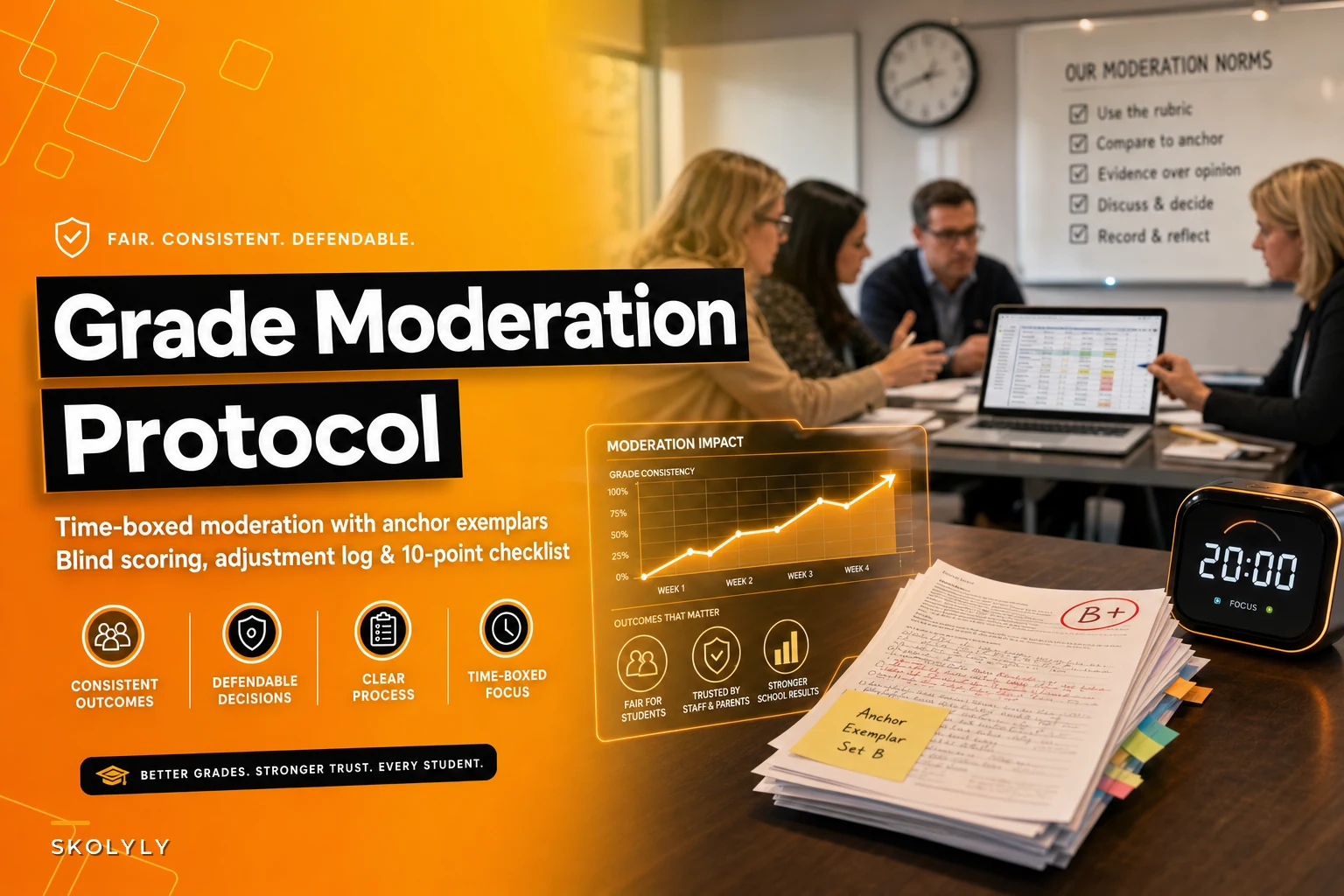

Every semester, schools run common assessments. Same test, same rubric, multiple teachers grading. The goal is consistent data across classes to track student progress and identify gaps.
What happens in practice? Mrs. Chen's algebra students average 78%. Mr. Rodriguez's class averages 62%. Ms. Williams lands at 85%. Same exact test. The department chair pulls up the data dashboard and sees wildly different "achievement levels" that have nothing to do with actual student performance.
This isn't about bad teachers or lazy grading. When you ask five teachers to independently score 120 essays or multi-step math problems using a "detailed rubric," you get five different interpretations of what "partially meets expectations" means for question 3b. That's just what happens.
The inconsistency torpedoes everything downstream. Parent complaints about unfair grades. Meaningless benchmark data. Students get moved into intervention groups based on which teacher they happened to have, not their actual skill level. RTI teams make decisions using fundamentally flawed data. The whole data-driven improvement cycle falls apart when the foundation—consistent grading—doesn't exist.
Why rubrics alone never create consistent scoring
Rubrics help, but they don't address the core issue: interpretation variance. Take a typical math rubric that says "Shows understanding of the concept with minor errors - 3 points." Teacher A thinks algebraic notation mistakes are minor. Teacher B considers those fundamental errors worth only 1 point. Both teachers are following the rubric perfectly in their own minds.
The problem gets worse with constructed response questions. One English teacher values sophisticated vocabulary and gives an essay 18/20. Another reading the same essay focuses on argument structure and scores it 14/20. Neither is wrong—they're emphasizing different things the rubric vaguely bundles under "effective communication."
Then add time pressure. Teachers grading 90 tests over a weekend. The first 10 papers get careful attention. Tests 40–50 get scored during halftime of Sunday's game. Tests 80–90 get rushed through Sunday night. Even the same teacher scores differently depending on fatigue and where they are in the stack.
Some schools run calibration sessions—teachers sit together, score a sample test, discuss differences. These help. But two weeks later, when everyone is grading alone at home, they drift back to personal habits. Without structured moderation during actual grading, calibration becomes a feel-good exercise that doesn't stick.
The moderation protocol that actually works
One approach consistently produces aligned scores: time-boxed moderation with anchor papers and structured adjustment rounds. Not perfect alignment—that's impossible—but close enough that the data becomes meaningful.
Keep every student on track with ease.
Skolyly helps you create, assign, and monitor classroom activities efficiently.
- Integrated lesson and assignment management
- Real-time student progress tracking
- Automated class scheduling & notifications
No credit card required
Here's the complete protocol schools can implement starting with their next common assessment:
Phase 1: Anchor Paper Selection (90 minutes total)
Before anyone grades anything, the team establishes anchor papers—actual student work that defines what each score level looks like.
Each teacher independently grades the same 5 student assessments. Not sample assessments. Real ones from the current batch. Choose a mix: one that looks strong, one weak, three in the middle. Everyone scores these using the rubric, working alone, no discussion.
-
10 minutes per assessment
-
50 minutes total independent scoring
-
Document scores in the moderation log
After independent scoring, teachers reveal scores simultaneously. Usually you'll see spreads like:
-
Student 1
72%, 78%, 65%, 71%, 74%
-
Student 2
45%, 51%, 39%, 48%, 44%
-
Student 3
88%, 92%, 91%, 85%, 90%
Now comes the critical part: structured discussion. For each assessment where scores vary by more than 5%, teachers explain their scoring decisions question by question. "I gave 2 points on question 4 because the student showed work but made a calculation error." Another teacher responds, "I gave 3 points because the methodology was correct despite the arithmetic mistake."
Through discussion, the team agrees on final scores for these five assessments. These become your anchor papers—the reference point for all subsequent grading. Document the agreed scores and the reasoning for contentious items.
Critical rule: Set a timer. Each paper gets a maximum of 8 minutes of discussion. No endless debates. If you can't agree in 8 minutes, average the scores and move on.
Phase 2: Blind Scoring Round 1 (3–4 hours)
Teachers grade their own class's assessments, but every 10th assessment goes into a blind scoring pool and gets redistributed randomly to other teachers. Nobody knows whose class they're scoring from the blind pool.
-
Grade at your normal pace
-
Reference anchor papers when uncertain
-
Document any scoring decisions that feel borderline
-
Submit blind pool papers within the same grading session
Practical tip: Use a simple numbering system. Papers 1–9 stay with the teacher. Paper 10 goes to the blind pool. Papers 11–19 stay. Paper 20 to the pool. This maintains randomness without complex logistics.
The blind scoring serves two purposes. First, it provides a consistency check—are teachers scoring similarly when they don't know whose students they're evaluating? Second, it prevents unconscious bias where teachers might score their own students more generously based on classroom behavior or past performance.
Phase 3: Consistency Check (45 minutes)
After Round 1, analyze the blind scoring results. Calculate the variance between the original teacher's score and the blind scorer's score for each assessment.
-
Most scores within 3–5% of each other
-
A few outliers with 10%+ variance
-
Specific questions where everyone struggles with consistency
Flag any assessments with >7% variance for review. Also identify questions where blind scoring consistently differs from standard scoring. These become focus areas for adjustment.
Quick example: If 8 out of 40 blind-scored papers show >7% variance, and 6 of those involve Question 7, you've identified a rubric interpretation issue that needs addressing—not a teacher problem.
Phase 4: The Adjustment Log Protocol (30 minutes)
Before Round 2, teachers document their scoring patterns in an adjustment log. This isn't about admitting mistakes—it's about recognizing patterns.
-
Questions where they consistently scored higher or lower than anchor papers
-
Types of student errors they're treating differently than the team norm
-
Any fatigue-related scoring drift they noticed
Example log entry: "Realized I'm giving full credit for correct answers even when students don't show work on questions 5–8. Anchor papers dock 1 point for missing work. Will adjust."
The adjustment log serves as a self-correction tool and creates documentation for future sessions. When the same issue appears across multiple assessments, it signals a rubric problem—not a teacher problem.
Phase 5: Blind Scoring Round 2 (2–3 hours)
Teachers re-score any assessments flagged for high variance, plus a new random sample of 5 papers from each class. This round moves faster because major interpretation issues are already resolved.
Apply adjustments identified in the log. Reference specific anchor paper examples when scoring borderline responses. Document any scores that change by more than 5% from Round 1—these become discussion points for the final calibration.
Phase 6: Final Calibration with the 10-Point Decision Checklist (60 minutes)
The team reconvenes for final score adjustments. Instead of debating every variance, use this checklist to decide which scores need adjustment:
-
Variance >10% from blind score? → Mandatory review
-
Score affects pass/fail status? → Review with department chair
-
Student's score >15% different from their typical performance? → Flag for possible scoring error
-
Question-level scores inconsistent across similar student responses? → Adjust to match anchor paper
-
Fatigue factor evident? (Papers 80–90 scored notably different) → Re-score affected batch
-
Parent visibility high? (Honor roll cutoff, athletic eligibility) → Additional blind score verification
-
Score impacts intervention placement? → Review with RTI coordinator
-
Systematic bias detected? (All struggling students scored lower on subjective questions) → Adjust using anchor papers
-
New grading pattern emerged not covered by rubric? → Team decision on standard approach
-
Statistical outlier? (Only score in its range for that question) → Verify scoring logic
Work through the checklist for flagged assessments. Make final adjustments. Document all changes in the moderation log with reasoning.
Time management: Spend a maximum of 3 minutes per flagged assessment. If the checklist doesn't clearly point to an adjustment, keep the original score.
A simple visual of the moderation workflow can help teams follow the steps efficiently.
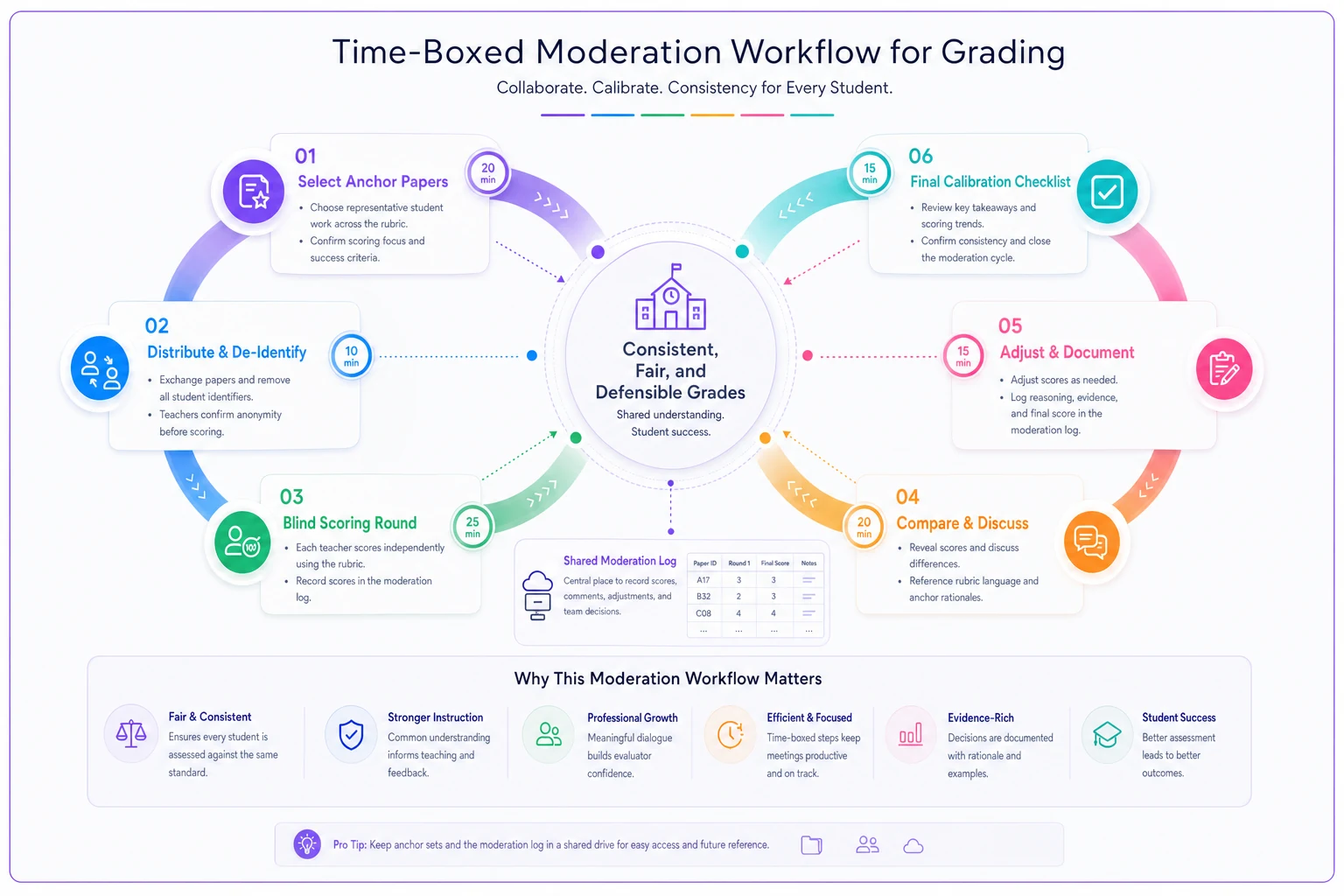
Keep the graph handy during your first run so everyone remembers the sequence and time limits.
What changes when you implement this protocol
Schools using structured moderation protocols see real improvements in grading consistency—not perfection, but genuine alignment.
Before implementing moderation, one middle school's algebra common assessment showed these ranges across five teachers:
| Metric | Before Protocol |
|---|---|
| Class averages | 62%, 71%, 78%, 69%, 85% |
| Standard deviation | 8.7% |
| Parent complaints per assessment | 12–15 |
After three assessments using the protocol:
| Metric | After Protocol |
|---|---|
| Class averages | 71%, 73%, 75%, 72%, 74% |
| Standard deviation | 1.5% |
| Parent complaints per assessment | 2–3 |
The tighter score distribution meant intervention decisions actually reflected student needs, not teacher variation. RTI teams could trust the data. Department meetings focused on instruction instead of defending grading practices.
Teachers initially resist the time investment. "This adds 4–5 hours to grading!" That's true. But it eliminates 10+ hours of parent conferences, grade disputes, and re-grading requests. Teachers also report feeling more confident in their scores, knowing they align with department standards.
The protocol also surfaces rubric problems quickly. When multiple teachers consistently struggle with the same question despite anchor papers, it signals the rubric needs revision. One school discovered their "analyze text evidence" rubric section was so vague that teachers had created five different interpretations. They revised it with specific examples, and variance dropped immediately.
Building the protocol into your assessment cycle
The full protocol seems overwhelming at first, but schools integrate it successfully by starting small. Implement it with one department, one assessment. Iron out the logistics. Then expand.
Here's a realistic implementation timeline:
Month 1: Math department pilots protocol with a mid-unit assessment. Document what works and what needs adjustment. Expect the first run to take 20–30% longer than stated times while teachers learn the process.
Month 2: Math department uses the refined protocol for the unit assessment. English department observers sit in to learn before their own implementation. Create shared templates for moderation logs and adjustment tracking.
Month 3: Both Math and English use the protocol. Science department begins planning their version. Share anchor papers and moderation logs across departments to build institutional knowledge.
Month 4–6: Full implementation across core subjects. Monthly calibration sessions become 45-minute focused reviews rather than 2-hour debates. Teachers internalize the anchor paper standards, reducing variance naturally over time.
Some schools modify the protocol based on their constraints. A small school with only two teachers per subject might skip blind scoring Round 2 but add peer review of all flagged assessments. A large district might create digital anchor paper libraries that all teachers reference. The non-negotiables are anchor papers, blind scoring samples, adjustment logs, and the decision checklist. Everything else can flex based on your context.
Technology amplification without losing the human element
The moderation protocol works with paper and spreadsheets, but the right technology makes it sustainable at scale. Not automated grading—that's a different conversation—but tools that manage the workflow and surface patterns automatically.
Digital assessment platforms can distribute blind scoring assignments without the logistics burden. Teachers submit scores, and the system flags variance automatically. No manual calculation, no spreadsheet juggling. The system shows exactly which assessments need review based on your variance thresholds.
More sophisticated platforms track scoring patterns across time. They'll show you that a teacher consistently scores a particular question type lower than department average, or that afternoon grading sessions run slightly higher than morning ones. Those kinds of patterns are nearly impossible to catch manually, especially across a whole department.
Some schools integrate their grading workflow systems with moderation protocols, so the same platform that manages grading efficiency also ensures consistency across teachers. Anchor papers live in the system, accessible during grading. The adjustment log becomes part of the grading interface rather than a separate document floating around in someone's email.
Technology should accelerate the human process, not replace it. Teachers still make scoring decisions. They still discuss anchor papers. They still calibrate through conversation. The tools just remove friction and surface data that makes those conversations more productive.
When this protocol makes sense (and when it doesn't)
This moderation protocol works best for:
-
Common assessments across multiple sections
-
High-stakes assessments affecting student placement
-
Departments with a history of grading variance
-
Schools building data-driven instruction cycles
-
Assessments with constructed response or essay components
It's overkill for:
-
Multiple choice only assessments (use answer keys)
-
Single-teacher courses with no comparison needed
-
Formative assessments used only for individual feedback
-
Schools with one teacher per grade level
The protocol also requires department buy-in. If teachers view it as administrative oversight rather than professional collaboration, it won't work. Frame it as ensuring fairness for students and protecting teachers from grade complaints. Most teachers want to grade consistently—they just need a structure that makes it possible.
Some schools adjust the protocol's intensity based on assessment importance. The semester final gets the full treatment. Unit tests get anchor papers and one blind scoring round. Quizzes get anchor papers only. This graduated approach maintains consistency without burning teachers out.
Real barriers and how schools overcome them
"We don't have time for 5-hour moderation sessions."
Valid concern. But calculate the actual trade-off. How many hours do teachers spend in grade complaint meetings? Re-grading assessments after parent challenges? Defending their scoring to administrators? The moderation protocol front-loads that time into prevention rather than reaction.
"Teachers won't honestly document their scoring patterns."
Start with no-blame framing. The adjustment log isn't about catching mistakes—it's about recognizing the natural variance that happens when humans score complex responses. Share your own log first. "I realized I was giving credit for partial work that didn't actually demonstrate understanding. Adjusting for next round."
"Our teachers grade at different times and locations."
The protocol doesn't require everyone in the same room simultaneously. Use shared documents for anchor papers. Conduct blind scoring asynchronously with clear deadlines. Hold virtual calibration sessions if needed. One school runs their entire protocol through shared Google Sheets and 30-minute video calls.
"The union will object to peer review of grading."
Position it as professional collaboration, not evaluation. Teachers aren't reviewing each other—they're collaborating to ensure fairness for students. Include union reps in protocol design. Most unions support practices that protect teachers from unfair grade challenges.
The compound effect of consistent grading
When grading becomes consistent, everything downstream improves. The school's data actually means something. RTI placements reflect real student needs. Parent trust increases because siblings in different classes get scored fairly.
Teachers benefit too. They spend less time defending grades and more time improving instruction. Department meetings shift from "why did you score this way?" to "how can we help students improve on Question 7?"
Most importantly, students get fair treatment. Their grades reflect their knowledge—not which teacher they were assigned to. When students believe grading is fair, they engage more deeply with feedback and actually try to improve.
The moderation protocol isn't perfect, and it won't eliminate all variance. But it transforms grading from individual interpretation into collaborative professional practice. That 10% variance between teachers becomes 2–3%. The data becomes trustworthy. The arguments mostly disappear.
Start with your next common assessment. Pick five anchor papers. Run one blind scoring round. Use the 10-point checklist for adjustments. Most departments see meaningful improvement after just one attempt—and teachers usually wish someone had put this structure in place years earlier.
Ready to elevate your classroom management?
Join 5,000+ educators using Skolyly to save time, engage students, and improve learning outcomes.