

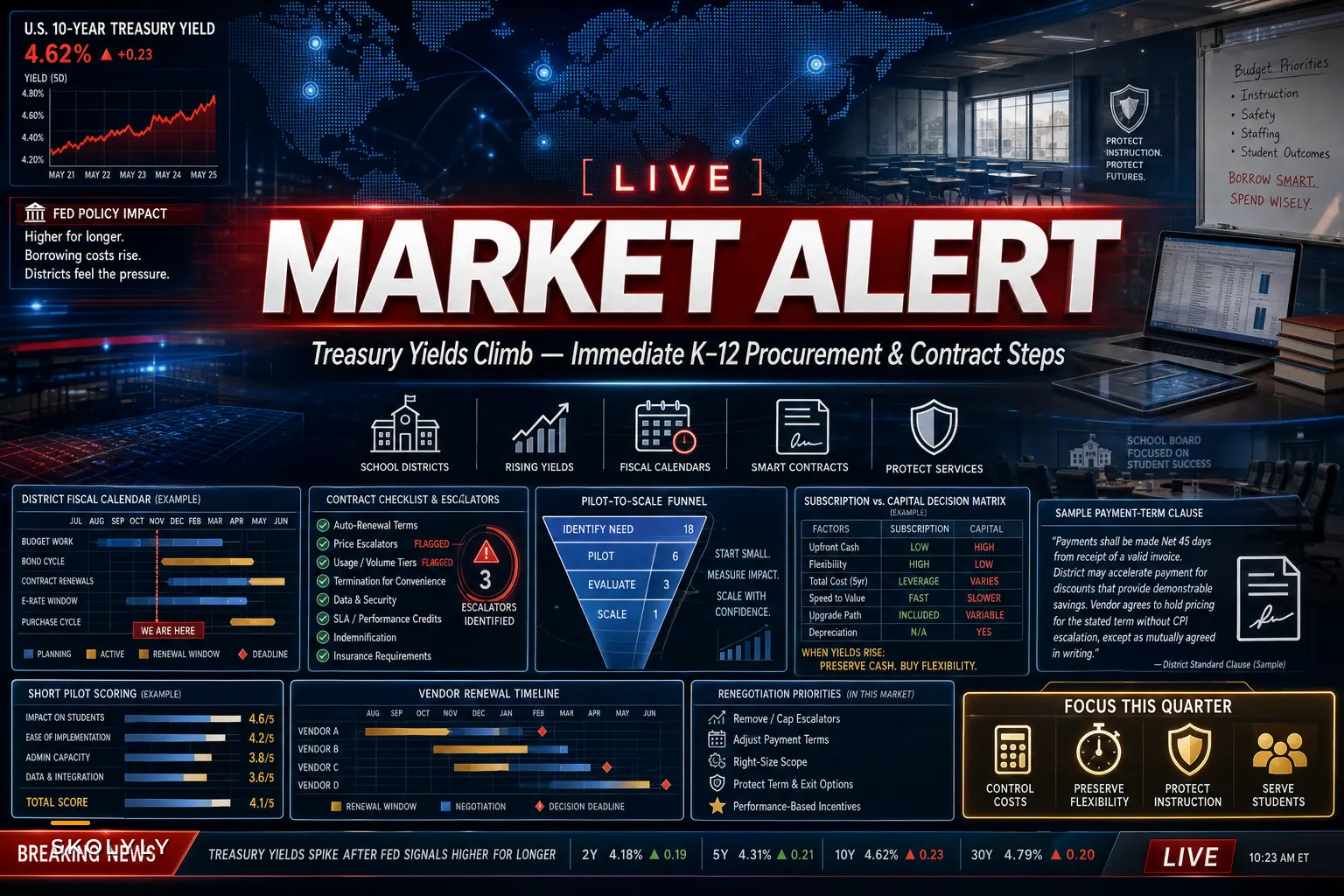

The Fed's October 29 statement didn't deliver a dramatic headline, but it did something that matters more for district finance offices: it kept borrowing costs elevated and nudged Treasury yields higher across the curve. Reuters described the Fed as highlighting economic strength while muddying the outlook for Treasuries, and the 10-year yield hovered just below 5% afterward. For a household, that's an abstract number. For a district sitting on a planned bond issuance or a refinancing window, it changes the math on real decisions being made right now.
Most procurement conversations miss the actual problem. The yield move itself isn't what hurts — what hurts is that most districts built their edtech spending around cheaper money, and those structures don't bend well when financing gets more expensive. This post is about the operational and contractual adjustments that actually protect your budget when the cost of money goes up. Not the macroeconomics, which you can't control anyway.
The yield jump hits two budgets, and most districts only watch one
When people talk about the Treasury yields impact on school procurement, they usually jump straight to capital projects — construction bonds, the new HVAC, the one-to-one device refresh funded through debt. That's the obvious channel. Higher yields mean higher debt service, which means either a smaller project, a delayed project, or a bigger chunk of future budgets eaten by interest.
But there's a second, quieter channel that does more day-to-day damage: your operating budget's elasticity shrinks. When debt service climbs on the capital side, general fund dollars get pulled over to cover gaps, cashflow management tightens, and short-term credit used to smooth uneven state payments costs more. CNBC's coverage of the move in Treasury yields after the Fed's signals is really a story about how much flexibility public entities lose when the cost of borrowing stays high.
The operational consequence shows up where you least expect it — in your edtech renewal cycle. When the capital side gets squeezed, subscriptions get scrutinized harder, faster, and often messier than they should be. That's the part you can actually manage.
The underlying problem: districts buy software like it's furniture
Most K–12 procurement treats a three-year platform contract the same way it treats a one-time equipment purchase. Sign it, budget it, forget it until renewal. That worked fine when money was cheap and budgets were growing. In a high-yield environment where every recurring dollar competes against rising debt service, it quietly becomes a liability.
Keep every student on track with ease.
Skolyly helps you create, assign, and monitor classroom activities efficiently.
- Integrated lesson and assignment management
- Real-time student progress tracking
- Automated class scheduling & notifications
No credit card required
A pattern that shows up repeatedly: a district locks a multi-year license with annual auto-escalators — say 4% to 7% a year — because at signing, the escalator felt small next to the convenience of a locked rate. Three years later, those escalators are compounding on top of a budget that's now absorbing higher borrowing costs. The contract that felt like stability is now a fixed obligation you can't easily unwind, and the escalator clause nobody flagged is doing real damage.
The deeper issue is that procurement optionality is worth more when money is expensive. A contract that lets you scale down, convert, or exit cheaply is worth far more in a high-rate environment than a slightly lower headline price locked in for 36 months. Most districts negotiate for the lowest sticker price and give away all the flexibility. That trade-off made sense in 2021. It's expensive now.
CapEx vs. OpEx: the conversion everyone considers and few do carefully
The instinct when capital budgets tighten is to shift device and infrastructure spending from CapEx (bond-funded, big upfront) to OpEx (subscriptions, Device-as-a-Service, leasing). On paper it looks like relief — you avoid a large upfront outlay and the debt service that comes with it. In practice, the conversion only helps if you run the numbers past year one.
| Factor | CapEx (bond-funded purchase) | OpEx (subscription / DaaS / lease) |
|---|---|---|
| Upfront cash | High, often debt-financed | Low, spread over term |
| Exposure to yields | Direct, through debt service | Indirect, through vendor financing costs |
| Budget flexibility | Low once committed | Higher — can scale or exit at term |
| Total cost over 4 yrs | Often lower if held full life | Often higher, you pay for flexibility |
| Hidden risk | Stranded assets if needs change | Escalators, lock-in, end-of-term fees |
The mistake is assuming OpEx is automatically cheaper because it avoids the bond. It usually isn't — vendors price their own financing costs into subscriptions, and when their borrowing costs rise, so do your renewal quotes. What OpEx actually buys you is flexibility, and flexibility is what's worth paying a premium for right now. Just make sure you're buying it on purpose, not stumbling into a more expensive structure and calling it savings.
When OpEx conversion makes sense: fast-obsolescing tech (devices, anything hardware-dependent), pilots you're not sure will scale, and categories where your enrollment or program needs are genuinely uncertain over the next few years.
When it's a bad idea: core infrastructure you'll run for its full useful life regardless, and any category where a vendor's subscription escalators outpace what a straight purchase plus maintenance would cost. Run the four-year total, not the monthly.
The contract clauses that actually matter when yields climb
Price is the thing everyone negotiates. The clauses below are what determine whether a contract hurts you when conditions change — and they get signed without review all the time.
-
Escalator caps and basis. Cap annual increases in absolute terms, not as a percentage tied to a vague index. "Up to 3% or CPI, whichever is lower" is defensible. An uncapped escalator or one tied to the vendor's "then-current list price" is essentially a blank check.
-
Right to reduce seats/licenses mid-term. Enrollment shifts. A contract that bills you for peak seats for three years regardless of actual usage is quietly overcharging you.
-
Early termination for convenience. Even with a penalty, a defined exit is better than being trapped. Negotiate the penalty down to a known number.
-
Payment timing flexibility. Quarterly or milestone-based payments instead of annual-upfront preserve cashflow — which matters more when short-term credit is expensive.
-
No cross-default or bundling traps. Make sure cancelling one module doesn't trigger penalties or price hikes on unrelated products from the same vendor.
-
Pilot-to-scale pricing clarity. The price you pay to expand after a successful pilot should be locked at signing, not "to be negotiated," which almost always means higher.
Negotiate escalator caps as an early-renewal concession; vendors often accept a lower cap in exchange for a longer or earlier commitment.
If your standard contract template doesn't already cover these, that's the first project for your procurement team this quarter — before the next round of renewals lands.
Staged pilots are your cheapest hedge against expensive money
The single most useful operational response to higher borrowing costs isn't a clever financing structure. It's refusing to make large, upfront, irreversible commitments. Staged pilots do that naturally. You spend a small amount to verify a platform actually gets adopted and delivers results, then you commit real money — and you negotiate the scale-up price from a position of evidence rather than hope.
This matters more now because the cost of a wrong commitment has gone up. A $180k platform that sees 30% teacher adoption was always a waste. In a tight-budget year where that money is effectively competing against debt service, it's the kind of waste that forces cuts somewhere else. Staging the spend turns a big bet into a series of small, cancellable ones.
If you're rebuilding how you evaluate and stage vendors, the framework in five recommended vendor and solution types for a lightweight district edtech governance pipeline — including the vendor-risk scoring worksheet — gives you a structure that holds up well under exactly this kind of budget pressure. The point of a governance pipeline isn't bureaucracy; it's making sure every dollar that becomes a recurring obligation earned its place first.
A workflow for pressure-testing your current contracts
You don't need a consultant for this. You need a half-day with your contract files and a disciplined pass. Here's the sequence that surfaces the most exposure fastest:
-
Pull every multi-year recurring contract with 12+ months remaining and list its annual cost, escalator terms, and renewal date in one sheet.
-
Flag the escalators. Sort by escalator size. The uncapped or index-tied ones are your first targets for renegotiation — even mid-term, vendors will often cap in exchange for an early renewal signal.
-
Score adoption against cost. For each platform, note actual active usage. High-cost, low-adoption contracts are renegotiation or cancellation candidates regardless of the rate environment.
-
Map renewal dates against your fiscal and bond calendar. Renewals landing in the same quarter as debt service or large payments are the ones to restructure first — stagger them so they don't all hit cashflow at once.
-
Identify three conversion candidates. Which CapEx-funded categories genuinely benefit from OpEx flexibility, and which three OpEx subscriptions are core enough to buy outright and stop renting?
-
Build your renegotiation ask for each flagged contract
escalator cap, payment timing, and a reduction right. Bring these to renewal conversations, not after.
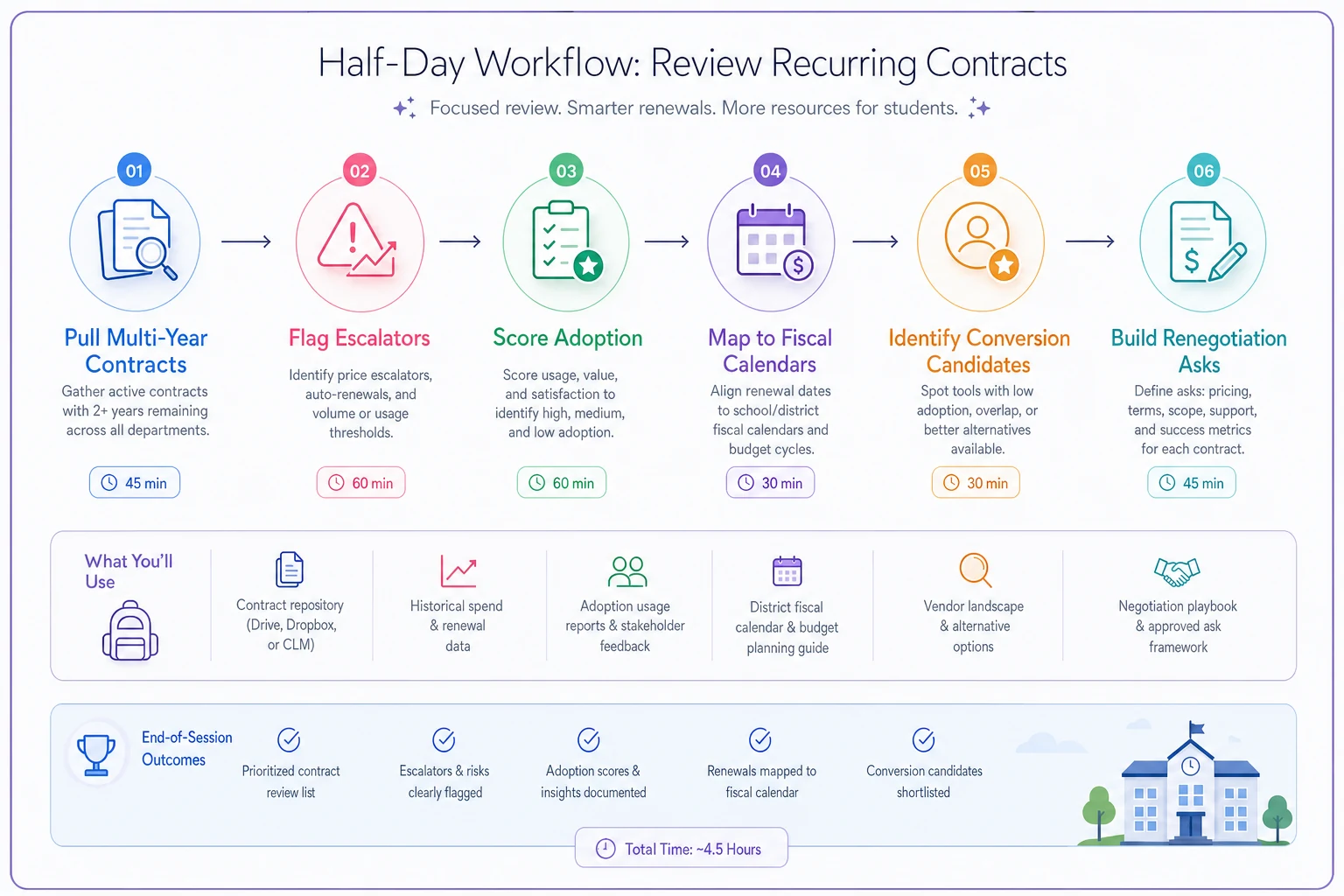
Use this visual as a checklist during your half-day review to keep the team focused on the highest-impact exposures.
Districts that keep this inventory current make far better decisions under pressure because they're not reacting to each renewal in isolation — they're seeing the whole recurring-obligation picture against the whole budget picture.
A real scenario: a mid-size district resets its renewal exposure
A district of roughly 6,000 students went through this exercise heading into a budget year where their facilities bond refinancing came in more expensive than modeled. Their recurring edtech spend sat around $410k annually across about 14 platforms. When they sorted contracts by escalator, they found four with uncapped or list-price-tied increases — accounting for a significant share of their year-over-year cost creep.
They did three things. They renegotiated two of those four contracts to hard-capped 3% escalators in exchange for signaling early renewal. They cancelled one high-cost platform sitting at under 25% teacher adoption — roughly a $34k line — and redirected part of that toward a staged pilot of a cheaper alternative. And they shifted their device refresh from a single bond-funded purchase to a staggered OpEx model so the cost stopped competing directly with debt service in a single year.
The result wasn't a dramatic windfall. It was something more useful in a tight year: they pulled roughly $40k–$50k of flexibility back into the operating budget and smoothed their renewal calendar so no single quarter got hammered. More importantly, they went into the next cycle with contracts they could actually adjust — which turned out to matter more than the immediate savings.
What to do before your next renewal lands
Higher yields aren't a crisis for most districts. They're a stress test that exposes whichever procurement habits were already loose. The districts that handle this period well aren't the ones with the best financing — they're the ones whose contracts were built to flex, whose spending was staged, and whose procurement teams knew exactly which recurring obligations could move and which couldn't.
Start with the contract inventory. Flag the escalators. Protect your renewal calendar from clustering against debt service. And treat every new multi-year commitment with the same scrutiny you'd give a bond — because in a high-rate environment, a locked recurring subscription behaves a lot like debt you forgot you took on.
The cost of money went up. The fix is making sure your commitments can bend when they need to.
Ready to elevate your classroom management?
Join 5,000+ educators using Skolyly to save time, engage students, and improve learning outcomes.