

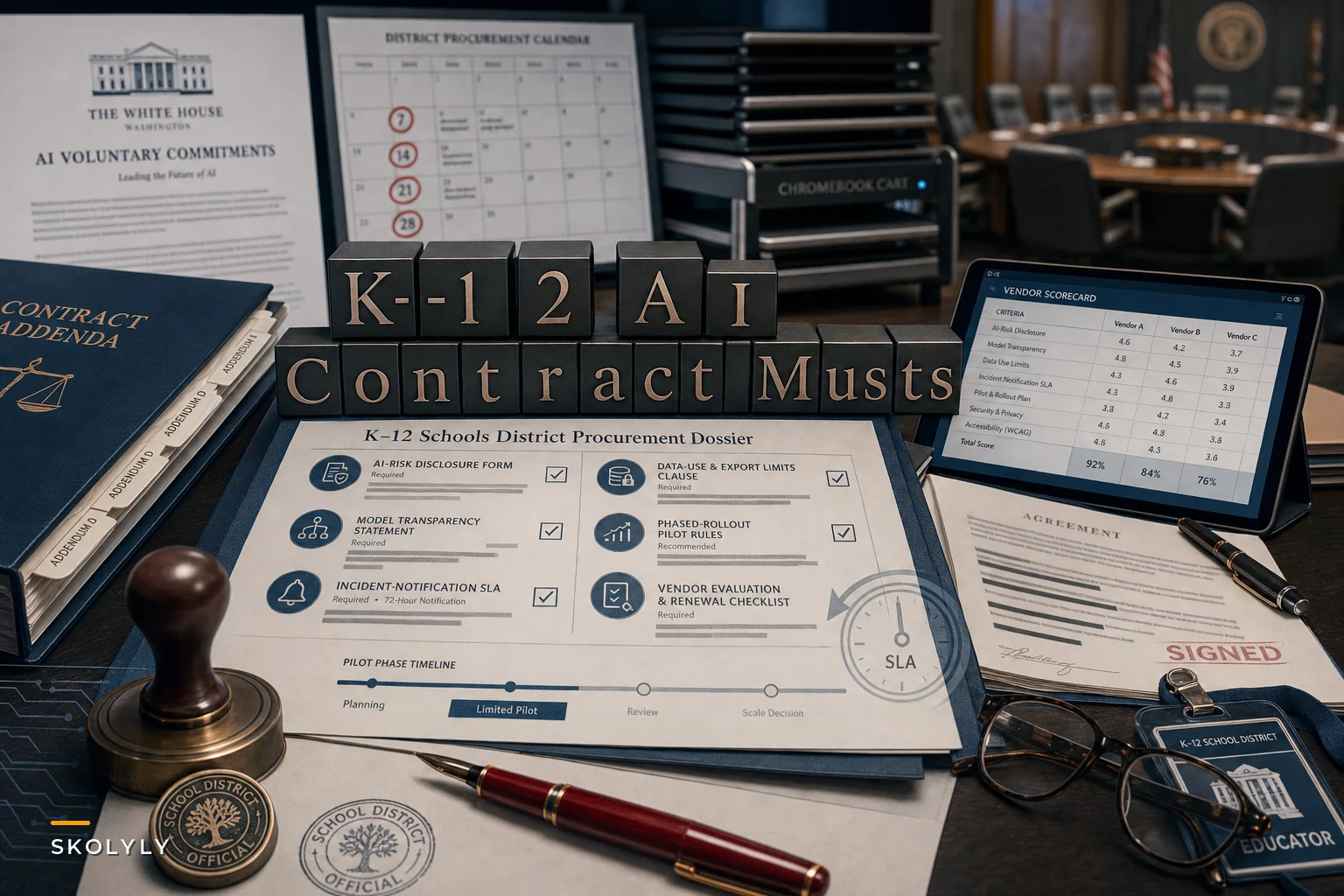

On September 29, 2026, the White House gathered senior executives from the biggest AI companies and released a voluntary "AI accord" — a set of industry commitments around safety, transparency, and data handling, signed by tech CEOs and described in Reuters' coverage as a framework the administration characterized as "morally binding." No new law. No enforcement mechanism. Just a public set of promises.
For most industries, that's background noise. For K–12, it's going to land in your inbox sooner than expected — specifically in the form of vendor marketing language. The companies building your LMS, your adaptive math platform, your writing-feedback tool, your early-warning student dashboards — they're all downstream of the same AI providers that signed this thing. Within weeks, expect phrases like "aligned with national AI safety commitments" to start showing up in renewal decks and RFP responses.
The accord itself isn't the problem. The problem is what happens when a voluntary, unenforceable commitment gets translated into a sales claim, and a district signs a contract assuming that claim means something. It usually doesn't. This post is about closing that gap in your AI edtech contracts — the actual clauses, disclosures, and verification steps that turn a vendor's marketing promise into something you can actually hold them to.
Why a Voluntary Accord Creates a Contract Problem
Voluntary industry commitments move liability in the wrong direction for a buyer.
When a vendor says they "follow leading AI safety practices," it sounds reassuring. But in a contract dispute, a marketing claim and a warranty are completely different things. A warranty is enforceable. A reference to a voluntary framework you can't cite by clause number is not. As CNBC reported, even the people promoting the accord leaned on moral language rather than legal language — which tells you exactly how much weight it carries in arbitration.
The operational risk plays out like this: your procurement team feels more comfortable because the vendor name-drops the accord, and that comfort quietly replaces the hard questions you'd normally ask. The accord becomes a substitute for diligence instead of a prompt for it.
What tends to happen across district procurement cycles is that vendor reassurance peaks right before renewal — when switching costs are highest and your leverage is lowest. A public accord just gives vendors one more reassurance tool at precisely the moment you should be tightening scrutiny, not relaxing it.
The Three Questions the Accord Doesn't Answer for You
The accord speaks in generalities. Your contract has to speak in specifics. Three gaps matter most:
Keep every student on track with ease.
Skolyly helps you create, assign, and monitor classroom activities efficiently.
- Integrated lesson and assignment management
- Real-time student progress tracking
- Automated class scheduling & notifications
No credit card required
1. What is the model actually doing with student data and student work? "We don't sell data" is not the same as "we don't use student essays to train or fine-tune models." A lot of edtech tools now run on top of third-party foundation models, which means student data may travel through a vendor you never evaluated. The accord doesn't surface that chain. Your contract has to.
2. What are the model's known limitations and failure modes? An AI writing tutor that hallucinates a citation is a nuisance in one context and a credibility problem in another. A behavior-flagging system with a high false-positive rate on certain student populations isn't a feature — it's a liability you absorbed without knowing it.
3. What happens when something goes wrong, and how fast do you find out? Incident notification timelines are the most consistently ignored clause in edtech agreements. If a vendor's AI system produces biased outputs or a data exposure, "we'll let you know" is not a timeline. You need specific hours and days, in writing.
Clauses to Add to AI EdTech Contracts
This is the section your legal counsel and CTO should mark up together. These aren't hypothetical — each one maps to a failure that's played out in real renewals.
| Contract Area | Weak / Common Language | What to Require Instead |
|---|---|---|
| Data use for training | "We protect your data" | "Vendor will not use district or student data to train, fine-tune, or improve any model without written, revocable district consent." |
| Subprocessor AI models | Silent / not mentioned | Named list of all underlying AI/model providers, with 30-day advance notice before adding or changing any. |
| Model transparency | "Industry-leading accuracy" | Documented known limitations, intended-use statement, and a plain-language description of what the model does not do reliably. |
| Incident notification | "Timely notice" | Written notice within 72 hours of a data incident; 7 days for discovered bias or systemic output errors. |
| Bias & disparate impact | Not addressed | Vendor provides documentation of any demographic performance testing; district may audit outputs. |
| Human-in-the-loop | Assumed | Explicit statement that no high-stakes decision (placement, discipline, eligibility) is fully automated. |
| Exit & data return | Vague | Data deletion certification within 30 days of termination, including any derived or embedded representations. |
The row districts underweight most is subprocessor AI models. You can vet a vendor thoroughly and still have no idea their "AI feedback engine" is a thin wrapper over a general-purpose model with its own data terms. Requiring a named list closes that blind spot, and it's a clause most vendors can produce quickly if they're operating honestly.
A Verification Workflow That Doesn't Stall Procurement
Strong clauses are useless if no one checks whether the vendor actually meets them. The common failure pattern: legal adds solid language, procurement signs, and then nobody verifies anything before deployment. Six months later a teacher flags something odd and there's no paper trail to work from.
-
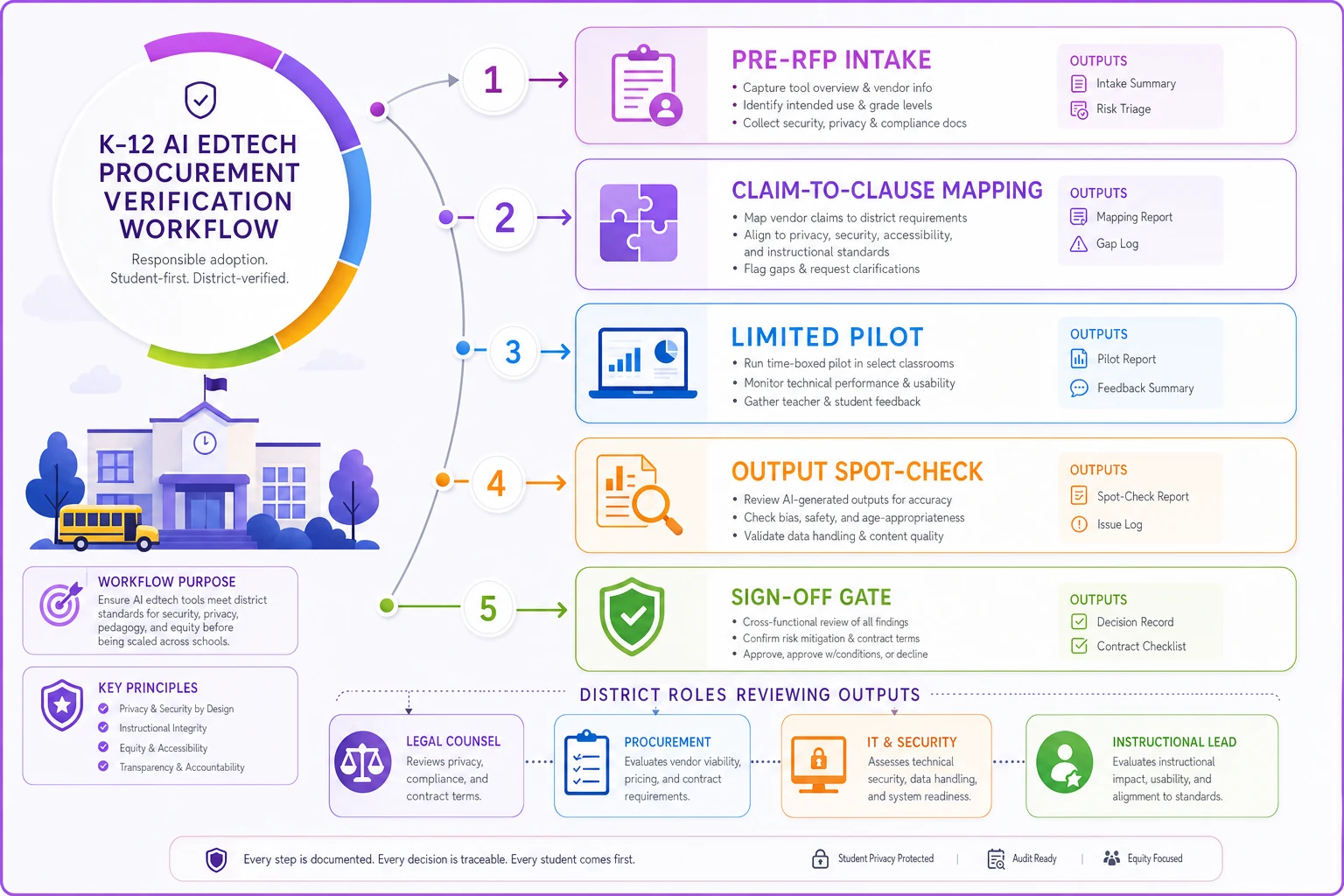
Pre-RFP intake. Add three AI-specific questions to your vendor questionnaire: what models they use, where student data goes, and their incident-notification timeline. Vague or evasive answers are a scoring signal, not a formality.
-
Claim-to-clause mapping. For every AI-related marketing claim in the vendor's materials, require them to identify the specific contract clause backing it. Claims with no clause get struck or rewritten.
-
Limited pilot before full rollout. Deploy to one or two grade bands for a defined window before committing district-wide. This protects instructional time and gives you real output to inspect.
-
Output spot-check. During the pilot, sample actual AI outputs — feedback given to students, flags raised, recommendations made — and have a content-area lead review them for accuracy and potential bias.
-
Sign-off gate. No full deployment until legal confirms clauses are in place, IT confirms data flows match the contract, and an instructional lead signs off on pilot outputs.
The workflow looks like this.
In practice this adds maybe one to two weeks to procurement. It catches the problems that otherwise take a full school year to unwind.
A Real Scenario: The Renewal That Almost Went Through Quietly
Consider a mid-sized district — roughly 8,000 students — renewing a three-year contract for an adaptive literacy platform, somewhere in the $90k–$110k annual range. The vendor's renewal deck prominently referenced alignment with the new national AI commitments. On the surface, it looked like a clean renewal.
During the claim-to-clause mapping step, the district's counsel asked a straightforward question: which contract clause guarantees student writing won't be used to improve the model? There wasn't one. The vendor's actual terms allowed "product improvement" use of aggregated student inputs — which, read carefully, included student essays.
The district didn't walk away. They used the pilot gate as leverage, held full rollout, and negotiated a revised clause with explicit opt-out language and a named-subprocessor list. The renewal still closed, roughly on schedule, but with actual guarantees replacing a marketing line. Catching it cost about two extra weeks of legal review. Missing it would have left a data-use practice the district couldn't defend to families or its board.
The lesson isn't that this vendor was acting in bad faith. It's that a public accord made the renewal feel safer than the contract actually was. That gap is the entire risk.
When to Push Hard — and When It's Overkill
Not every tool needs the full treatment. Calibrate by risk:
Push hard when:
-
The tool makes or informs high-stakes decisions (placement, discipline, special-ed eligibility, graduation).
-
Student-generated content flows into the model (essays, responses, recordings).
-
The tool touches a protected or vulnerable population directly.
Keep it lighter when:
-
The AI feature is cosmetic or optional and processes no identifiable student data.
-
The tool is already covered by a strong master data agreement and you're adding a minor feature.
Who should slow down before signing at all: Districts without a named owner for AI vendor review. If no single person — usually in the CTO's office — owns the claim-to-clause mapping, strong contract language won't actually get enforced. In that case, delaying the renewal is better than signing something no one will police.
Keeping This From Becoming a One-Time Scramble
The accord is a news cycle. Your vendor portfolio isn't. Districts that handle this well don't treat it as a special project — they fold AI-specific checks into the renewal process they already run. The existing vendor review rubric gets a short AI section, incident-notification standards get written once and reused, and pilot gates apply to any tool making automated decisions.
If you're building that muscle from scratch, it's worth grounding the AI clauses inside a broader renewal discipline rather than bolting them on as an afterthought. Our K–12 edtech vendor contract checklist covers the renewal-risk fundamentals those AI clauses need to sit on top of — because an AI transparency clause doesn't do much if your underlying exit, data-return, and liability terms are already shaky.
The Takeaway for District Leaders
A voluntary accord shifts public expectations. It does not shift your legal position. Districts that benefit from this moment are the ones that treat vendor references to the accord as an opening question — "great, show me the clause" — rather than a closing reassurance. Your leverage is highest before you sign. Use it to convert vague alignment language into named subprocessors, written notification timelines, explicit data-use limits, and human-in-the-loop guarantees for anything high-stakes. The work is manageable: a few extra questions during intake, a mapping exercise, a pilot gate, and a sign-off that actually gates deployment. The alternative is discovering, a year into a three-year contract, that the reassuring language in the sales deck was never anywhere in the agreement you're now stuck with.
Ready to elevate your classroom management?
Join 5,000+ educators using Skolyly to save time, engage students, and improve learning outcomes.