

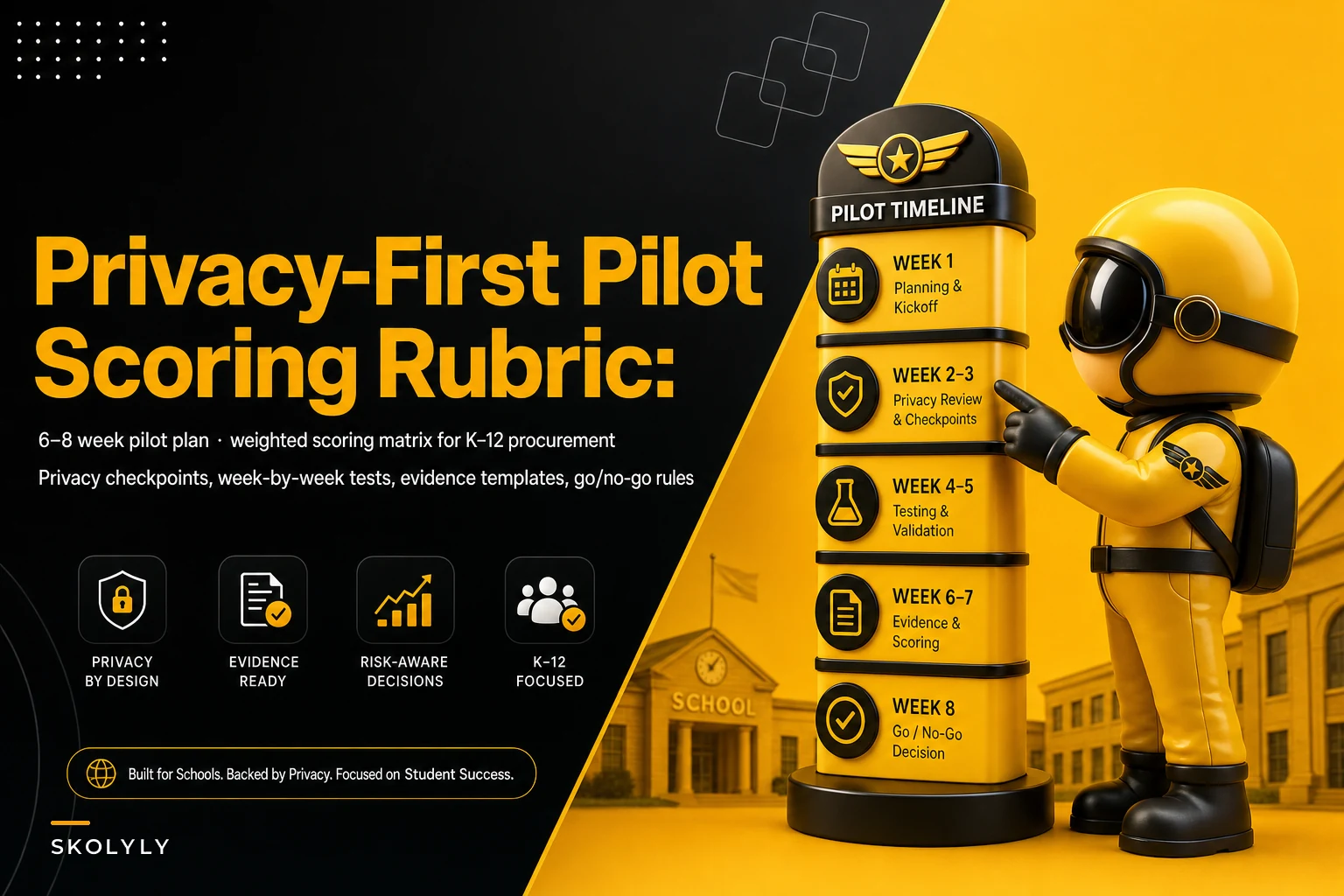

Most classroom platform pilots collapse in the same quiet way. A district runs a six-week trial, three enthusiastic teachers log in constantly, everyone agrees it "feels good," and the purchasing decision gets made on vibes plus a vendor demo. Then nine months later the gradebook won't export cleanly to the SIS, parents are getting double-notified about the same missing assignment, and nobody can produce a straight answer about where student data goes when a family transfers out.
The fix isn't a longer pilot. It's a pilot with a scoring rubric that forces evidence—and treats privacy checkpoints as pass/fail gates woven into weekly tasks rather than a compliance box checked at the end. What follows is a week-by-week plan you can lift directly, with sample weightings, score thresholds, evidence templates, and role assignments. No vendor names, no shortlist, no "recommended platforms." Just the instrument.
Why pilots score the wrong things
The default pilot measures enthusiasm. Enthusiasm is a terrible proxy for durability. The teachers who volunteer to pilot are, almost by definition, the ones most willing to tolerate friction and figure out workarounds. Their experience tells you almost nothing about what happens when a skeptical 23-year veteran with 150 students tries to enter grades during a 40-minute prep period.
A privacy-centric rubric fixes this by scoring four operational domains and five privacy domains, and by requiring artifacts—not opinions. You don't score "parent messaging felt easy." You score "we sent a test message to 30 families; 2 bounced, delivery logs were accessible, and opt-out was honored within one cycle."
The second thing most pilots get wrong: they sequence privacy last. By the time someone reviews the data processing agreement, the teachers love the tool and the committee is emotionally committed. Reviewing retention and exportability in week six means you're negotiating from weakness. Pull those checks forward.
The nine scoring domains and how to weight them
The weighting structure below gives privacy and data governance real teeth—roughly a third of the total—so a platform that wows teachers but fumbles data handling can't sail through on goodwill.
Keep every student on track with ease.
Skolyly helps you create, assign, and monitor classroom activities efficiently.
- Integrated lesson and assignment management
- Real-time student progress tracking
- Automated class scheduling & notifications
No credit card required
| Domain | Category | Weight | Pass threshold |
|---|---|---|---|
| Centralized assignment management | Operational | 15% | ≥ 3.5 / 5 |
| Gradebook integrity | Operational | 15% | ≥ 4.0 / 5 (higher bar—errors here are expensive) |
| Parent messaging | Operational | 12% | ≥ 3.5 / 5 |
| Automated scheduling | Operational | 10% | ≥ 3.0 / 5 |
| Consent & notice | Privacy | 10% | Gate: must pass |
| Data retention & deletion | Privacy | 10% | Gate: must pass |
| Exportability & portability | Privacy | 10% | Gate: must pass |
| Admin controls & roles | Privacy | 10% | ≥ 4.0 / 5 |
| Interoperability (rostering/SIS) | Privacy/Operational | 8% | ≥ 3.5 / 5 |
Two things worth noticing. First, three of the privacy domains are structured as pass/fail gates—not just weighted. A platform can score a 92 overall and still get disqualified if it fails the retention gate. That's intentional. You don't want a weighted average letting a strong gradebook paper over the fact that there's no documented deletion process.
Second, gradebook integrity carries a higher internal threshold (4.0 instead of 3.5). A gradebook that rounds inconsistently or silently drops a dropped-lowest-score rule creates grade disputes that eat administrator hours for an entire semester. It deserves a stricter bar than scheduling does.
If you've already built a procurement rubric at the district governance level, this pilot rubric should slot underneath it as the hands-on evidence layer. It's worth reading alongside your broader student data privacy playbook covering retention, consent, and vendor checklists, since several of the gate criteria below are the practical, in-pilot test of policies that playbook defines on paper.
Stakeholder roles: who does what
A pilot without named owners produces consensus mush. Assign these five roles before week one, and make sure the people in them actually have time blocked.
-
Pilot lead (assistant principal or curriculum director) owns the timeline, convenes the scoring sessions, holds the master evidence folder.
-
Teacher evaluators (4–6, deliberately mixed) include at least one reluctant adopter and one teacher with a heavy caseload. Their job is daily use plus logging friction.
-
Data/privacy reviewer (someone from IT or a data governance lead) owns all four privacy gates and the interoperability check. Non-negotiable that this is a different person than the pilot lead.
-
Parent liaison (one counselor or front-office staffer) runs the parent-messaging and consent-experience tests from the family side.
-
SIS/rostering admin owns the import/export and sync testing. Often the most overlooked role, and the one that surfaces the dealbreakers.
When the privacy reviewer and the pilot lead are the same person, privacy loses every time. The pilot lead is invested in a successful pilot. Separate those incentives.
The week-by-week plan
This runs as a six-week core with two optional buffer weeks for larger districts or multi-school pilots. Each week pairs operational tasks with a specific privacy checkpoint so the gates get real attention early.
Here's the weekly workflow.
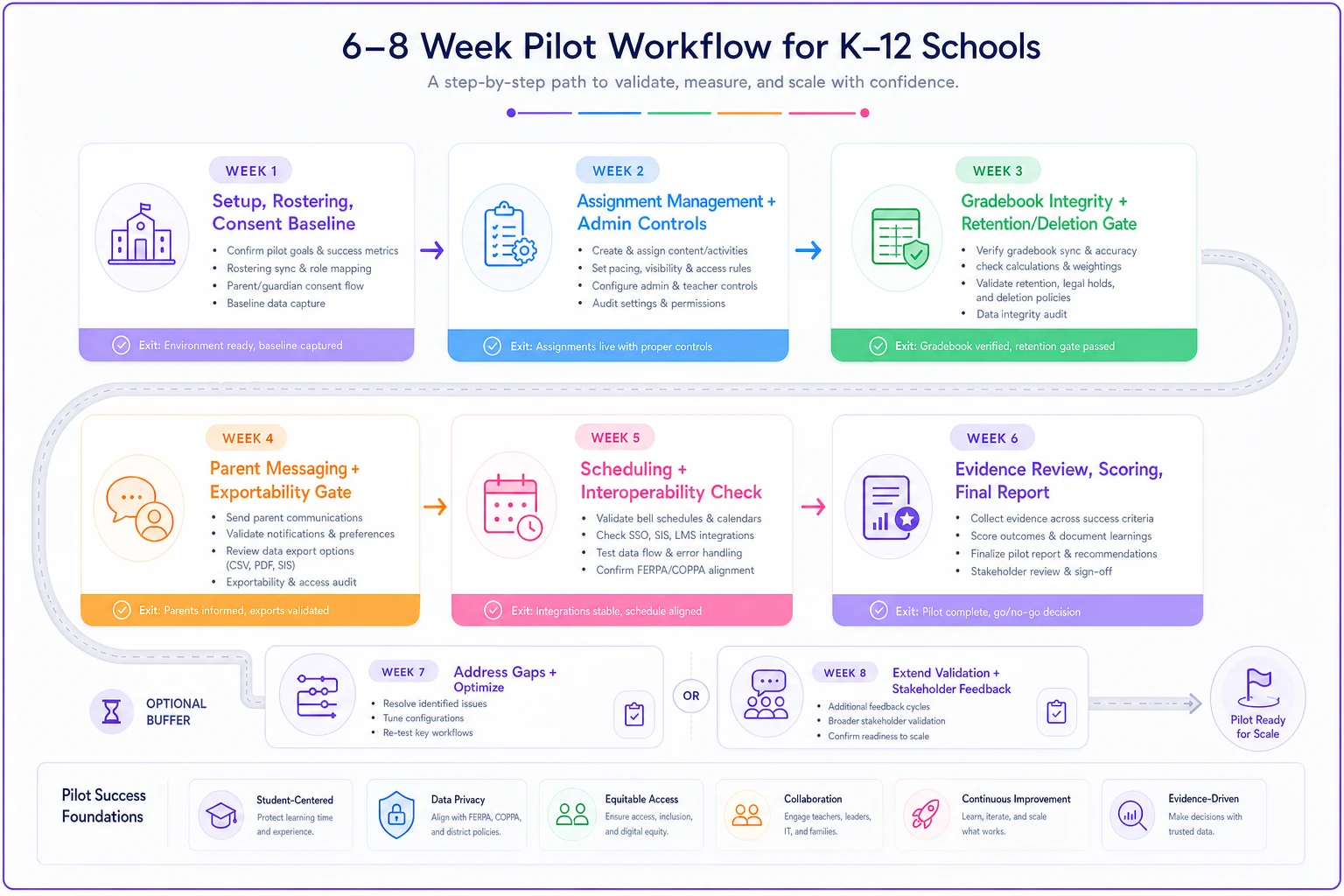
Week 1 — Setup, rostering, and consent baseline
Operational work this week is unglamorous: provision accounts, import a real roster (not a sample), and configure one grading period. Use an actual class roster with messy edge cases—co-taught sections, students enrolled mid-year, a student with a legal name that differs from their preferred name.
Privacy checkpoint — Consent & notice: The parent liaison documents exactly what data the platform collects at first login and whether the district's existing consent notice covers it. Evidence: screenshot of the first-run data collection, plus a one-line mapping to your consent inventory.
Gate question: Does anything get collected that families weren't told about?
Week 2 — Centralized assignment management
Teachers build out two real units' worth of assignments across sections. The test isn't "can you post an assignment"—every platform can do that. The test is whether a teacher can reuse an assignment across three sections and edit it once so all three update, and whether they can see every student missing work across all their classes in a single view without clicking through each section individually.
Privacy checkpoint — Admin controls & roles: The data reviewer tests whether a teacher can see students outside their roster, whether a substitute account can be scoped down, and whether role changes take effect immediately. Evidence: a permissions matrix showing what each role can view and edit.
Week 3 — Gradebook integrity (the hard week)
This is where you spend the most time, and where pilots most often reveal what actually matters. Have teachers enter a full set of grades including the awkward cases: excused assignments, late penalties, weighted categories, a dropped lowest score, and a grade correction after the fact.
Then—and this is the step most pilots skip—recalculate by hand for five students and compare. Platforms that silently handle "excused" as a zero in the average, or that round at the category level and again at the final level, produce grades that are off by a point or two in ways nobody notices until a parent appeals an 89.4 that should have been a 90.
Privacy checkpoint — Data retention & deletion: The data reviewer requests the platform's documented retention schedule and tests whether a withdrawn student's record can actually be deleted or anonymized on request. Evidence: the vendor's written retention policy plus a screenshot or confirmation of a test deletion.
Gate question: Is there a real, demonstrable deletion path—or just a promise?
Week 4 — Parent messaging
The parent liaison and two teachers run a realistic messaging cycle: a class-wide announcement, three individual messages, and one message to a family that has opted out of digital communication. Test delivery logs, bounce handling, translation (if your families need it), and whether replies route back to the right teacher or vanish into a no-reply void.
A common failure: messages send fine but there's no audit trail, so when a parent says "I never got the message about the field trip," nobody can confirm. Delivery evidence matters.
Privacy checkpoint — Exportability & portability: The SIS admin exports a full class's data—grades, assignments, comments—and checks the format. Is it a clean, documented format (CSV, OneRoster-compatible) or a locked PDF that's useless for migration? Evidence: the actual export file.
Gate question: If we leave this vendor in two years, can we get our data out in a usable form?
Week 5 — Automated scheduling and interoperability
Test scheduling features against a real constraint: an intervention block, a rotating bell schedule, or a shared-resource booking. Then run the interoperability test hard—push a roster change in the SIS and confirm it syncs, verify SSO works for both a student and a parent account, and check that grade passback (if claimed) actually lands correctly in the SIS.
Privacy checkpoint — Interoperability: The SIS admin confirms the data-sharing method (API, SFTP, manual) and documents what data crosses the boundary and how often. Evidence: a data-flow note describing what moves between systems. Score ≥ 3.5 to pass.
Week 6 — Scoring, evidence review, and reporting
No new testing. This week is for assembling evidence, running the scoring session, and writing the report. All evaluators score independently first, then reconcile in one meeting. The pilot lead compiles the evidence folder; the data reviewer confirms each gate passed or failed.
Once the evidence folder is assembled, the pilot lead and data reviewer should do a final cross-check before the scoring session—confirming that every criterion has at least one artifact behind it, and flagging anything that came back incomplete. Gaps found in this stage are findings, not oversights to quietly ignore.
Weeks 7–8 (optional buffer)
Use these if you're piloting across multiple schools, if a gate failed and the vendor requested a chance to remediate, or if you need a second grading cycle to confirm gradebook behavior across a reporting period boundary. Don't use them to extend enthusiasm-gathering.
Scoring mechanics and thresholds
Keep scoring on a simple 1–5 scale with anchored descriptions, not a vague "rate your satisfaction." For each criterion, write what a 1, 3, and 5 actually look like before the pilot starts. Example for gradebook integrity:
-
5 Hand-recalculation matched the platform exactly across all five test students, including excused and dropped-score cases.
-
3 Matched on standard cases but one edge case (e.g., excused handling) required a workaround.
-
1 Produced grades that differed from hand calculation with no clear explanation.
Overall decision thresholds:
-
Any privacy gate fails → platform is disqualified, regardless of total score. No exceptions, no "we'll fix it in the contract."
-
Weighted total ≥ 80% AND all operational thresholds met → advance to contract/negotiation stage.
-
Weighted total 65–79% → conditional; document specific gaps and require written remediation before advancing.
-
Below 65% → do not advance.
Hard-coding the gate rule matters because committees talk themselves out of privacy concerns when they like a product. A written rule, agreed to before anyone saw the demos, removes that temptation.
Evidence collection templates
Every score needs an artifact behind it. Keep this in one shared folder organized by domain:
-
Assignment management screenshots of cross-section reuse and the missing-work overview.
-
Gradebook the hand-recalculation worksheet (five students) with platform values next to manual values.
-
Parent messaging delivery log export and one opt-out confirmation.
-
Scheduling a built schedule showing the real constraint handled.
-
Consent first-run data-collection screenshot + mapping to consent inventory.
-
Retention vendor retention policy document + test-deletion confirmation.
-
Exportability the actual export file.
-
Admin controls completed permissions matrix.
-
Interoperability data-flow note + sync test result.
If a criterion has no artifact, it scores incomplete—not a default pass. "We didn't get to test it" is itself a finding.
A realistic look at how this plays out
A mid-sized district—around 4,000 students across six schools—ran a pilot the old way the previous year and renewed a platform largely on teacher excitement. The gradebook turned out to round at two levels, and by fall the counseling office was fielding grade-recalculation requests that ate somewhere between 10 and 15 staff hours across the first marking period. The exportability problem didn't surface until they tried to migrate records for transfer students and discovered exports came out as flattened PDFs.
The next cycle they ran this rubric with a four-teacher mixed panel and a separate data reviewer. The retention gate failed outright for one strong-looking contender—there was no documented deletion path, just a support-ticket promise. That platform scored an 84 on everything else and would have won under the old approach. Under the gate rule, it was out.
The platform they advanced scored lower on teacher enthusiasm but passed all four gates cleanly and exported in OneRoster-compatible format. No grade-dispute pileup the following fall, and the transfer-record migration took an afternoon instead of a scramble. The lesson wasn't that the first platform was bad software. The pilot finally measured the things that generate downstream administrator hours instead of the things that generate week-one excitement.
When this rubric makes sense—and when it's overkill
Use the full rubric when: you're committing to a core classroom platform (gradebook + assignments + communication) that will touch every teacher and every family, and when the contract runs multiple years. The stakes justify six weeks.
Scale it down when: you're evaluating a narrow single-purpose tool—a flashcard app, a formative-assessment tool—that doesn't hold grades of record or sync with the SIS. Run the four privacy gates and skip most operational scoring; the operational surface is too small to warrant it.
Who should not run this as-is: a single school piloting something informally with two teachers for a semester. The role separation and gate structure assume district-level stakes. For a classroom experiment, this framework would over-engineer a decision that's easy to reverse.
The reporting template
Close the pilot with a one-to-two page brief, not a deck. It should state: the four operational scores and the five privacy results (pass/fail or score), whether each gate passed, the overall weighted total, the decision tier it lands in, and the top three pieces of evidence that drove the call. Attach the evidence folder.
Anyone who reads the brief should be able to reconstruct why the decision was made six months later—which is exactly when someone always asks. A pilot's real output isn't a winner. It's a defensible, evidence-backed decision that holds up when the gradebook gets audited, when a parent appeals a grade, or when a family requests their child's data be deleted.
Score the boring, expensive-later things early, keep privacy as a gate rather than a footnote, and the six weeks will save you a year of cleanup.
Ready to elevate your classroom management?
Join 5,000+ educators using Skolyly to save time, engage students, and improve learning outcomes.