

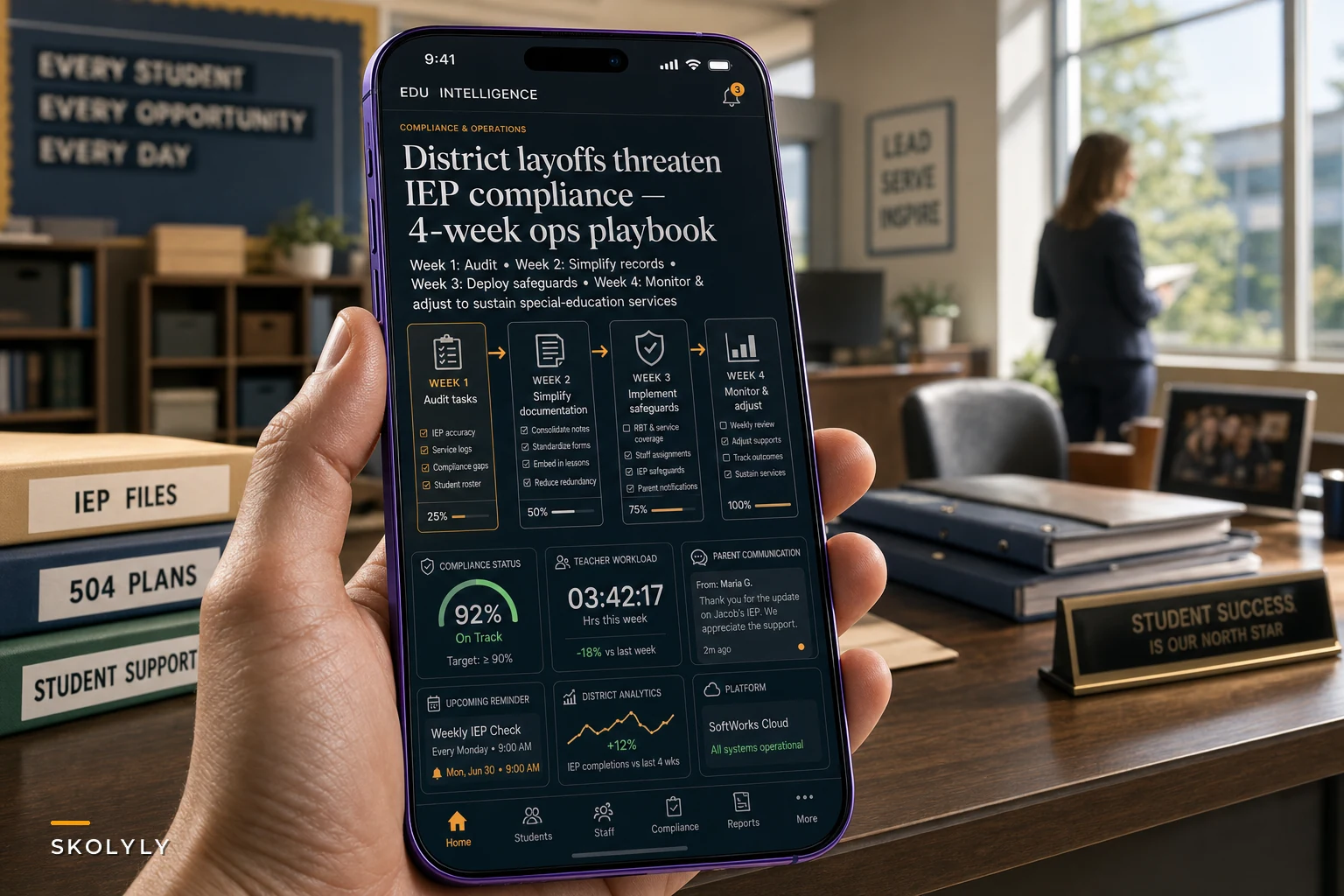

Last week, my district's special ed coordinator texted our admin group chat at 11pm: "Lost three more paraprofessionals. Still have 47 active IEPs in those classrooms. How are we supposed to document accommodations now?"
She's not alone. Education Week reports that thousands of school employees across major districts just received layoff warnings as federal pandemic funding expires. Districts from Los Angeles to Houston are cutting positions while enrollment drops and costs rise.
What makes this particularly brutal for IEP compliance: you're losing the very staff who help track and implement accommodations, but the legal requirements don't shrink with your headcount. They actually get harder to manage.
The compliance trap that budget cuts create
When districts cut support staff, three things happen immediately that most administrators don't see coming.
First, accommodation tracking falls apart. Those paraprofessionals weren't just helping students — they were your second set of eyes confirming that Tommy got his extended time on the math test and Sarah used her text-to-speech tool during independent reading. Without them, teachers are flying blind on whether accommodations actually happened.
Second, the paperwork burden shifts entirely to remaining teachers. A third-grade teacher managing 24 students might have had help documenting the daily accommodations for her four IEP students. Now she's doing it alone while also covering playground duty because two aids are gone.
Third, legal vulnerability skyrockets. Every missed accommodation is a potential due process complaint. Every undocumented support is ammunition in a lawsuit. And stressed, overworked teachers make more documentation mistakes.
The districts getting sued aren't the ones with bad intentions. They're the ones whose documentation systems collapsed when staffing got tight.
Why traditional tracking systems fail during staff reductions
Most schools track IEP accommodations through some combination of paper forms, shared spreadsheets, and whatever system individual teachers cobble together. This works okay at full staffing. It becomes a disaster when you're short-handed.
Keep every student on track with ease.
Skolyly helps you create, assign, and monitor classroom activities efficiently.
- Integrated lesson and assignment management
- Real-time student progress tracking
- Automated class scheduling & notifications
No credit card required
Take Roosevelt Elementary's experience from last spring. They had a decent system — weekly accommodation logs that paraprofessionals filled out, monthly reviews with the special ed team, quarterly parent updates. Then they lost about 30% of their support staff.
Within six weeks, documentation went from comprehensive to spotty. Teachers started skipping the logs because they were drowning. The special ed coordinator couldn't review what wasn't being recorded. Parents started noticing accommodations weren't happening consistently.
By October, they had three due process complaints and a state compliance review. The review found "systemic failures in accommodation tracking and implementation."
The principal told me later: "We were doing our best with less people, but 'doing our best' doesn't hold up in a compliance hearing."
The hidden multiplication effect of documentation burden
People outside education don't realize how documentation requirements stack up across a school day.
Say Ms. Chen teaches fourth grade with 26 students, five with IEPs. Here's her daily documentation load:
Morning:
-
Check which students need preferential seating for the science lesson
-
Note who gets modified assignments for math
-
Document behavior intervention for one student during morning work
-
Track who used assistive technology during reading groups
Afternoon:
-
Log accommodations provided during state test prep
-
Record modifications made to the social studies assignment
-
Document sensory breaks for one student
-
Note parent communication about homework modifications
End of day:
-
Transfer all notes to official accommodation logs
-
Update behavior tracking spreadsheet
-
Email the special ed coordinator about concerns
-
Prep tomorrow's modified materials
That's easily 40-45 minutes of documentation daily, assuming everything goes smoothly. Now remove the paraprofessional who usually handled half of this. Add covering another class during prep because you're short a substitute. Include three new IEP students who transferred in because their school closed positions.
Ms. Chen now faces 90+ minutes of documentation work daily. Something has to give. Usually it's the documentation, not the actual accommodations. But legally, undocumented accommodations might as well not exist.
Building a defensive compliance system with less staff
Schools surviving these cuts without compliance disasters aren't trying to maintain their old systems with fewer people. They're fundamentally restructuring how they handle documentation.
Start with accommodation bundling. Instead of tracking 15 individual accommodations across seven subjects, group them into daily implementation clusters:
| Traditional Tracking | Bundled Tracking |
|---|---|
| Extended time - Math | Morning academic block: Extended time + Breaks |
| Extended time - Reading | Afternoon academic block: Modified assignments + Tech support |
| Movement breaks - All subjects | Daily behavior supports: Check-ins + Sensory tools |
| Preferential seating - Science | Environmental: Seating + Noise reduction (all day) |
| Calculator use - Math |
This cuts documentation points from 15+ to 4 without losing legal coverage.
Next, shift from individual to classroom-level tracking where it makes sense. Instead of "Tommy received extended time on math quiz," document "Extended time provided to all IEP students during math assessment (T.S., S.M., J.R.)." This covers the compliance requirement while cutting documentation time by more than half.
A few other shortcuts that hold up legally:
-
Pre-populate weekly templates with standard accommodations
-
Use codes instead of full descriptions (ET = extended time, MB = movement break)
-
Batch documentation at natural transition points
-
Photograph work samples showing modifications instead of writing descriptions
These changes reduce documentation points and make compliance feasible with fewer hands on deck.
The compliance safeguards you can't afford to skip
Even with simplified systems, certain elements remain non-negotiable. You need clear evidence of:
Daily accommodation provision — Not every single accommodation, but proof that each student's plan was actively implemented each day they attended.
Parent communication — Regular updates showing you're monitoring implementation, even if staffing is stretched thin.
Team coordination — Evidence that remaining staff know each student's requirements and are actually working together to meet them.
Roosevelt Elementary learned this the hard way. They simplified everything except parent communication to save time. But when complaints came in, the lack of proactive parent contact made it look like they were hiding problems rather than managing through constraints.
When to admit your manual system is breaking
There are clear warning signs that your documentation system can't handle current staffing levels:
-
Teachers regularly stay past 5pm just for paperwork
-
Documentation is happening days after accommodations were provided
-
You're finding blank accommodation logs from previous weeks
-
Parents are asking about supports you can't verify actually happened
-
Your special ed coordinator is personally re-checking everyone's documentation
Two or more of these and your manual system has already failed. You just haven't seen the compliance complaint yet.
This is where schools start looking at operational software that can automate tracking. The better platforms let teachers confirm accommodations with a quick click during natural breaks, automatically generate parent updates, and flag missing documentation before it becomes a legal issue.
Some schools resist this, thinking technology just adds more complexity. But modern educational operations platforms actually reduce work. Teachers spend less time on paperwork, parents get better updates, and administrators have real-time compliance visibility instead of finding out about gaps after a complaint lands.
Protecting your highest-risk students during transitions
Staff reductions hit certain students disproportionately hard from a compliance standpoint. Your highest-risk categories:
Students with behavioral IEPs — These require the most documentation and are most likely to trigger complaints when supports disappear.
Students with new IEPs — Their accommodations aren't routine yet, so they're easily missed when staff is stretched.
Students with complex medical needs — Missing their accommodations can have immediate health consequences.
Students with involved advocates — Parents who know their rights will notice immediately when documentation slips.
For these students, you need backup documentation systems. Maybe that's a daily check-in email to parents. Maybe it's assigning them to your most experienced teachers who won't let documentation slide. The point is to identify your compliance vulnerabilities before they become legal problems.
Building sustainable documentation with 70% staffing
Let's be realistic. You're probably operating at 70-80% of ideal staffing. That's not changing next semester. Maybe not next year either.
So you need documentation systems built for this reality, not for the staffing levels you wish you had.
Here's what sustainable documentation actually looks like with reduced staff:
Morning routine (5 minutes):
-
Teacher opens daily accommodation checklist (pre-populated)
-
Scans for any changes needed based on today's activities
-
Makes quick modifications if needed
Pre-populate daily accommodation checklists so teachers can confirm quickly each morning.
During instruction (30 seconds per transition):
-
Quick click or checkmark as accommodations are provided
-
Photo of modified assignment instead of a written description
-
Voice note instead of typed observation
End of day (5 minutes):
-
Batch confirm all standard accommodations
-
Flag any concerns for follow-up
-
System auto-generates parent updates and compliance reports
Notice what's missing? The redundant transferring of information between systems. The lengthy narrative descriptions. The duplicate documentation across team members.
Schools tracking accommodations efficiently during transitions have found that streamlined documentation actually improves compliance because teachers consistently complete it.
The conversation with teachers that changes everything
Your teachers are drowning. They know it. You know it. But they're also terrified of compliance violations.
Here's how some principals are reframing documentation during staff cuts:
"We're not asking you to document less. We're changing what documentation looks like. Instead of writing paragraphs about every accommodation, we need consistent confirmation that core supports happened. Instead of perfect records, we need legally sufficient records."
Before: "During the 9:15-10:00 reading block, student was provided with text-to-speech software for the grade-level reading passage. Student used the tool independently after initial setup support. Completed modified comprehension questions with 80% accuracy."
After: "Reading block: TTS provided, modified assessment given (photo attached)"
Same legal coverage. About 75% less time.
Teachers need to hear that perfect documentation that never gets done is worse than good-enough documentation that happens consistently.
Why partial automation beats full manual tracking
Schools resist automation because they picture complicated systems that require weeks of training. Modern educational operations platforms work differently though.
Instead of replacing your entire workflow, they automate the repetitive parts while keeping teachers in control. A teacher still confirms accommodations happened — the system handles generating reports, updating logs, notifying parents, and flagging missing documentation.
Right now your teachers probably spend roughly 40% of their documentation time on actual observation and the rest transferring, formatting, and reporting that information. AI-assisted platforms flip that ratio without adding new decision-making burdens to already-stretched staff.
The operational software doesn't make decisions about accommodations. It just makes sure the accommodations teachers provide actually get documented without eating their entire planning period.
Your next 30 days: building crisis-resistant compliance
If you're facing staff cuts now or expecting them soon, here's a practical defensive playbook:
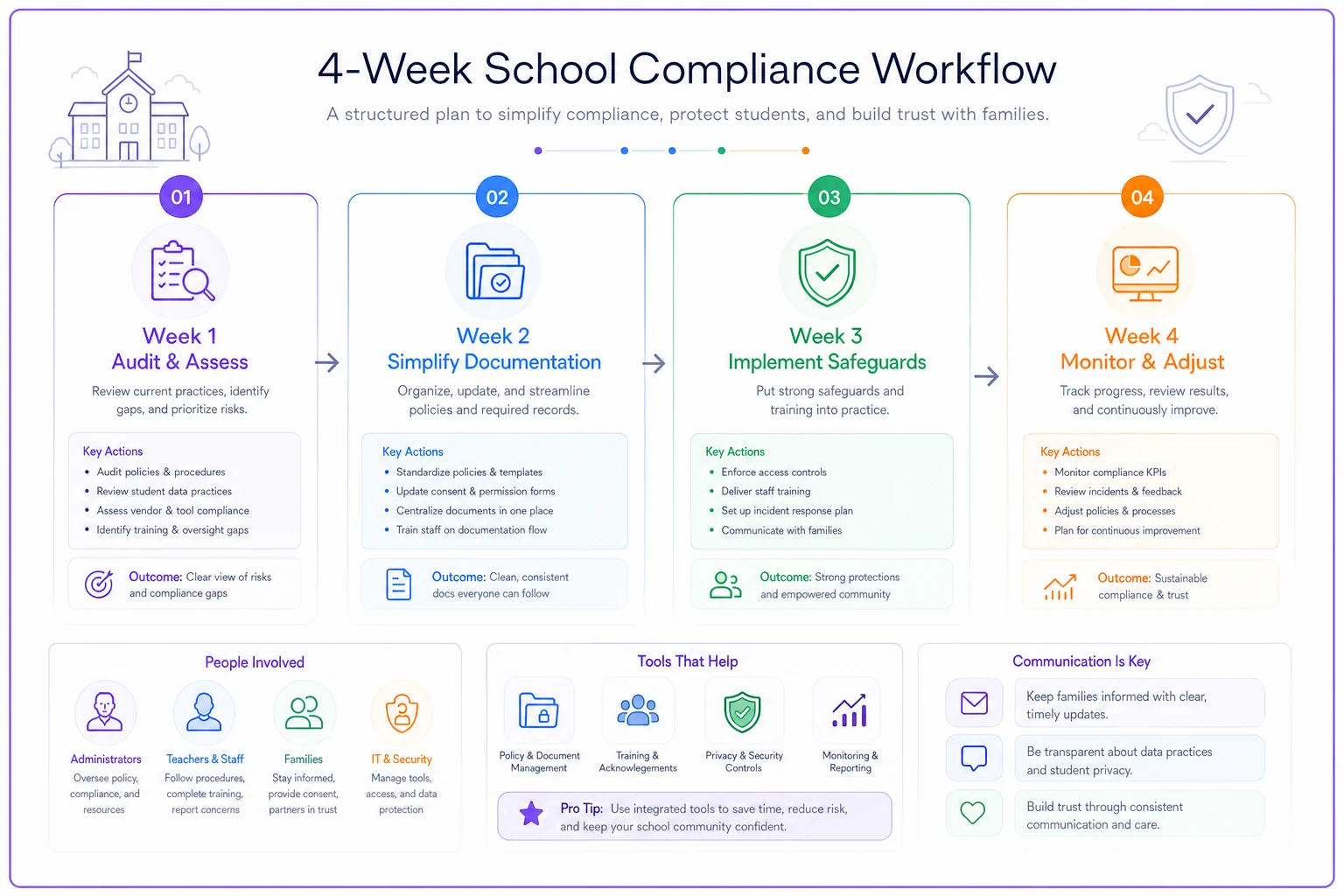
This simple workflow maps the weekly steps school leaders can follow over a month.
Week 1: Audit your vulnerabilities
-
List every IEP student losing direct support staff
-
Identify documentation that will disappear with departing staff
-
Flag your highest-risk students for compliance issues
Week 2: Simplify documentation requirements
-
Bundle accommodations into trackable groups
-
Create simplified tracking codes
-
Build template systems for common accommodations
-
Eliminate any documentation that exceeds legal requirements
Week 3: Implement safeguards
-
Set up daily/weekly documentation checkpoints
-
Create backup systems for high-risk students
-
Establish clear parent communication protocols
-
Train remaining staff on streamlined systems
Week 4: Monitor and adjust
-
Check documentation completion rates
-
Talk to teachers about what's still a pain point
-
Adjust systems based on what's actually getting done
-
Consider operational software for gaps that aren't closing
Schools that weather staffing cuts without compliance disasters don't have more resources. They have better systems that assume constraints rather than ideal conditions.
The hard truth about compliance during budget cuts
Bloomberg has reported on how widespread these staffing pressures are becoming. The districts caught flat-footed aren't the exception — they're the norm.
You can't maintain the same documentation quality with significantly less staff. That's just math. But you can maintain legal compliance with smarter documentation systems.
The difference between schools that get sued and schools that survive comes down to one thing: Did you adapt your compliance systems to match your staffing reality, or did you pretend everything was fine until parents started filing complaints?
Your IEP students deserve their accommodations. Your teachers deserve sustainable workloads. Your district deserves protection from lawsuits. None of that happens automatically when budgets get cut.
Because when that due process complaint lands on your desk, "we were understaffed" isn't a defense. But "here's our documentation showing accommodations were provided" is.
Ready to elevate your classroom management?
Join 5,000+ educators using Skolyly to save time, engage students, and improve learning outcomes.