

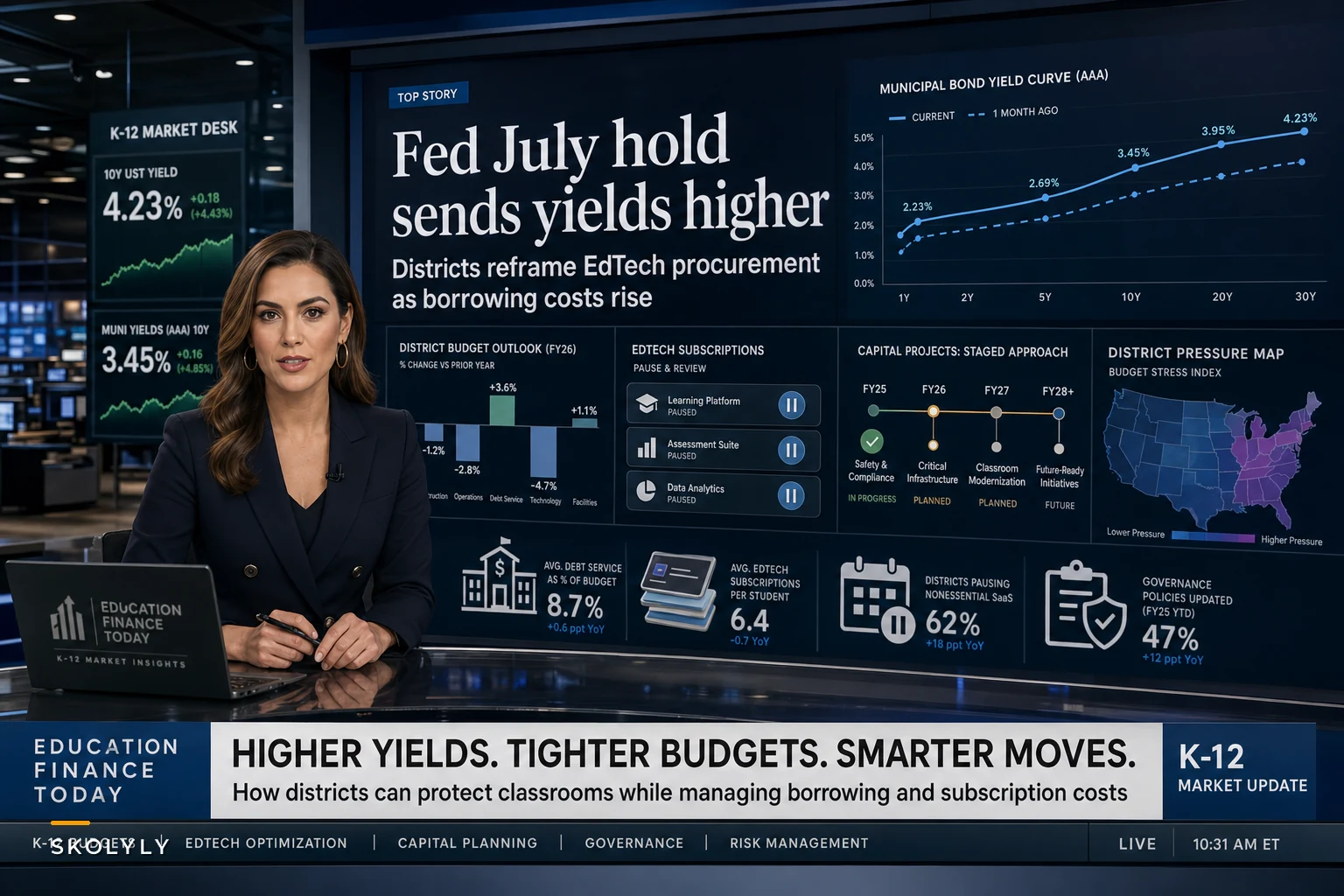

The Fed just held rates at 3.50%-3.75%, and bond markets aren't buying the stability story. Longer-term Treasury yields jumped immediately after the July 29th announcement, pushing up borrowing costs for school districts right as fall budgets get finalized.
For district CFOs watching debt service projections climb while trying to lock in vendor contracts for August, this creates an ugly squeeze. Municipal bond rates track Treasury yields pretty closely, so that planned $15 million facilities bond your board approved in May? It now costs an extra $400k-$600k over its lifetime. That's roughly twelve teacher salaries gone before the school year even starts.
But the real budget killer isn't the bond payment increase. It's the subscription creep that happened when money was cheap and everyone thought digital tools would solve everything.
The hidden cost structure of K-12 tech budgets
Walk into any district office right now and you'll find procurement teams drowning in renewal notices. Most signed three-year deals back in 2023-2024 when federal COVID funding was still flowing and rates were near zero.
Now those contracts are up for renewal at exactly the wrong moment.
The math gets brutal fast. A mid-sized district with around 8,000 students typically spends somewhere between $1.8 and $2.2 million annually on software subscriptions. It breaks down roughly like this:
| Category | Annual Cost | Number of Vendors | Utilization Rate |
|---|---|---|---|
| Core LMS/SIS | $450k-550k | 2-3 | 85-95% |
| Assessment platforms | $280k-350k | 4-6 | 60-70% |
| Intervention tools | $340k-420k | 8-12 | 35-45% |
| Communication systems | $180k-230k | 3-5 | 50-60% |
| Specialty programs | $420k-520k | 15-25 | 20-30% |
| Admin tools | $130k-180k | 10-15 | 40-50% |
Those utilization rates are the problem. When borrowing was cheap, districts could afford redundant systems. Three different math intervention platforms? Fine, let teachers pick their favorite. Four communication tools because different departments wanted different interfaces? Sure.
That tolerance evaporates when your debt service jumps 18% and the state cuts funding because property tax revenues are softening.
Why traditional procurement cycles break in rising-rate environments
District procurement follows a predictable calendar. RFPs go out in February, evaluations happen in March-April, board approvals in May, contracts finalize in June-July for August implementation. This worked fine when conditions stayed relatively stable quarter to quarter.
Keep every student on track with ease.
Skolyly helps you create, assign, and monitor classroom activities efficiently.
- Integrated lesson and assignment management
- Real-time student progress tracking
- Automated class scheduling & notifications
No credit card required
Rapid rate changes blow up this timeline. A vendor quote from March assumes one financing cost. By July, their own borrowing costs have increased — especially for smaller EdTech companies that rely on venture debt or revenue-based financing. CNBC reported that tech sector borrowing costs spiked immediately after the Fed's announcement, with some firms seeing credit lines repriced within hours.
What happens next is predictable: vendors come back asking to modify payment terms. Instead of annual billing, they want quarterly or monthly payments. Net-60 becomes net-30 or immediate payment. Some start adding 3-4% "processing fees" for anything except ACH transfers.
One district got hit with revised payment terms from eleven different vendors in a span of three days. Their accounts payable system literally couldn't handle it — they ended up manually processing each invoice because their automation assumed annual billing cycles.
The subscription audit nobody wants to do (but everyone needs)
Most districts are paying for zombie subscriptions that haven't been seriously used in months. The pattern is pretty consistent:
Year 1 — enthusiastic adoption, a principal champions the tool, 70% of target users log in regularly. Year 2 — that champion leaves or gets reassigned, usage drops to around 40%. Year 3 — the auto-renewal hits, nobody remembers who originally requested it, and usage is below 20%.
One district discovered they were paying $47,000 annually for a reading intervention platform that exactly three teachers were still using. Another found duplicate licenses across four schools for the same assessment tool, costing an extra $31,000 per year.
The audit process that actually works:
-
Pull usage data, not survey data
Teachers will say they "might" use something. Check actual login records from the last 90 days.
-
Map subscriptions to specific standards or objectives
If you can't connect a tool to a specific curriculum standard or operational need, it's probably redundant.
-
Calculate per-active-user costs
That $50k platform with 20 active users? You're paying $2,500 per user. A part-time aide costs less.
-
Check for feature overlap
List the top 5 features of each platform. If two tools share 3+ features, you probably don't need both.
-
Identify bundling opportunities
Vendors desperate to keep contracts will often bundle services at significant discounts rather than lose the entire account.
One district discovered they were paying $47,000 annually for a reading intervention platform that exactly three teachers were still using. Another found duplicate licenses across four schools for the same assessment tool, costing an extra $31,000 per year.
Renegotiation tactics that actually move the needle
Forget what you learned about vendor negotiations in calmer markets. When rates rise and venture capital dries up, EdTech companies need your revenue more than you need their specific platform. They just won't admit it up front.
EdTech companies are facing their own crisis right now: customer acquisition costs have roughly doubled, venture funding has slowed significantly, and their own financing costs have spiked. They cannot afford to lose existing customers. Most districts don't realize how much leverage they have.
Start with payment terms, not price. Vendors will often hold the headline price but accept extended payment schedules. Net-90 or Net-120 terms effectively give you a zero-interest loan while inflation chips away at the real cost. One district negotiated Net-120 with eight vendors and freed up around $340k in working capital for the first quarter.
Start with payment terms, not price.
Multi-year locks work differently now too. Normally, vendors push for three-year commitments with small annual increases baked in. In this environment, you can often lock year two and three at the same rate — or even get slight decreases. The vendor gets revenue certainty, you get price protection.
The move that actually creates urgency: the partial cancellation. Instead of threatening to cancel entirely (which vendors know is often a bluff given switching costs), propose cutting licenses by 40-50% based on actual usage data. Suddenly, they find ways to reduce per-license costs to keep the total contract value stable.
Implementation costs that destroy the savings
Districts consistently focus on subscription costs and ignore implementation drag. Switching from one LMS to another might save $80k annually, but if it requires:
-
200 hours of IT staff time for data migration
-
40 hours of professional development per teacher
-
3-6 months of reduced instructional effectiveness during transition
-
Parent communication and retraining costs
...the real first-year cost could easily exceed $300k. Factor in the operational chaos when teachers can't access historical student data, or when report cards get delayed because the new system doesn't integrate cleanly with your SIS.
Smart K-12 tech budgets in this environment focus on optimization, not replacement. Negotiate aggressively with existing vendors. Maximize utilization of current tools before adding anything new.
Building a sustainable subscription model when money isn't free
The districts that come through this transition will restructure how they approach EdTech procurement entirely. Instead of department-by-department purchasing decisions, they'll centralize subscriptions under a technology committee that actually includes finance, curriculum, and operations — not just IT.
Hard caps start making sense: no more than a defined number of subscriptions per department, no tool under $10k without demonstrated 60%+ utilization within 90 days, automatic cancellation triggers when usage drops below set thresholds.
More importantly, they'll start treating subscriptions like the operating expenses they actually are, not like capital purchases. That means building in 15-20% buffer for price increases, 10% for currency exposure (many EdTech companies bill in USD but operate globally), and around 25% for scope creep as vendors push add-ons that require additional licenses.
Automation opportunities most districts miss
A significant chunk of K-12 tech spending goes toward tools that just move data from one screen to another. Take attendance tracking: a teacher enters it in the classroom system, someone re-enters it in the SIS, another person pulls it for state reporting, someone else compiles it for grant compliance.
Districts running modern operational platforms eliminate these hand-offs entirely. When a teacher marks attendance once, that data flows automatically to the SIS, updates administrator dashboards in real time, triggers parent notifications for absences, and populates compliance reports — without anyone touching it again.
The same logic applies across IEP progress monitoring, behavior tracking, assessment data, and communication logs. These shouldn't require separate systems with manual re-entry in between. A properly configured operational platform handles these workflows in one place, eliminating the need for several standalone subscriptions that each do one piece of the puzzle.
Here's a simple workflow to visualize how a unified operational platform removes redundant steps.
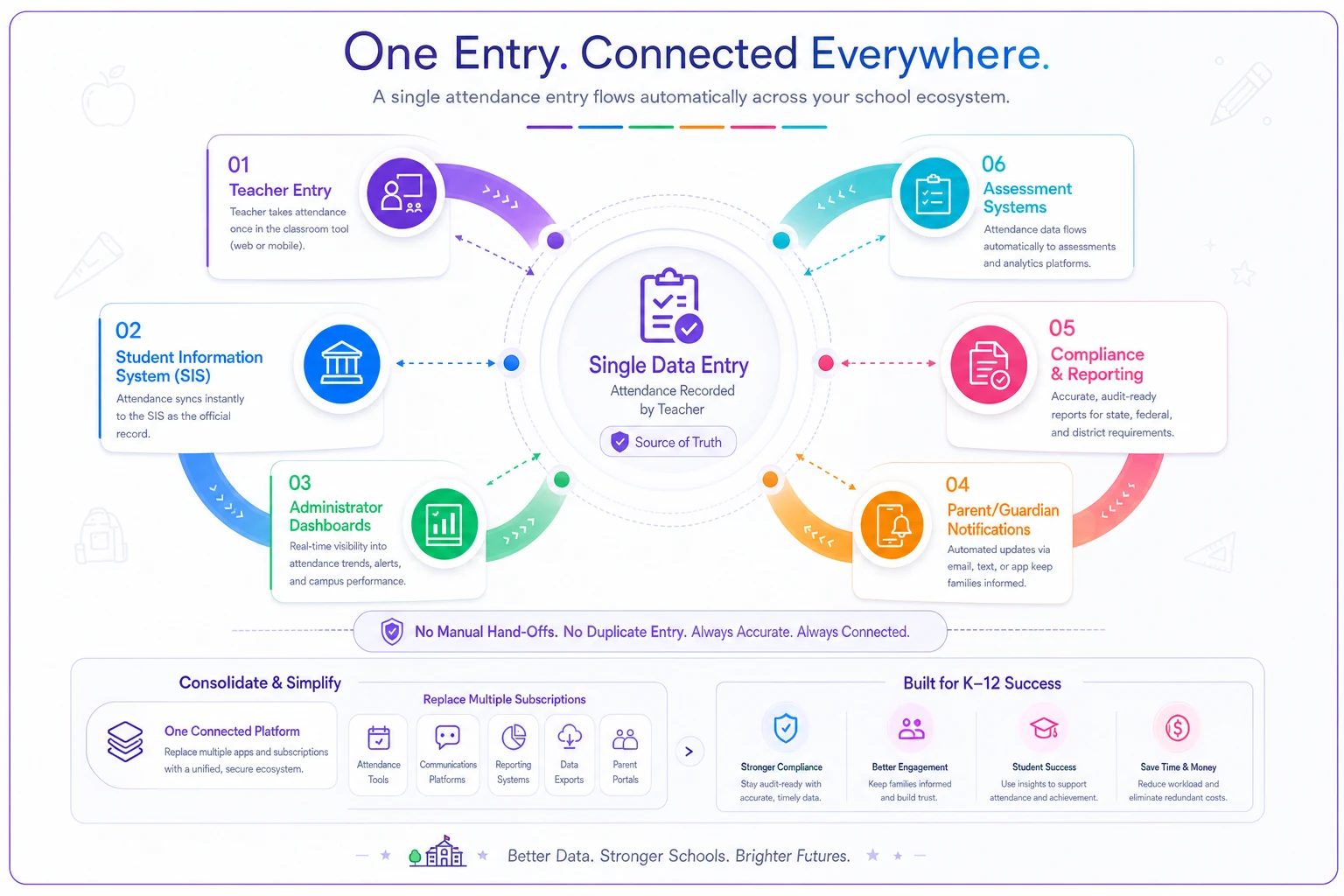
This illustrates the automated flow for attendance and similar data, showing how consolidation eliminates duplicate entry points.
Districts that consolidate redundant data-entry tools into a single AI-enhanced platform often cut software costs by 30-40%. When operations run on unified data, you stop paying for expensive band-aid solutions.
Moving beyond the subscription trap
The Fed's rate decision exposed something that's been building for years: districts got comfortable with cheap money and ended up with bloated tech stacks that don't move the needle on outcomes. The average teacher uses maybe four tools consistently but has logins for fifteen.
As you review K-12 tech budgets this month, every dollar spent on underutilized subscriptions is a dollar not reaching the classroom. The districts that come out ahead won't be the ones with the most tools — they'll be the ones with the most disciplined approach to operational efficiency.
If you're still processing vendor invoices manually while paying for "automation" tools that don't actually automate anything, it might be worth reconsidering what real operational software looks like. The same pressure that's forcing you to cut administrative costs and protect classroom time applies directly to your technology spending.
Your fall budget meetings are going to be intense. Walk in with actual usage data, a clear redundancy analysis, and a realistic consolidation plan. When the board sees that debt service increase, they'll start asking hard questions about every line item — and the subscriptions you can't justify won't survive.
Your fall budget meetings are going to be intense. Walk in with actual usage data, a clear redundancy analysis, and a realistic consolidation plan. When the board sees that debt service increase, they'll start asking hard questions about every line item — and the subscriptions you can't justify won't survive.
Ready to elevate your classroom management?
Join 5,000+ educators using Skolyly to save time, engage students, and improve learning outcomes.