



Last week, Nevada bumped its minimum wage to $12 an hour. Oregon hit $14.70 in Portland metro areas. Washington D.C. crossed $17. According to the Department of Labor's updated wage tables, twenty-three states increased their wage floors on July 1st—affecting millions of hourly workers, including the people who actually keep schools running: custodians, cafeteria staff, bus drivers, paraprofessionals.
For K–12 administrators finalizing budgets this month, these increases hit at the worst possible time. Districts already squeezed by declining enrollment and inflation are now staring at immediate payroll increases anywhere from $180,000 to over a million dollars, depending on size and staffing.
The predictable reaction: cut programs, freeze hiring, reduce support staff. But districts that actually weather these budget storms don't just cut—they rethink how administrative work gets done in the first place.
The hidden multiplier effect
When minimum wages rise, the impact doesn't stop at your direct employees. Your contracted services—cleaning, food service, transportation—face the same wage pressures, and they'll pass those costs through, typically with a 15–20% markup to protect their margins.
A medium-sized district with 12 schools might see something like:
-
Direct payroll increase
$340,000
-
Contracted services increase
$225,000
-
Substitute teacher pool costs
$87,000
-
Total exposure
roughly $650,000
And that's before wage compression kicks in. When entry-level positions jump to $15/hour, experienced paraprofessionals making $16 start feeling undervalued. Adjusting their wages creates a cascade up the salary ladder.
One superintendent in California described it well: "We thought we were looking at a $400k problem. By October, it was $1.1 million."
Why the standard cost-cutting playbook doesn't work here
Corporate cost-cutting doesn't translate cleanly to schools. You can't just "optimize headcount" when state law mandates specific student-to-staff ratios. You can't offshore special education services. Every cut carries compliance implications.
Keep every student on track with ease.
Skolyly helps you create, assign, and monitor classroom activities efficiently.
- Integrated lesson and assignment management
- Real-time student progress tracking
- Automated class scheduling & notifications
No credit card required
The typical progression goes like this:
-
Month 1–2 Freeze discretionary spending. Cancel professional development. Delay tech purchases.
-
Month 3–4 Eliminate positions through attrition. Combine roles where possible.
-
Month 5–6 Reality sets in. IEP meetings get delayed. Behavior incidents spike without adequate supervision. Interventions stop. Parent complaints pile up.
-
Month 7+ Emergency hiring at premium rates to stay compliant. Budget savings disappear. Morale tanks.
Districts caught in this cycle often spend more recovering from compliance failures than they ever saved through cuts. Meanwhile, teachers absorb extra administrative work and actual instruction time shrinks.
The operational inefficiency most districts ignore
What surprises a lot of administrators: their highest-paid staff often spend 40–60% of their time on low-value admin tasks. A principal at $120,000 annually shouldn't be spending twelve hours a week arranging substitute coverage. A special ed coordinator at $95,000 shouldn't be manually pulling compliance reports from paper files.
These inefficiencies existed before the wage increases. They just didn't feel urgent enough to fix. Now they do.
Take substitute management alone. In a district with 400 teachers:
-
Average daily absence rate
8%
-
Substitutes needed daily
~32
-
Time to arrange coverage per absence
25 minutes
-
Administrative hours weekly
21
-
Annual cost at $35/hour
$38,220
That's one workflow. Multiply it across attendance tracking, behavior documentation, IEP progress monitoring, assessment data entry, and parent communication. The administrative burden adds up to the equivalent of several teaching positions.
Where smart districts find hidden capacity
Rather than cutting positions, operationally mature districts reduce the administrative load on existing staff. Not adding technology for its own sake—actually eliminating redundant processes that waste skilled people's time.
A district in Ohio restructured their special education documentation workflow. Previously:
-
Teachers spent 6 hours weekly on IEP paperwork
-
Coordinators spent 14 hours weekly compiling reports
-
Compliance reviews took 3 days monthly
-
Error rate
around 12%
After moving to structured templates and automated compliance checks:
-
Teacher documentation
2 hours weekly
-
Coordinator compilation
automated daily
-
Compliance reviews
4 hours monthly
-
Error rate
under 2%
The district recovered roughly 2,400 instructional hours annually—equivalent to two additional teachers—without adding a single position.
A three-tier approach to protecting classroom resources
Districts handling these pressures well tend to follow a consistent pattern:
Tier 1: Immediate administrative reduction (Weeks 1–4)
-
Standardize substitute request processes (saves 15–20 hours weekly)
-
Consolidate behavior tracking into a single system (saves 8–10 hours weekly)
-
Automate attendance reconciliation (saves 12–15 hours weekly)
-
Streamline parent communication channels (saves 10–12 hours weekly)
Tier 2: Workflow consolidation (Months 2–3)
-
Merge IEP tracking with daily progress monitoring
-
Connect assessment data directly to intervention planning
-
Link attendance patterns to early warning systems
-
Integrate discipline records with counseling referrals
Tier 3: Targeted automation (Months 4–6)
-
Compliance deadline monitoring and alerts
-
Report generation for state requirements
-
Data aggregation for board presentations
-
Schedule optimization for support staff
Districts handling these pressures well tend to follow a consistent pattern:
What actually works vs. what sounds good
The education technology market is full of "comprehensive solutions" that create more work than they eliminate. Clear patterns emerge from watching these implementations play out.
What works:
-
Single-purpose tools that solve specific problems
-
Systems that mirror existing workflows
-
Platforms teachers can learn in under 20 minutes
-
Solutions that cut down on double-entry
-
Tools that generate required reports automatically
What fails:
-
All-in-one platforms requiring extensive training
-
Systems that demand workflow redesign before going live
-
Tools that add "just one more step" to everything
-
Platforms that need a dedicated administrator to function
-
Solutions that don't connect with existing systems
The common mistake: buying feature-rich platforms that theoretically handle everything but practically require a full-time person just to keep running.
Decision framework: where to start when everything needs attention
With limited time and resources, prioritization matters. This matrix helps:
| Workflow | Hours Saved Weekly | Implementation Difficulty | Compliance Risk | Priority Score |
|---|---|---|---|---|
| Substitute management | 15–20 | Low | Medium | High |
| IEP documentation | 8–12 | Medium | High | High |
| Behavior tracking | 6–10 | Low | Medium | Medium |
| Assessment data entry | 10–15 | Medium | Low | Medium |
| Parent communication | 8–10 | Low | Low | Low |
| Attendance tracking | 12–15 | Low | High | High |
| Inventory management | 3–5 | Low | Low | Low |
Start with high-priority items that combine significant time savings with compliance exposure. These create real budget relief while protecting the services that matter most.
When paying more for fewer people makes sense
It sounds counterintuitive, but it works: some districts are moving toward smaller teams of higher-paid, more capable staff instead of larger teams of lower-paid generalists. Rather than three $15/hour administrative assistants, one $25/hour operations coordinator with solid technical skills.
A Texas district restructured their office staffing last year:
Before:
-
18 administrative assistants across 6 schools
-
Average wage
$14.50/hour
-
Total cost
$543,000 annually
-
Constant coverage gaps and ongoing training needs
After:
-
9 operations coordinators with expanded responsibilities
-
Average wage
$24/hour
-
Total cost
$449,000 annually
-
Better consistency, fewer errors
The critical factor: giving skilled staff the tools to handle significantly more without burning out. One coordinator with the right systems can realistically cover what two or three traditional positions handled.
The automation conversation nobody wants to have
Automation in education feels uncomfortable, and that resistance is real. Nobody wants to feel like they're replacing people who work with kids.
But the actual goal is narrower than that—eliminate the mindless tasks pulling teachers away from teaching.
"We'll lose the human touch" Automation handles data entry and report generation, not student relationships. Teachers who spend less time on paperwork have more time for actual students.
"Our staff isn't tech-savvy" Modern operational platforms built for schools work like apps people already use daily. If someone can navigate their phone, they can submit an absence request or log a behavior incident.
"It's another system to manage" True—if you add without removing anything. Implementations that work replace multiple systems with one, reducing overall complexity rather than adding to it.
Districts making this work frame it as operational improvement, not a technology rollout. The focus stays on outcomes: more instructional time, fewer compliance gaps, less administrative drag.
Connecting budget pressure to lasting improvement
Budget crises force hard decisions, but they also create real urgency for changes that were overdue. Districts using minimum wage increases as a forcing function for efficiency often come out of it stronger than before.
This connects directly to what we covered in maintaining IEP compliance during staff reductions—the key isn't doing more with less, it's doing less of what doesn't matter.
-
20–30% reduction in non-instructional time
-
50–70% faster compliance reporting
-
15–25% decrease in overtime costs
-
Improved staff satisfaction despite tighter budgets
The pattern holds: reduce administrative burden on skilled professionals, automate repetitive compliance tasks, preserve resources for direct student services. Districts following this approach tend to see:
Making the transition without disrupting operations
Overhauling operations in the middle of a budget crisis requires careful sequencing. You can't rebuild the engine while the bus is moving.
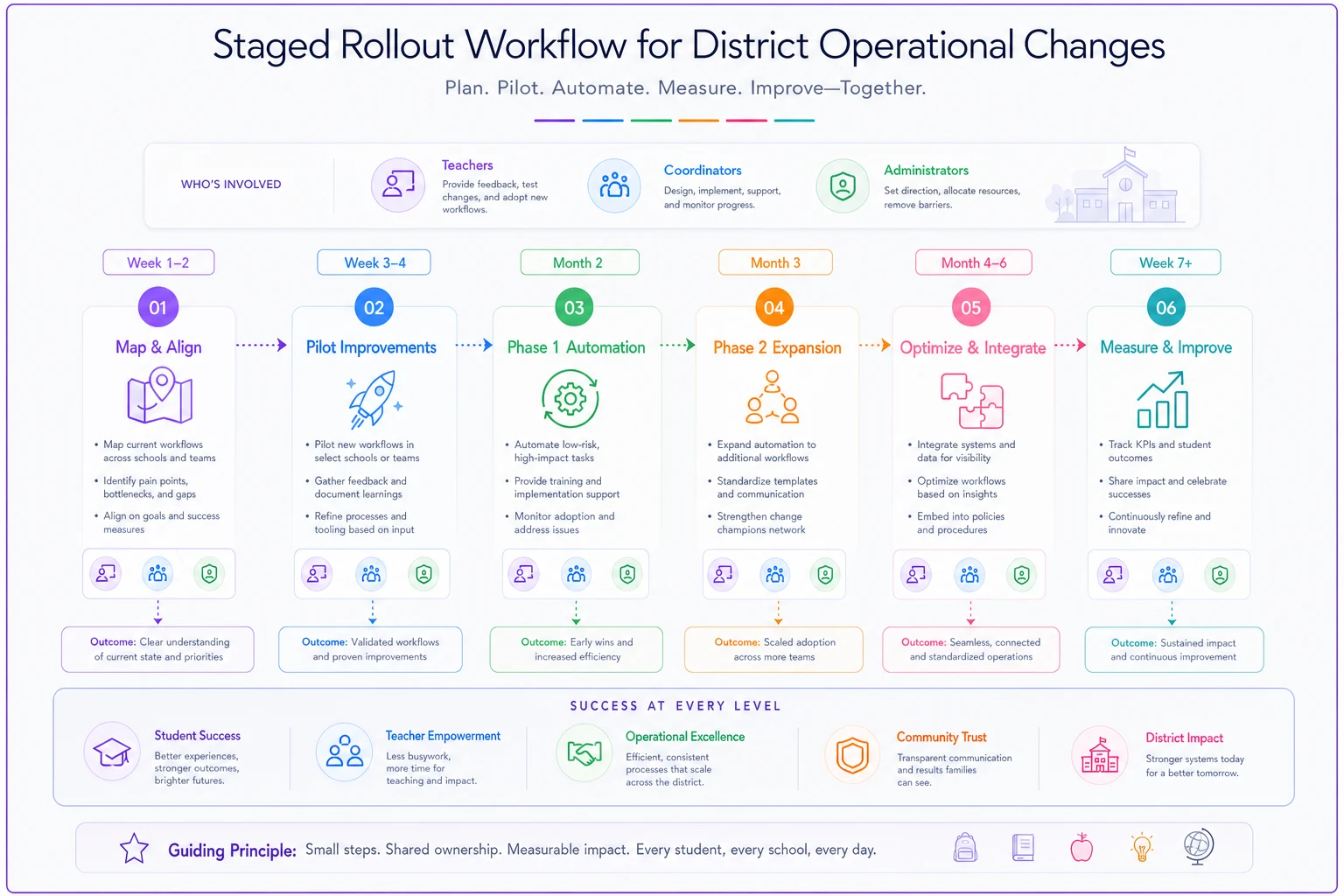
The timeline below is a common practical sequence:
-
Week 1–2 Map current workflows. Document where administrative time actually goes.
-
Week 3–4 Pick 2–3 high-impact processes for immediate improvement—usually substitute management and attendance tracking.
-
Month 2 Simplify those workflows without introducing new technology. Standardize forms, cut redundant steps.
-
Month 3 Introduce targeted automation for the workflows you've already cleaned up. Start with one school or department.
-
Month 4–6 Expand what's working. Adjust based on real feedback. Add additional workflows.
-
Month 7+ Measure impact, document savings, reinvest in classroom resources.
Use short shadowing sessions during Week 1–2 to capture what admin time actually looks like in practice.
Here's a quick visual of the implementation workflow.
You can't rebuild the engine while the bus is moving.
The operational efficiency nobody talks about as a competitive advantage
Districts that get operations right gain more than cost savings. They attract better teachers—people want to work somewhere they can actually focus on teaching. They retain staff longer because reduced administrative burden makes the job more sustainable. They deliver better outcomes because more instructional time, compounded over years, actually moves the needle on student achievement.
A superintendent in Colorado said something that stuck: "We thought we were solving a budget problem. We actually transformed how our district operates. The wage increase forced us to eliminate inefficiencies we'd tolerated for years."
Practical first steps
Minimum wage increases aren't going away. Neither are budget pressures, compliance requirements, or parent expectations. But districts don't have to choose between financial stability and educational quality.
-
Calculate your true exposure, including contracted services
-
Map administrative time by role and task
-
Identify 3 workflows consuming the most non-instructional time
-
Pilot improvements in one school or department
-
Measure time saved and errors reduced
-
Scale what works, adjust what doesn't
The districts holding up best under budget pressure share one trait: they treat operational efficiency as part of their educational mission, not something separate from it. Every hour recovered from administrative tasks is an hour that goes back to students.
Budget crises expose operational weaknesses, but they also create the urgency to finally fix them. Districts that use this moment to modernize will come out stronger and better positioned for whatever comes next.
The minimum wage increases of July 1st were just the beginning—smart districts are using the pressure to build operational models that protect classroom resources regardless of what happens externally. In education, that's not just good management. It's the job.
Ready to elevate your classroom management?
Join 5,000+ educators using Skolyly to save time, engage students, and improve learning outcomes.