

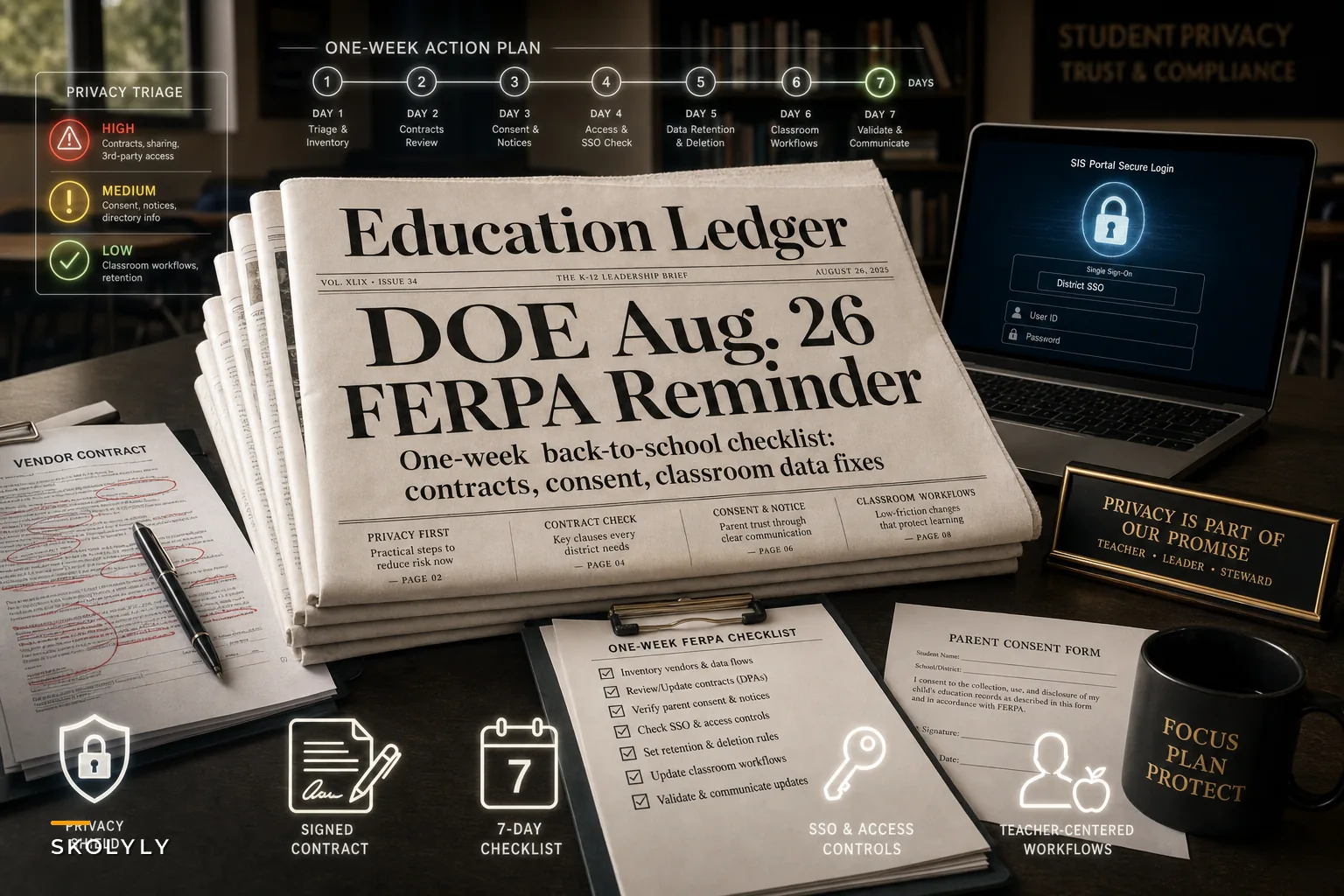

The Student Privacy Policy Office posted its annual back-to-school guidance and cover letters to state and local education agencies, dated 08/26/2026, reiterating obligations under FERPA and PPRA. If you've been in district leadership more than a year, you know these notices aren't new law. They're a reminder. But the timing is the whole point—it hits exactly when districts are finalizing vendor renewals, onboarding apps teachers requested over the summer, and dusting off consent packets that haven't been touched since last August.
The problem isn't that anyone forgot FERPA exists. It's that compliance work sits across three different buildings—procurement, IT, and the classroom—and those three groups rarely talk before the first bell rings. You can read the full guidance and current notices on the Department's student privacy portal, but the reminder itself does almost nothing to fix the operational gap it's pointing at.
So skip the summary. Here's what actually breaks in the next few weeks, and a checklist to close it before school opens.
Where districts actually lose control of student data
The failure almost never looks dramatic. No breach headline, no angry parent at a board meeting. What happens is quieter: a teacher signs up for a free classroom tool with their district email, clicks "I agree," and now student names, emails, and behavior logs are flowing to a vendor nobody in procurement has ever heard of.
Multiply that by 60 teachers across a school year and you've got something we've seen in a lot of districts—a shadow app list that's two or three times longer than the officially approved one. The district thinks it manages 40 vendors. In reality, student data is touching closer to 110.
The three most common leak points, in order of how often they cause trouble:
-
Click-through tools. Free or freemium apps where a teacher accepts terms on behalf of the district without authority to do so.
-
Renewed contracts that silently changed. A vendor you approved two years ago updated its data-sharing terms in a subprocessor list nobody re-read at renewal.
-
Directory information drift. A tool that only needed a student's first name last year now pulls full rosters, photos, and parent contacts because a new feature got quietly switched on.
None of these are exotic. They're the boring, repeatable ways districts drift out of alignment—and the August reminder exists precisely because SPPO knows this drift happens every fall.
The uncomfortable math on vendor contract review
Here's the part nobody budgets for. A genuine contract review—reading the data-sharing agreement, checking the subprocessor list, confirming retention and deletion terms, verifying the consent flow—takes a knowledgeable person somewhere between 45 minutes and 2 hours per vendor. That assumes the contract is well-organized, which it usually isn't.
Keep every student on track with ease.
Skolyly helps you create, assign, and monitor classroom activities efficiently.
- Integrated lesson and assignment management
- Real-time student progress tracking
- Automated class scheduling & notifications
No credit card required
If your district actively uses 80 to 120 tools once you count the shadow apps, you're looking at real staff hours before school even opens. And most of that work lands on one or two people who already have full jobs.
| Task | Time per vendor | 90 vendors | Who usually does it |
|---|---|---|---|
| Locate current signed agreement | 10–20 min | 15–30 hrs | Procurement / admin assistant |
| Review data-sharing & subprocessor terms | 30–60 min | 45–90 hrs | CIO/CTO or privacy lead |
| Confirm retention & deletion language | 10–15 min | 15–22 hrs | Compliance officer |
| Map to consent forms in use | 15–30 min | 22–45 hrs | Compliance / registrar |
That's easily 100+ hours concentrated in a two-to-three week window. It's why most districts don't actually do the full review—they spot-check the big-name vendors, wave through everything else, and hope nothing surfaces. That gap between "reviewed" and "assumed fine" is exactly where FERPA exposure lives.
The back-to-school FERPA compliance checklist
This is the part to print and hand to your team. Work through it in the order below, because sequence matters—you can't fix consent forms before you know which vendors actually touch student data.
-
1. Build the real vendor inventory (not the official one). Pull the approved list, then cross-reference it against two things: your single sign-on logs and your email domain's OAuth grants. Every app teachers logged into with district credentials shows up there. That's how the shadow apps surface.
-
2. Classify each vendor by data sensitivity. Three buckets is enough: - PII + educational records (grades, IEPs, behavior, attendance) — highest scrutiny - Directory information only (name, email, grade level) - No student data (adult-only tools, admin software) Spend your review hours on bucket one. Don't waste a compliance officer's afternoon on the coffee-fund spreadsheet tool.
-
3. Confirm each bucket-one vendor has a signed data-sharing agreement on file. Not a screenshot of the terms page. An executed agreement that names retention periods, deletion timelines, subprocessors, and breach-notification obligations. If it's missing, the tool pauses until it's in place.
-
4. Re-read subprocessor lists on renewals. This is the step everyone skips. Vendors add subprocessors between contract cycles. If your agreement doesn't require notice before they do, that's a red flag to address at renewal.
-
5. Reconcile consent forms against actual data flows. Your directory-information notice and any parent-consent forms need to match what vendors actually collect. If a tool now pulls parent phone numbers and your consent language never mentioned that, you have a mismatch to fix before it goes live.
-
6. Verify retention and deletion actually happen. A clause saying data gets deleted after a student leaves means nothing if no one triggers it. Assign an owner and a calendar date for end-of-year deletion requests.
-
7. Set a hard stop on new integrations mid-review. Freeze new app onboarding until the inventory is done. It's the only way to stop the list from growing while you're trying to shrink it.
Work through it in the order below, because sequence matters—you can't fix consent forms before you know which vendors actually touch student data.
The workflow that actually keeps this from breaking again
The checklist above fixes this August. The harder question is why it re-breaks every August.
Most districts treat privacy compliance as an event—a scramble—rather than a standing workflow. The DOE reminder is annual, but the drift is continuous.
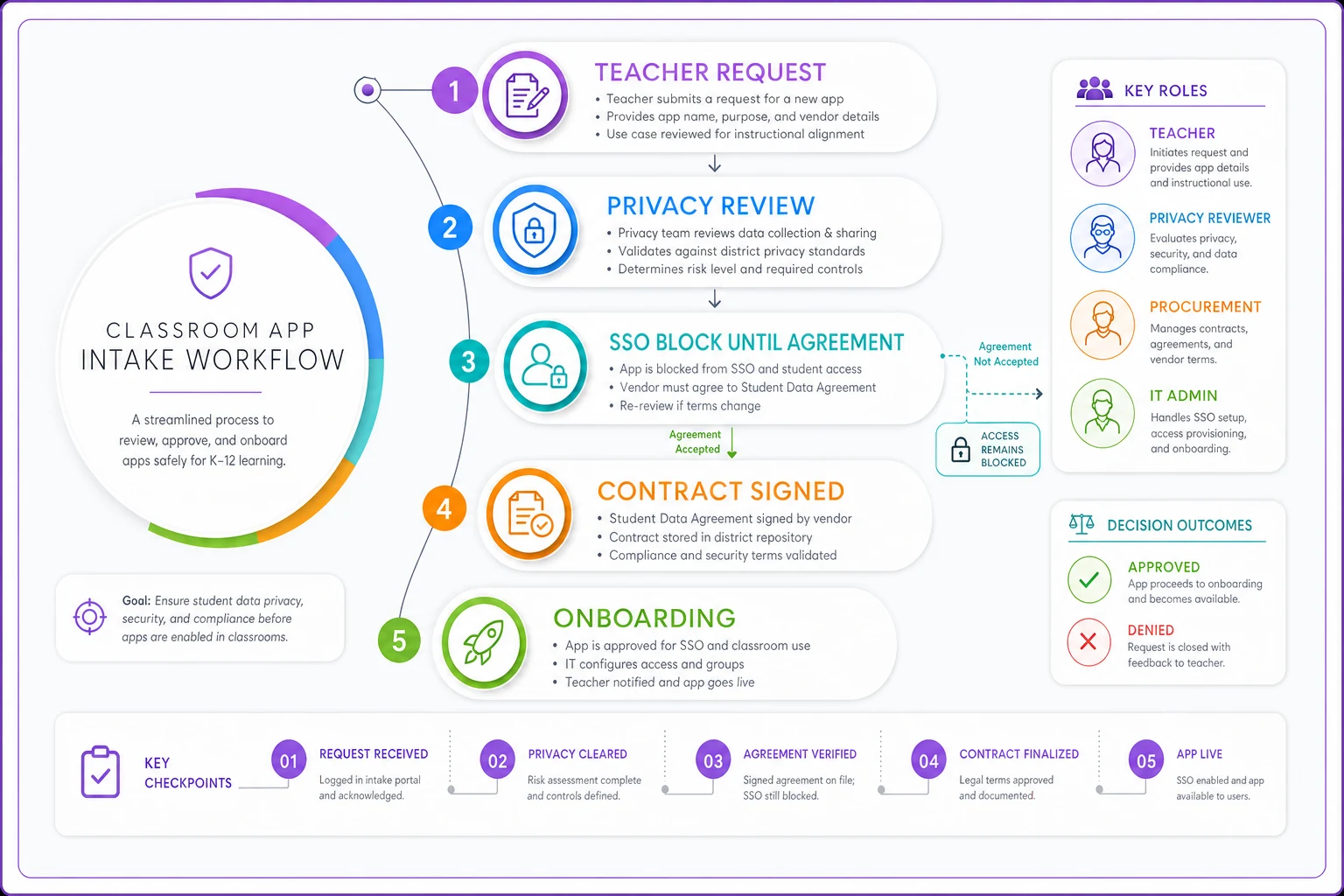
A working intake process looks like this: any teacher who wants a new tool submits a short request. It routes to whoever owns privacy review. That person checks whether the vendor already has a signed agreement, and if not, the tool stays blocked at the SSO level until it does. Nothing gets used before it's cleared.
Tie the SSO block to production access so "blocked" means the tool truly can't be used until approved.
Here's a simple flow to visualize the intake gate.
Where this falls apart in practice is tracking. Spreadsheets rot. The vendor list from last August is already stale, contract dates live in someone's inbox, and consent-form versions are scattered across three drives. Centralizing everything into one operational system makes a real difference here—AI-assisted platforms can flag when a vendor's terms have changed since the last review, surface contracts approaching renewal, and match consent-form language against what each tool actually collects. The value isn't automation for its own sake. It's that a compliance officer stops rediscovering the same 90 vendors from scratch every fall and instead reviews only what's actually changed.
For the full framework on retention schedules, consent language, and vendor evaluation criteria, the K-12 student data privacy playbook goes deeper than a back-to-school checklist can.
A real scenario: mid-sized district, three weeks before opening
A district of roughly 6,000 students went into August believing it managed about 50 EdTech vendors. When the CTO pulled the SSO logs, the real number of tools touching student data was closer to 130. Most of the extras were free classroom apps teachers had adopted individually over two years.
The team triaged fast. Of the 130, about 40 fell into the high-sensitivity bucket. Of those, roughly a dozen either had no signed data-sharing agreement or had subprocessor terms that had changed since the last review. They paused those twelve tools, sent amendment requests to the vendors, and moved affected classrooms to already-approved alternatives for the first few weeks.
The cleanup took a two-person team about three weeks of concentrated work. But the payoff showed up the following year: because they'd built a real inventory and a working intake gate, the next August's review took a fraction of the time. They weren't rebuilding the list from scratch—they were checking 15 changes against a known baseline. That's the difference between an annual fire drill and a maintained process.
When to slow down instead of rushing
A checklist tempts everyone to sprint, but a few situations call for the opposite. If a high-sensitivity vendor's terms are ambiguous, don't approve it under deadline pressure just to keep a classroom running. Pause the tool, use an approved substitute, and get the agreement right. A rushed sign-off on a bad data-sharing agreement is worse than a two-week disruption.
Don't try to review all 130 vendors at the same depth either. That's how the whole effort stalls and nothing gets finished. Triage by sensitivity, clear bucket one properly, and handle the rest on a rolling basis after school opens.
And if your district genuinely can't complete the high-sensitivity review before opening day, document what you've done, what's pending, and your timeline. A defensible, in-progress posture beats a paper claim of full compliance that falls apart under a single parent inquiry.
The takeaway for this fall
The August reminder isn't the story. The story is that FERPA alignment lives across procurement, IT, and classrooms, and those functions rarely share a single view of which vendors touch student data. Every fall the gap reopens because the work is treated as a seasonal scramble rather than a maintained workflow.
Run the checklist this year. But the districts that stop repeating this exercise every August are the ones that turn the annual review into a standing intake gate—one real inventory, one owner, one place where new tools get cleared before students ever log in. Do that once, and next year's DOE reminder becomes a quick confirmation instead of a three-week fire.
Ready to elevate your classroom management?
Join 5,000+ educators using Skolyly to save time, engage students, and improve learning outcomes.