


Your district probably spent months creating a beautiful curriculum map. Color-coded standards, elaborate unit progressions, perfectly aligned assessments. Three weeks into the school year, teachers are pulling lessons from Pinterest again while that map gathers dust in Google Drive.
This pattern repeats across dozens of schools. The gap between what administrators envision and what teachers actually do Monday morning keeps growing wider—not because teachers are rebellious, but because most curriculum mapping frameworks are built backwards. They start from standards instead of from the reality of teaching 28 kids at different levels while managing behavior, tracking IEPs, and somehow finding time to grade.
The problem isn't motivation. Curriculum maps become massive, rigid documents that break the moment reality hits. A student transfers in mid-unit. State testing shifts by two weeks. Half the class bombs a pre-assessment nobody expected them to fail. That beautiful map becomes another source of stress instead of support.
Why traditional curriculum maps become expensive shelf decorations
Most schools approach curriculum mapping like they're building a cathedral. Committees meet for months. Standards get unpacked into elaborate frameworks. Every lesson gets scripted down to the minute. The final product looks impressive in board presentations.
Then September arrives.
Teachers open these massive documents and immediately feel overwhelmed. The third-grade team has 47 priority standards to cover, each mapped to specific weeks that assume perfect pacing. The assessment calendar is locked before anyone knows this year's kids. By October, teachers are quietly doing their own thing because following the official map would mean leaving half the class behind.
The fundamental flaw in most curriculum mapping frameworks is treating teaching like manufacturing. Standards go in, instruction happens, test scores come out. Except teaching is more like navigation—you need a destination and major waypoints, but the exact route changes based on conditions.
Schools that insist on hyper-detailed curriculum maps often create a hidden curriculum problem. Teachers maintain two realities: what they report up the chain and what actually happens in classrooms. This shadow curriculum grows wider each year, making it impossible to have honest conversations about what's working. Assessment data becomes meaningless when the assessed curriculum and the taught curriculum barely overlap.
The administrative burden makes it worse. Teachers spend Sunday nights backward-mapping their actual teaching to fit the official framework for lesson plan submission. They copy-paste standards into boxes to satisfy requirements while knowing those standards don't match what students actually need that week. All that documentation time could've gone toward instruction or feedback.
The three-layer framework that flexes without falling apart
Schools that find balance between rigid maps and complete chaos tend to organize curriculum into three distinct layers that work together but update independently. Think of it like navigation software—you need the destination, major highways, and turn-by-turn directions, but only the last part changes minute to minute.
Keep every student on track with ease.
Skolyly helps you create, assign, and monitor classroom activities efficiently.
- Integrated lesson and assignment management
- Real-time student progress tracking
- Automated class scheduling & notifications
No credit card required
Layer 1: Priority standards with proficiency markers Instead of listing every standard equally, successful schools identify 8-12 must-haves per grade level. Not just the tested standards—the skills that unlock everything else. For fifth-grade math, that might mean fraction operations, decimal place value, and multi-step word problems. Not because the state says so, but because without those, sixth grade becomes impossible. Each priority standard gets clear proficiency markers that teachers actually recognize in student work. Not "demonstrates understanding of fractional concepts" but "can add fractions with unlike denominators and explain why the method works." Teachers can spot this in two minutes of circulating during independent practice.
Layer 2: Flexible unit frames with assessment boundaries Units become containers, not scripts. Each unit frame includes:
-
The 2-3 priority standards in focus
-
Entry and exit assessment items (not dates)
-
Core resources and materials available
-
Time range (3-4 weeks, not March 2-23)
Teachers decide internal pacing based on their kids. The agreement is that everyone hits the priority standards and uses common assessment items to measure progress. How they get there varies by classroom. This respects teacher expertise while maintaining schoolwide coherence.
Layer 3: Weekly pacing suggestions, not mandates Instead of dictating "Chapter 4.3 on Tuesday," schools provide pacing suggestions that teachers adjust based on formative data. These are default plans assuming typical progress. When kids need more time with fractions, teachers extend. When they grasp concepts quickly, teachers add depth rather than racing ahead.
The key difference: pacing guides become living documents that teams update during weekly grade-level meetings. If three teachers all needed extra days on the same concept, that information feeds back into next year's guide. The curriculum map learns from actual teaching instead of remaining frozen.
Building your prioritization rubric (and the fights it will cause)
Creating a priority standards rubric forces uncomfortable conversations. Every teacher thinks their content is essential. The fourth-grade teacher insists students must master long division. The fifth-grade teacher says they never use it. These arguments matter—they reveal the hidden assumptions breaking curriculum alignment.
Start with vertical articulation meetings where teachers bring student work samples showing what "proficiency" looks like at their grade level. When the third-grade teacher sees what fourth grade actually expects versus what she imagined, priorities shift. Work samples tend to be more powerful than any standards document.
The rubric itself should weigh four factors:
| Endurance | Leverage | Readiness | Assessment |
|---|---|---|---|
| Will students use this skill repeatedly in future grades? Fraction concepts appear everywhere. State capitals don't. This seems obvious until you count how many hours go toward memorization tasks with no downstream value. | Does mastering this unlock other learning? Reading comprehension strategies apply across subjects. Specific poetry terms don't. High-leverage skills often hide inside larger standards, so the rubric needs to dig deeper than state frameworks typically go. | Can students actually develop this skill at this grade level, or are we forcing something developmentally inappropriate? Abstract reasoning has cognitive prerequisites that no amount of good teaching can override. Better to build foundation skills thoroughly than introduce concepts students can only memorize without understanding. | Can we reliably measure this in ways that inform instruction? Some standards sound important but produce vague assessments that don't help teachers adjust. "Appreciates literature" matters less than "identifies cause-and-effect relationships in text" because the latter gives clear next steps when students struggle. |
The rubric should force brutal prioritization. If everything is priority, nothing is. Schools that try to keep everyone happy end up with 30 "priority" standards, which defeats the purpose entirely. Better to have eight standards all students master than 30 that get surface coverage.
The update workflow that prevents curriculum drift
Most curriculum maps become obsolete because updating them requires committee approval, district sign-off, and formal revision cycles. By the time changes get approved, they're already irrelevant. The framework needs built-in update mechanisms that happen naturally through teaching routines.
Weekly grade-level meetings become update sessions, not just planning time. Teams spend 15 minutes on a standing agenda: What worked this week? What didn't? What needs adjusting in the pacing guide? These micro-updates accumulate into meaningful revisions without anyone filling out forms.
Here's a simple workflow diagram teachers can follow:
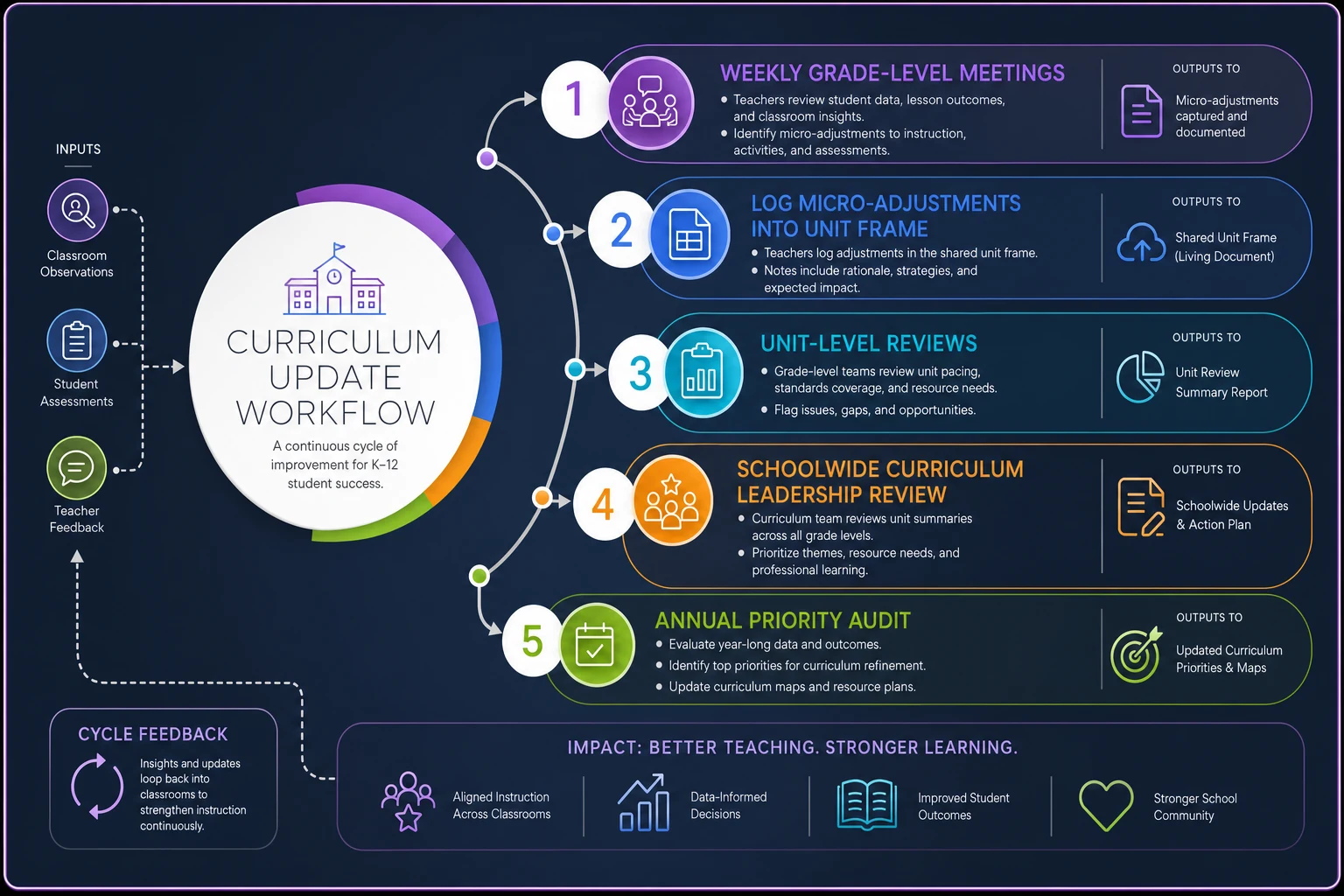
The update workflow operates on three timescales:
Weekly micro-adjustments: Teams flag specific lessons or resources that didn't work. Maybe the fraction manipulatives confused more than helped. That note goes into the shared unit frame immediately. Next year's teacher sees the warning and tries something different. No committee needed.
Unit-level reviews: After each unit, teams complete a five-minute survey rating the unit's pacing, resource quality, and assessment alignment. Consistent problems trigger deeper review. If every teacher says the unit needs four weeks not three, next year's guide reflects that. Data drives changes, not opinions.
Annual priority audit: Once per year, usually in May, teams review whether priority standards still make sense based on student performance data. Did focusing on certain standards actually improve outcomes? Are students prepared for the next grade level? This isn't about adding more priorities—it's about confirming the right ones.
The system needs a simple way to track changes. Not elaborate documentation, just something like a shared spreadsheet where teachers log adjustments with one-line explanations. "Extended fraction unit by 2 days—pre-assessment showed gaps" tells next year's teacher everything they need to know.
Assessment blueprints that actually match what you taught
The most frustrating part of rigid curriculum maps shows up during assessment week. The district benchmarks Chapter 5 content, but you're still on Chapter 4 because students needed more time with foundational skills. Now you face an impossible choice: rush through material students aren't ready for, or accept that assessment data will be meaningless.
Assessment blueprints should define what gets measured, not when. Instead of "Unit 3 Test on October 15," the blueprint specifies "After Unit 3, assess these five skills with these item types." Teachers determine timing based on actual student readiness, not calendar dates.
Each blueprint includes:
-
Specific skills being assessed (tied to priority standards)
-
Number of items per skill
-
Item types and complexity levels
-
Sample items teachers can use or modify
-
Basic proficiency thresholds
Teachers maintain assessment flexibility within boundaries. They might adjust timing by a week or two, modify items for their students' context, or add formative checkpoints. But everyone assesses the same priority skills using comparable methods, making schoolwide data meaningful.
The blueprint also specifies what doesn't get assessed formally. Not every standard needs a test. Some skills get checked through observation, work samples, or quick exit tickets. This prevents assessment bloat while ensuring important skills don't get overlooked just because they're hard to test.
Common assessments only work when teachers trust them. That means involving teachers in blueprint creation, not just test administration. When teachers help design assessments, they're more likely to use the data—they know exactly what each item measures and why it matters.
Daily teaching within standards alignment (without the paralysis)
The framework only matters if it influences actual instruction. But most teachers already feel overwhelmed without adding curriculum alignment to their mental load. The system needs to make standards-aligned teaching easier, not harder.
This works through what I'd call "alignment anchors"—simple connection points between daily teaching and bigger curriculum goals. Teachers don't need to reference standards every minute, but they need clear touchpoints that keep instruction on track.
A second-grade teacher planning a reading lesson knows this unit prioritizes "identifying main idea and supporting details." That's the anchor. Whether she uses the textbook story, a current events article, or a student-chosen book, the skill focus stays consistent. The standard doesn't dictate the content—it clarifies the skill being developed.
Include one exit ticket item directly aligned to the priority skill to keep daily checks simple and consistent.
These anchors show up in practical tools teachers already use. Lesson plan templates have one line for "priority skill focus." Exit tickets include one item aligned to the current priority standard. Weekly newsletters to parents mention which big skills students are working on. Small touches that maintain alignment without burying teachers in documentation.
The framework also needs release valves for when teachers spot better opportunities. Maybe a current event perfectly illustrates a concept scheduled for next month. Grab it, note the adjustment, move on. The curriculum map guides but doesn't imprison.
The surprisingly hard part: getting teachers to trust the framework
Teachers have been burned by too many "revolutionary" curriculum initiatives that created work without improving outcomes. They've learned to smile in meetings, close their doors, and teach the way they know works. Breaking through that skepticism requires more than good framework design.
Start with volunteers, not mandates. Find two or three teachers frustrated with current chaos and willing to try something different for one unit. When their colleagues see them spending less time on paperwork and more time teaching, interest grows on its own.
Share control from the beginning. Teachers should help create priority standards, design assessment blueprints, and establish update processes. When they own the framework rather than having it imposed, they're invested in making it work. This takes longer initially but prevents the passive resistance that kills most curriculum initiatives.
Build in recovery mechanisms for when things go wrong—because they will. A unit will flop. An assessment will be too hard. The pacing will be off. The framework needs explicit processes for fixing problems without blame. "This didn't work" should trigger curiosity and adjustment, not criticism.
Most importantly, reduce before adding. For every new requirement the framework creates, remove two existing ones. If teachers now complete unit reflection surveys, eliminate redundant lesson plan components. If they're using common assessments, stop requiring separate standard documentation. The framework should feel like liberation from busywork, not another compliance layer.
Technology that helps (or how everything becomes a spreadsheet nobody updates)
Schools love buying curriculum management software that promises to solve everything. Two years later, teachers are still using paper planners while administrators wonder why nobody logs into the $50,000 platform. The technology usually fails because it's designed for compliance reporting, not daily teaching reality.
Effective curriculum frameworks use simple, familiar tools. Shared Google Docs for unit frames. Basic spreadsheets for pacing guides. Whatever gradebook system teachers already know for assessment tracking. The goal isn't technological sophistication—it's reducing friction between planning and teaching.
That said, certain automation genuinely helps. When teachers enter assessment scores, the system should automatically flag students who need intervention on specific priority standards. When multiple teachers extend the same unit, the pacing guide should surface that pattern. When a resource consistently gets poor ratings, flag it for review.
The AI-powered operational platforms built for schools focus on exactly these connection points—not replacing teacher judgment, but eliminating repetitive correlation tasks. A teacher shouldn't spend Sunday night cross-referencing assessment data with standards to identify reteaching needs. That kind of pattern recognition can happen automatically, letting teachers focus on designing the actual reteaching.
These platforms also preserve institutional memory that typically walks out the door when experienced teachers leave. All those micro-adjustments, resource notes, and pacing modifications get captured through normal teaching workflows. New teachers inherit collective wisdom instead of starting from scratch.
But here's the crucial part: technology serves the framework, not vice versa. Schools should be able to run this entire system with paper and folders if needed. The digital tools just make it faster and more sustainable. Any curriculum mapping framework that requires specific software to function is too fragile for school reality.
The implementation timeline that doesn't blow up your school year
Rolling out a new curriculum mapping framework mid-year is like renovating a restaurant during dinner service. Possible, but painful for everyone involved. The smart approach phases implementation across natural break points while maintaining teaching continuity.
Phase 1 (Spring before implementation): Establish priority standards and create assessment blueprints for first semester units. This happens during existing planning time, not additional meetings. Teachers who are planning next year anyway just use a new template. No extra work, just redirected effort.
Phase 2 (Summer with stipends for volunteers): Develop unit frames for priority units and create initial pacing guides. Pay teachers for this work—it's specialized curriculum development, not volunteer time. Focus on getting first quarter materials ready, not the entire year. Better to start strong than spread thin.
Phase 3 (First quarter implementation): Run the framework with volunteer early adopters while others observe. Collect feedback aggressively. Fix problems immediately. When teachers see colleagues finishing planning faster and stressing less about alignment, they'll want in.
Phase 4 (Second semester expansion): Open the framework to all interested teachers. Provide support but don't mandate participation. The volunteers become natural mentors. Resistant teachers can continue their current methods while watching the alternative work nearby.
Phase 5 (Following year full implementation): With proven success and refined processes, implement schoolwide. By now, the framework has local evidence and teacher champions. The bugs are worked out. The tools are familiar. Implementation becomes adoption of a tested system, not another experiment.
The difference between looking aligned and being aligned
Many schools create elaborate curriculum maps primarily for accreditation visits or district reviews. The documents look impressive. Standards are color-coded. Assessments are scheduled. Everything appears aligned on paper. Meanwhile, actual instruction stays disconnected and inconsistent.
Real alignment shows up in student experience, not documentation. Can a student who moves between teachers mid-year continue learning without major gaps or repetition? Do all third-grade teachers mean the same thing by "proficient" in fraction understanding? When fourth-grade teachers receive students, do they share common expectations about prerequisite skills?
The framework described here prioritizes functional alignment over documentary evidence. Yes, you can print impressive reports for visitors. But more importantly, teachers know what their colleagues are teaching, assessments measure what students actually learned, and students experience coherent instruction regardless of which classroom they're in.
This means accepting imperfection in exchange for usability. Pacing guides will have handwritten notes in the margins. Unit frames will show revision history with crossed-out ideas. Assessment blueprints will have teacher modifications penciled in. That messiness indicates active use, not poor planning.
What changes when curriculum mapping actually works
When a curriculum mapping framework truly functions, the changes are subtle at first. Teachers stop asking "what are you teaching this week?" because they already know. Grade-level meetings shift from logistics to actual instruction because everyone shares common language around priority standards. New teachers don't flounder through October trying to figure out school expectations.
The bigger shifts appear over time. Assessment data becomes actionable because it measures consistent skills across classrooms. Students who struggle get similar support regardless of teacher. Advanced students can accelerate through priority standards without missing foundations. The hidden curriculum disappears because the official one actually works.
Teacher retention improves—not dramatically, but noticeably. The framework reduces one major source of teacher stress: constantly guessing whether they're teaching the right things. When expectations are clear but methods are flexible, teachers feel professional autonomy within reasonable boundaries. Less bureaucratic compliance, more actual teaching.
Student transitions smooth out considerably. Whether moving between units, grade levels, or schools, students encounter predictable progression rather than random variation. The kid who changes teachers mid-year doesn't lose three months catching up or repeating content they already covered.
The operational gains compound annually. Each year's refinements make the next year smoother. Institutional knowledge accumulates in shared frameworks instead of individual memories. New curricula or standards integrate into existing structures rather than requiring complete rebuilds.
Most importantly, conversations about instruction become more honest. When everyone knows what should be taught and assessed, discussions focus on how to teach it better. Teachers share strategies for struggling learners because they're working toward common goals. The framework provides enough structure for meaningful collaboration without stifling creativity.
Making it stick when everything else is also urgent
The challenge isn't designing a good curriculum mapping framework—it's maintaining it when standardized testing, behavior incidents, and parent concerns consume every available minute. The framework needs to be self-sustaining, not dependent on constant administrative attention.
Embed framework maintenance into existing routines rather than creating new obligations. The weekly grade-level meeting already happens—just add five minutes for pacing updates. Teachers already give assessments—have them rate alignment on the same form. Everyone already complains about what doesn't work—provide a simple way to log those concerns for next year.
The framework also needs champions at multiple levels. Not just administrative support, but teacher leaders who see personal benefit. The second-grade teacher who no longer struggles with fraction prerequisite gaps becomes a natural advocate. The new teacher who inherited useful unit plans spreads the word. Success stories matter more than mandates.
Regular pruning keeps the framework manageable. Every addition should trigger a subtraction. If teachers want to add a priority standard, something else must go. If new assessment requirements arrive from the district, simplify the internal ones. The framework should get lighter over time, not heavier.
Perfect implementation never happens. Some teachers will always modify more than others. Some units will remain works in progress. Some assessments won't quite align. The goal isn't perfection—it's sustainable improvement that reduces chaos while respecting the complex reality of teaching. A framework that's 70% implemented but actually used beats a perfect system that exists only in binders.
Perfect implementation never happens. Some teachers will always modify more than others. Some units will remain works in progress. Some assessments won't quite align. The goal isn't perfection—it's sustainable improvement that reduces chaos while respecting the complex reality of teaching. A framework that's 70% implemented but actually used beats a perfect system that exists only in binders.
Ready to elevate your classroom management?
Join 5,000+ educators using Skolyly to save time, engage students, and improve learning outcomes.